The following story was first told to me by Uncle Noel Nannup (interviewed below) but I have heard it subsequently from several other Elders. It tells of the vital importance of the separation of the salt and freshwater at the mouth of the Derbarl Yerrigan, as the oceans rose during the last Ice Age.
The Waugal, or 'Rainbow Serpent', is the boss creation spirit of Whadjuk Nyungar Country, and is responsible for creating the Derbarl Yerrigan [Swan River] and the Djarlgarra [Canning River] and all of Nyoongar boodja [land]. One day, the Waugal could smell the crocodile spirit, Yondock, coming down from the north. The Waugal sensed danger and knew he had to protect the fresh water from Yondock, so he made his way to Walyalup, the mouth of the river, which means 'lungs' in Nyungar wankininny [language]. On the way he stopped at his Waugal hole, and spoke to Wooritj the lizard to get some advice on how to defeat Yondock. Wooritj told him he had to bite off his tail, so he took this secret tactic with him to Walyalup. As he neared, he took a long drink from a sweetwater spring that was flowing underwater to gather his strength.
"Wooritj told him he had to bite off his tail, so he took this secret tactic with him to Walyalup. As he neared, he took a long drink from a sweetwater spring that was flowing underwater to gather his strength."
Waugal swam out from Walyalup to meet Yondock, and there they locked into a terrible battle to the death, and Yondock almost got the better of the Waugal. But remembering the advice of Wooritj, he seized Yondock’s tail in his mouth, tearing it clean off. After he had ripped the tail off, he also bit off Yondock's head as he could no longer power himself through the water with his powerful tail. After this he flung the head and body out to sea, where they formed Meeandip [Garden Island] and Ngooloormayup [Carnac Island]. Then he dragged the tail back to the mouth of the river, and lay it across the mouth at Walyalup to make sure the saltwater stayed out forever. If Yondock ever reformed and became whole again, he might come back up the Derbarl Yerrigan, which would have disastrous consequences for the Nyungar. So he asked the Dwerda, the dingo spirit, to come and keep watch over the mouth of the river and the limestone reef embankment. Nyungar would come here to set their fish traps for mullet and mulloway and other fish that gathered there. The Nyungar would slap the water with their spears and call the river dolphins, who would help herd the fish into the traps for the annual harvest, when the people would spear only what they needed to get the vital nutrients that kept the Nyungar healthy and strong.
"He asked the Dwerda, the dingo spirit, to come and keep watch over the mouth of the river and the limestone reef embankment."
The knowledge that is held in stories is often difficult to convey when the story or Country is unfamiliar. The oral tradition of storytelling is a multidimensional, multi-sensory, place-based practice. It is high-context knowledge that resonates with the land itself and the language used to tell it. The stories are held within a wider container of cultural knowledge systems that differ from the western scientific paradigms, but are no less scientific in their nature. Indigenous sciences are based on the same scientific method of observation, hypothesis, prediction and experiment. Except Indigenous science is holistic and does not seek to destroy, reduce, simplify or decontextualise its information, and the knowledge is then embodied through continuous practice.
A western scientist may seek to understand a goanna by capturing it, dissecting it, or placing it in a lab to administer tests. This is knowledge creation based on the values of control, domination, separation and decontextualisation. Indigenous scientists will observe the goanna in its natural environment. They will watch how it hunts, nests, mates and migrates, gaining an understanding of how its pattern fits into the broader pattern or ecology of nature: patterns within patterns within patterns. This is knowledge that does not seek to dominate or own or control, but is based on mutual flourishing, and water is the conduit that allows this flourishing to occur. As Newton came to understand, 'every action has an equal and opposite reaction' or as Blakfellas might say, 'what we do to Country, we do to ourselves'
"This is knowledge that does not seek to dominate or own or control, but is based on mutual flourishing, and water is the conduit that allows this flourishing to occur."
These stories have been distilled over time to describe detailed knowledge of Country and how to care for it, but they themselves are understood as part of a deeper ecology, a pattern within a pattern. Even writing this story down on the page is separating it from its original ecology, and reduces it to an abstraction. The real knowledge, the deep knowledge, comes when it is told on Country, in language, where the birds and animals and fish and lizards respond, where the gums and sheoaks bristle with pleasure upon hearing the stories that tell of their mutual flourishing.
JACK MITCHELL Thanks for talking to us Uncle. Reckon you could tell us a bit about the Nyungar cultural relationship to the Derbarl Yerrigan (Swan River) and how it has changed since invasion?
NOEL NANNUP So our spirituality is based on large doses of common sense, whereas the modern world is based on large doses of scientific principle. That's the difference between the two. Ours is an ancient world that has been here, untainted by anybody for more than 80 thousand years. Then along comes this modern world with all its modern stuff and before you know it, you've got stuff-all natural vegetation left. This, of course, then reduces all your animals and birds and everything that goes with that.
One of the things that they brought was mining, and with that came trade. So a port became important to the settlement of Western Australia, which just happened to be where Fremantle is now, where the Swan River spills out into the ocean.
There were times when the river fully opened to the sea, and there were times when it would seal off. It sealed off all the water that was coming out of the hills, which would build up in the river itself. As it built up, by roughly a metre and a half, it would then flow back around into lakes. Where the city of Perth is, that chain of lakes is called Boorloo, and when there was lots of water it was one body but when it goes down, it's a chain of lakes.
It was a massive nesting site for birds and it was also a breeding place for fish. Our people wouldn't harvest those fish until they'd laid their eggs and were trying to get back out into the ocean. They would be waiting there with their fancy fish traps and grab the fish and throw them out onto the bank. They weren't great big groups of people, and there was enough because everything was eaten fresh, and you only took what you needed. You wouldn't take just for the sake of taking and let it go to waste as we do now. So there was a spiritual flow, and it's still there.
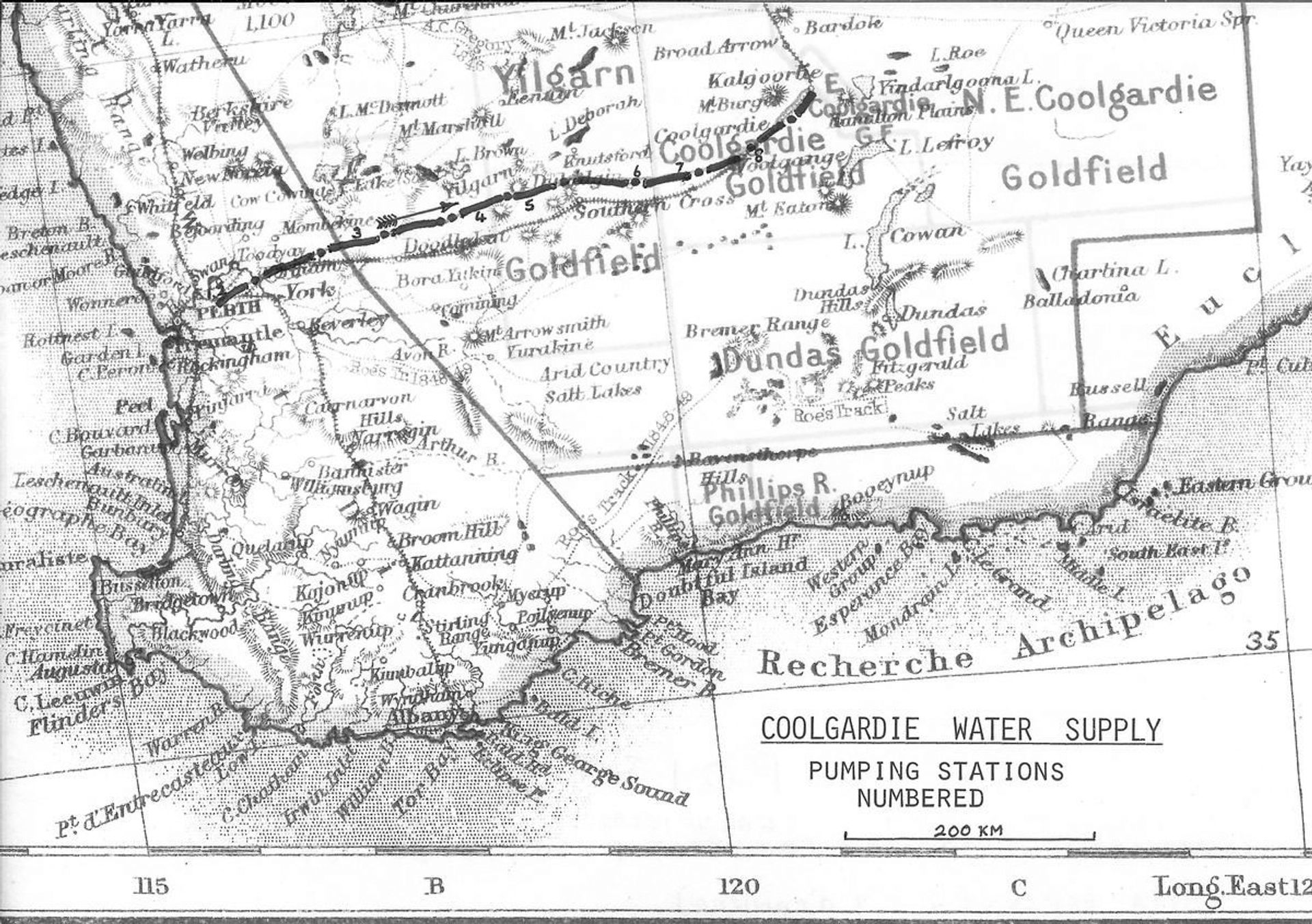
Gold was found out where Kalgoorlie is now. And because so many people went out there in the gold rush, and the nature of the mining is it's got to have water, so they had a problem of how to get water out there. So they hunted around and they found CY O'Connor: Charles Yelverton O'Connor. He was an engineer who they brought here from New Zealand, and when he came here his primary role was to make the harbor down at Freo. This meant blasting a limestone reef that extended at least two thirds of the way across the river from the north to the middle and beyond to make the harbor.
The next stage was to build the pipeline to Kalgoorlie. You see, the rain falls out there, the water flows down through all the tributaries and makes its way back down here where the Swan meets the Ocean, near Walyalup. But O'Connor was putting it all in pipes and sending it all back out to Kalgoorlie! Our people didn't like that, because spiritually water is so important. It is the conduit, the thing that everything travels through.
JM Is the Wagyl [Rainbow Serpent] the river itself?
NN Yes and no. Initially it was ice that formed it, glaciers. Then of course when the ice melted, that water was the Sacred Water and it filled up the valleys that the glaciers made. So the water was still seen to be sitting in there, therefore connecting to that spiritual essence and flowing out into the ocean which made its way out to a very special place out there that used to be the edge of the sea-before the sea level rose.
O'Connor was the person responsible for setting up pumping stations on the major water holes between here and Kalgoorlie, on all the Country he went through. Following the ancient Aboriginal way, no one camped right on the water, which allowed birds and animals everything to get a drink. If you camp on it, it's all about you: you don't give a shit about anything else. Well, that's what was happening with O'Connor and his men. Even the Aboriginal people couldn't get in there to get a drink, because they were being shunned by the settlers. So that created animosity. When O'Connor blasted the reef to access the harbor for the boats and ships, the people all the way along from here to Kalgoorlie said that he had interfered with the spiritual flow. So they sang him.
They all sang in their different languages. That is a powerful thing. If you get sung, you're in deep shit in that old way, and that's what they did. They sang him. He was of sound mind, and he rode his horse out into the sea just down here and shot himself. Which left people absolutely bewildered and thinking well what the hell did he do that for? You know, they don't understand that he was sung. When people sing you, that affects your mind.
JM So the intention was to send him crazy? So he couldn't continue his work destroying the waterways?
NN Yeah, he went Kart Warra. Kart is your head and Warra is bad. So your head goes bad. Within a day of his death, the water came out the pipeline at the other end at Kalgoorlie and is still flowing today. So it's a pretty amazing feat. In 1903 that first pumping station opened up there at Mundaring. You know, he's still lauded in every learning institution across the globe for his achievements.
JM You don't hear anything about the limestone embankment or the spiritual flow or the explosion or the singing in any way in schools. It's amazing because he's a figure you learn about all through school, but there is no mention of Aboriginal people at all, or that whole side of the story.
NN We know that's wrong, but when you're the victor you get to write the history. So that's that side of it.
JM Could you talk about responsibility to Country?
NN It gets back to that 'ask not what your Country can do for you, but what you can do for your Country.’
JM And Country, in this sense, means something deeper, not what you can do for the political structure but the land itself.
NN That's right. Waterways are so important. For example, water tells you where your boundaries are. It flows that way on that little ridge, or line in the landscape, and then the others go that way. You know that's the boundary. At the confluence of every tributary, a major tributary like this one, you've got rivers coming into it, or smaller dance grounds on either side.
The right hand side of the dance ground is for the females and the left hand side for the males. They danced and sang. They also worshiped the people whose skin had been shed and washed down there and was now in the she-oak trees, where the placenta is buried. There was this rhythm. This vibration. We look at it like this, and this is our world.
So big ceremonies were done around that water. It's all about water. Then if you look at scientifically, they say 73% of the surface of the planet is water, and us as humans, 73% of our body is water. That's got to tell you something. I've long said, if our river's not healthy then neither are we. It's holistic.
So when you talk about this area here, Karagurrup, they used to gather here in big numbers. While they didn't have a major campsite here, they stayed for a long time. A whole lot would gather, males and females and all the Elders would go over to a special spot over there, and that's where they would sit, for five nights before the moon and five nights after it. The oldest generation starts singing five nights before the moon. The next night, the next generation joins, then the next generation, then the next.
On the full moon, they're all dancing and singing. Of course, they're passing on knowledge of totems on the full moon. So whoever's master of ceremony for each totem...
"The oldest generation starts singing five nights before the moon. The next night, the next generation joins, then the next generation, then the next. On the full moon, they're all dancing and singing."
JM What totems were there?
NN The Wardung [the crow], Manitj [the white cockatoo], Yonga [the kangaroo], and Nyingarn [the echidna] because they represent the spirit of the dead. They're supported by Karda the goanna. There's a story about them all getting together as spirits and going through a process of elimination as to who would win the right to care for everything. And eventually the humans won.
JM The right to care for everything? Not the duty?
NN It's not about any specific thing, it's about everything. All of those major players that are represented now in the Milky Way, the night sky. Yonga the kangaroo, Waitj the emu, Karda the goanna, the great Wagyl itself and people. The female is represented there, but not the male because in the story, he ate the children. Because he ate the children he was not allowed to be the voice of the people, he missed out.
And, with all of that story, that gets you to the point where you've got trees, wattles, jarrah trees, moodja [the christmas tree], sheoaks. These are all the ones that are represented in the story. Everything fits together; it's just this complete package. And the youngsters now are learning the dances and the art. The same art has been around for a very long time. So there's this continuing tradition, you know? And people learn more about their genealogy through these dances, songs and art. So when we analyse all that and boil it all down, what you end up with is a group of people who know themselves and how they fit into the system.
JM Could you talk about living with the seasons as part of that system?
NN During the six seasons, all of the things that you needed in your body to keep it in mint condition were consumed in the right amounts. And in the right order. As you traveled around, you know, you're on the coast, you're eating seafood. Waves of it. Starts with the yellowfin whiting. They just come in there by the tonne. Then salmon, and then the pink snapper and the West Australian dhufish, crayfish, blue swimmer crabs. Our vitamin D came out of all of them. Lots and lots of it. They tell us that now it comes from the sun. But most of it came from our food, twelve weeks we spent on the coast.
JM So you topped up your vitamin D. Obviously, your omega 3 and omega 6, and everything was there. Then heading inland for the cold winter. So the twelve weeks on the coast, that was part of which season?
NN It started with a season called Birak, then Bunarroo and then Djeren. Each season lasts eight weeks, so you had the end of Birak, all of Djeren and half of Karbarang.
That's the yellow season, when people are spread right out across everywhere, but they're making their way back to the coast. Half of one season, then all of another season, then half of the next one, they were on the coast. It would've been awesome. And all those different things to eat. There was just tonnes and tonnes of food and they only ate it fresh. They didn't store it or anything like that. And that gave the animals time to breed up and be able to eke out an existence without any interference from the people, apart from anyone who was traveling through, who needed a ‘roo or whatever. Then they went back up the river, making their way slowly up eventually over Darling Scarp.
And they would stay over the back there in their camps, which were out of the wind. Because the characteristic wind's always from the southwest. It's there and it just tumbles over. So you've got this tumbling wind on the other side and that's where they had their Mia Mias [homes].
They had a northeasterly aspect where the sun would shine nice and warm in the morning. At this time of the year there was also lots of foggy stuff because a bit of rain on this Country here before it was cleared and you're getting heavy dew. Let's bring the months into it—the end of April, beginning of May—as we know it now, is the time when your dew point would be about between six and seven o'clock in the evening.
So when it was time to burn, they would light their fires, say one o'clock in the afternoon, burning the valleys, keeping them open along the waterways. By six to seven o'clock at night, the dew was that heavy, the fires would go out because it controlled the fuel.
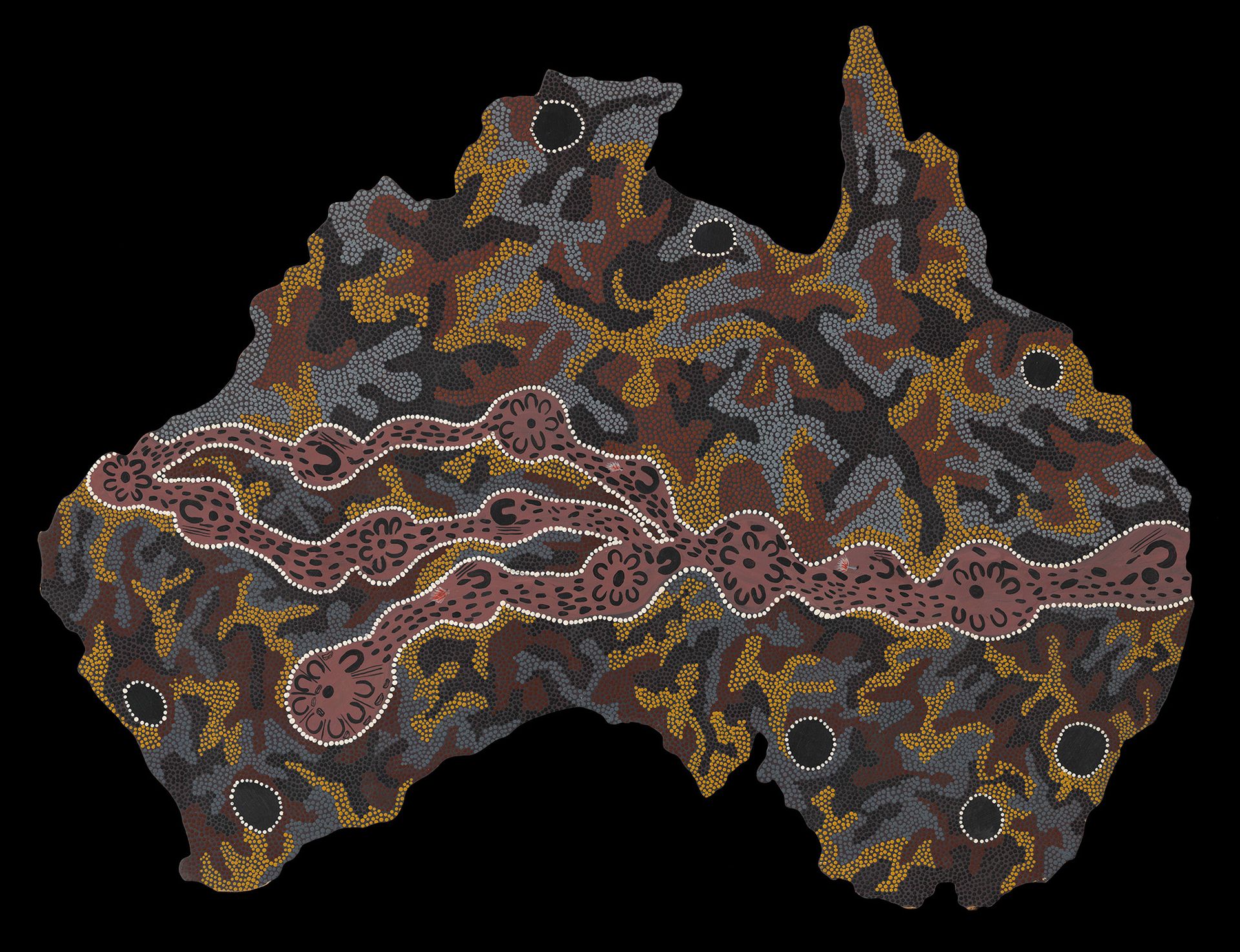
Seven Sisters Songline. Artwork by Josephine Mick, 1994.
JM So that would just moisten everything so it wouldn't burn?
NN The dew's heavy. The dew comes out with plants. You know, it goes in, and it comes out again. At night you look at some of our plants, and at night their leaves are shiny. You know, you'd have been driving around sometimes and seen shiny leaves on some of the Eucalypts at night? That's the dew coming out onto the leaf, so nothing will burn!
All you had to do is keep the fuel level low. Fire is crucial in the landscape. Understanding it is even more important, you know? The first thing you learn about fire is what suppresses it. So water suppresses it, and you need to know about fire and water. There's a code with fire in the natural landscape. Very few things go up a hill faster than fire, because they create their own draft and draw it up. As soon as it gets to the top, it just stops and trickles along. Very few things in the natural world go down a hill slower than fire, because it's still creating its upward draft and it's just trickling down. So straight away, if you get that understanding of your natural environment, you know how to burn it and not kill everything, you know?
So what suppresses fire is water. There's nothing in the natural world that goes down a hill faster than water, and nothing out there goes up a hill slower than water. So straight away you've got your base that you work from, with your understanding of it. When you've got that, it's just a matter of looking after your Country. You know, what it is, how it works: the whole thing's right there.
JM It's the two basic natural forces.
NN It brings in lots of other things too, like your connection to a piece of Country and how an Elder lived before you with a suite of totems. When male Elders get older, all their earthly based totems, they pass on to young men coming behind the extra pressure of having more totems; because the older males totems then shift to the cosmos, and you get to understand the planet and how the whole solar system works.
You've gotta learn the names of stars. When you get to about 45–50: that's some serious business. I know there's a couple of observatories out on Country where they sat. They must have had a lot of oil and fat on their bodies, because the rocks are shiny where they sat. And they sat on one spot, on one side is a lake that's about 11 kilometres wide. What they did was observe where the planets came up.
Then on the other side, they stood standing stones where the planets went down. They call it female, the sun. Whereas the sea is male. The moon is male too. But the ocean is Wadarn, some say Mamba Cort, which means the waves as they hit the edge of the beach. It's like the male's heartbeat. Cort is your heart. and Mamba Cort is 'male heartbeat'.
You can just lie there in the rhythm, and you hear it. Boom. Boom. Boom. It's really deeply connected. There's just so much to learn. It's never ending. And as you learn more and you think who else is gonna be able to tell me some stuff now, suddenly someone will come through. Whether it's through a dream or whether it's through a person that has that knowledge it'll be there. And wow, it's amazing.
If you start to think about song lines, then the key to them is they can be any length and variation, but they have a story that goes around. A full circle, that brings you back to where you started. With where you're born, and you have your karlup ger, your 'home run, and your six season cycle. When you travel around in your six season cycle, you walk past the birthplace of every person in your group, once a year. Sometimes you camp at those places, then, you also walk past where everyone in your group is buried. So you walk past their grave every year.
An Elder has to carry a hair belt, and that belt contains a bit of hair from that person who's buried there. That's spliced with more hair. These hair belts can be many metres long, but the male carries the one for the males and female carry ones for the females. As you are going past that spot and they got the hair and they're singing it. They're singing about that person who's buried there. And they're passing their hair through their hands. That's how connected it is.
If that person is your ancestor, and they've got the same totem as you, then you learn about those people in great detail. You can look at a piece of land and you know that when he walked on it or she walked on it, it was much higher, and now it's washed down and it's lower. So you can get a pattern of the whole Country through the story. And if that person saw a major flood, then that would've been the highest level of the story that was kept, and they would sing about it. So that would be in the song, that would be sung as well. A normal flood they don't bother, only the most major ones. So that way you know that where you camp is always above that highest flood line.
You also learn that when the water runs down off the inland, it runs off their Country. When it runs this way, it brings the ochres from their land in the color of the water. That's why it's all rusty and red and also the vegetation from their Country comes down too. So as that water which is full, then goes down, the banks are covered with the soil from out there. So those people out there have got entry to the ocean. And they're walking on their own soil, they're not walking on your soil.
Because they're walking on their own soil, that means they also have access to food, that's the unwritten rule, the unwritten law. They then get to the ocean, and something that your mob wasn't allowed to eat, they can eat. Of course there's different songs as well that go with that journey. I was born on the Greenough River and the Chapman River in Geraldton. The inland people there call them Yamatjis. They're Wadjuri speaking Yamatjis. Wadjuri is the language. I learned that language as well.
And if you know the song inland, they call their serpent Bimmarah. But in our one, Nyungar, because it's a northern Country, we call it Yaberah Boodjarah. You know that when that water spreads out, there's a flat up there they call the Greenough Flats today. Just miles and miles. This unbelievably flat country.
JM So the songlines in there are very connected to waterways?
NN In The Dreaming, those two serpents fought. They formed that area of water there. This was a female and a male Wagyl that fought here. Up there it was two males, but they were from different Country. One was Yamatji's from inland, and one was Nyungars, from the coast. Salt, water and fresh water. So when they fought, there would be a song for it. So when the red dirt's covering the land, it's Yamatji. Then the rain comes along, washes it goes down, it's gone. Ihe grass grows, then it's back to Nyungar. People just know, and understand it. Because they sing about it and they dance it.
JM So to really understand something you need to embody it with song and dance, rather than just see it as a concept?
NN That's why they're called songlines, because you gotta sing. The song for that one up there is bimmerah barma bimmeral barma Wagyl barma… And you go down low, and then you come back up again. And them old people, I used to hear 'em singing it when I was a kid, you know? Never forget it. Just rhythmic and it impacts. It's brilliant how it all works.
Songlines are crucial. You need to get your head around them and understand them. Once you do, you're right. Wherever you go, they're there.
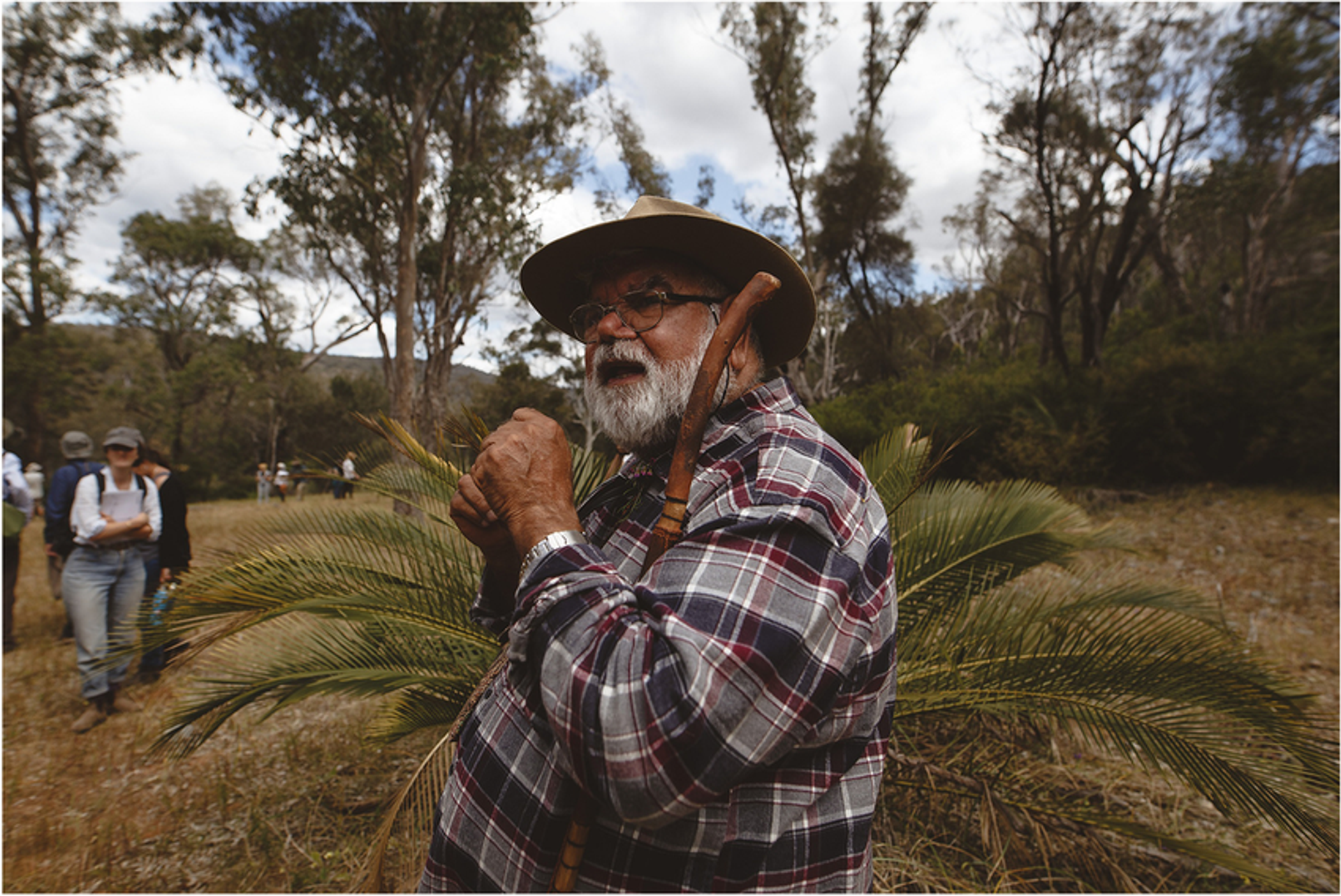
Noel on Country. Photograph by Zal Kanga.
BOOK
The book Aqua Nullius: First Nations Water Rights in Australia, published and edited by the not-for-profit Melbourne based design research practice OFFICE, focuses on the concept of aqua nullius — the attempted application of the falsehood of terra nullius to water. The book highlights the voices of First Nations people interviewed from across Australia about their cultural relationships to water. This is a publication of collected writings and over twenty interviews structured around four key themes: storytelling, water injustice, First Nations water management, and overturning aqua nullius. Contributors include; Alex Bond, Colleen Raven Strangways, Dave Wandin, David Collard, Erin O’Donnell, Hozaus Claire, Jack Mitchell, Jim Everett, Joseph Williams Jungarayi, Josie Douglas, Kazan Brown, Maureen O’Keefe, Melissa Kennedy, Norman Frank Jupurrurla, Oliver Costello, Sophia Pearce, Sue Jackson, Tony Birch, Troy McDonald, Noel Nannup, Virginia Marshall.
BIOS
Noel Nannup is a Nyoongar Elder, storyteller, traditional knowledge holder and cultural guide. He is a heritage consultant, former NAIDOC Male Elder of the Year, and Edith Cowan University's Elder in Residence. He has worked as a Ranger across Western Australia from Geraldton in the north to the south west, as well as in academia and a variety of government roles.
Jack Mitchell is a designer, artist and researcher with Whadjuk/Balladong Noongar heritage. He is currently undertaking a PhD at Monash University which uses storytelling, yarning and conversations with Elders and knowledge keepers to explore Indigenous cultural relationships to water. This work builds upon his ‘Blak White and Bluespace’ project investigating how the built environment can better engage with Indigenous water knowledge and expertise. Jack has also worked as an architectural assistant and Indigenous architectural advisor.
OFFICE is a not-for-profit multidisciplinary design and research practice based in Melbourne. Its projects span the intersections of built form, research, discourse and education. As a registered charity, the studio’s operations, processes and outputs are bound by a constitution to make projects for the public good.