This conversation is the fourth of a series produced by Me AndOther Me as part of their ongoing WebRTC BackRooms project, a podcast deep-scrolling into XR, AI, and the future of hanging out in the spatial internet, hosted by Koozarch. You can listen to the full episode via our podcast channels or watch the video version on the Me AndOther Me Substack page.
Me AndOther Me Welcome to The BackRoom of Virtual Bonds with Joe Hunting. This is an excerpt from our conversation in the WebRTC BackRooms, a podcast series deep-scrolling into XR, AI, and the future of hanging out in the spatial internet.
In this episode, together with Joe, we discuss what it means to make documentaries inside social VR spaces, where people meet, rehearse, grieve, fall in love, dance, organise, and stay close across distance. From a wedding in a fantasy VR cathedral to a sky lantern released into a digital night, from Club Zodiac’s dance floor to the friendship at the center of The Reality of Hope, we follow the ways VRChat becomes a place where stories unfold through avatars, gestures, and self-made bottom-up environments. We also speak about the camera inside VR, the ethics of filming while invisible, the shift between virtual and physical encounters, and the future of community-driven online spaces as they face increasing pressure from corporate platforms.
Me AndOther Me You began exploring VR worlds already during your studies, if we are not wrong. Could you tell us how you discovered VRChat, what inspired you to start making films inside virtual reality, and in what ways working inside VRChat has challenged or inspired you creatively?
Joe HuntingI discovered VRChat in 2018, while I was doing my film production degree. I first came across it through an article about how VRChat was enabling people to form large-scale communities online, assisting with mental health, saving lives, and helping people avoid being a risk to themselves. I found that so profound, how an immersive reality or VR could create that kind of impact.
I grew up playing multiplayer games and always found joy in immersive worlds and gaming environments. So naturally, I was also excited about VR as a gamer, just to participate and engage with the technology. Filmmaking came as I read those articles and started talking to people about what this space meant to them. Very quickly, I realised that those articles had truth to them, and that people were forming profound relationships and communities. I found a harmony between my love of gaming and my interest in documentary and experimental filmmaking. That led me down the path I have been on for the past six years, trying to understand what the truth of film could be in that environment.
There are a lot of technical challenges that come with filming inside a social VR platform, but those limits also became a source of inspiration. Early on, I realised that imperfection is part of the truth of this world, and that it was important to embrace the quirks and glitches as part of the cinematic truth, and also as part of the humor of the films.
"imperfection is part of the truth of this world, and that it was important to embrace the quirks and glitches."
There have been so many amazing moments to witness: people embodying avatars in such rich and present ways through full-body tracking, while constructing flourishing communities and true bonds. In my first film, A Wider Screen, I spoke a lot with a clinical psychologist called Noah Robinson, who was exploring how VRChat and social VR platforms could support therapeutic practice. He has now gone on to create Innerworld, a social VR space for anonymous therapy groups. Talking to him and connecting with the impact of what this could be, especially through themes of mental health and hopeful stories of overcoming mental health issues, was a key moment. It gave me a lot of inspiration.
M&OM It is so interesting what you are saying about how one moves inside the space, and how capturing such worlds, with all the challenges that come with it, can open up different possibilities for storytelling. We were thinking especially about the camera inside VRChat, because it is very different from holding a camera in physical space. It is almost something you embody, no? At times, the camera becomes a sort of character that plays along with you. Was there a moment while filming when the camera allowed you to witness something you might otherwise not have been invited to, or to capture a special moment in a different way than in the real world?
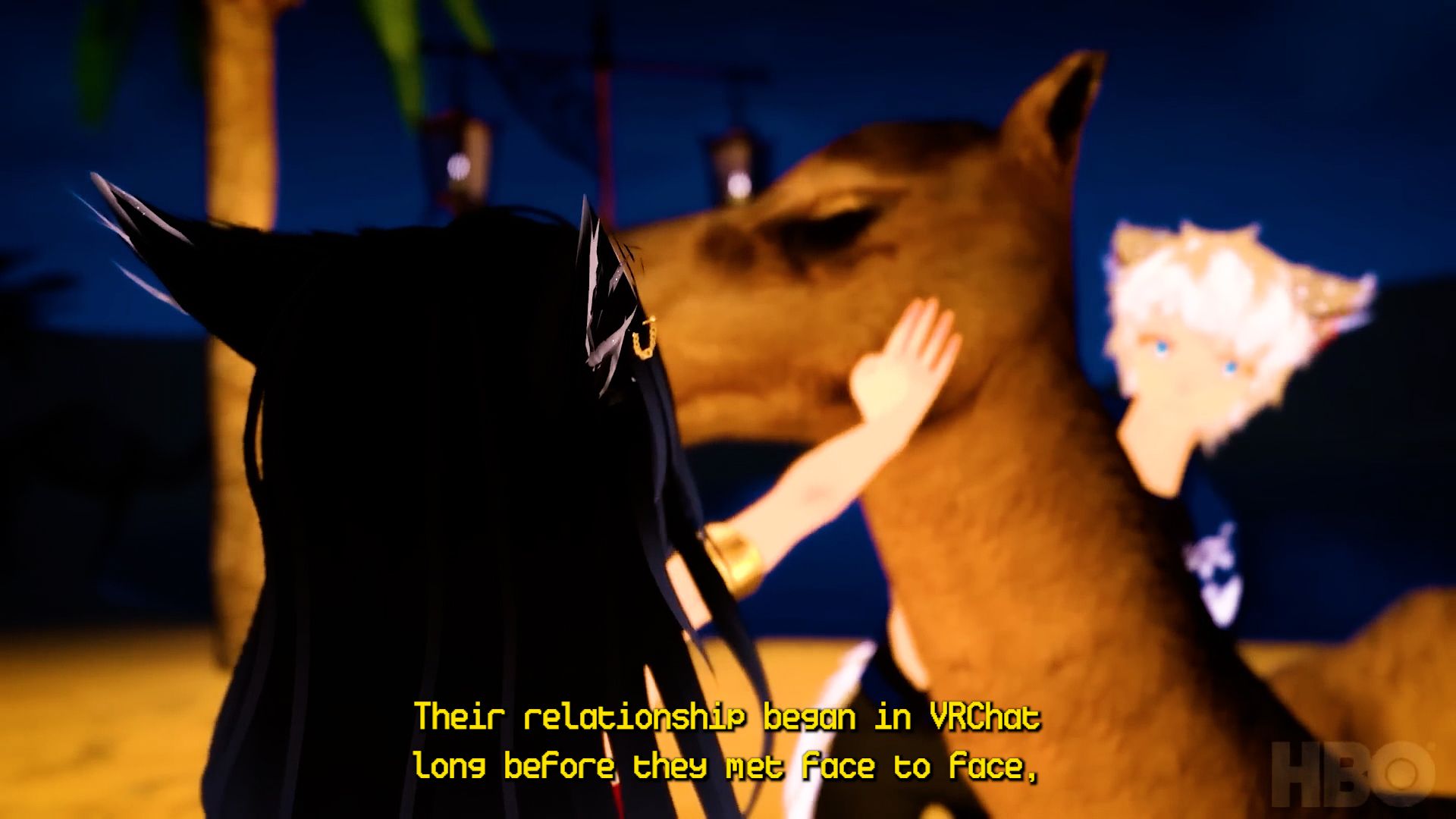
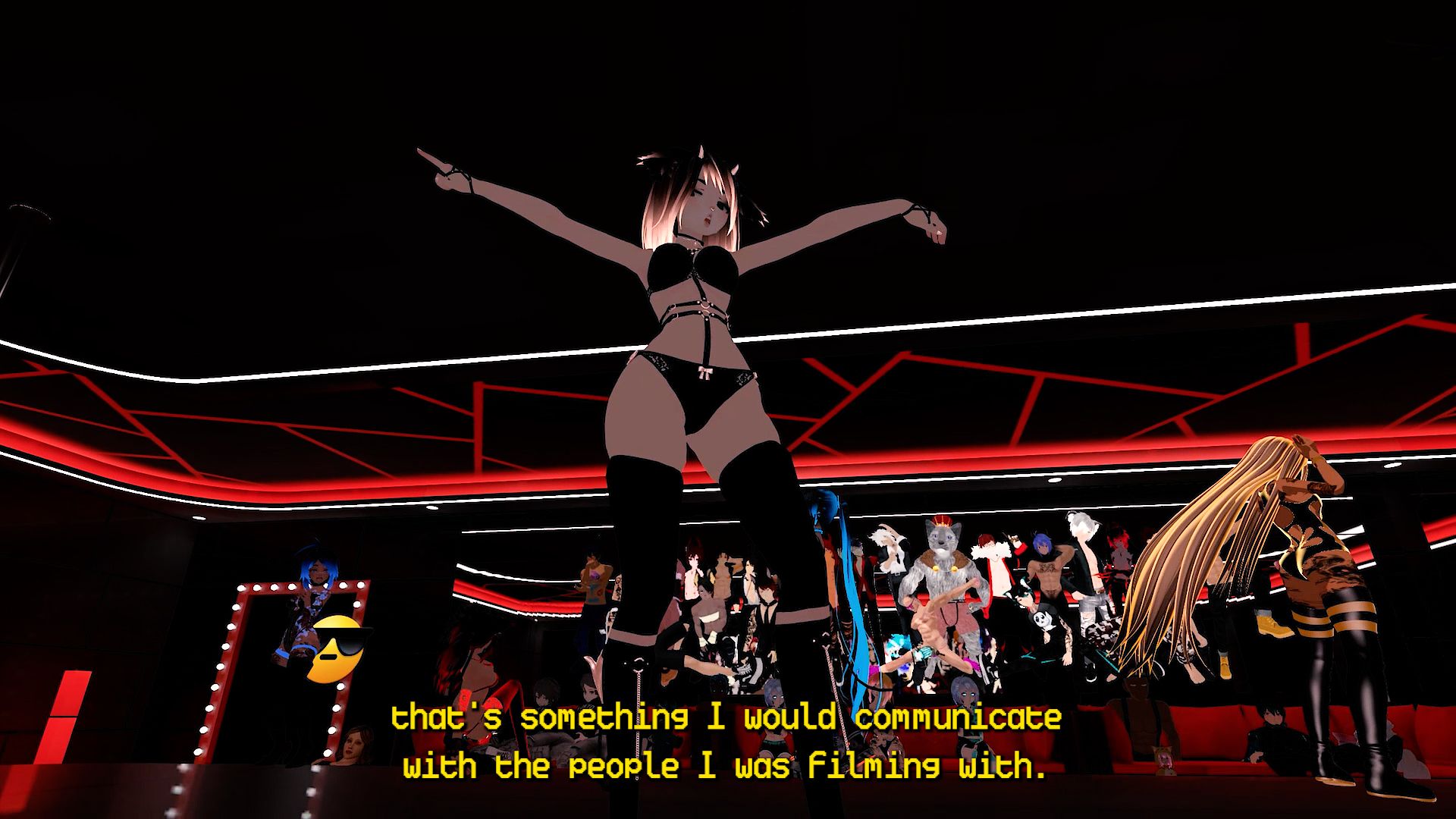
JH That is a very relevant question. Early on, in terms of how I found my cinematography and the ways I wanted to direct the camera, I did not have a VR headset for my first film, A Wider Screen. I was filming on a flat screen, and that had a really dissociative effect. I was looking at the output of the film immediately and was not fully present with the subjects I was filming with. I did not really understand the impact of that until I got my first VR headset a year later, around the production of Club Zodiac. Wearing a headset, being fully present, and using the virtual camera with my hands was the moment when I understood the camera’s role, how I could use it, and how I could bring my own presence in. The audience can feel the weight of me behind the camera, feel that this is being made by a person, and feel the realism a bit deeper. During the production of Club Zodiac, my second film, I took advantage of being invisible. I was able to wear an entirely invisible avatar. When I first started doing this, it felt like crossing an ethical boundary. Most documentary filmmakers would feel the same way. You do not want to capture someone without them knowing that you are there, in most cases. But it can also be a huge advantage for a documentary process if it is done well. So I would communicate this with the people I was filming. I would even say, “I am present. I am here, but you will not see me. I am invisible.” Like any documentarian, I wanted people to forget I was there. There were moments where I was able to capture very intimate and quiet scenes, specifically in We Met in Virtual Reality, where there is more room to breathe because it is a feature film. I like creating a safe space for the people on camera to talk to each other and be themselves.
"I was able to wear an entirely invisible avatar. When I first started doing this, it felt like crossing an ethical boundary."
M&OM Club Zodiac is also one of my favorite works of yours, as you know. For me, it was an eye-opener to see how physical space itself is re-curated or reorganised by community members to make space for their dancing practices. One of the dancers hitting the Christmas tree shows how virtual space is quietly tied to physical space, and how these two domains are bound to each other. My question is: how do you encounter these communities and enter their stories?
JH I myself am very much a participant, especially in the earlier years and during the pandemic. I was really engaged in the VRChat community. I was making films, but I was also off-camera playing games, socialising, going to educational events, classes, and cultural exchange groups. During my studies, I would be on physical film sets and work there, but then I would come home and go into VR for three or four hours at night. I felt like I had this very special secret world outside of my physical film work. I think that engagement built trust, because people would see me around different events. I would naturally converse with people and learn about their communities. After making A Wider Screen and getting my first headset, I met a lot of people in the burlesque dance club scene of VRChat. As someone newly encountering full-body tracking and embodiment as themes in film, I was fascinated by their commitment to dancing, and by how they were creating an inclusive, safe space built on empowerment and fitness as well. It is not easy to dance in VR. It is not as easy as it looks, especially pole dancing. I wanted to make this film as a way to understand how that works. I was also skeptical about representation in these spaces. How truly diverse is it, and what voices are emerging within these burlesque clubs? Club Zodiac was a space I discovered naturally through talking to people, and it was the most open to a filmmaker coming in and examining it. I became quite good friends with one of the founders of the community, Virgo, who appears in the film. She is such a motherly figure to so many people in that community and welcomes everyone who wants to come and dance. Almost like a stereotypical burlesque mother of a real club would be in a film. So it is quite cinematic. We started interviewing different dancers, and I was able to understand the empowerment that the space offered to many women, trans women, and men, as well as the level of fitness and relief from, or escapism from, the real world that this club offers.
"I was able to understand the empowerment that the space offered to many women, trans women, and men, as well as the level of fitness and relief from, or escapism from, the real world."
M&OM In We Met in Virtual Reality, which you filmed entirely inside VRChat, you capture deeply intimate moments of people’s lives, from love and loss to unexpected connections, mental health, and identity struggles. You have described the film as offering a hyperreal journey into the human experience of an online world that may soon shape the future. Could you tell us more about this idea, and how you imagine social connection and meeting spaces evolving alongside XR, especially with augmented and mixed reality becoming part of everyday life?
JH When I was first thinking about how to define the experience of watching work shot in VR, especially while making We Met in Virtual Reality, the best word I could think of was hyperreal. It is about how reality becomes blurred with a simulated environment. I wanted the audience to go on this grounding journey, where the opening of the film feels very much like a video game. It feels chaotic and absurd, and you are struggling to make sense of it. But by the end of the film, I wanted people to almost forget that they are watching a film shot in VR, and just connect with the realism that exists there. I think this is emphasised in the ending of the film, where we have this quiet, intimate moment with Jenny, the ASL teacher we follow in the documentary, lying on the beach and listening to the waves. But those waves are non-diegetic. The sound was added in post, and the ambience is simulated. She looks up at the clouds and says they are painted and not real. For me, that was the moment of hyperreality: being in such a real moment, while everything is simulated, including the film itself that we are watching. I think hyperreality is still very relevant today, especially in how mixed reality, and even the way we are doing this podcast, affects how we approach VR and XR in the future. A lot of my thinking about this medium is filmic. I think there is a bright future for film production and virtual production. I am also curious about social XR, and the ways in which things might become more blurred. I do not know exactly where it will go, but I think this is a good example of what it can be.
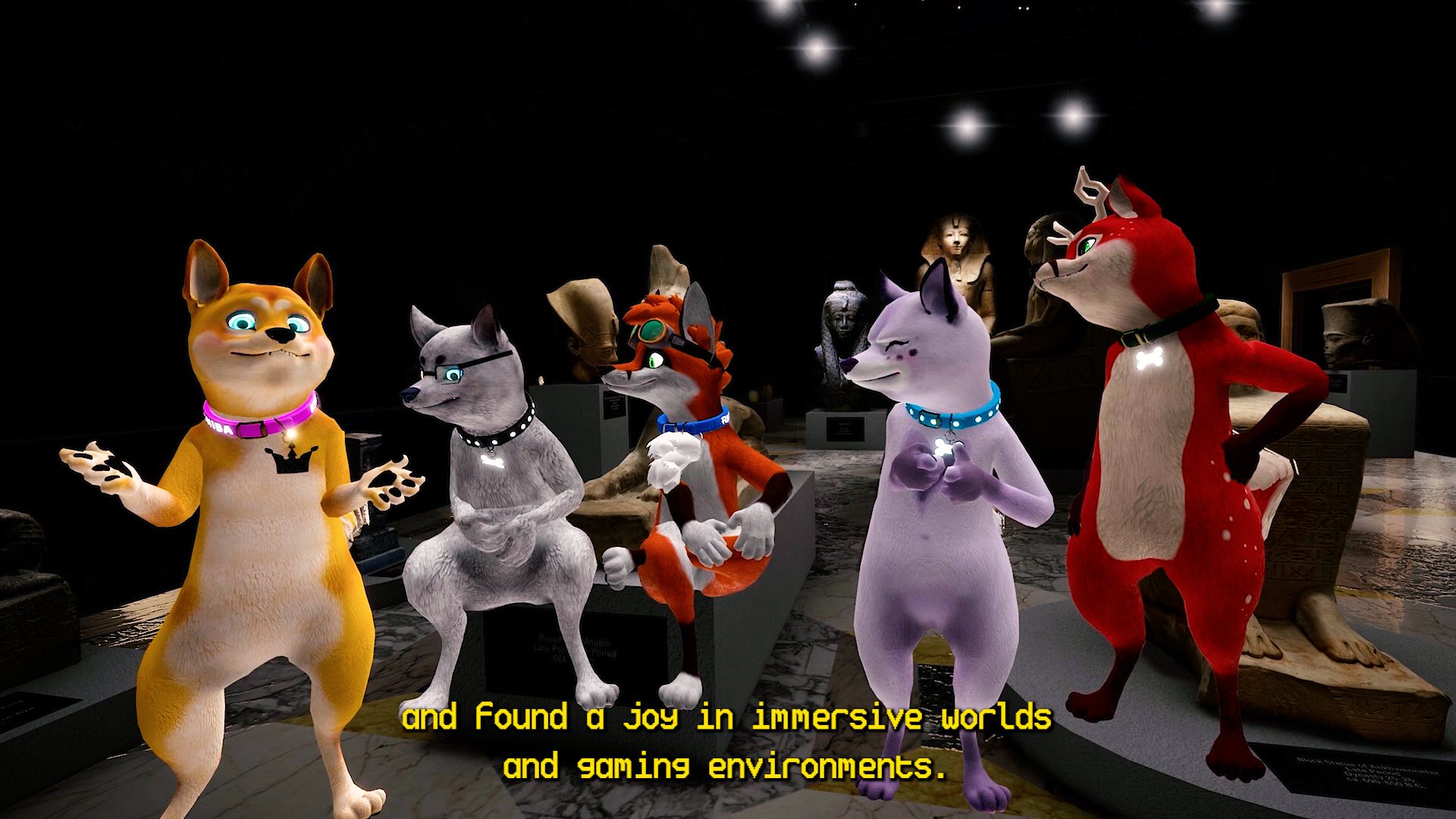
M&OM I think your films are very good examples of the social and humane use of XR, where it is not about capitalising, extracting, or monetising, but about creating social bonds and relationships. In a way, one understands this very well through your work. VRChat is, of course, a platform, but it still allows a more bottom-up way of creating a community, running a community, and being yourself. I also really like the way you use the term hyperreality. It is almost counter-provocative, because many people still see VR as a form of escapism from reality. But maybe hyperreality emphasises that it is much more than that. It is affective, emotional, bodily, and spatial. I really enjoy the way you describe We Met in Virtual Reality.
JH That is exactly the experience I have had as a filmmaker in the space. It feels so organic to be present with someone in that world. There is a strange thing that happens when you are holding a camera in VR. Sometimes I would be so focused on the monitor, making sure that I was pulling focus at the right time or panning the camera properly, that I would look over my monitor and just think I was in reality. Because I was so focused on that reality. Then, when you look over your monitor and see a grasshopper staring at you, there is a strange element of hyperreality in those moments. To trace how We Met in Virtual Reality emerged, I felt like my previous short films, A Wider Screen, Club Zodiac, and the series Virtually Speaking, had been training me for the pandemic in 2020. Entering lockdown, I did not realise how important VR would become at that time. It felt like if I was going to make a feature film, which I had been thinking about since my first short, it had to be then: during a pivotal point in the technology’s history, but also at a moment when human-centered stories and communities online were flourishing through isolation. That is what made me fully focus on making a feature film. I already knew some of the key subjects in the film. Jenny, the ASL teacher, had been involved in my series Virtually Speaking, so we already knew each other. The other protagonists, Dustbunny, Toaster, IsYourBoi, DragonHeart, and others, I met organically by going to community events and looking for stories that could speak to both people familiar with VR and people entering this world completely fresh. I was looking for stories that could bridge that gap. For me, it was a very organic process of being present in virtual space during the pandemic and wanting to capture a certain truth in that time.
M&OMIn We Met in Virtual Reality, we see what it means to be present in a virtual place. With your newest film, The Reality of Hope, you take this further by showing how relationships formed in VRChat return to people’s physical lives. The film traces a story across VR and the hospital room, across friendship, illness, and care. That must have brought many challenges and discoveries for you as a filmmaker. Could you tell us how The Reality of Hope came together?
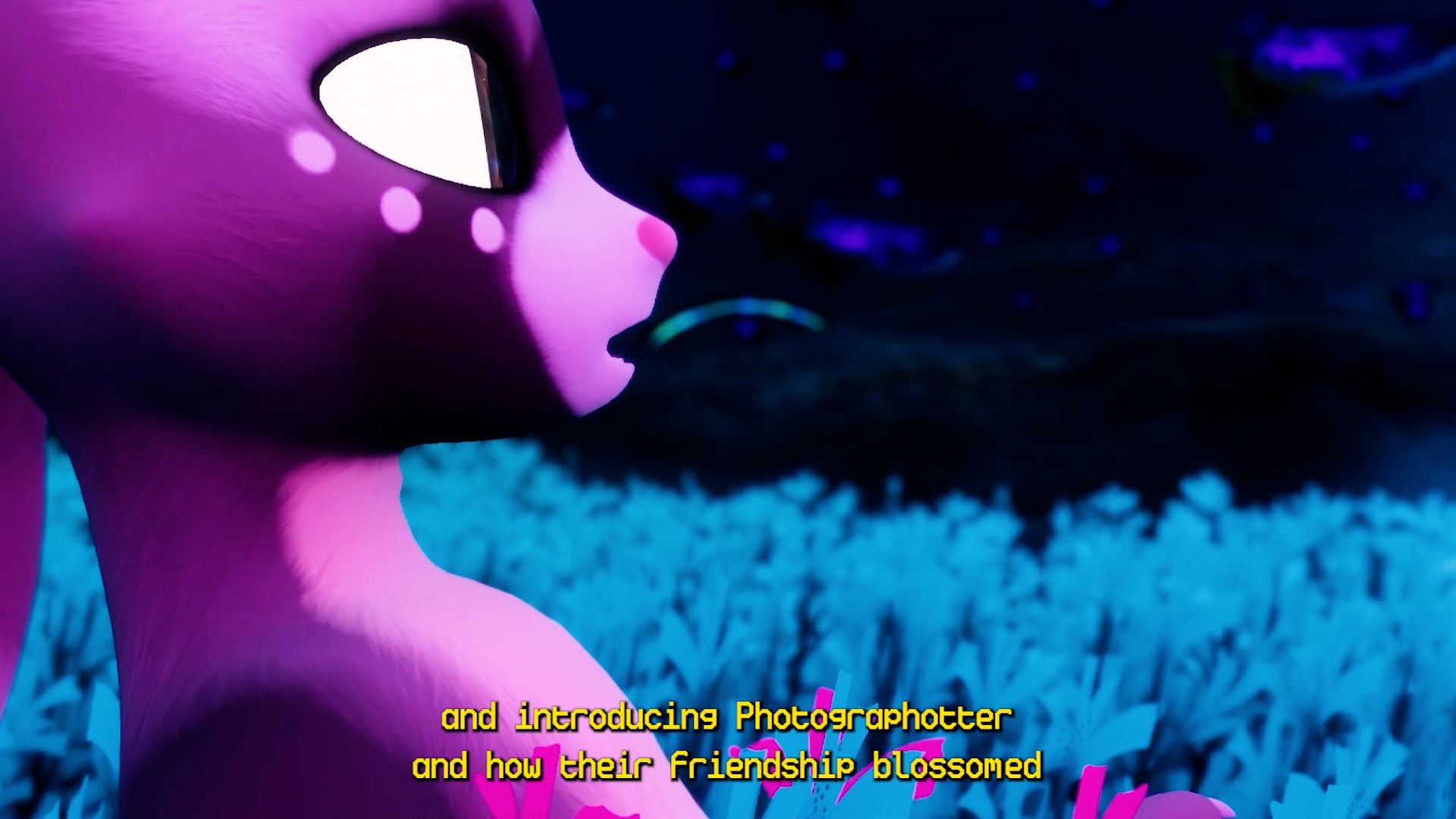
JHYes, of course. I discovered Hiyu and Photographotter through my now good friend Max Willson, or Max Films VR, as he is known in the VRChat community. We met in October 2023, and he pitched me to collaborate on a documentary following their kidney transplant story. He was already good friends with both of them, and I said yes immediately because I was excited to represent how a friendship made in VR can become a physical, meaningful friendship in the real world. I came on to direct the project in October 2023. At that time, Hiyu and Photographotter had just been confirmed as a match for the transplant. We started filming right away in VR, periodically interviewing both of them about Hiyu facing kidney failure, finding a donor, and how their friendship had blossomed in VR before leading to this donation. Then we met physically four months after that first introduction. There was only a short amount of time to think about how we would move between realities, from getting to know them in VRChat to being in the hospital in Stockholm. For me, Hiyu’s dialysis room was always important, because dialysis treatment was a key part of the story. I was brainstorming with Max and my art team, Rob Ouellette, Tia Johnson, and Morgan Furtado, about recreating Hiyu’s dialysis room in VR. We used a 3D scan as a reference, then fully modeled the environment again, using it as a poetic space to reflect on how isolated Hiyu could feel during dialysis. Sometimes, while on dialysis, he would wear his VR headset and be around people. Seeing him with people in VR while undergoing dialysis felt like a unique way to honor that experience. That became the place for the transition between realities. Although we created the scene specifically for the film, we still wanted to shoot it in real time and keep the nature of filming in VRChat. It was actually the last scene we shot, after the transplant had already happened. It gave Hiyu and Photographotter a very particular moment to walk back into a room that had been quite traumatic for him, to sit again in the chair where he had spent over a year, three times a week, and reflect on what the whole experience had been.
"I was excited to represent how a friendship made in VR can become a physical, meaningful friendship in the real world."
M&OM This brings me naturally to our next question. In your films, people appear through their avatars rather than through their bodies, or through both. We are big fans of Glitch Feminism by Legacy Russell, where she argues that digital online worlds are as real as away-from-keyboard ones, and that the boundaries between digital and physical worlds are increasingly dissolving. How do you see this playing out in VRChat? Do your subjects, your friends, or yourself use avatars to express aspects of identity that might be harder to show offline? And how does the avatar body influence social identity and self-expression in your films?
JH That is a loaded question, and an exciting one for me, because avatar expression is such a key part of my interest. I think everyone considers how they are going to express themselves in online environments, especially in VRChat, where you physically embody a character, often with full-body tracking. In terms of The Reality of Hope, something we wanted to represent very intentionally was furry expression and the VR furry community at large, which is a very expressionistic group. Their avatars are anthropomorphised, of course. Hiyu and Photographotter, and much of the VR furry community, all have facial tracking, so they feel extremely expressive. They know what facial movements to use to master their avatar’s expressions. As a director, it created an amazing experience, because I could really feel that and see it on camera. How their avatars relate to their physical selves was also an important consideration in the real-life transition. As you mentioned, I wanted the distinction between physical and virtual to become almost nonexistent, so that they, and the audience, could fall into the same conversation we were just having in VR, now in the physical world. Although it is a pivotal moment in the film, we did not want it to feel dramatic. We wanted it to feel organic, subtle, and natural, as it was for them. For them, for me, and I think for many people who have met close friends from VR in real life, there are 10 or 15 minutes, maybe longer, of getting used to this other version of the person you have been speaking to for years. But if it is a close friendship or relationship, the intimacy and the bond you have created naturally fall into the same flow. I wanted that to be felt in The Reality of Hope especially.
"I wanted the distinction between physical and virtual to become almost nonexistent, so that they, and the audience, could fall into the same conversation we were just having in VR."
M&OM How do you see the significance of spaces like VRChat? They are community-driven, open, welcoming, and shaped from the bottom up. At the same time, we are seeing an increasing corporatisation of online environments, with social media platforms and spatial computing technologies becoming more integrated into everyday life, while figures like Zuckerberg continue to push branded versions of the metaverse. What is at stake when open digital worlds like the ones you explore in your films are absorbed into corporate frameworks? And where do you see possibilities for the future?
JH I think this is a really valuable question to be asking now. VRChat and many social VR platforms flourished during the pandemic lockdown, from 2020 to maybe 2022. There was a large increase in visibility and population on these platforms, which has since declined as we returned to a post-pandemic world. But the communities still very much exist in VRChat. Unfortunately, we recently lost Altspace, but I am hopeful to see that many communities that emerged during the pandemic still continue within VRChat. However, those communities are at the mercy of the corporation. I think VRChat is having to monetise more and find ways to profit and continue to grow, which makes sense, and there is no judgment on that. But it does incentivise a certain culture, where people create worlds and avatars that can generate profit, and where user-generated communities are increasingly seen as something to make money from. Much like Roblox, I think that culture is now seeping into social VR environments, and changing how creation is handled. I fear that VRChat might become more of a Roblox-like space, in the sense that there is a growing culture around monetization and virtual currency. That can be beneficial, but it can also create real disadvantages for communities that exist only to support people in a nonprofit sense.
M&OM I think this makes a strong parallel to what has happened, and is still happening, to cities. Over the last decades, many urban public spaces have become increasingly privatised or privately managed. In London, for example, some spaces that look and feel public are actually controlled by private owners, with security guards, CCTV, and rules that shape who can gather there and how the space can be used. So I would say a similar process is being applied from physical space to digital public space. This raises the question of how resistance and community ownership can happen, and how protest might even take place inside virtual, digital, online spaces. I think this will become a fundamental question in the near future.
JH I completely agree with that sentiment. I naturally want to say that I still really value VRChat, and I think there is so much goodness within it. However, it may be losing some of that public space feeling, because it is at the mercy of what the corporation wants to do. That seeps into the values of the community and might change or privatise spaces that were once public. So I think this is very important to consider. I think people will start building their own social VR frameworks, or ways to empower other developers to create small experiences of their own. These might also be experiences that exist in WebXR and are truly accessible. Building full platforms might be too much of an undertaking for people at the moment, with competitors like Meta and VRChat already existing. So I can see independent developers creating smaller spaces and frameworks for others. I know there is a team of developers doing this at the moment, building an open-source project that will allow others to create social VR spaces. Their intention is for it to be open source and interoperable between WebXR and other game engines.
"I think people will start building their own social VR frameworks, or ways to empower other developers to create small experiences of their own."
M&OM Is there any upcoming exciting project before we conclude our conversation?
JHI am working on a new major feature film project. It is my first scripted project, so it is a full narrative feature. It is set in a fictional social VR platform that explores the intersection between VR and AI, and what happens when we start to see personified AI existing within immersive worlds. That is all I can say at the moment. You can follow my social media or check my website, joeahunting.com. It is a feature film, so that is very exciting.
M&OM We are looking forward to it, Joe. Very much.
JH Thank you. Thank you so much.
M&OM Thank you so much, Joe, for having time for us. I am going to do a dramatic cinematic exit shot, flying all the way back. Goodbye.
Bios
Me AndOther Me is a new media-driven artistic and architectural research studio exploring the future of our spatial experiences and communication through practical applications of social mixed reality experiences focused on online culture, counter-platforms, and the spatial web. The studio is directed by Innsbruck-based architects, educators and researchers Cenk Güzelis and Anna Pompermaier. They are interested in how social media and the internet have evolved to accommodate online communities in networked virtual spaces that have become alternative places to practice social and cultural activities, and how these virtual spaces affect the architecture of our social lives and social selves.
Joe Hunting is a filmmaker from the UK, currently working in California. His practice explores remote filmmaking within online virtual reality spaces, with a focus on documentary, social VR, and real-time animation. His latest directorial film, The Reality of Hope, is a short documentary that premiered at Sundance Film Festival 2025, while his feature film We Met in Virtual Reality, premiered at Sundance Film Festival 2022. Hunting created an eleven-episode series titled Virtually Speaking, as well as two short films, A Wider Screen and Club Zodiac. Since 2023, he has worked with artists Tia Johnson and Rob Ouellette under the studio name Painted Clouds. Hunting has also worked as a remote VR videographer, capturing online events for MIT, A MAZE, CreativeXR, and Raindance Immersive. More recently, he worked as the VR cinematographer for a scene in Fatherhood with My Father on Netflix. He has hosted several virtual production and VR filmmaking workshops; most notably, he led two multi-day workshops at the University of Bergen in Norway. Since 2020, he has also worked as a curator and programmer for Raindance Immersive Festival.
Podcast Credits
Direction & Production: Me AndOther MeVirtual Camera: Cenk Güzeliş, Luca Lazzari, Viktoria Märkl, Lilly Krüger, Ruben Ungerathen, Adrian Weiss, Linus MemmelTechnical Setup: Me AndOther Me, Luca LazzariSound Design: Dila Kırmızıtoprak, Mehmet Cakir
Editing: Marius Lindl
Audio Mix: Kristaps Andris AustersVolumetric Streaming: Me AndOther Me, Marek Simonik (Record3D)Text: Me AndOther Me
Thanks to the ORF III Cultural Advisory Board. Produced with the support of the Federal Ministry for Housing, Arts, Culture, Media and Sport as part of the funding program Pixel, Bytes + Film.