Federica Zambeletti/KOOZ My first question starts from understanding Weather Commons, a project that proposes that the atmosphere is neither a resource to be claimed, nor a service to be sold, but a shared condition of existence. What does it mean to speak of weather as a commons today, when the capacity to observe and alter the weather is held so unevenly amongst different actors?
Eduardo Castillo Vinuesa That's precisely the question we want to open up with Weather Commons, to collectively explore what it might mean and the risks that emerge when we fail to address it. The question of weather, and how it is or should be governed, is something that the different members of the curatorial team have been exploring for quite some time through our respective practices — often approaching weather modification as a critical spatial practice, which is not always recognised as such. In my case, I've spent the past couple of years researching different weather modification programmes across East Asia and the governance frameworks being developed around them, as well as the intersection between weather modification and financial mechanisms — in particular weather derivatives, which enable speculation on future weather conditions, and the incentives they might create to actively modify weather in the present.
Then there’s the institutional level. At TBA21–Academy, through programmes like UNI, we try to engage with questions that are often overlooked, fall between established disciplines, or take us into uncomfortable territory. We believe it’s important to create spaces where these issues can be critically addressed rather than avoided. And that’s precisely why this topic felt particularly relevant to us. Aleksandra, perhaps you can explain how you ended up working on weather, before we get into Weather Commons per se.
Aleksandra Czerniak I work with Eduardo at TBA 21 Academy, and I have previously worked for other university programmes. I approach weather from a slightly different perspective; currently I am doing a PhD research on the digital twin of the ocean and the future of governance through the simulation itself. The weather modification Eduardo is describing creates a certain governmental gap that, we might propose, the digital twins might answer. That's also how I approach weather modification and atmospheric phenomena, and how thinking about the commons connects me to this topic.
Jose Luis de Vicente The first conversation we had with Eduardo was about our common interest in histories, mythologies and the cultural contexts in which weather modification arises. As a phenomenon it feels as much connected to narratives of myth, superstition and conspiracy than to science, technological practice and progress. Both Eva and I have independently worked on the politics of climate and post anthropocene conditions in previous projects. But our interest in weather modification really started when Eva told me about the coeteres in the delta of the Ebre River, where she was born and raised… This was an architectural infrastructure built up in the 1940s, used to disrupt hail storms that would otherwise risk destroying the rice crops; a good number of them are still standing,. She traced that narrative through the history of the people who managed them. This is of course a not very known episode within the wider history of cloud seeding and the use of silver iodide to interrupt the formation of hail within the clouds. This is in contrast to the current imperative of geoengineering as a very top-down, almost authoritarian, planetary scale practice to negotiate with the changing climate. The past history of the coeteres in the Ebre delta, as well as in other places in Europe suggested another, more grassroots, communitarian and bottom-up logic of weather modification. This research ended up being a two-screen film and an installation: The Storm, for the main exhibition in the Arsenale of last year's Venice Architecture Biennale. That was our point of departure in thinking about what vernacular geoengineering could be. What would be vernacular practices of weather modification — not only what they tell us about the past, but also about the future? And with Eduardo being in Japan, getting versed within the current geopolitics of weather modification, this collided into a conversation that is still ongoing now.
"What would be vernacular practices of weather modification — not only what they tell us about the past, but also about the future?"
Eva Franch i Gilabert One of the central questions we posed through The Storm was how to create forms of collective agency around something that everybody inhabits, but nobody experiences equally. The atmosphere is a shared condition of existence, but our capacities to observe, anticipate, interpret and transform it are profoundly unequal. With the rice fields and the coeteres, we had a very clear, historical case in which we knew how weather modification was taking place, and all the agents and networks produced. We finished this work with a new series of questions about how we might genuinely produce space to discuss those commons, and how certain actors have the capacity to read, manipulate and to transform the atmosphere.
We live on a planet that is more extensively monitored than ever before, through satellites, radars, sensors and increasingly complex computational infrastructures. Yet who produces that knowledge? Who has access to it? Who has the capacity to act upon it? And who bears the consequences of those decisions?We were interested in vernacular forms of weather modification and their connections to specific communities, to start a dialogue between weather modification from different points of view and stakeholders. The idea is that these forms of inequality are emerging in relation to climate change. They are also part of weather modification, embedded in a much more precise and specific form of design.
As architects and designers, we are particularly interested in how we might create spaces for collective thinking, experimentation, and speculation around future forms of governance and civic agency. What kinds of new architectures, institutions, and forms of collective action might emerge if we bring together different forms of knowledge, experience, and expertise? In the spirit of TBA21–Academy and its Ocean-UNI platform, we have encountered extraordinary voices working across disciplines, geographies, and scales, each approaching these questions from different perspectives. Bringing these practices into dialogue is not only timely but essential to imagining new ways of collectively engaging with the atmosphere.
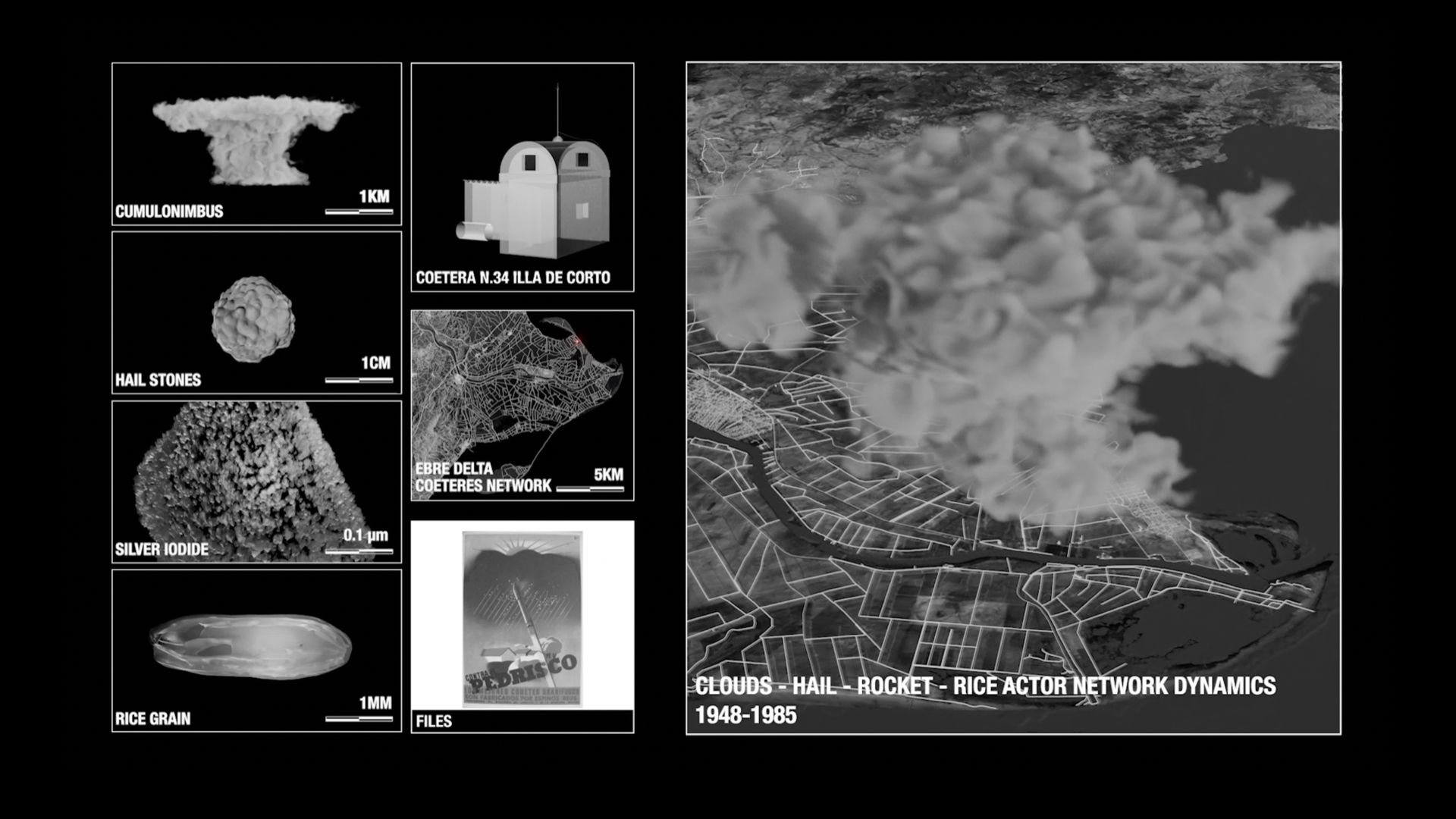
The Storm. FAST / Eva Franch i Gilabert + José Luis de Vicente. 2025. Two-channel video installation, 19 min. Film still. © FAST.
ECV What's really interesting is to understand the complete lack of governing frameworks around these forms of knowledge and practice. If there is a common thread between the coeteres in the Ebre Delta and the Moonshot Goal 8 programme — a weather modification initiative of the Japanese government — it is the absence of a shared supranational framework governing such interventions; they take place in silos, developed either by agricultural communities or by an independent government. The implications of these operations depend largely on the scale at which they take place. Yet, while they are developed within local or national jurisdictions, their potential consequences may extend far beyond those boundaries. This reveals a fundamental limitation of our current governance models: we lack shared frameworks capable of addressing atmospheric interventions at the scale of their potential consequences.
One example that really got me thinking is a research article by Marco Ferrari and Elise Hunchuck, with Jingru (Cyan) Cheng. Titled Prologue to the Sky RIver, addresses the Chinese weather modification programme on the Tibetan Plateau and how its potential consequences could extend far beyond the region, affecting weather patterns across northern India. There's very little transparency or international coordination around these programmes. Information isn't always shared with the World Meteorological Organization, and there's no clear international framework for dealing with their potential consequences beyond national borders. And you can imagine the kind of conflicts this might create, particularly when it comes to water resources. What should we think about this? So rather than approaching these questions from a purely technocratic perspective, we became interested in exploring other possible models of atmospheric governance, perhaps more collective and bottom-up..
KOOZ As Jose Luis suggested, prior to the technocratic management of the atmosphere, there were more holistic or even spiritual ways of engaging with weather. Do those ways of understanding the weather as a common play into the programme? What does it mean to engage with these in a non-extractive manner?
JLDV I’d have to start with the fact that most narratives about geoengineering tend to produce a technical solution to a ‘wicked problem’ — namely, climate change and everything it entails — by presenting it purely from the approach of atmospheric engineering. Ittf's a classical technocratic quick fix to a problem that requires changing things on many levels. These are only technical and relatively quick ‘solutions’ for problems that are embedded politically, culturally, socially, in terms of class and beyond. One of the things we want to build or create is a certain historical continuity in which to place traditional narratives and histories of rainmaking and manipulating the atmosphere, which have existed in every culture for a very long time. These cultural manifestations have produced practices that arise from a common necessity, which is the production of agency.
When we were making The Storm — the project on the coeteres of the Ebre delta — one of the major conversations was around the motivations behind such practices: where it was to do with agricultural efficiency or, in that negotiation between the actor and the storm, as a way of gaining agency between entities that exist in two different ontological levels. In shaping that narrative, we feel it might be worth starting from an approach towards understanding geoengineering paradigms and Earth systems interventions from a less technocratic and productivity-oriented basis: less, in other words, as a market centric-proposition. This is where the principle of the commons becomes important. If the weather is a one of the central commons that we propose, it is because we understand that we are living in an age of climate-alteration services and strategies; of startups and carbon offsetting schemes that are based on modifying the biosphere in one way or another. I'm sure you would see why we feel that we need a different ethos around this reality.
EFG There is one aspect that you just started to point at between the technocratic to the more mystical aspects, around effectiveness: does it work or it not? The basic concern with your rain dance or ritual is not only whether it will work or not; it is in the fact that you are dealing with something that is much bigger than yourself. You know that you cannot control the rain. Whereas with scientific approaches, we often have the illusion that we can control things. One of the incredible facts about the atmosphere is that we cannot make a one-to-one scale model to understand exactly how it works.
Weather modification science still has a lot of unknowns, and yet it does not quite share the same realm as vernacular practices in terms of mysticism or collective ceremonial aspects. The processions, the bells, the prayers, the fires, the sacrifices, the sound, the smoke: a lot of these rituals have in fact existed across very different cultures. In the case of the the coeteres, it was fascinating to learn how rockets are used to shoot particles of silver iodide into the bottom of the cumulonimbus clouds, which in turn will accelerate — depending on the geometry of the cloud — the production of ice crystals at lower altitudes , causing the storm to start sooner usually becoming rain or very small hail in comparison to high altitude formed hailstones. The principle is not unlike the act of dancing in the dust for days, causing a dust cloud to travel up into the atmosphere, with the hope that this would ultimately affect the clouds and accelerate precipitation — ultimately creating rain. There was knowledge and a definite technology, if you like, held within some of these practices and rituals. Yet both, rituals and cloud seeding, have not been scientifically validated.
For me, the most important and significant shift is the understanding that we exist in relation to forces larger than ourselves, and that we must collectively negotiate that relation. As Eduardo described about Japan and China, this mutuality happens in the same way at smaller scales across the land. Those contestations are geopolitical and bioregional, but they depend on different interests and even different communities. Within the context in which we are working, we are very interested in the questions of planetarity. What are the various scales at which weather modification and the idea of a weather commons could exist, from the planetary to the hyperlocal? These are some questions that rituals and specific vernacular cultures can speak to; they often reveal a very different scale and cosmology. We are at a global moment in which new rituals must be invented, and this is an important aspect of the design of contemporary life. The day of the rain, the dance for the weather: these are forms of ritualizing our collective awareness in relation to larger planetary concerns.
"We are at a global moment in which new rituals must be invented."
Again, another interesting aspect of these processes is their spatiality. The work on the coeteres also led us to investigate other typologies, including the comunidors: historical structures associated with churches, where priests performed rituals intended to protect communities from storms and hail in the 17th and 18th century. The comunidors were built specifically for priests to negotiate and to dialogue, if not to invoke, the clouds and storms; together with the bells, they would aid in the work of modifying the weather. As JL was saying, they were not there solely because they knew that it worked; they were there because the community asked for it — because there was a need and a belief that something could be done. From those spaces of mysticism — which were often aligned with feminist and even occult practices within that region — to the silver-iodide rockets of the coeteres, we are interested in an anthropological analysis of contemporary forms and weather modification technologies. What interests me is what new architectures, institutions and rituals might emerge from the atmospheric conditions we face today.
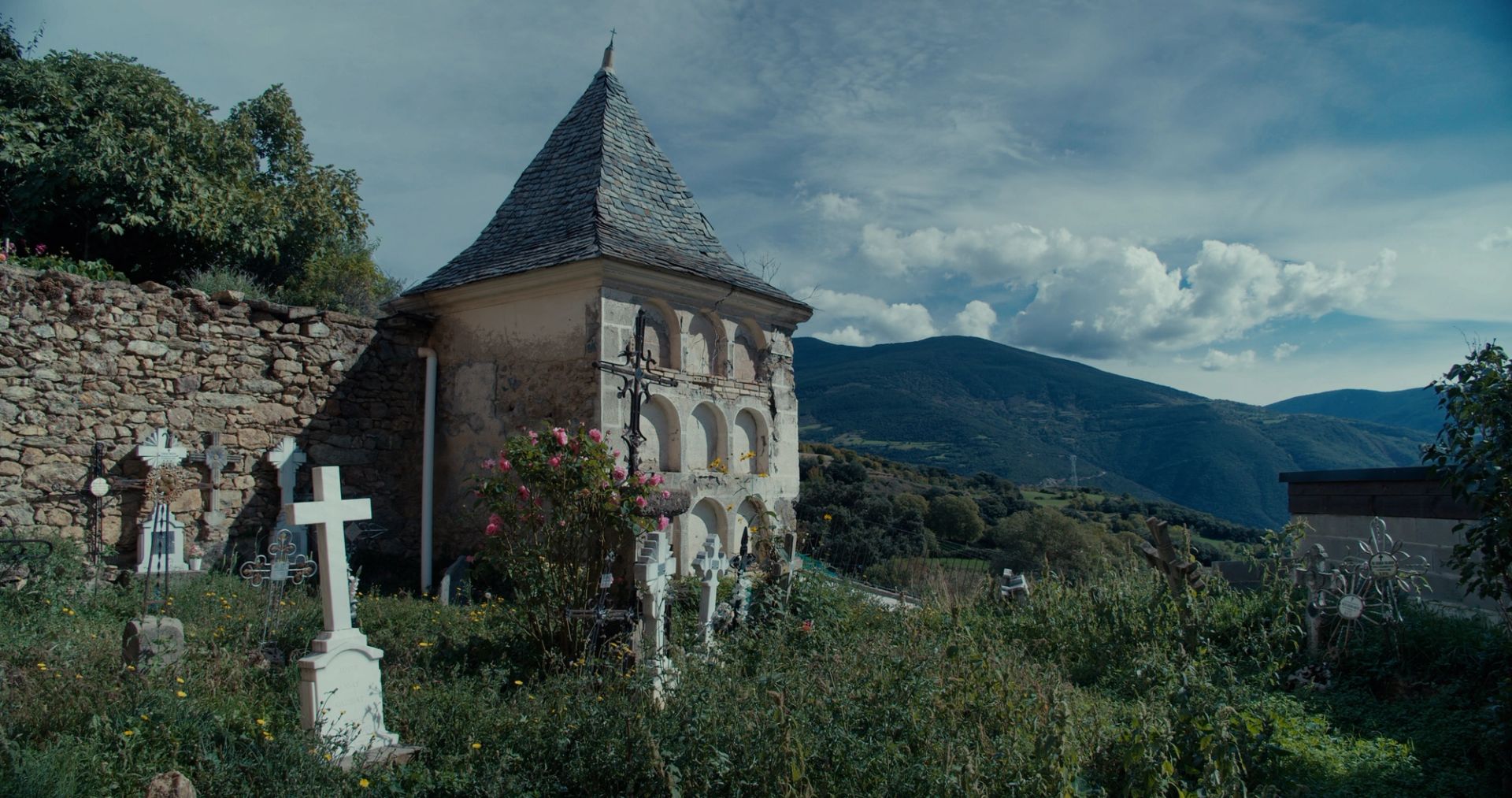
FAST’s investigation of comunidors, church-bell rituals and vernacular ways of negotiating with weather. Atmospheric Thresholds, 2025. FAST / Eva Franch i Gilabert & José Luis de Vicente. Video installation. Film still. © FAST.
KOOZ The images that you drew upon were indeed very spatial. Where and how does architecture come in discussing the commons, not only as a tool for visualization but also as a much bigger and broader tool.
ECV You touch upon two key points. Firstly, it's important to understand that any weather modification operation relies completely on our capacity to model atmospheric phenomena, upon which we can act. In a way, the creation and design of those models is the first act in the chain of events that leads to modification. That opens up two essential dimensions that are particularly relevant to architecture. The first is what we might call a scopic dimension: before we can intervene in the weather, the atmosphere needs to become an image. This makes it important to look at the whole genealogy of how we design systems and architectures devised to make the atmosphere intelligible; systems that produce not only images but amalgamations of images that are used to sense and make sense of how atmosphere and weather works. By images I mean technical abstractions, from isobar maps to digital twins. There is no accurate operation without understanding how weather behaves and being able to predict its future behaviour. There's also a spatial or infrastructural dimension. I think it's important to understand weather modification as a spatial practice that goes far beyond the infrastructures used to directly intervene in the atmosphere, like the coeteres distributed across the Ebre Delta. There's also this vast, distributed infrastructure that allows us to observe, model and simulate atmospheric phenomena in the first place, and to produce the very images we were just talking about.
Most weather forecasting today still relies on numerical prediction models — although AI is getting in the game now — whose origins go back to the work of Lewis Fry Richardson in the early twentieth century. The idea is relatively simple: if you understand the atmosphere as a fluid governed by the laws of fluid dynamics and thermodynamics, then, with enough data and computing power, you can predict how that fluid might behave. That was the whole logic. In his 1922 book, Richardson proposed dividing the atmosphere into a grid, calculating how conditions would evolve in each part, and then bringing those calculations together to produce a picture of how the atmosphere as a whole would behave.Of course, when he tried to do this manually, it took him more than six weeks to produce a forecast for just six hours in the future. The computational capacity simply did not exist at the time. But what's fascinating is that he also imagined the architecture that would be needed to perform these calculations in real time; an enormous spherical hall, with thousands of human computers performing calculations for different parts of the planet. In a way, that architecture was eventually realised, but not quite as he imagined it: not as a single monumental building, but as a vast distributed infrastructure that allows us to sense, model, simulate and potentially intervene in the atmosphere.
And that's why I think the idea of the atmosphere as a commons also needs to extend to the infrastructures through which we observe and understand it. These infrastructures are not simply mechanisms for describing the weather; they're also interfaces through which we can anticipate, mediate and potentially modify it. So if we're asking how the atmosphere should be governed, we also need to ask who has access to these infrastructures, who controls them, and how they might be governed collectively.
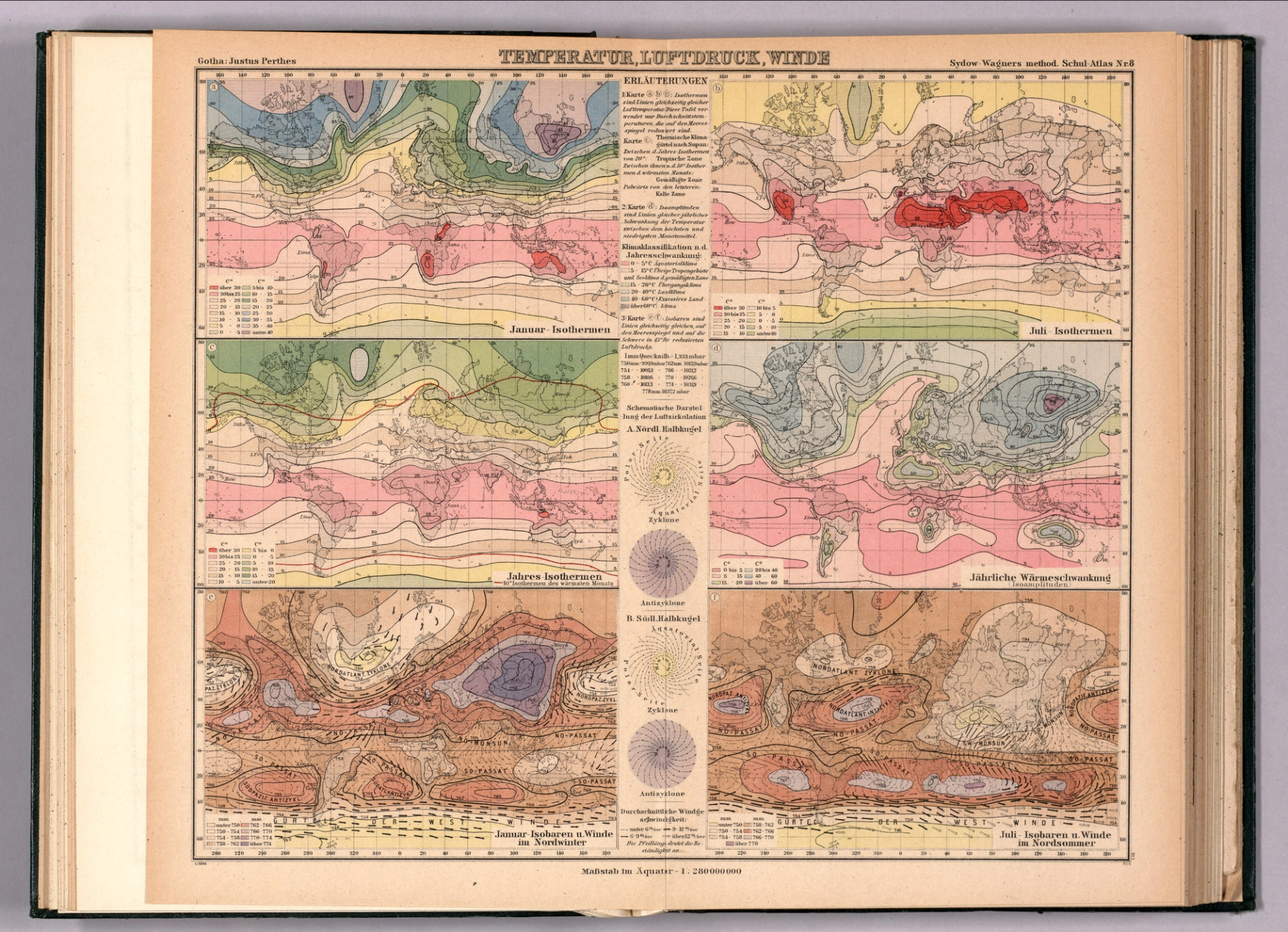
“Temperatur, Luftdruck, Winde”, plate 8 of Sydow–Wagners methodischer Schul-Atlas, published by Justus Perthes, Gotha. Six world maps assemble temperature, atmospheric pressure and winds into a comparative visual field.
EFG Architecture has a long tradition of producing speculative scenarios, from dystopian visions to hopeful projections of possible futures. But speculation is not simply the production of images of what might come. It is a method through which we can rehearse new forms of collective life, negotiate competing interests and construct the conditions through which possible futures might become real.
This is how I understand the ambition of Weather Commons. We are not simply gathering knowledge about atmospheric sciences, technologies or histories. We are asking how architecture, as a form of research and a projective practice, might contribute to the creation of new civic institutions.
At UMPRUM, through our Weather Architectures design studio, we are investigating the physical, technological and institutional infrastructures through which societies have historically engaged with the atmosphere. From vernacular architectures of weather modification to planetary systems of sensing and computation, we are interested in architecture not merely as the container of these technologies, but as a methodology through which they might be transformed into civic space. We are looking for new modes of civics, beyond the traditional typologies of the library, city hall or public square, in which the atmosphere itself becomes a territory of architectural and political imagination.
KOOZ Ola, you mentioned your engagement and collaboration on this project through the idea of the digital twin, as one possible way of tackling questions around the civics and governance at the heart of weather commons. Could you unpack that further, as a specific form of strategic image making?
AC Of course. So there's a gap in governance, and the digital twins are supposed to bring this gap into view, so that society can interact with predictions for the future. In this way, people can participate in this decision making process. But as Eduardo mentioned, the process by which those digital twins are actually created is still vague. This technology is developing faster than the pace of scientific attribution — especially in the advent of AI. We definitely need a shift in transparency, to understand better how data monitoring works and, in terms of decision making, what the concept of observation means in practice. I think we should explore independent shared observation networks, as well as recognising local knowledge as legitimate evidence. Through the weather commons, we aim to bring together interdisciplinary practices that also recognise art, architecture and design as a means to bring less visible and research-based practices forward as evidence. One aim is to articulate the experience of local communities that are often excluded from the construction and modeling of digital twins. Right now, a major issue involves the fact that data is mostly held by the states or the corporations that own it; citizens experience the consequences of the decisions they make, with little agency. In this sense, I'm not 100% sure the digital twins are the perfect or even best-fit solution. I agree that we need more vigilance and transparency in terms of how these technologies are created, and how they will work in the future.
"We definitely need a shift in transparency, to understand better how data monitoring works [...] data is mostly held by the states or the corporations that own it."
KOOZ Going back to civic infrastructures, historically we think of these as built or material entities — yet a library, for example, is not only a container of books, but also a space to gather and share knowledge. What does it mean to create a civic infrastructure around something as ethereal as the weather — and moreover, weather as commons?
EFG I think the question is, how does one design with something that is constantly shifting and moving? This is true of so many activities and agencies that actually occupy buildings, right? Personally, I’m even more interested in the paradigm shift: if the mid 20th century calls for an architecture of the well-tempered environment, and the idea of controlled systems, we’re now moving into the production of spaces that are in sync or connected with the atmospheres that they occupy — which requires us to understand the responsibilities that come with such acts. We are facing a constant alarms resounding across cities: in Barcelona, over the last few days we experienced series of alarms and digital alerts communicate — through our phones — that we should not go into the public space, that we should not inhabit the city as we used to, and even that we should modify our homes in particular ways. From a small domestic space to the design of cities to the design of territories, exactly who has the capacity to send such an alarm in a given political context? Prompted by the tragedy that happened following the DANA (Depresión Aislada en Niveles Altos, or cold-drop, in meteorological terms) that caused devastation in Valencia, this is an issue currently facing the Spanish courts.
One of the big questions is how can we create forms of governance, knowledge production, knowledge dissemination and communication — including alerts — that are not exclusively reliant on technologies that are instrumentalized and regulated by existing forms of corporate or governmental control. As we know, such power structures derive from histories that are problematic though sadly not obsolete, which are not aligned with the planetary necessities and realities of these phenomena. So when we talk about bioregions, atmospheric patterns or territories, it's much more interesting to start thinking without those delineations: one of the incredible things about the atmosphere and the weather is that because it's not static, it cannot be owned. You cannot make a map; it's not land, or anything that allows us to operate within the same terminologies. The next question is how to produce a more dynamic framework, and this task extends beyond architecture into many other fields and epistemological models at different scales, including design approaches and artistic practices. Unfortunately, architecture is usually contained at the scale of the city or of the territory: who commissions architects to think at a planetary scale, or at an atmospheric paradigm? We’re also trying to lay the ground for those architectures — intellectual, epistemic, and even material — to emerge.
"One of the incredible things about the atmosphere and the weather is that because it's not static, it cannot be owned."
JLDV Architecture has historically been very good, I think, at producing the basic infrastructure for symbolic and ritual acts. The church is the building, but also the congregation; the parliament is the building, but also the political body. These equivalences and materialisations are at the heart of what architecture does for the public body. As we speak, I'm sitting inside Spain's National Supercomputation Center (BSC) — a huge office sitting on top of a massive computer, which itself is one of the main infrastructures used for Destination Earth, Europe's digital twin. This project is trying to build the most elaborate reproduction of Earth’s systems ever developed. You can come visit as a tourist and get a tour and you can take a selfie in front of some servers — but this is definitely not a symbolic architecture. This is an anonymous office building on the outskirts of the city.
Cities still initiate large scale projects as civic symbols; Barcelona has done it recently, and incredibly. Yet we don't have models as symbolic entities for the atmosphere or the ocean. In a way, I think we need architecture to take on this challenge and jump from the urban to the planetary scale.
I remember conversations from a decade ago between Rem Koolhaas and Hans Ulrich Obrist, on the data center as a public library and the possibility of thinking about these institutions as new architectural typologies. We are largely failing at that; I can hardly think of any successful civic architectures that represent these orders of the planetary scale. In my own practice, we're thinking about our generation as one that is starting to understand the responsibility of thinking about Earth systems design — operating on the scales of the hydrosphere, the atmosphere, the biosphere as conditions of design, and producing the relevant icons, symbols and rituals. Lately, we have been working on sediments and whale songs; future projects address ocean-borne carbon and its circulation. Which symbolic architectures and social rituals frame these new spaces?
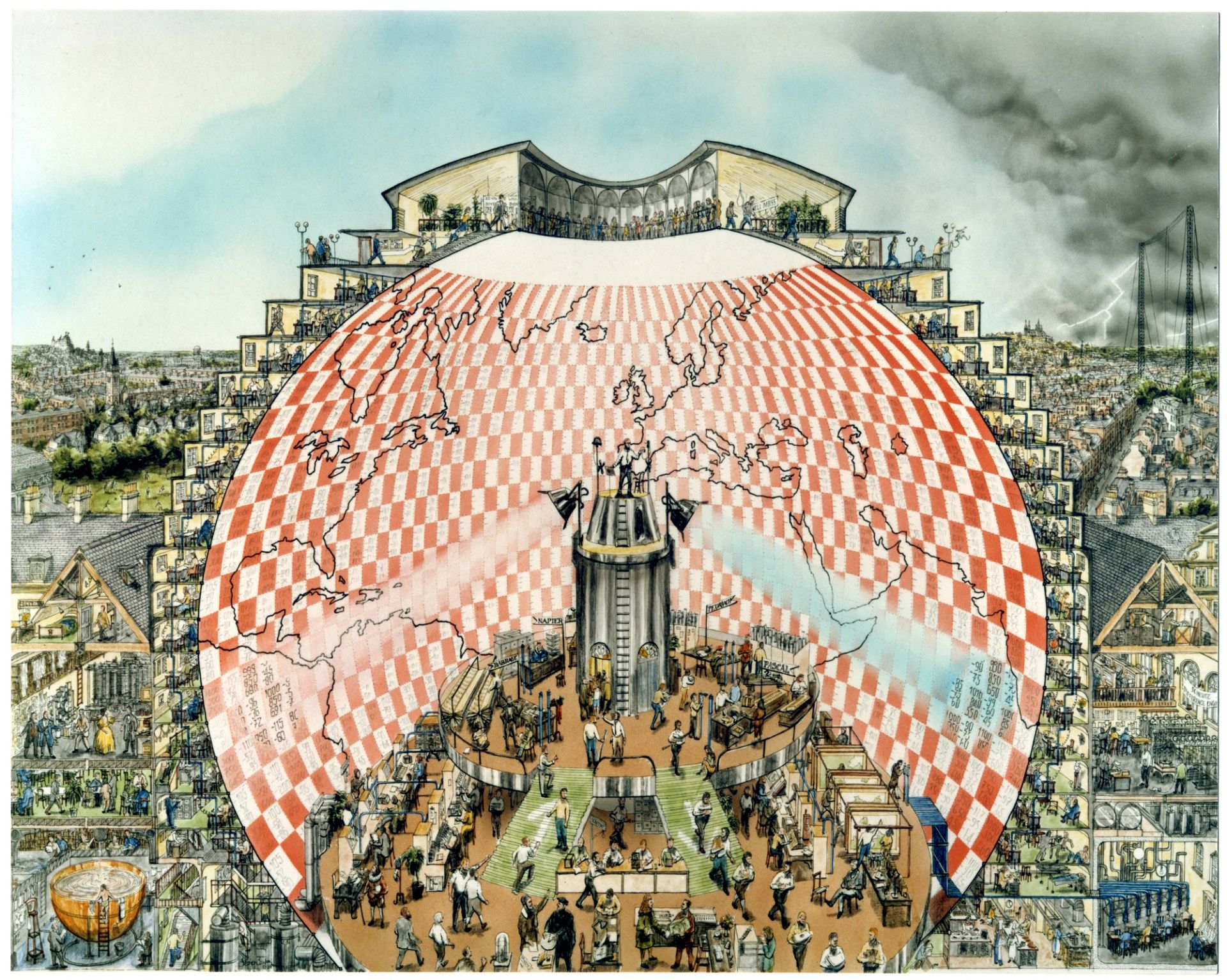
Forecasting Factory. The illustration gives architectural form to Lewis Fry Richardson’s 1922 vision of a coordinated workforce calculating the weather across a gridded globe. © Stephen Conlin, 1986.
KOOZ I'm glad you brought up the data center. As Eva mentioned, we now receive environmental and governmental announcements on our devices, but where does that leave us if we are not on our phones or without a network? How can one take into account the different points or levels of access that communities might have to these infrastructures?
EFG Also: who has the capacity to provide data for these systems? While we may be familiar with the infrastructures of data that have advanced over the last few decades, vernacular knowledge is largely untapped and vast. When you are connected to the land, you can perceive changes and variations of the atmosphere in relationship with plants, animals or levels of humidity; these patterns manifest in a multitude of ways. We have a lot of programmes for citizen science, but considering the reality of creating global civics in relationship with weather and atmospheric conditions, those questions are on the table. How might we seek the contribution of someone who chooses not to use any technological device, but holds knowledge about particular conditions in a specific context? What would that network interface look like? Those questions about the architectures, the networks, and the modes by which one can engage must not be top-down but bottom up. Decision making processes must not rely on a society that is being served, and moreover, one that is constantly instrumentalised in the interest of private lobbyists.
ECV … Nor for economic gain, which is also connected to the broader logic of neoliberal finance. When you lack a clear governance framework, the first thing that takes over is the logic of insurance and financial speculation. You can end up in strange situations where weather interventions, combined with certain financial operations, could be carried out not to prevent or mitigate the consequences of extreme weather events, but rather to generate economic gains. This is not so different to what happens when a building, or indeed a forest, is burned down in order to claim on an insurance policy, or even in the hope of having the land rezoned. This logic is being reproduced in other scales and contexts, contributing to the financialization of nature itself. The lack of governance frameworks and regulation produces these weird pitfalls.
KOOZ The four of you represent an alliance of worlds. The alliance between TBA 21 and FAST — that is to say, between an institution and a collaborative practice — comes together through an alignment in approaches towards the ecology, and particularly of the ocean. What other alliances are necessary for this project to substantially bring these conversations to the forefront — and even spearhead change?
ECV Several of the institutions that we built in the second half of the last century were supposed to address and regulate some of these issues that go beyond the international model. Over the last years, we have witnessed proof that they're falling apart. We saw it first with COVID and the World Health Organization; while providing guidance, they had very little power to enforce it, and decision-making ultimately remained in the hands of nation-states. We've seen something similar with the United Nations and its inability to stop the genocide taking place in Gaza. Even when these international institutions denounce what is happening, they have very limited capacity to act. . So it is with the World Meteorological Organisation. Not only does it lack the authority to regulate weather operations carried out by different countries, but there's no international legal framework whatsoever that it can rely on. The only supranational treaty signed around this issue was after the Vietnam War, when it was disclosed that the United States had been performing weather modification activities in Vietnam for military purposes. They had been using cloud seeding in an attempt to extend the monsoon season and disrupt Viet Cong supply routes. This eventually led to the ENMOD Convention, adopted in 1976, which prohibits military or hostile uses of environmental modification techniques, but leaves other potential uses largely unaddressed.
In proposing the idea of the weather commons, we do not do so in a prescriptive manner. None of us have a clear picture of what a weather commons is or how it might work. And that's precisely why we're launching this programme: to bring together a wide range of voices who have been addressing these questions for a long time, from very different perspectives. We want to open up the idea of weather commons as a question, to see what comes out of it. Take Japan's Moonshot Goal 8 programme, for example. Alongside developing weather modification technologies, they're already asking what kinds of social decision-making platforms would be needed to decide whether and how to use them, considering the ethical, legal and social implications of these interventions. Japan faces several typhoons every year, so dealing with the consequences of extreme weather is a very real concern. But when you start developing technologies to intervene in these phenomena, there can also be harmful consequences beyond the areas you're trying to protect. So who gets to make those decisions? In the case of Moonshot, these questions are already being discussed. But when decisions scale up to and beyond the national level, there is no platform to begin having these discussions. Part of the idea is to build alliances. That’s why we aim to bring together so many people and institutions through Weather Commons, as an alliance-building initiative to open up these much-needed conversations in different contexts.
KOOZ Do you have any closing remarks to leave us with, before we wrap up?
EFG I think Eduardo just articulated it very clearly. Perhaps the most important thing is that Weather Commons is not a proposition with a predetermined form or outcome. It is an invitation to collectively imagine what the civic architectures of the atmosphere might be. We have encountered an extraordinary constellation of people and practices already working across these questions, from law and science to technology, philosophy, art and architecture. What we want to construct is not simply a conversation, but a growing network capable of producing knowledge, alliances and new forms of collective agency.
The atmosphere belongs to no single discipline, institution or nation. Neither should the imagination of its futures. This is an open invitation to participate in constructing those futures together.
"The atmosphere belongs to no single discipline, institution or nation. Neither should the imagination of its futures."
JLDV I would emphasise that we really need institutional structures like TBA 21 Academy, willing to support non-disciplinary based, non-structured research programmes that give centre stage to the questions at the meeting point of ecology, architecture, policy and speculative thinking. Such programmes are a necessary experiment, as convergence will allow us to discover how people can think together about these entangled futures.
KOOZ Wonderful, thank you so much to the four of you.
ABOUT
Weather Commons is an initiative of TBA21–Academy, co-curated by Eva Franch (architect and curator, founder of FAST), José Luis de Vicente (curator and researcher in cultural practices, founder of FAST), Eduardo Castillo-Vinuesa (architect and Director of TBA21–Academy) and Aleksandra Czerniak (PhD Candidate in Digital Cultures, and Digital Program Manager TBA21–Academy). Weather Commons is part of UNI, TBA21–Academy’s public studies program. Transversal to all TBA21–Academy strands, it connects research lines and program frameworks through online curricula, workshops, and collective study formats that open the Academy's work to wider communities. Rather than focusing on a single theme, UNI follows the evolving questions of the programming, turning them into spaces for shared learning, discussion, and critical reflection across geographies and disciplines. UNI’s curriculum provides students, researchers, and the public with wide-ranging and accessible explorations through regular live sessions, reading groups, small-scale workshops or activations, collective visual notebooks, an online archive of gathered knowledge and materials.
TBA21–Academy is TBA21’s research and action arm, fostering deeper relationships with the Earth’s hydrosphere and its extended ecologies through the lens of art to activate new forms of care and collective action. Operating as an incubator for collaborative inquiry, research-based artistic production, and environmental advocacy, the Academy works through exhibitions, commissions, fieldwork, residencies, pedagogical programs, and assemblies, and generates new forms of knowledge emerging from exchanges between art, science, policy, and civic engagement.
BIOS
Eduardo Castillo-Vinuesa is an anti-disciplinary architect and curator whose work explores the intersections of climate, technology, and geopolitics. Through a transdisciplinary practice that spans architecture, institutional design, filmmaking, and alternative curatorial strategies, he investigates how spatial and visual cultures shape contemporary forms of governance and ecological transformation. He is an Associate Professor at the School of Architecture of the Polytechnic University of Madrid (ETSAM-UPM), was editorial director of Arquitectura COAM magazine (2017–2021), curated the Spanish Pavilion at the Venice Architecture Biennale (2023), and served as artistic director of Medialab Matadero, Madrid City Council's experimental platform for collaborative research and creation (2021–2024). He currently serves as Director of TBA21–Academy, TBA21's unorthodox research and action branch.
Aleksandra Czerniak is a cultural worker and researcher focusing on simulations as well as technological and climate justice. WIth a background in both performance and art history, she is currently a Doctoral Candidate at Weibel Institute for Digital Cultures researching Digital Twins. She is based in Vienna and works as a Digital Program Manager at TBA21–Academy.She publishes on art and technology in Format.Eva Franch i Gilabert is an architect, curator, educator, and researcher whose practice explores the political, cultural, and social dimensions of architecture, advancing experimental practices, alternative histories and futures, and new forms of civic and collective agency. She is the co-founder of FAST, a transdisciplinary platform at the intersection of architecture, culture, technology, art, and design. Franch is currently Professor of Architecture and Head of the Future Architectures Platform at UMPRUM in Prague, Adjunct Professor at Columbia GSAPP in New York, and Distinguished Professor at the Shanghai Academy of Fine Arts. Previously, she directed the Architectural Association in London and Storefront for Art and Architecture in New York. Through civic architectures, exhibitions, research, and education, her work challenges established conventions and expands the possibilities of collective imagination.
Jose Luis de Vicente is a curator, cultural researcher, and artistic director based in Barcelona. He is, along with Eva Franch i Gilabert, the cofounder and principal of FAST a transdisciplinary curatorial platform, and the cofounder of Archipelago of Possible Futures together with Francesca Bria. Archipelago of Possible Futures is a summit that brings together leading thinkers, artists, technologists, and institutions to explore how Europe can reimagine its infrastructures to build a more sustainable, democratic, and inspiring future.