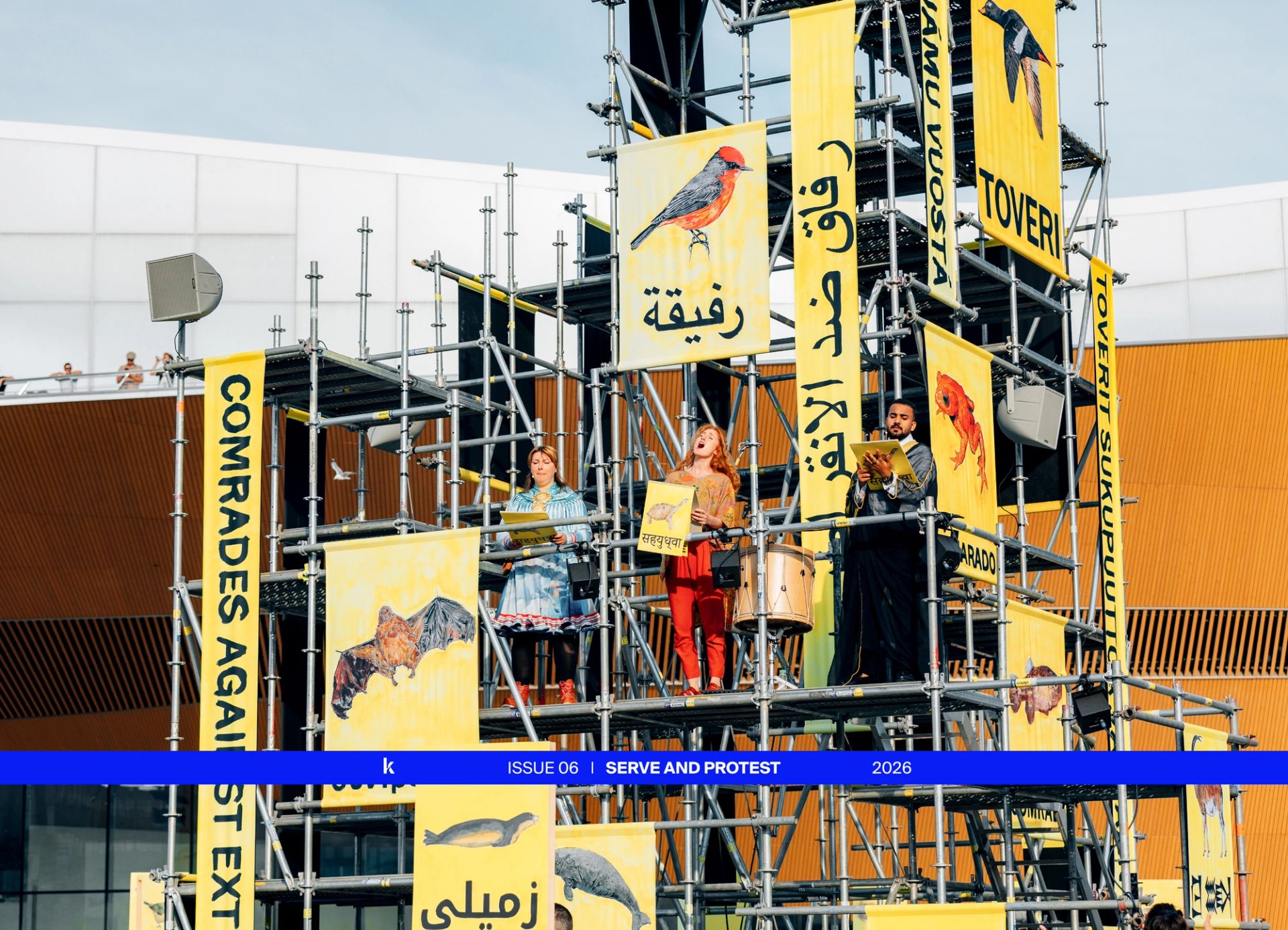
Shumi Bose/KOOZ Thank you so much for joining me to talk about labour issues, between architectural practice and the academy. To start with an observation: a millennium-reflecting gloss pervaded architectural discourse through the 1990s — money flowed like information, technology leapt forward, markets were flung open and ‘things could only get better’. In terms of unions and labour organisations, nobody paid much mind. You both represent contemporary currents in the acute awareness of today’s labour issues in architecture. Please go ahead and introduce yourselves
Reishin Kunishima Watabe Hello, I’m Reishin Kunishima Watabe. For two years, I was the campaigns coordinator for the Section of Architectural Workers (SAW), which is the architects’ branch within the construction sector branch of Unite the Union — one of the largest unions in the United Kingdom. I am also doing a PhD on the architectural profession in the UK, particularly in the 1990s so it’s funny that you mentioned the optimism of that era. I also teach at Cardiff University and the AA Visiting School workshop in Japan; hopefully it’s all relevant and urgent to our conversation.
Sben Korsh I’m Sben Korsh. I am a PhD candidate at the University of Michigan, at the Taubman College of Architecture and Urban Planning. I’ve also just started teaching studio and history at the University of Detroit Mercy’s School of Architecture and Community Development. I have helped to establish two branches of The Architecture Lobby and since 2014, seeding chapters in the Bay Area and in the Twin Cities of Minneapolis-St. Paul — I was also elected Research Coordinator, and co-edited our book on the “economy of architecture in theory and practice.” At different times, I’ll claim the Michigan chapter, too.
KOOZ Whether emerging or established, many architects are similarly uninformed on how to address labour issues and align themselves with related institutions — can you talk about how you fell into this field?
Sben Korsh A whole cohort of comrades and I have had an awakening of sorts through our work in The Architecture Lobby. Then I got to Michigan and became involved in my union of graduate workers, and we went on strike following a year-long campaign. The Lobby prepared me to think about myself as a labourer and part of an organisation, but it is here — at the site of my immediate workplace — where I’ve had the best education in terms of labour organisation and political struggle.
I will say that I do feel awkward divulging some of this and do expect to face difficulties because of how it might be perceived in the future on the job market. Here we tie a lot of our livelihood, like healthcare and retirement, to employment — and that really produces a great disciplining mechanism. As other Lobby folks often point out, it's academic privilege that even allows us to speak openly about this.
KOOZ Thanks for your candour; this is a reality, and relies on your comfort. What led you to The Architecture Lobby?
SK Peggy Deamer, Quilian Riano, Manuel Shvartzberg Carrió and a few others started this group — The Architecture Lobby — and they had published a sharp little manifesto. The idea of the manifesto and the call to participate in a systemic change was very juicy at that time. It felt like architecture was finally responding to the issues raised by Occupy Wall Street. What’s ironic, all these years later, is to find my life so dependent on professionalised architecture schools — with their task to reproduce the profession — and it feels like nothing much has changed. If anything, it’s gotten worse.
So there is a contradiction in spending ten years in discursive consciousness around labour, raising questions about how to make education less of an extractive system; to have more of a holistic view of yourself as a human being that needs to work for a living. And now, as other Lobby folks and I have grown up, we now have to run the very systems we had critiqued. One example is on studio review panels. I thought that we had already established how to do a non-hierarchical studio review, but we are repeatedly asked to sit in the seat of the critic, tasked with influencing the student’s subjectivities, yet not wanting to discipline them. I struggle with a lot of those stuck behaviours.
KOOZ Reishin, do you ever feel that you’re trying to square a circle, in talking about labour practices while teaching studio in a professionalised architecture school?
RKW Well, holding contradictions is important and messy work. I feel similarly about hierarchies: as much as we talk about decentralisation and non-hierarchical spaces — realistically, we can’t remove hierarchy, in one swoop. Besides, hierarchy to some degree can be productive. A union requires structure to be able to organise. Democracy needs to be practised. So I think that contradictions are okay: we’re supposed to reckon with them.
Academia is a weird space. Firstly, I would point to the economic burden on both students and universities at the moment, which really squeezes accessibility. Our time period is so chaotic and uncertain, and the stakes are so high. That demands a certain level of critical thinking and practice — and the training of an architect is unique. We’re not necessarily exceptional, but the training is specific: it’s material, spatial and speculative — and it’s a really powerful disciplinary tool. Pushing students to think critically about that and engage in production is my teaching position.
Students who come into education take on debt and want a job at the end, which suggests a particular aspiration. Yet if we’re committed to being critical about labour equity, perhaps that aspiration needs to be challenged.
That challenge is increasingly difficult to host within the academy, and that weighs on me. I often refer to Brian Arao and Kristi Clemens’ paper ‘From Safe Spaces to Brave Spaces’. It is important not to insulate students from all conditions — which sounds like such a boomer statement, but I do think about where and how we can practise bravery.
KOOZ What you describe translates to a lot of uncertainty. For instance, the UK has a proud history of unionisation, particularly for teachers. Yet in architecture, these conversations are so latent. Do you think there are structural reasons why this is?
SK Actually, I was pushing at the intersection between the two. Massive transformations are being pushed onto the educational system from the institutions of practice. I have big regrets, alongside with other comrades, of us not pushing our way into the spaces of professional accreditation: the whole alphabet-soup of power-wielding structures and their associated institutions.
"Massive transformations are being pushed onto the educational system from the institutions of practice."
In terms of unions and exposure to labour struggles, I was part of some early discussions within The Architecture Lobby. We always debated whether we should unionise or form cooperatives. As “activists,” we didn’t really consider infiltrating the existing structures of power. It’s almost funny to look back at the intensity of those conflicts, between unions and co-ops: we all thought that the stakes were so high, yet we were leaving a lot of power on the table by not trying to wield our other forms of power to shape the field's institutions.
Looking back, it was a very intellectualised conversation. Yet these union structures are not new and already exist — have existed for a long time — even as we have little awareness of them within architecture. Right now we’re seeing a new potential wave of unionisation among architecture school professors: a new partnership between the American Federation of Teachers and the American Association of University Professors means that AAUP chapters can start to seed into unions. Will the professors take up the charge?
This is what I would hope could still happen within our architectural labour spaces: that we do not fully abscond from the struggle of taking over the National Architectural Accrediting Board, the AIA or NCARB. We — across several lefty groups within US architecture — are still not moving into those spaces, which means that they take our discussions and make water-down “progressive” versions of the reforms that we could be having at scale. Instead, it seems our vision now tend towards “de-professionalisation” — and while broadly I agree, the way that translates at the moment through these institutions seems simply neoliberal — devoid of the social and cultural value we do bring. I feel like a social conservative when I say that, but I don’t mean it to be. I think if we want to change the architecture academy, we both need to unionise, but also change these regulating institutions.
KOOZ Another contradiction to hold. Let’s start at the other end: the classroom.
RKWI’ll start with the prompt of how to engage a new cohort. My immediate thought, albeit superficial: it helps to have some propaganda. At SAW, we recently produced a new set of pamphlets, so now I just have stacks in my bags to share; there is an eye-candy ‘stickiness’ that proves helpful.
But in working with students over time, there are ways to ensure that the tools we offer are useful beyond checking off the requirements of a degree. Often, students — in broad generalisation — are focused on what targets they need to hit to meet a grading rubric. What gets results? Sometimes it’s useful to prompt thinking about things like about getting a better paycheck — approaching a conversation about labour through other means can be productive, from an organising perspective.
"Working with students over time, there are ways to ensure that the tools we offer are useful beyond checking off the requirements of a degree."
Another concrete example of the educational link comes from a professional practice lecture I gave to graduates at a well-known university in London on behalf of SAW, when most students are or have already been in practice. A staff member later shared that for some people in the audience, our lecture was the first prompt they had to actually look at their contracts. Sometimes asking the question and holding that space is important. It’s not enough to assume that the kids will just figure it out; there can be constructive ways to use the authority of education.
What we’re talking about is the training pipeline to learn about unionising or organising. One of the differences I’ve found between SAW and other collectives or labour groups is SAW’s enthusiasm for the experience of trying to organise: the effort, the struggle, to move beyond discourse alone, and towards tangible labour actions. Perhaps this is because of the architect’s prerogative: we like to discuss intentions, and what would be great to do or have. But trying things, getting it wrong, learning and reflecting with other people is really the biggest advantage.
SK While there is a ton of educational work to be done, I guess I wonder how many people you need to actually form a line and build a new politics. You don’t need to convince everyone. This is essentially what Architecture Workers United (AWU) has done. AWU announced itself during the pandemic, through the SHoP architects campaign in New York. Ultimately, it was a failed campaign to unionise one of the city’s most prominent firms. SHoP’s partners employed one the most notorious union-busting law firms in the country — which only shows the real stakes of these struggles.
There’s always the desire to get the ideological critique right on, to get as many people on board as possible. But what if you don’t need absolutely everyone right now? What we might do best is to win power within a specific structure, a specific group of people — a cadre. The particular inertia of our field pushes you down by sheer exhaustion. This is also where it helps to have bounded and clear demands —a bounded community with whom you organise.
"The particular inertia of our field pushes you down by sheer exhaustion. This is also where it helps to have bounded and clear demands."
KOOZ In bringing realities forward for students, a classic union response runs ‘our labour conditions are your future working conditions’. This would seem to point to the precarities of work, and that the way we learn serves as a rehearsal.
SK What I’m hearing is that you’re modelling a form of politics for the students — that itself is the pedagogical move. When I came to the University of Michigan at Ann Arbor, it had a long-standing chapter of the Architecture Lobby, with a rich history of master’s students hosting events, reading groups, and panels on labour politics. I got there from a different position: as a PhD amongst colleagues being paid starvation wages — we all used the local food bank — and given little respect. A former chair called us leeches! Even though PhDs are core to the teaching and research of the college. So I got a bunch of us to join the union, and we waged a year-long contract campaign that convinced about 75% of the graduate instructors to go on strike at the end of the Spring term. This was predominantly master’s students, but we were able to show them that we need a living wage, and they came to understand that the way their role operates in the architecture school is a part of an extractive economy. The following year, Taubman PhDs campaigned for and won an additional year of funding for a total of 5 years, matching all other PhD programs at Michigan, and we halved the number of teaching semesters, giving us two and a half years of research fellowships. I think our doctoral packages are now among the best in the world.
That practice of modelling can shift the pedagogical and labour consciousness. Again, this is partially a self-critique about what kinds of activist organising we’ve done in the past versus what can actually move the needle. Those students are not members of the Architecture Lobby, they may not know the discourse — but they went on strike over what they believed in, and that will stay with them, hopefully, when they seed campaigns in their own workplaces.
RKW Decolonisation is one organising angle crystallising recently around institutional responses to the issue of genocide in Palestine. Certainly for activist-minded and especially racialised communities, there’s a loss of faith as to whether the institution is redeemable in the first place. Changing society necessitates working both inside and also outside of the institution at the same time, both are synchronistic. Take the struggle for freedom in South Africa: it required the people in South Africa, but also pressure from outside — especially from the West and specifically London as the colonial metropole. That parallel work of inside-and-outside is tricky, but I agree with the critique that decolonisation now has become somewhat of a floating signifier, to borrow from Stuart Hall’s description of race; labels are useful to a point, but they can be co-opted by institutions of power. The dictum of Eve Tuck and K. Wayne Yang’s famous paper ‘Decolonization is not a Metaphor’ still holds.
"Changing society necessitates working both inside and also outside of the institution at the same time, both are synchronistic."
KOOZ We’ve seen this happen with race and supposed decolonisation; care is another term that is heavily co-opted. How do you respond to the dissonance between the sorts of consciousness that your work proposes, and the optics of care?
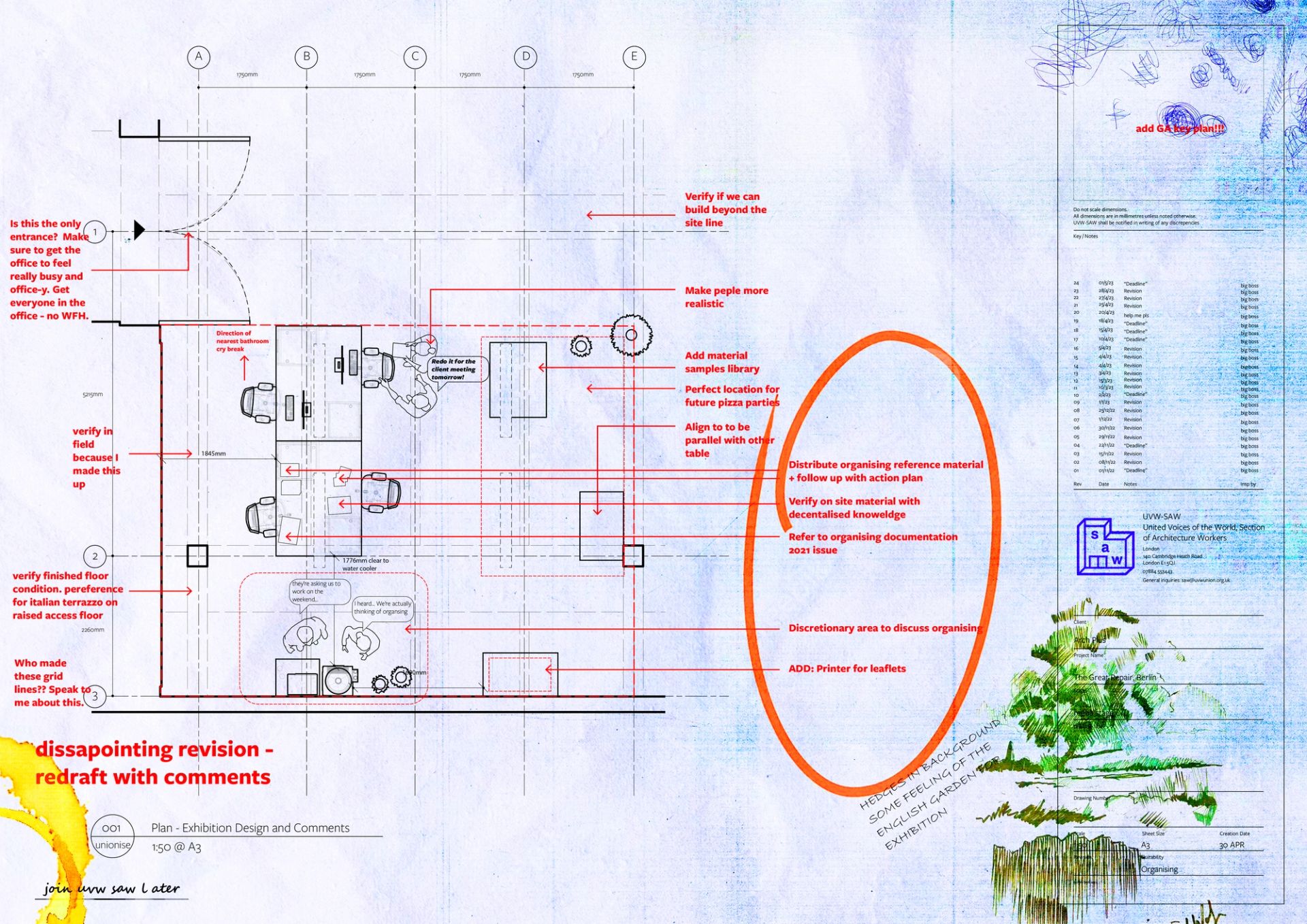
RKW The question of care is a difficult one. In general, we can agree that we should be nice and collegiate; people want to get work done and not be bullied for doing so. Care is, in other words, an agreed construction. But is the labour of organising actually considered as work? How should SAW describe the unpaid time spent on making flyers, Instagram posts, symposiums and workshops… I think that is labour and it is a labour of care.
It’s important, especially within organising spaces, to avoid reproducing those harms that we struggle against. Likewise, critique should be shared constructively, which can be tough if you’re very passionate, stressed or short on time — not easy scenarios, but healthy challenges; the only way to deal with them is to work through them. You could argue whether any systemic change could happen within the confines of an average architectural workplace, or even the university; perhaps this kind of organising can only happen in pockets outside of it.
SK When it comes to care and the dissonance within organising spaces. The Lobby has had really heated debates about whether our work is work and if it should be compensated. Often this would come out through fights over named authorship or attribution. From my engagement in union organising, I now think, on an almost spiritual level, why so many people are moved to give their life over to such struggles is out of a sense of care, not just for others, but for ourselves. This shifted how I viewed all the extra work we take on through organising. Through my architectural writing and design background, I’ve often found myself working on PR and graphics for local movements — and I’ll do it without pay until the cows come home — because ultimately I have real skin in the game, and a conviction in what we’re doing.
This perspective really lifted me from a depressive position — one without agency — to be able to join in the struggle towards winning concrete demands. There is a fair critique of overwork in the culture of organising, yet sometimes allowing oneself to give your life over to the movement — not some bullshit nonprofit mission but real work — can be an act of care. Not for others, but for yourself. Organising can be an act of self-care to psychologically bolster yourself from a dystopian world.
"Organising can be an act of self-care to psychologically bolster yourself from a dystopian world."
KOOZ Given that isolation is a pervasive symptom of institutional and larger systemic failures, is this bid for solidarity perhaps the biggest appeal to organising or unionisation?
RKW The economic labour condition in the UK — and I’m sure elsewhere — is not good. It’s terrible. There are far too many students for the number of jobs; if you are in a job, there are still numerous issues, especially if you’re a woman, a person of colour, too young or too old. In this climate, you can’t afford to assume that a benevolent employer will stumble across you, and you’ll be set for the future. Sure, it happens — there are many great, ethical practices — but for most people, that’s not the case.
Without launching into Marxist critique, would you want your agency to be handed over to paymasters only concerned with the bottom line? That’s the current business model of architectural practice; fingers crossed that the next round of redundancy will not get you. Or, do you want to try to change that? Either way, there’s a risk. The benefit of organising is that you will always have more support than you ever would alone — not only in terms of leverage, but also because your name is protected by our numbers.

KOOZ That issue of naming and attribution is hard to square when we are evaluated on individual trajectories, careers — everything rendered as an asset for competition. That makes it hard to foster a culture of collegiate, non-performative solidarity, much as there is a hunger for it.
SK As I’ve found in my own research, during the 1960s and 70s — a period of major social upheaval across the United States — we can see a push towards unionisation in our industry; in Detroit, the United Auto Workers tries to organise engineering and architectural firms in the metropolitan region. The same happens in New York, Chicago, San Francisco, Los Angeles, and elsewhere, prefiguring what’s happening now. The mere challenge of a few young architects posed such a serious threat to the AIA and the building industry at large, that they started to counter-organise. We see then the introduction of continuing education credits and HR handbooks, — they sold the young, dispirited workforce the idea of a career ladder: careerism. By the late seventies, even the federal government was pushing this careerism through the applied-focus on technical and professional education: you’re not merely a worker or labourer, but rather someone with a career: a subjectivity that will constantly progress. This is an untold story of neoliberalism in architecture.
All this to say that I think a key part to learn from those organising campaigns was the potential threat that radicalisation of professionals holds. That means taking advantage of our class positions and its privileges. The critique that architects are more privileged than construction workers is said with scorn; that those of us in the academy are bourgeois… I think, ‘Okay, and… ?’ From my reading of history, it is precisely such professional radicalisation, visibly unionising and joining in solidarity with others — that’s when we can achieve greater power. . We can’t castigate ourselves into it. We need to organise from where and how we work now..
So to your question, it can be great at times to boycott or quit these systems as individuals, but the truth is that these institutions will continue to exist. Take for instance, the recent resignation of the entire editorial board for the Journal of Architecture Education. I admire a lot of the people who did this — many are friends and comrades — but the journal has continued without so much as taking a beat. It’s still getting sent out to every professor in the nation. So unless we do the deeper work to transform these institutions at the structural level, and that to me is the more painful work of staying with the trouble, then these systems will always find ways to render our actions as performative. We need to get to a position of power so that we can’t be censored, so that we don’t have to quit. Reishin, I really want to hear more about your own research — do you see any parallels?
RKW The post-war period is so interesting, though my research focuses on the 1980s and onwards. At that point, neoliberalism ramps up and the world order changes: the opening of new markets, the fall of the Berlin Wall, Fukuyama’s so-called “end of history” and so on.
Much like the US, Britain developed anti-monopoly committees. Peggy Deamer has written about the fact that in the US, the Sherman laws prevented the AIA from creating flat fees. They argued this would be a monopolistic practice: the implication is that collectivisation would be anti-democratic and regressive. The UK had a similar thing with mandatory fee scales that were active within a post-war period of altruism, and ultimately abolished in the 1980s.
My work focuses on the early 1990s, when the British government questions whether the title of architect should warrant its protected, professional registration. This registration only exists for architects, no other building professional; a report arguing for its abolition was published in 1993, which sets the profession off in reactionary response: there’s no way that any ‘Tom, Dick, and Harry’ can make architecture. The decision was ultimately overturned within a year, which led to the Architects Act 1997.
One could argue that nothing has changed since those critiques about elitism and professional exclusivity; they very much mirror what we are saying today. At what seems to be a generational interval — 1960s, 1990s, 2020s — political shifts have altered both the regulatory position and the agency of architects. In the UK, the question rises again as to whether the government protects the title or function, but as Sben alluded earlier, does asking the question provoke people to simply remove registration, causing more friction between RIBA and the Architects Registration Board. We can’t solve it all at once, but I think the question is less about separating the title and professional education; the cultural layers and disciplinary tools overlap and the tools that we’re building are still very meaningful.
KOOZ Thinking of that nineties moment — also around the widespread adoption of computation — architecture’s relationship with the adjacent professions and workers altered significantly. The modes of production changed, while perhaps the hierarchies have not.
RKW I would challenge the assumption that modes of production have changed significantly. Despite digital tools, are we really any more productive now than we were in the 1990s? The fundamentals are still the same: the tools are there to draft, but there are architects and even whole offices where, even if the procedure uses Nano Banana or any other AI tool, workers will still pull all-nighters.
"There are architects and even whole offices where, even if the procedure uses Nano Banana or any other AI tool, workers will still pull all-nighters."
KOOZ I am thinking about the uncertain image that my students have: on one hand, an architect can be a socially engaged visionary; on the other, the role is precarious, badly paid in relation to training and prone to abuse because we don’t have unions; on top, we’re embroiled in one of the most polluting industries in the world. Perhaps in response, the boundaries of the architect and of architectural agency are shifting today.
RKW To quote Stuart Hall again, it’s about Marxism without guarantees; none of it is a given. Without flattening things too much, cycles of uncertainty and crisis do happen. I’ve been writing about the design practices of a group of feminist practitioners in the 1990s — Sarah Wigglesworth, now an esteemed retired architect, among them. Nobody predicted that feminism would then become an accepted liberal term or framework, unified in a certain way. Actually, 1990s feminism was not unified; it was a complicated, messy, passionate, sometimes kind of tense conversation within feminist circles. We have everything to gain, and change doesn’t just happen; if things get bad enough, resistance can be effective. That’s what I choose to believe.
"We have everything to gain, and change doesn’t just happen; if things get bad enough, resistance can be effective."
KOOZ Uncertainties go hand in hand with the need for and formation of solidarities and the imagination of new utopias.
SK Your issue title for this series, Serve and Protest, obviously makes me think of abolition; abolitionist practice and how to model the same within our institutions. The utopia that I was riffing on earlier would indeed be to abolish the hierarchies of professionals and non-professionals alike — in an ideal world, we are all workers of equal social worth — and at the same time, we would abolish the private ownership of the means of production.
I get this idea from the work of sociologist Melinda Cooper, whose two books ‘Family Values’ and ‘Counterrevolution’(Princeton University Press, 2019 & 2026 respectively) help to think together the forces of neoliberalism and social conservatism. Her work has me thinking about of the interplay between economic liberalism — something constantly seeking to expand and deregulate these protected statuses and markets, like architectural registration or a national market and — and the impulses towards social conservatism in our field, like that old call towards architects as authors of space, as conservators of social order. Things like the relationship between the academy and museums — between the Venice Biennale and the universities; between the cultural and the academic apparatus — these maintain a hierarchy, a curation of the social.
Personally, I think we’re seeing not a cyclical return but rather a continuous moving forward — that these two forces of liberalism and conservatism are what Cooper sees as the “double-movement” of capital today. History isn’t cyclical: the stakes are always at play, and we do have agency to try to change them.
KOOZ Having focussed on the US and British context, I’m obliged to consider the sheer volume of overseas students, on whose money and labour those systems depend to some extent. From my own post-colonial context, the status of being ‘foreign educated’ causes a reproduction of the same harmful systems of labour and extraction.
SK In terms of the nation state, you can really clearly see the effect of this capitalist double-movement: both our countries use their privileged positions to attract foreign students. This relies on the conservative view of social hierarchies; the conservative idea that Euro-American nations are exceptional. At the same time, there is a push for liberalisation of the nation, that there should be no borders for labour or capital.
We see this most clearly in the dispute about visas between the Silicon Valley liberalism of Elon Musk and the social conservatism of the MAGA-right. One side wants to uphold an exceptionalism of a national citizenship while the other side wants to wholly disregard it and have everyone come and work.
It is within this back and forth which, in the capitalist system, moves forward and perpetuates itself. So architecture schools purport to be upholders of citizenship — to be producing the future spatial pastors of the nation — yet at the same time, they have wholly given up the idea of state-funding, moving instead to rely heavily on international students’ tuition dollars. So the schools play both hands, appealing to conservative social hierarchies while liberalising their economics. At US public universities, we have this term for two classes of tuition, “in-state” and “out-of-state,” and under the current system, both are losers — both those considered citizens in the state, and those foreigners considered out of the state. In the end, it's the university — a corporation — that benefits the most.
KOOZ Thinking about protest over the last six years and particularly the risks undertaken by students, I often wonder about stamina. Emotional labour is exhausting; must one actively involve oneself in agitation in order to feel engaged?
RKW On that point about the emotional labour, I hear that so hard. I’m so exhausted myself; many people in these spaces feel burnt out, nobody has enough time and it’s not fair. One solution is to recruit more people, but you need energy for that. But here’s the thing about organising, the mantra if you like: if nobody does anything, the mission dies.
Actually, I think there is a need to pressure people to join forces. It’s a tricky power dynamic with students, but I think it’s really important to think about the leverage that is needed. What we’re talking about today is how value is determined, in terms of service or protest. One thing that unions do is to demonstrate leverage. Let’s say that you have fifty people who will walk out of their workplace; suddenly you have leverage and that can move the conversation.
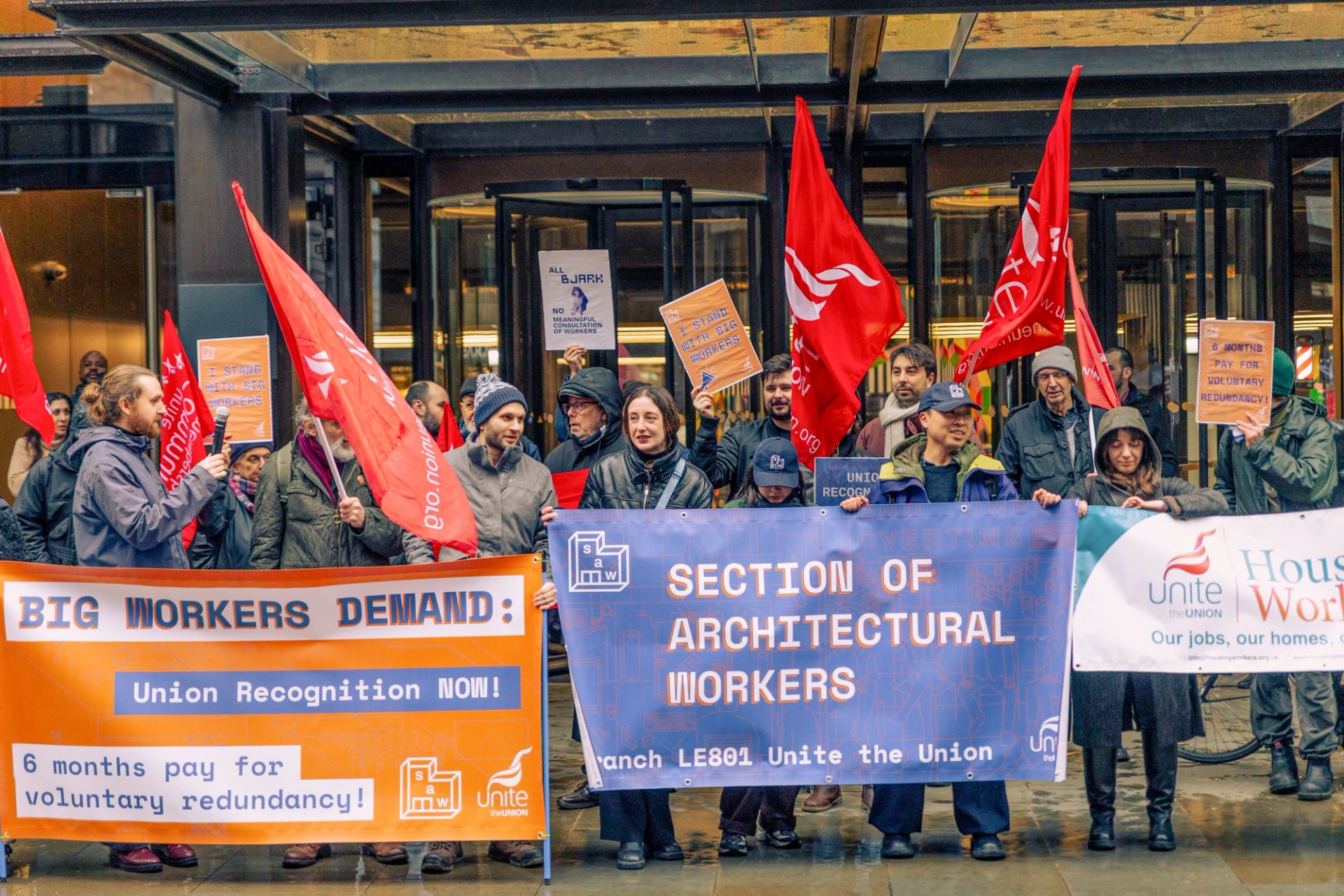
To fold in recent events in architecture, the protests at the London office of Bjarke Ingels Group — as much as those at SHoP and other practices — turned on the demonstration itself, on the street outside the studio, which created huge international press. That was productive for conversations in other offices. So the leverage is there, and relating decolonisation to abolition theory, Frantz Fanon says that decolonisation is the programme of complete disorder — the undoing of frameworks we perceive as the unchangeable status quo. As Fredric Jameson wrote, it’s easier to imagine the end of the world than the end of capitalism — but actually, what does the end of the world look like?
That’s one really exciting point of commonality between organising and architecture: architecture is inherently a discipline of reimagining. It is about using your tools to say this is what a different world might actually look like or operate or behave, perhaps in concrete, or prefabricated rammed earth panels. To create space to organise, to exchange those ideas, to test them and acknowledge that you’re not alone and you can build something together — these are incredibly potent and hopeful forms of praxis, which I think is a fitting reflection at the end.
"Architecture is inherently a discipline of reimagining. It is about using your tools to say this is what a different world might actually look like or operate or behave."
KOOZ Let’s drop the mic there. This conversation has been such pleasurable labour, thank you so much.
BIOS
Sben Korsh is a PhD candidate in architecture at the Taubman College of Architecture and Urban Planning, University of Michigan, where he is also an affiliate of the Center for Inequality Dynamics within the Institute for Social Research. He also teaches architecture studio and history at the University of Detroit Mercy’s School of Architecture and Community Development. He played an early and long-term role in establishing The Architecture Lobby, was previously its elected Research Coordinator, and co-edited Asymmetric Labors: The Economy of Architecture in Theory and Practice (2016).
Reishin Kunishima Watabe is a London-based PhD candidate and architectural worker at London Metropolitan University, where they hold a Vice Chancellor’s Scholarship. Their research examines how the boundaries of the architectural profession were redefined in the 1990s, exploring professional identities and institutional reform. Reishin was previously an elected Campaigns Coordinator and Equalities Officer of the architectural worker's union SAW-Unite. They were invited to speak at RIBA’s Decolonising Architecture symposium, co-organised the symposium Working for What? and teach at Cardiff University and the AA Visiting School.