KOOZ/Shumi Bose Thank you all for agreeing to join me in this intuitive conversation, around questions of land, movements and agency in the subcontinent. Let's start with introductions.
Radha D'SouzaI'm Radha D’Souza, and I am from India; I've lived all my life in Bombay, and my family is from Tamil Nadu. I belong to what you might call the post-Naxalbari generation. We grew up in the shadows of Naxalbari, the Communist uprising with roots in Bengal, which reached a zenith in 1967–68. The fact is that at that time the youth of the whole country was radicalised and it had profound impacts on cinema, on literature, on poetry. So why did that happen?
We have to ask why. It is important for the theme of this conversation. We came from the post-independence generation, so we grew up with all these stories about freedom struggles, our grandmothers talking about how Gandhi came to our village and how they threw Manchester-made cotton shirts into a bonfire. Their generation dreamed of a certain kind of India. It would be free, doing away with caste; women would be respected, there would be justice, fairness, blah blah... So as young people in school and university, we started asking: where is that India? What happened to this promised land that our parents and grandparents — many of whom went to prison — told us about? It's important to understand that moment: Charu Majumdar said “Jump jail” and 18,000 young people jumped. Today’s students would not do that, and you have to ask what has changed.
What has changed, in my view, is the idea of service. For our generation, we were taught that service was given to the community, to the land, to the people — that was service. Service was not about institutions, governments, corporations or anything like that. We were being pulled away from that, towards services rendered to the state, to bureaucracy, to administration. That was the spirit of rebellion we held at that time — and which has not yet come back. I hope it will, some day.
"Our generation, we were taught that service was given to the community, to the land, to the people — that was service."
KOOZ What a perfect frame for our discussion — thank you, Radha. Sujatro is the youngest of us here, but his politics were forged another time. Perhaps he can explain why.
Sujatro Ghosh I’m Sujatro; I'm an artist who's trying to be an academic, currently at the University of Manchester. My artistic practice sits somewhere between the intersection of history, imagination, memory. Right now, my work revolves around the Bengal famine of 1943. What I'm looking at is not the urgent responses of the famine — as reflected in the work of artists like Chittaprosad, Badal Sarkar and many others — rather, I’m looking at embodied memories.
I’m trying to do away with the conventional archive — that is, colonial archives — through Saidiya Hartman's ‘critical fabulation’ among other ideas. There are certain lived experiences of the famine, lived experiences of hunger — which cannot be relived 83 years after the fact. I talk about transgenerational, transmitted memories, mostly of Bengali peoples on both sides of the India-Bangladesh border. How does the memory of famine persist within a community in bodily gestures, recipes, daily life and conversations?
"How does the memory of famine persist within a community in bodily gestures, recipes, daily life and conversations?"
These conversations are not restricted to the 1943 famine; it’s almost impossible to avoid touching on the partition of 1947, as well as the time between that moment of Indian independence and the Bangladesh Liberation War in 1971. It talks about a community practice — as Radha mentioned — in terms of people coming together and the idea of service. I talk about food as something celebratory as well, and how it exists in a post-famine world. And it exists through gathering and festivals, which leads to ideas of renewal and regeneration. That's where I’ll stop for the time being.
KOOZ What about the idea that certain moments gave rise to particular movements? Your interest in the histories of famine is connected to the protests against landowners and landed peoples in Naxalbari — but there is an historical gap between that moment and the desire to be involved in a political conversation today, as well as a gap in agency.
SG Yeah, there's a certain sense of imagination driving my practice, and it comes from conversations and inspiration from particular voices like Charu Majumdar, Badal Sarkar and others. There are also references in literature and cinema. I’d say there's this obsession of looking at a world which feels unattainable — it's not possible to have that world or those politics anymore.
Ironically, as we speak there is another — perhaps very limited — movement happening in India under the banner of the Cockroach Janta Party, “a satirical party for the overqualified, underemployed and politically frustrated youth”, so named after India’s chief justice described the unemployed youth as cockroaches. This has happened in history over and again: disaffected citizens are brought down in the imagination and rhetoric of our political representatives. As somebody who believes in imagination, for the time being my work comes from a sense of resistance.
Sonali Dhanpal I'll follow, picking up on threads that you both mentioned. The world in which Radha grew up no longer existed when I was born. 1992 was the year of the demolition of Babri Masjid, and two years after the wake of neoliberalised reforms in India — both these were deeply determinant of my adolescence. The capital into so many spheres of our lives brought surveillance as well as connectivity, while also determining the kind of education I had — fundamentally private, because of the receding of public institutions in India more broadly, and disincentivizing the notion of service towards any form of public. I was intended to be an upwardly middle class upper caste person, working as a consultant for a Fortune four company or becoming a computer science engineer — this was the ascendant promise of my generation in that era of individuation. Along with this, of course, there was a virulent Hindutva or ethno-nationalist project on the horizon, which not only rendered that post-colonial promise of a previous generation as an impossibility, but also made it a very different beast to tackle.
At this moment, I did an undergraduate degree in architecture — and I really disliked doing it, because the only form of practice was to work on a bespoke farmhouse, or building a nice residence for a very wealthy client. There were no more possibilities for educational campuses for the public sector. I did a master's degree in Conservation of Historic Buildings and began working with a nonprofit called the Indian National Trust of Art and Cultural Heritage, where we would restore buildings and create public awareness — that's how I became an architectural historian.
After that, I did my PhD in the UK, related to the struggles I described both in terms of what to do and the somewhat Leninist question of what is to be done. I grew up in Bangalore, yet I had such a disaggregated way of understanding not only the history of the city, but history of the state more broadly. It is not fully explained by processes of colonial capitalism nor nationalist politics, and so there was this deep interest in understanding certain continuities, both spatially but also politically. For example, why are there two dominant caste parties and certain types of land holders within the city? What explains some of the specialised formations that we now understand as urban peripheral Bangalore — that area ripe with software headquarters and tech parks, right?
That's what pushed me to engage in this work of architectural history, and where my first project emerges — in which I'm trying to understand what it means to view caste in terms land and property, not with the intervention of colonial modernity, but rather through the fact that caste persists from pre-modern India through colonialism and has been re-entrenched post-colonially as well. So how does one engage with that? That continuity, I argue, is clearly present because of material inequalities — in the built environment, space, land and property more broadly — and this cannot be separated from the way we understand capital itself. The scholarly work doesn't necessarily become part of movement building or protest, but it does attempt to engage, even if to direct attention to those who are involved in that labour.
RDSSonali raised a very important point there, speaking of intergenerational equities. That period of 1990–1992, when you were born, was the second-most important or seminal period in our history, after 1947. That was a most important transition, and many of us lived through that on the streets. We protested about GATT and the transition to the World Trade Organisation; we protested everything under the sun.
But I wanted to ask if you could reflect on your connection to rural India. I grew up in Bombay but there was always a connection to rural India — primarily through grandparents, relatives, weddings and so on. One went to the gaon, it was always there. If you didn't have one, how do you view that in the development of yourself?
"Caste persists from pre-modern India through colonialism and has been re-entrenched post-colonially as well."
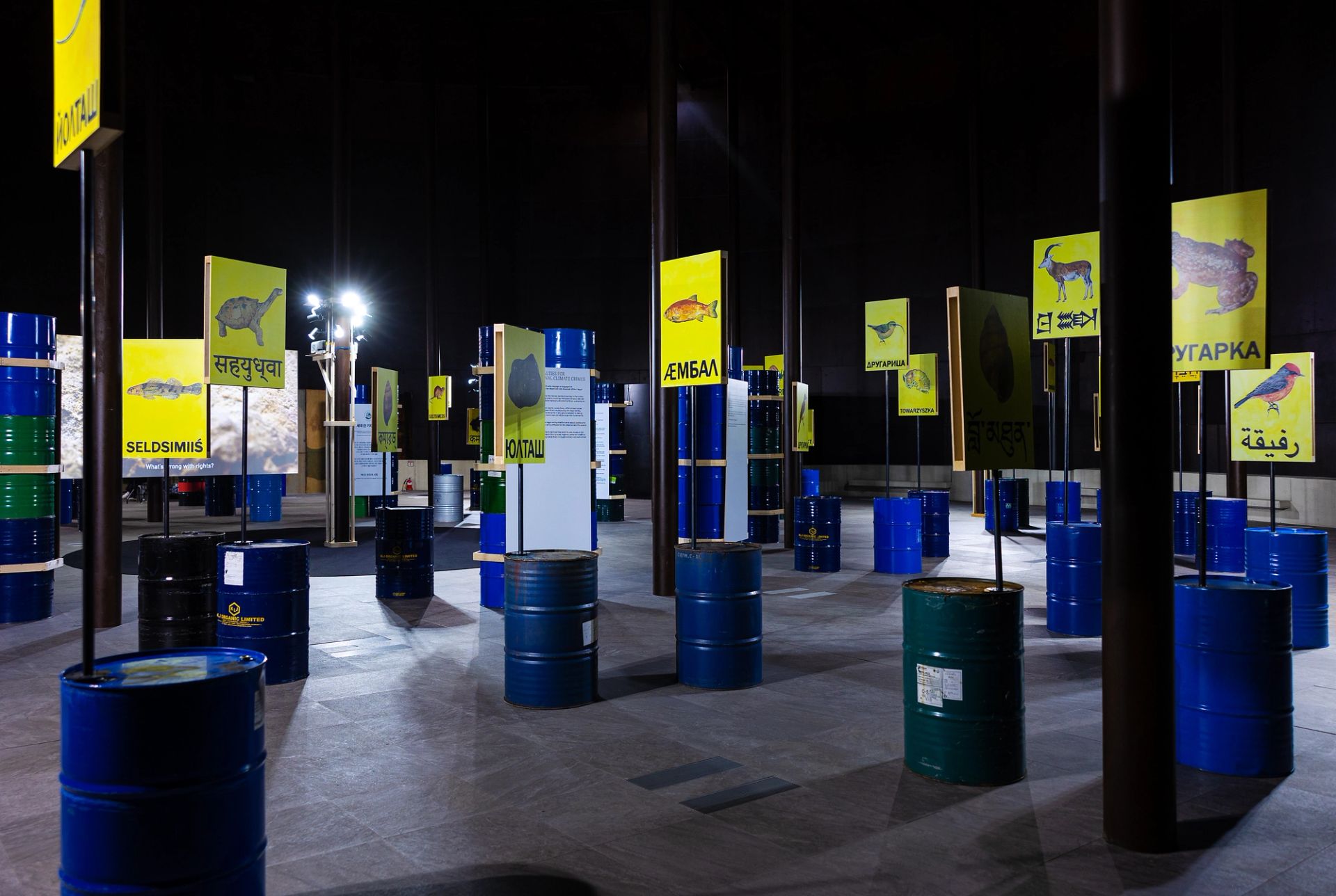
Radha D'Souza and Jonas Staal, Court for Intergenerational Climate Crimes: Law on Trial, Oil Tank Culture Park, Seoul (2022). Part of the ongoing Court for Intergenerational Climate Crimes, the installation reimagines the courtroom as a civic space in which legal frameworks are challenged to account for the intergenerational and more-than-human consequences of colonialism, extraction and ecological destruction. Photo: Hyosup Jung
SD I think you're right in identifying something about the generational turn in the 1990s. There is this rupture between urban and rural India; for me, ‘the rural’ is really an abstraction, almost as part of that individuation. One doesn't know where the food comes from, or what is seasonally available any more. So my engagement with the rural hinterland is one that produces for the urban —, because of the severance of ancestral homes and so on.
Interestingly, the main remnant is in my surname. Dhanpal is the name of a village near Tumur. It was used by my father because he was asked for a middle name at school and in Telugu ancestry we don’t have a culture of middle names, so they put Dhanpal instead. At some point, the actual surname got knocked off — so my name is the ancestry level at which I am still connected to land.
KOOZ Beautiful. Let’s throw that across to Sujatro as well.
SGThe idea of rural is also somewhat abstract for me. I've also grown up in urban spaces, I'm a big city boy. Having said that, within the context of working with food, this question is quite integral: where does our food come from? I was born in 1993, but I was exposed to a political climate where these conversations about the transition of systems were quite normal, at least in Bengal. Courtesy of my uncle or my parents, I went to protests in different parts of rural Bengal. In fact the Farmer’s Protests became part of why I got started: an attack on our farmers is also an attack on food security. This brought back memories of famine, and so my practice does deal with these conversations. Radha, as you have worked with many subaltern movements, how does this divide affect your own practice?
SDI will make a quick addition to that question: what are your thoughts on the evolution of such movements since you've begun working?
RDS Those are both complicated questions, but never mind. On the subject of the rural: as I said, we were never that alienated from it. As soon as you finished your last school exam, you were put on the train and packed off to the countryside for two and a half months, where my earliest memories were formed. I can draw South Indian villages for you as an architectural plan. They all had the same structure: there was the tank; the temple; the agraharam, as we call it, where Brahmins lived and the pond.
That love for land was inculcated early on. And it came along with a whole history: for instance, my mother's village was located in what we call Tipu territory, after Tipu Sultan, who famously led the Mysore wars against the British East India Company. Of course, my ancestors supported soldiers against the British, so when the Company came to power, they confiscated all their lands. When I came to academia later in life, I had to learn to see this as an academic subject — but it was all very real: there was nothing academic about it.
The post-Naxalbari generation looked back to the villages as we came of age. In 1972 there was a terrible, terrible famine in Maharashtra. As student citizens, we refused to give money to the Prime Minister's Fund and Chief Minister's Fund, evidently corrupt. Instead we set up our own student-run solidarity actions: we said we will go there and work. We spent months and months in remote regions of Maharashtra — in drought-prone, rocky areas, and that was life transforming. In truth, we had never seen that kind of poverty. You have to see it to know what it means.
There were famine relief workers, too; the contractors in charge of these works would give people three rupees, while in the book they would write ten rupees. Purely because we were literate, we were able to point that out to the villagers. It created a revolution in that area — just through being able to read and see what's going on. As students from Bombay, we didn't understand rural dynamics and the politics of all that. Those things were always very profound.
Coming into the early nineties, there was globalization and the Dunkel draft, an agreement on agriculture within the WTO. How many protests did we have against the Dunkel draft! We never really disconnected: the village was never an abstraction, it was very much part of our lives. So when the farmers' agitation started in 2020, that seemed normal: we were back in business. This generation has to learn a thing or two about protest, and about what India really is.
"This generation has to learn a thing or two about protest, and about what India really is."
SD I want to open up a generational question to all of us, about our own politicisation and the transnational movements that Radha has engaged with — for example, the Ghadar movement, precisely made by transnational connections.
I'm thinking about a particular kind of animation that does sit across geographies. Through Sujatro’s work with rice, there’s the Bandung Conference with its transnational connections, or my own recent work, in which Asian, Afro Caribbean and other Black migrants came together under politically Black identities to resist state racism during the welfare period in the United Kingdom. While these are things that we study historically through archives, they're also entry points into different sets of transnational politics.
SG What strikes me is this connection through ideas of land and ownership, which is of course integral to this idea of famine and hunger and especially to those affected by partition. What does ownership mean when you know you could be displaced overnight? It's impossible not to think about Gaza at this time.
The Bandung conference of 1955 does enter this conversation as well; it became important to me because it was more than just a political conference. Rather it was a coordinate of different possibilities, in which non-white nations gathered around this idea of imagination of a new world — one which refused the binaries of the Cold War, as well as colonial dependencies and imperial domination. When I talk about seeding non-aligned rice narratives — as in one of my projects — it is about this unfinished imagination, which traverses food and seed sovereignty at a time when solidarities are often suppressed, surveilled or delegitimised. Bandung represented a certain way of thinking, about how the voice travels through violence and across geographies — this is where the work becomes diasporic. When we are talking about movement, migration, and also the famine, the embodied memory is not only residual within communities staying in Bengal or Bangladesh; it travels within the communities who moved away from these lands, looking for a better life, be that in Manchester or Queens.
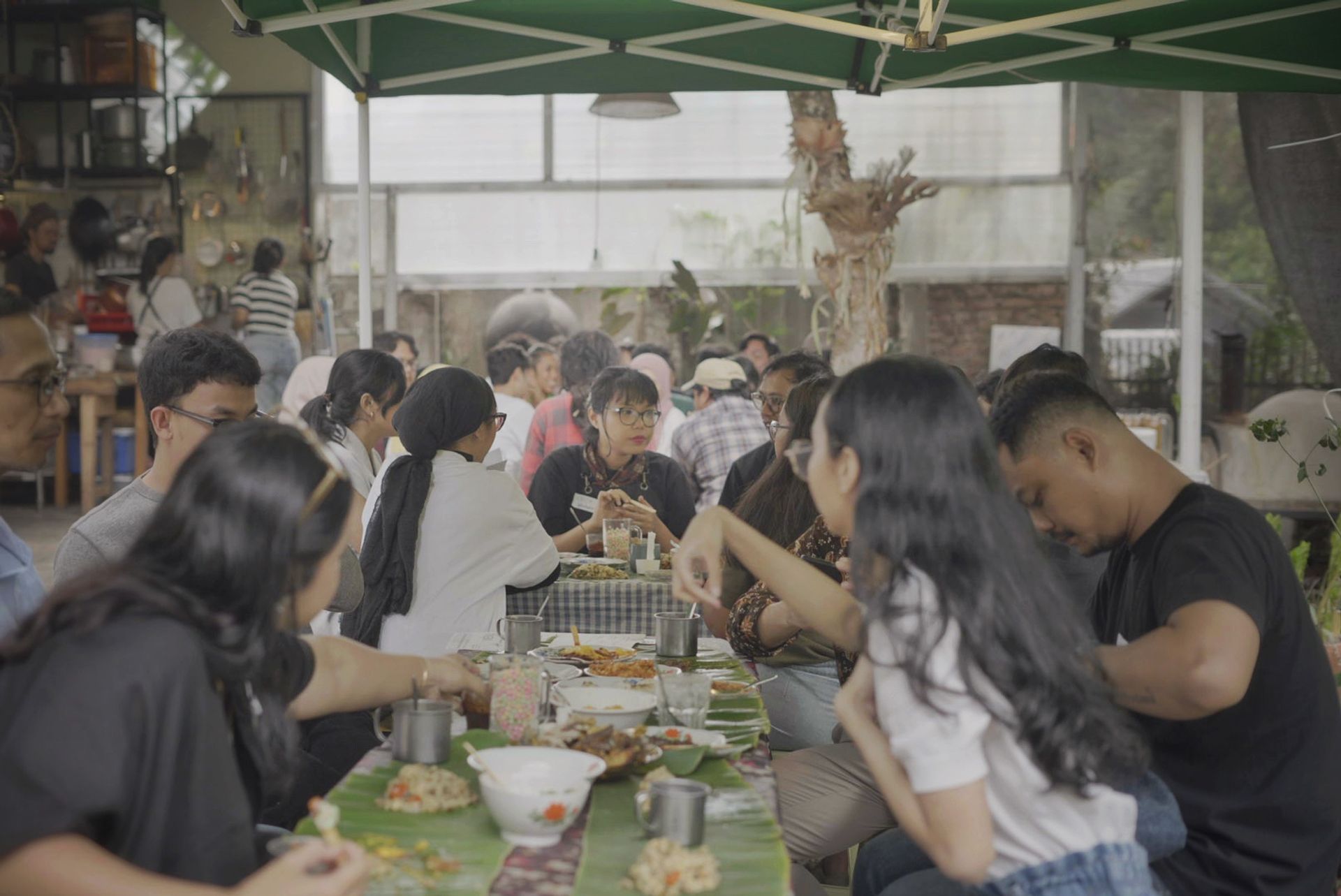
Sujatro Ghosh, Community Dinner: Seeding Non-Aligned Narratives, Bandung. Bringing participants together around a shared meal, the project revisits the spirit of the 1955 Bandung Conference through food as a medium of memory, exchange and solidarity. Rice becomes both material and metaphor, cultivating conversations around migration, decolonisation and collective futures.
"When I talk about seeding non-aligned rice narratives, it is about this unfinished imagination, which traverses food and seed sovereignty at a time when solidarities are often suppressed, surveilled or delegitimised."
RDS I’ll return to Sonali's question on international movements. The Ghadar movement started around the turn of the 20th century. It grew out of immigrant workers in the United States, mainly due to British land policies in the Punjab. As a solution to poverty, they migrated — then, just as people do now. Upon arrival, they were subjected to racism and so they tried to organise. They asked an interesting question: why are we being treated in this way? They concluded that we were being discriminated against because their nation was considered a slave nation. The solution against racism for the Ghadar movement was to return to India and fight the empire, because only when your nation has dignity can you yourself have dignity.
What was radical about the Ghadar movement was the way they framed solidarity: they said we have to organise wherever the British Empire is, because our fight against the Empire in India is not just about us. The British were sending them to shoot at other subjects of the same Empire, so they refused to fire in Shanghai against the Chinese workers, and they refused to fire in Iraq. So the Ghadar movement spread to all sorts of places: Argentina, Kenya, Singapore, Iran — wherever the British Empire went.
As a people's historian, I’ll even say that the first independent government of India was actually established by the Ghadar movement: a government in exile, functioning from Kabul. This is a history that the Congress that came to power after 1947 would never tell you. Then, of course, the British mercilessly finished them. It was one of the bloodiest repressions in our history. In fact the first so-called anti-terrorism law was a direct result of the suppression of the Ghadar movement. “The troubles” as used in British politics usually describes the Irish troubles, but it started off as the Punjab troubles. So you can see how vocabulary has integrated all of this history.
To tie up the Ghadar movement with Bandung, I'll fast-forward from 1902 to 2005, in the middle of all the anti-globalization movements, which were at a certain peak. It was decided that we would hold a people's Bandung on the fiftieth anniversary of the initial conference: an alternative Bandung. Now, at the people’s conference — and this is a real story — there was an elderly villager from Bandung who wanted to speak. He told us this amazing story about how he was 14 years old when the original Bandung Conference happened, with Jawaharlal Nehru and Chou En-lai in attendance. These world leaders would go for a walk in the morning with no security, no police, nothing at all. The villagers around Bandung had contributed food: rice and vegetables for the delegates; this man was one of the young people who helped to load and unload the carts carrying food to the delegation. What he said in 2005 was this: I can see the change that has come over the political class. No leader goes for a walk in the morning, and no villager contributes to their meal. It was quite an exhilarating narrative — a personal story about a teenage boy, thinking back to that moment.
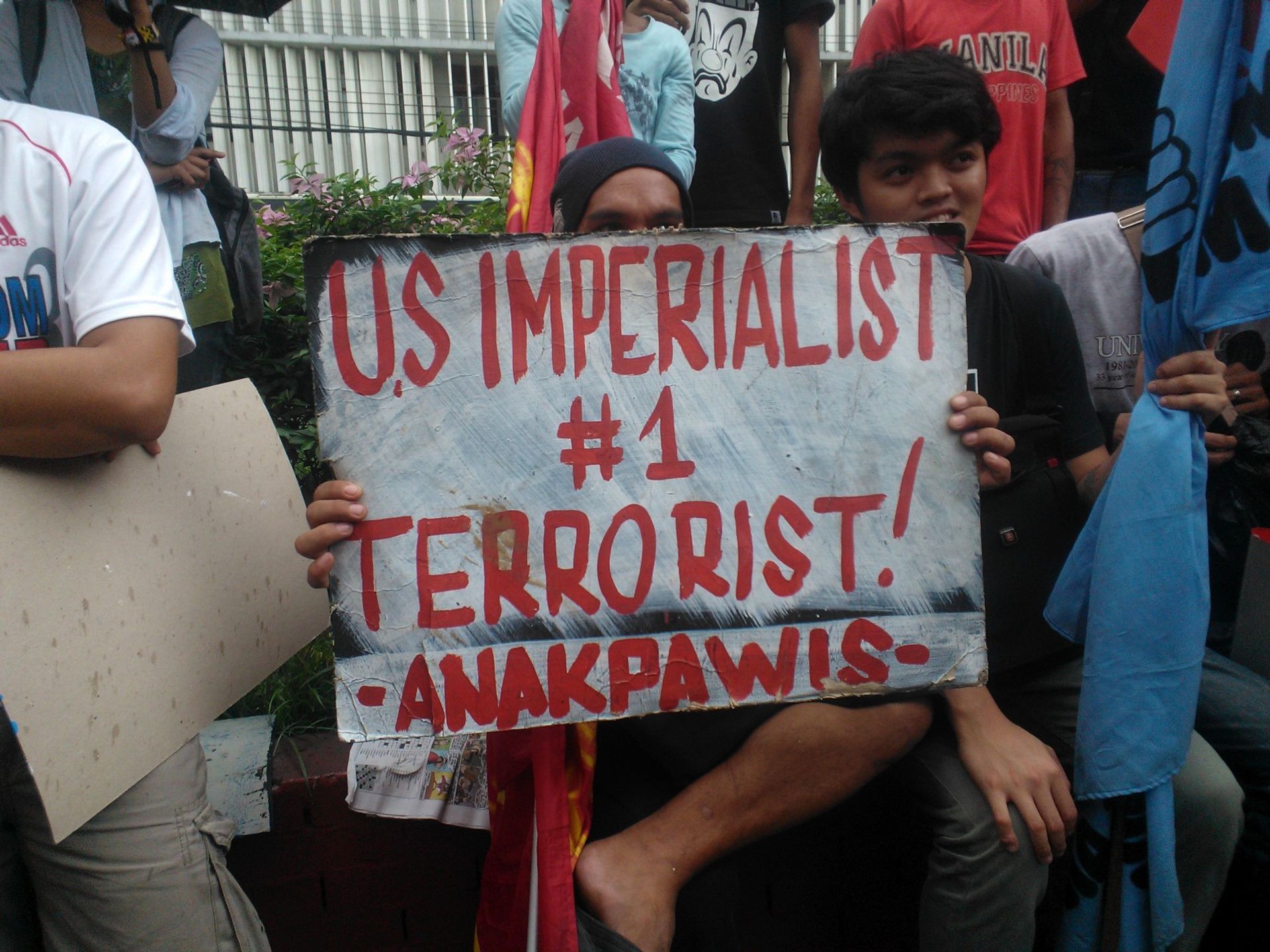
No To Bases anti-imperialism protester in Manila, Philippines, 2017. Photo: Radha D'Souza
"If there is no love for the land, what are you fighting for?"
On the question of why movements happen, I have a theory. I'm in academia now, so I'm allowed to theorise. One of the reasons why anti-colonial struggles had that inspirational power and drive was that love for the land. If there is no love for the land, what are you fighting for? Because of the way in which the global economy — or global capitalism, neocolonialism, or whatever you want to call it — functions, we are inculcated with a sense that land doesn't matter, and so people don't matter. It comes from a disconnection between soil and self-determination. Cosmopolitanism means that you can embrace everybody and anything but when nothing is yours anymore, you can’t have empathy for anything else.
I believe that solidarity in transnational movements came out of empathy. When we love something, we can understand why others love something. Just as my child is wonderful for me, another mother must feel the way I feel about my child. It's the same thing with land and people. I don't know if there is an easy answer to how we can bring that back — but intellectualism without the heart will not bring us there. The heart has to travel with the head.
"I believe that solidarity in transnational movements came out of empathy.[...] The heart has to travel with the head."
KOOZ I admire your optimism. Sonali, what can you tell us about your ongoing work and how it takes on some of these questions?
SD In my earliest work, I was trying to make sense of my city. The first project was trying to understand Bangalore’s oscillating relationship with princely rulers and the introduction of the East India Company; I ended up writing about suburbanization, land and property law. That unraveled a huge maze of bureaucracy: not just the bureaucratic state of the British Raj but also of the princely government. Half the archives that I looked at were in Karnataka and Bangalore, and the other half in the British Library. My thesis attempts to understand why they got separated, and that’s how I found myself in the UK.
That in turn incentivised another project, which is about post war housing in Britain. Aneurin Bevin’s welfare consensus was extremely productive for a huge number of working class people, even as it bypassed migrants from the Commonwealth. How did this moment emerge? For me, the immediate postwar moment is remembered and understood as an emancipation from colonialism and its structures, but in the UK it marks a total severance from empire and the era of heroic government, which itself feeds the narrative that justifies welfare capitalism.
I ended up looking at a lot of anti-racist movements and anti-nationalist state movements, which were primarily embodied by black and brown workers in this period. One might remember the historic Grunwick strike, at the forefront of which were East Asian women in particular. I thought of it in response to Radha’s love for the land, and as seeming hopeful in terms of how metropolitan politics animates all these different actors to come together under different rubrics. These solidarities are animated precisely because of the conditions that the metropole creates.
All these migrants from the empire found themselves left out of welfare consensus, and then began organizing across the state, without projecting or romanticizing. This is how I found myself in Newcastle, England: trying to find solidarities with people whose histories are not necessarily related to my own, yet finding this common ground. It brought me closer to what it means to engage with socialism rather than socialist aesthetics, to which architecture can sometimes be reduced.
KOOZ There is optimism to be found, I think, in that engagement through scholarship. Sujatro, you're just entering that phase: how has your experience of displacement changed your work?
SG My practice exists within slightly different tensions, partly because I have grown up in Kolkata and had a government education all my life, so I have the right to criticise my government! This is something which I've been taught from day one. Then too, I’m primarily trained as a journalist, with a certain clinicality. In a series of works from 2017, I talked about how the cow became a political animal, which suddenly began to take over a space in a country. The Modi government instituted a ministry for cow protection, and cow protection became a job in itself — which is rather interesting, in a country with such a high level of unemployment.
I started looking at this dichotomy where yes, there are fanatics who believe that cows symbolises the mother, but they don't think twice before killing people. In a country where cows are protected because they are mothers, women are raped every 15 minutes. I studied in Delhi, so I was very exposed to a hyper masculine energy and what patriarchal Hindutva politics looks like. I also learned that within a space like India, I could jeopardise the safety of the people with whom I’m working. As an artist and practitioner, I can decide whether to put myself in harm’s way, but not my collaborators
So I started working on this project called the Cow Mask Project, where I started using a latex Lee cow mask — bought from a party shop in New York. The mask serves the purpose of protecting a person’s identity; it also comes across as a political expression, as in Greek theater. The project was shared in a documentary by Al Jazeera, and then the harassment I was receiving ramped up — to the extent that I had to leave the country.
Since then I’ve moved from India to Germany and now Manchester; within these tensions that I work with between Bengal, Europe. These diasporic, transcontinental spaces shape my access as well as a responsibility of sorts: I am outside the histories with which I'm working and I'm not physically present in those spaces. This means that I have to work carefully through collaborations; through listening and with non-extractive forms of practice. As an artist, my practice begins where a conventional archive ends: not necessarily through colonial or bureaucratic documentation, but rather from bodily gestures, sonic or olfactory memories, and things that are both tactile and visual.
"My practice begins where a conventional archive ends: not necessarily through colonial or bureaucratic documentation, but rather from bodily gestures, sonic or olfactory memories, and things that are both tactile and visual."
KOOZ The act of inventing such careful collaborations also sounds like an optimistic practice — building alternative archives based on solidarities and genuine co-creation.
RDS I do have faith that this empathy and love for land will come back. The fact that I'm speaking to you and your generation means that somewhere you have been dissatisfied with that wonderful world that your parents gave you. Something has come to the surface, and that happens when we become conscious. It’s not just you: I see it in so many others. The Dalit movements, the epidemic of student movements, everywhere: this is not going away. So don’t focus on the newspaper headlines — this is why I love having conversations like this.
KOOZ Thank you Radha, and thank you all so much for speaking so generously.
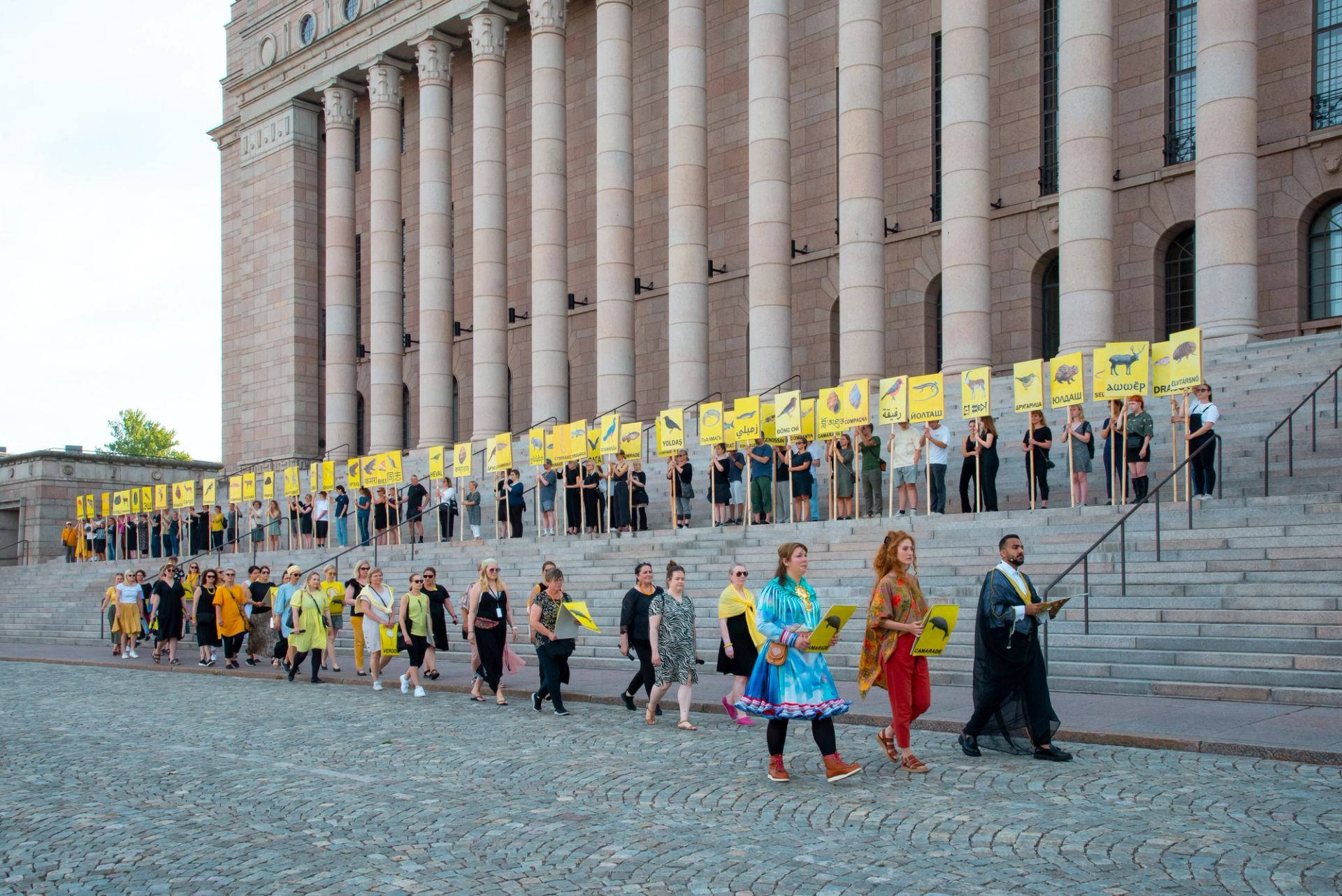
Radha D'Souza and Jonas Staal, Comrades Against Extinction, Musical Procession, Helsinki (2022). Developed as part of the ongoing Court for Intergenerational Climate Crimes, the installation and musical procession commemorates species driven to extinction through colonialism and extractive capitalism. By naming the extinct as "comrades", the work reframes ecological loss as a shared political struggle grounded in interdependency, regeneration and collective responsibility. Photo: Jonas Staal.
*Cover Image: CICC: Comrades Against Extinction, Musical Procession in Helsinki, 2022. Photo: Petri Anttila
BIOS
Radha D’Souza is a Professor of International Law, Development and Conflict Studies at the University of Westminster, London. D’Souza works as a writer, critic and commentator. She is a social justice activist and worked with labour movements and democratic rights movements in India and with social justice movements in the Asia-Pacific region to focus attention on the effects of international economic policies on developing countries. She practiced law in the High Court of Mumbai in the areas of labour rights, constitutional and administrative law, public interest litigation and human rights. Recent publications include The Court for Intergenerational Climate Crimes (Framer Framed, 2024) and Decolonizing Knowledge: Looking Back, Moving Forward (Bloomsbury Publishing, 2025).
Sonali Dhanpal is an architect, a conservationist, and a historian of modern architecture and urbanism. Her research focuses on questions of land, property, and housing in late colonial South Asia and post-colonial Britain. Her first book, tentatively titled "Caste and the City: Spatial Politics in Colonial and Princely Bangalore," analyses the city’s emergence out of a boundary between colonial and princely rule. Her second project, “Empire Comes Home: Housing Race Relations in Britain,” intends to bring colonial legacies of the welfare state into conversation with the architect-planner-led postwar construction boom in Britain.
Sujatro Ghosh is a multi-disciplinary artist and activist. His practice attempts to initiate a conversation about social action and political protest which produces the conditions for othered voices to be heard. Sujatro’s work combines conceptual and material adventures around queer rights, diasporic tensions, women rights, climate change, gastro-politics and transnational migration through the mediums of film, performance, poetry, sonic installations, fabric works and photography. His current practice deals with the relationship between food, memory, violence, ecology and justice.