Beyond the Plaza by Kateryna Malaia and Nathan Mark Hutson
Public protests contain a paradox: they are most successful when visible in signature public spaces, but they emerge and are sustained through their relationship with a network of ordinary, behind-the-scenes places and actions. Wide streets and open plazas are the most common forum for a protest’s zenith, but these are only the tip of the iceberg. The hardship and injustice that give rise to protest are experienced not within ornate plazas, but within ordinary spaces. Before discontent erupts in public protests, everyday forms of resistance often ferment in inconspicuous ways, in places outside the state’s primary concern. The everyday simmer persists in neighbourhoods and courtyards long before it boils over into plazas.
At the same time, a neighbourhood, a residential street, and a courtyard are an articulation of the state’s power over the everyday life of its citizens. In Democracy and Urban Form, Richard Sennet speaks about the prohibitive, undemocratic nature of orderly, homogeneous streets that minimise social conflict by throttling social contact necessary for democratic discourse to occur. By design, high-traffic Hausmannian streets are places to pass through, rather than places to live and interact.1 In fighting against oppressive actors, protesters must face not only the oppressors of the moment but must also battle against a legacy of urban infrastructure often designed to suppress public expressions of dissent. Not only does the state strive to control a designed street in a planned city grid, but as of recently, state institutions suggest a remission of protests to “free speech zones” — a controlled, bottled form of quasi-resistance that may release steam without enabling structural change. Not surprisingly, the state envisions its “free speech zones” in signature public places. That is because, as Chattopadhyay notes, “Any social or political process that [the state] cannot apprehend within its spatial and structural logic remains illegible and opaque.”2 The state cannot see in the small spaces and cannot discern small acts. Illegibility to the state in ordinary spaces is resistance’s tactical strength:
Lacking its own place, lacking a view of the whole, limited by the blindness (which may lead to perspicacity) resulting from combat at close quarters, limited by the possibilities of the moment, a tactic is determined by the absence of power just as a strategy is organised by the postulation of power.3
"The state cannot see in the small spaces and cannot discern small acts. Illegibility to the state in ordinary spaces is resistance’s tactical strength."
When democracy shrinks and norms of acceptable political discourse change, so do traditional methods of public debate.4 Widescale protests thereby emerge as the primary expression of popular political will. In this sense, the global growth and evolution of protest culture is an emergency second-best response that has materialised due to the continuation of power inequalities and intolerance for official forms of discourse. But the protests cannot be studied through traditional methods: their archives are contradictory, if not sparse, then overwhelming; their narrative is written by the winners, often other than the protesters themselves; and, of course, the identity of protesters should not be compromised despite the critical need to write their history. The current environment demands direct observational fieldwork, multi-media documentation, and applied scholarship. In response, this volume aims to highlight emerging methods used to document and theorise modern public dissent.
This diverse selection of case studies, both geographically and thematically, evokes the multiplicity of ways by which humanity overcomes powerlessness — demonstrating that resistance is inherent to the human experience. This fact has been borne out in recent years by the bravery of protesters in nondemocratic societies. It has become clear that respect for human rights is no longer a guarantee in any area of the world, and the response must be to ensure that the “free speech zone” is the city in its totality — you can face your oppressor where they live, and where you live as well.
"The 'free speech zone' is the city in its totality — you can face your oppressor where they live, and where you live as well."
Dynamics of Neighborhood Resistance by Vafa Dianati and Asma Mehan.
Recent civil resistance movements across the globe have redefined the spatial and technological dimensions of urban protests. This global pattern finds expression in Iran, where demonstrations have evolved from centralised rallies in symbolic squares to hyperlocal resistance — using residential streets, alleyways, and other familiar spaces as both shield and staging ground against state repression. While protests still occur globally in public urban spaces and plazas, and have long taken place in ordinary spaces, this tactical adaptation reflects the heightened constraints Iranian demonstrators face. Simultaneously, the rise of “digitalised resistance” has reshaped mobilisation, with platforms like Twitter and Instagram enabling real-time coordination, visibility, and global solidarity. However, this digital turn introduces contradictions: while democratising participation, it exposes activists to enhanced surveillance and repression.
***
The tactical evolution of Iranian protests since the 2009 Green Movement reveals a significant spatial shift — from centralised demonstrations in symbolic squares to decentralised resistance across heterogeneous urban environments. This transition parallels global patterns observed in movements such as Hong Kong’s Anti-ELAB protests,1 yet adapts to Tehran’s unique urban conditions. While Hong Kong protesters leveraged the city’s hyper-dense verticality, Tehran’s demonstrators navigate a different landscape shaped by state-controlled urban planning, expansive residential peripheries, and the accumulated experience of past repression. Forced by intensified surveillance, contemporary Iranian protests increasingly inhabit interstitial spaces — residential neighbourhoods, local passageways, and other everyday environments — transforming them into sites of political contention while drawing on the collective memory of previous movements.
This shift can be hypothesised as a strategic retreat from public squares, roundabouts, and plazas, driven by security concerns and influenced by experiences of brutal crackdowns — such as the “Battle of the Camel” in Cairo, Egypt — when pro-regime mobs and security forces attacked Tahrir Square protesters with clubs, swords, and firearms in 2011 — and “Bloody Thursday” in Manama, Bahrain — when Bahraini forces raided Pearl Roundabout, killing and wounding dozens of unarmed demonstrators in 2011.2 The appeal of everyday spaces, while convenient, extends beyond mere accessibility; it indicates a more profound, strategic decision by protesters to engage with areas that are central to their daily lives. Everyday life constitutes a political domain where ordinary citizens cultivate resources, dispositions, and capacities for collective action and mobilisation.3 The lived experiences of ordinary citizens are formative of the oppositional subjectivities enacted in the context of this revolutionary mobilisation.4
Moving to the realm of the everyday incorporates a variety of protest methods, from place-based networks, anchored in a physical presence in particular locations, to connecting broader groups and communities through digital media platforms.5 This evolution in protest strategies also reflects a shift toward integrating both physical and digital realms in modern protest movements, where the power of physical presence in particular locales and the ability of digital tools to transcend geographical boundaries create a multifaceted space of resistance that combines the tangible and the virtual.
***
Since the 2009 Green Movement and post-election uprisings — when state violence under Ahmadinejad crossed a critical threshold — Iranian protests have progressively abandoned centralised symbolic spaces for decentralised neighbourhood actions, as vividly demonstrated in the 2018, 2019, and 2022 uprisings.6 This spatial transformation reflects broader shifts in protest organisation, demographics, objectives, and state violence levels, marking a strategic evolution from visible mass gatherings to dispersed resistance across Tehran’s urban fabric. Against this background, the political protests of 2022 stand out as a key historical point showcasing a broader geographic reach, a diverse mix of sociodemographic groups, and a more decentralised and coordinated approach to political protest on a smaller scale. Starting September 16, 2022, Iranian cities were engulfed in daily protests that spanned several weeks.
The trigger for this surge in demonstrations was the tragic death of Mahsa Jina Amini, a 22-year-old Kurdish-Iranian woman, while in the custody of Tehran’s “morality police.”7 Although Iran had previously seen numerous national demonstrations and anti-government protests, the protests in 2022 stood out for their impromptu emergence, significant involvement and leadership by women, and their varied geographic scale and extensive, novel protest strategies. The following section examines these dynamics during the 2022 protests in Ekbatan, Tehran.
Ekbatan is a residential master-planned community located in the western part of Tehran, developed in the 1970s as a planned community to accommodate the city’s growing population. It is known for its distinctive architectural design, modernist and brutalist style, high-rise residential buildings, green spaces, and pedestrian-friendly layouts. The development of Ekbatan unfolded in various phases, where phases 1 and 3 were finished by 1976, and phase 2, interrupted by the 1979 Revolution, was constructed during the 1980s. The construction of Ekbatan was deeply intertwined with Iran’s rapid modernisation and urbanisation fueled by the mid-1960s oil boom. Central to the government’s development agenda was a 1964 law mandating partnerships between Iranian and international architectural firms for mass-housing projects — a policy that coincided with increased private sector investment and was crucial to the nation’s modernisation efforts.8 The global oil market accelerated the internationalisation of architectural practices, fostering cross-cultural exchange through international congresses, foreign collaborations, and large-scale urban planning projects. This influx of foreign expertise profoundly shaped Tehran’s architectural landscape, especially in mass-housing projects, where Iranian modernists, many with overseas experience, collaborated with international architects.
Tehran’s modernisation was further guided by the Master Plan, commissioned in 1968 to Victor Gruen, an Austrian American architect renowned for his shopping mall designs.9 The plan aimed to address Tehran’s challenges of housing shortages, overcrowding, and inadequate services. Gruen envisioned ten new urban units — a tenfold city expansion — with a strong emphasis on westward growth toward Karaj (Figure 5.2). Each district was to be centered around a large shopping center, interconnected by highways and public transit lines, and interspersed with green spaces. This concept mirrored Gruen’s earlier urban development proposals in the United States, emphasising retail as a central element of urban life. The plan also sought to foster a new domestic culture in Tehran, characterised by car-oriented lifestyles and the prominence of shopping malls.10
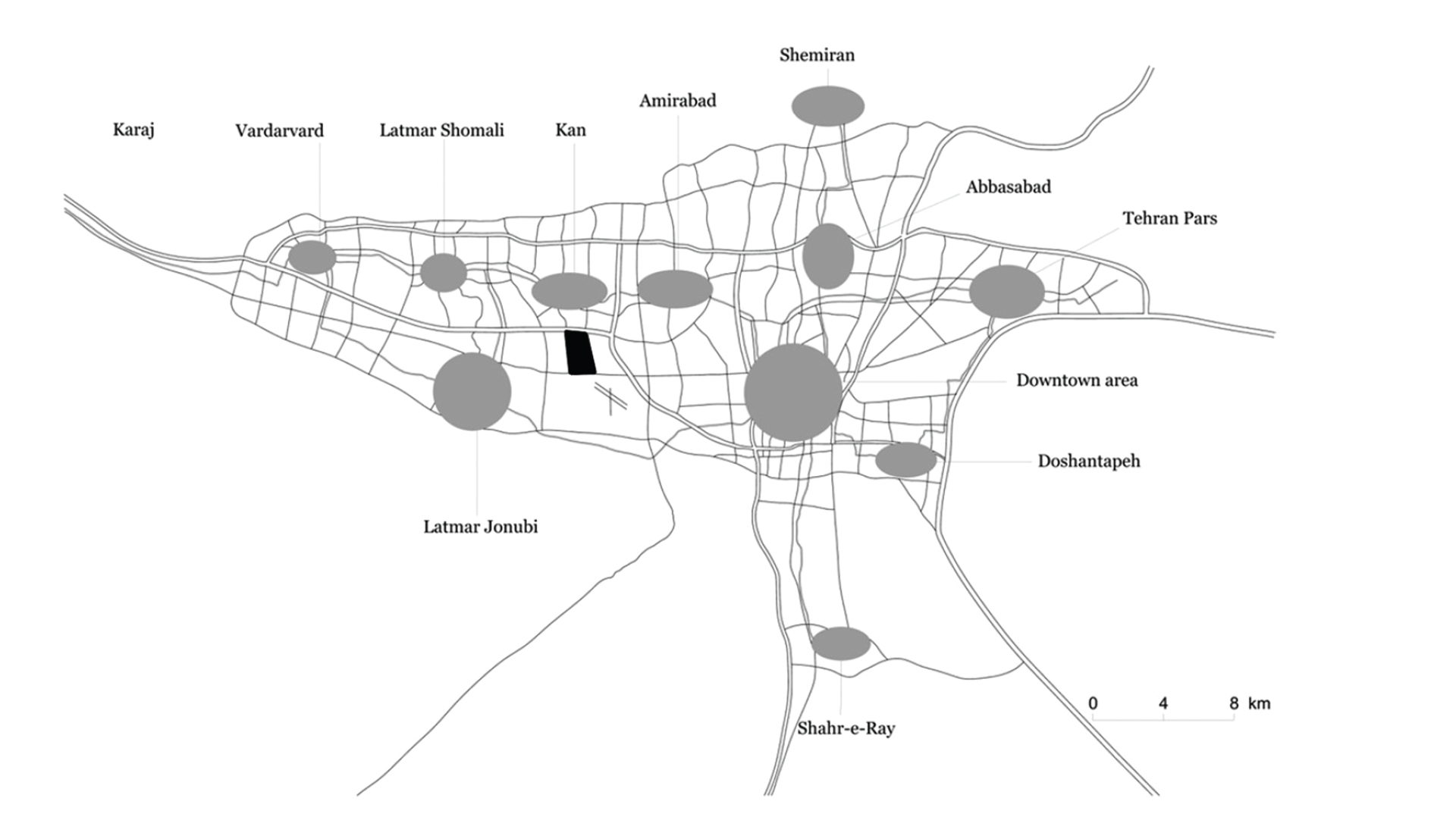
Figure 5.2 | Urban districts proposed by the Tehran Comprehensive Plan of 1968. The location of Ekbatan is marked in western Tehran. Source: Asma Mehan, Tehran: From Sacred to Radical (Routledge, 2022), 98– 99.
Ekbatan emerged as one of the few middle-class mass-housing projects that materialised Gruen’s concept of satellite cities centered around shopping malls. Located east of Mehrabad Airport, the complex comprises three groups of buildings constructed in three phases.11 Ekbatan’s design synthesises international influences and traditional Iranian urban forms. The complex’s U-and Y-shaped buildings, set amidst green spaces, recall Marcel Breuer’s 1940s proposals for New York, echoing his “Future Garden City” concept.12 The linear shopping center in Phase 1, designed to meet residents’ needs and ensure the settlement’s autonomy, evokes both traditional Iranian bazaars and Gruen’s American shopping malls. Its underground car parks, with six entrances from surrounding streets, encourage pedestrian movement through the center.
Residential blocks in Ekbatan generally feature a dual row of apartment structures elevated on concrete pilotis (Figures 5.3 and 5.4). On the ground level, these pilotis create an incredibly porous, walkable, and accessible setting. The spaces between these blocks are interspersed with interconnected gardens, facilitated by the open ground level created by the pilotis. This spatial arrangement bears similarities with modernist, large-scale Soviet-era housing estates, where elevated structures and open courtyards enable fluid pedestrian movement, semi-public gathering spaces, and alternative routes for navigation. In both cases, these design elements have played a crucial role in shaping urban resistance strategies, allowing protesters to leverage the built environment for movement, concealment, and reorganisation in response to state repression. The spatial configuration of Ekbatan also explicitly illustrates a clear segregation between vehicular and pedestrian domains, reserving the entirety of the communal area amidst the residential blocks exclusively for pedestrians. Ekbatan exhibits a notably youthful demographic profile, with national census data from 2016 indicating that approximately 30% of its population belongs to the 20–35 years age group. Ekbatan’s symbolic status is highly regarded in popular culture, notably in cinema, for its distinctive modernist architecture and representation of alternative lifestyles and aspirations. Ekbatan represents a captivating amalgamation of diverse architectural attributes and qualities.
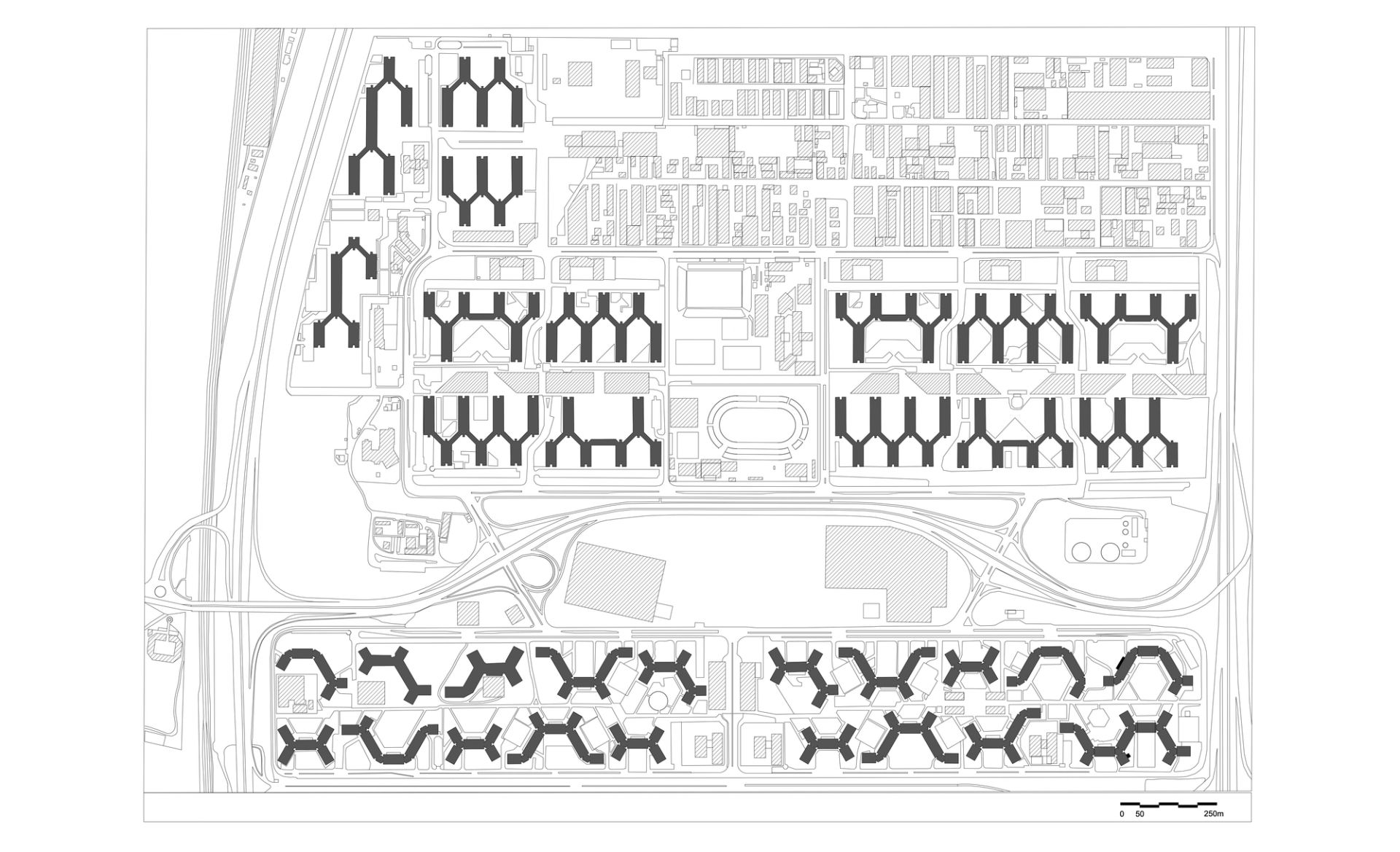
Figure 5.3 | The architectural layout of Ekbatan. The design facilitates pedestrian movement, interconnected courtyards, and green spaces, promoting social interactions and community engagement. Source: Mohamad Sedighi, “Megastructure Reloaded: A New Technocratic Approach to Housing Development in Ekbatan, Tehran,” ARENA Journal of Architectural Research 3, no. 1 (2018): 2. Available under a CC- BY 4.0 license.40
Its enduring legacy lies in creating a unique, self-sufficient neighbourhood that harmoniously integrates modern conveniences with elements of Iranian urban tradition, continuing to resonate with its residents.Ekbatan has consistently been a focal point for anti-government protests since the Green Movement of 2009. Often referred to as the “defiant Tehran neighbourhood” or “Tehran’s hotbed of protests,” Ekbatan has attained its unique status primarily due to its vibrant social atmosphere and young population, coupled with the socioeconomic status of its residents, who are often seen as representative of the urban middle class. As the largest housing estate in the Middle East, Ekbatan is a remarkable example of the urbanisation of consciousness, where concepts of modern civil society and standard discursive practices emerge. Being referred to as “an enormous assemblage of right angles, functional voids, and horizontal strips of glass and concrete,”13 Ekbatan stands as a monument and an architectural counterstatement to both the decline of the grand narrative of modernist architecture in the West and the Islamic Republic’s dominant discourse on traditional forms of sociality and living. The spatial features of Ekbatan — such as its enormous scale, car-free inner spaces, pilotis, interconnected courtyards, and rooftops — facilitate unobtrusive movement between residential blocks. These interstitial spaces enable socially and politically unacceptable activities to unfold discreetly without drawing unwanted attention.
Ekbatan has also emerged as a significant site for activities deemed unacceptable within the authoritarian theocratic state framework, including hijab defiance, alternative lifestyles, graffiti, and unauthorised social and cultural gatherings, as well as the adoption of spatial practices that subvert the prevailing state narrative. Popular culture has repeatedly featured the neighbourhood as a location for alternative lifestyles and social relations. Ekbatan’s distinctive physical layout plays a crucial role in these dynamics, offering a semi-autonomous environment conducive to alternative practices and, when necessary, strategies of dissent.
During the protests that started on September 16, 2022, and gradually declined by mid-March 2023, Ekbatan witnessed the emergence of “counter-spaces” within its neighbourhood, spaces that represented a fusion of the ordinary and the extraordinary by integrating everyday life with moments of intense mobilisation.14 Based on direct observation and media reports, on the first night, demonstrators initially gathered in semi-private spaces of residential blocks, where security forces encountered difficulties in maintaining control and access. Local activists used their neighbourhood knowledge to identify gathering spots close to security force positions. Small groups would initially assemble before swelling in numbers — a pattern that, as one interviewee noted, “made suppression difficult.” In some instances (documented through multiple digital sources), protesters blocked roads to hinder outside security reinforcements, leading to direct confrontations. As several social media posts described and approved by firsthand observations, this often culminated in protesters retreating into courtyards and piloti areas, pursued by security forces in what one activist recalled as “guerrilla-style chases.”
During these confrontations, Special Units and Basij militia forces, unfamiliar with the maze-like design of Ekbatan’s courtyards and passageways, struggled to contain the movement of demonstrators, vandalised lobby entrances and local facilities to intimidate residents. Such back-and-forth movements became a recurring pattern in the next couple of nights, where the protestors benefited from Ekbatan’s built environment and their own local knowledge of its pathways and hidden corners.
Furthermore, security forces employed novel intimidation methods. In previous years and earlier episodes of political unrest in Ekbatan, the security forces had often avoided entering semi-private residential areas. Yet, in 2022, they moved into such spaces to quell demonstrations at their source. In the area known as Phase 2, forces were gathering nightly in the public courtyard, training laser devices on windows, firing projectiles at onlookers, and using loudspeakers to threaten residents. High-rise residential blocks then became targets themselves, regardless of whether occupants joined the street protests or not. To counter these tactics, residents began coordinating through encrypted messaging apps, sharing real-time updates on the movements of security personnel and establishing safe routes for escape. A defining moment came when Ekbatan’s residents used their knowledge of the neighbourhood’s spatial organisation to stage coordinated flash protests, appearing suddenly in one section of the complex before dispersing and regrouping elsewhere.
The dispersion of power across diverse, fragmented groups of protestors that melded into the neighbourhood’s porous built form was a turning point in the protests in Ekbatan. All social movements risk losing momentum over time. However, through their flexibility and adaptability, resilient spaces can help movements regain energy by offering new strategic opportunities to grow and evolve.15 This involves opportunities for congregation, organisation, mobilisation, retreat, and subsequent regrouping. The architectural configuration of Ekbatan facilitated these possibilities, which is a crucial reason why quelling protests in Ekbatan poses a significant challenge for security forces. The architectural form thus promotes endurance and resilience as the cornerstones of any successful social movement.
By strategically shifting away from traditional dissent spaces like squares and plazas, protesters in Ekbatan — primarily young, middle-class residents and politically active citizens — innovatively redefined their methods of dissent and blurred the lines between public and private realms. This decentralised strategy effectively harnessed the protesters’ deep familiarity with the local spaces in Ekbatan, creating a notable contrast between the unfamiliarity of security forces and the physical setting of the neighbourhood. Familiar navigation also served as a safety measure, allowing quick dispersal, retreat, and reorganisation in another location. Public open spaces like urban squares leave little room for spontaneity, which is essential in urban protest and social mobilisation strategies, specifically when the oppressive forces have no limit to practicing their oppressive and violent tactics. The communal ownership of land in Ekbatan also plays a vital role in these dynamics, as the absence of barriers between residential blocks makes the entire approximately six square kilometer area, with its varied architectural and topographical elements, publicly accessible. Such innovative utilisation of space significantly enhances the impact and nature of the protests in Ekbatan. However, almost a year following the onset of the protests, there have been reports on social media and local news outlets of increased pressure on the residential block associations to demarcate the land with fences. This appears to be an effort to delineate more distinctly between public and private spaces, thereby implementing stricter control over public areas. It also aims to limit free movement within the estate and, in the event of future protests, to hold association heads accountable for any protest activity within their territory.
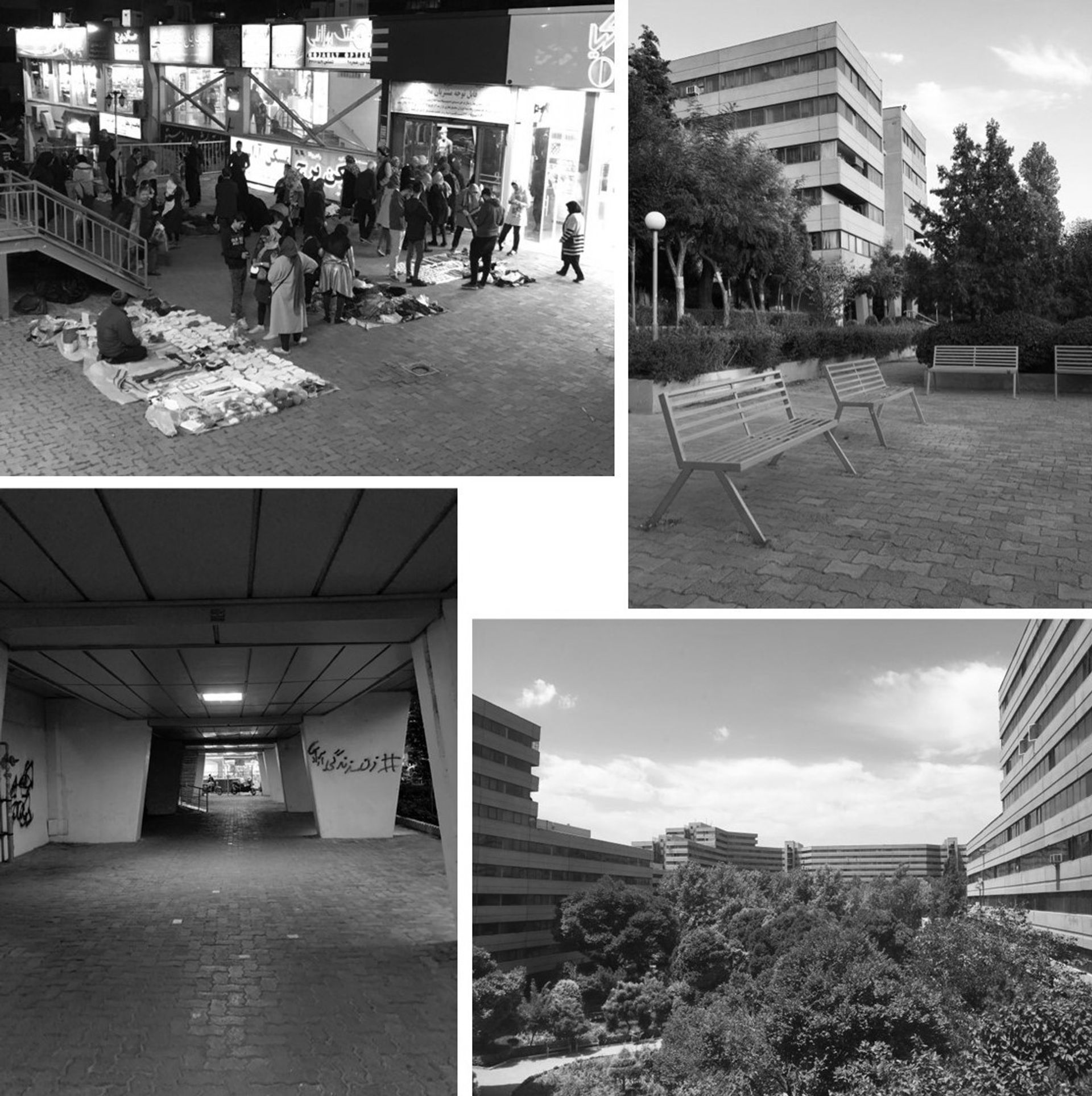
Figure 5.4 | Spatial features of Ekbatan. The images highlight the pilotis, movement paths, courtyards, and shopping centers. Source: Authors.
Territorial control is one of the central themes in protest policing to assert power and control over the protest’s physical site and its surrounding social and spatial dynamics. In response, protesters exhibit diverse spatial strategies with varying organisational levels, prompting the security forces to devise innovative spatial practices for heightened effectiveness.16 Power is no longer synonymous with a massive crowd gathered in a square, but with a dispersed crowd, fragmented and flown into the porous space of the neighbourhood, exemplifying the militant urban warfare strategies. Notably, here, the built environment simultaneously amplifies the crowd’s popular force and serves as a protective net, all made possible at the everyday and political threshold.
"Power is no longer synonymous with a massive crowd gathered in a square, but with a dispersed crowd, fragmented and flown into the porous space of the neighbourhood."
Additionally, territorial control extends to social media through overt attempts to infiltrate online chat groups, channels, and networks.17 While the discussed place-based networks are vital in establishing the initial resistance groups for social movements, digital platforms have become increasingly important as a reaction to intensified state surveillance, the rise of new methods of control, and lessons learned from previous setbacks in social and political movements. Digital technology plays a pivotal role in enabling the scale shift, offering platforms for the rapid dissemination of information, coordination of geographically dispersed actions, and fostering a shared sense of identity and purpose among global constituencies. This digital facilitation extends the reach of protest movements, allowing them to engage with global audiences and mobilise international support in real-time. Recent scholarship on social movements has also examined the importance of digital platforms such as Twitter and Facebook.18 This literature illustrates how digital platforms are not just adjunct tools but central to the contemporary dynamics of resistance, offering new possibilities for democratised participation and the global diffusion of protest movements. As state surveillance and control mechanisms evolve, so do the tactics of resistance, with digital platforms playing an increasingly central role in enabling and shaping contemporary social movements.
The case of Ekbatan reveals a fundamental truth about urban dissent: a city’s physical layout does not merely host political contention but actively shapes it. Space operates as a dynamic participant in protest — structuring movements’ rhythms, tactics, and outcomes, while simultaneously being remade by them. This dialectic exposes the fallacy of treating “public” and “private” as static categories; in reality, they are fluid constructs, continually renegotiated through collective action and repression. Protesters’ ability to exploit semi-private courtyards or evade surveillance through alleyways underscores how spatial agency emerges from the interplay of design and praxis — where social imaginaries and material constraints collide. As states intensify control over traditional protest sites, the future of dissent may hinge on this very capacity to politicise the mundane, transforming everyday spaces into landscapes of resistance. Hence, to understand modern protest, we must analyse not only the actors and ideologies but also the very ground beneath their feet.
— edited extract from ‘Shifting Landscapes Of Digital And Urban Dissent In Tehran: Dynamics of Neighborhood Resistance in the Screen Age’, by Vafa Dianati and Asma Mehan.
BOOK
Protests Beyond the Plaza: Everyday Spaces, Urban Morphologies, and Strategies (Routledge, 2026) edited by Kateryna Malaia, Nathan M. Hutson, investigates some of the most important urban upheavals in recent history through different political, social and cultural contexts. Through this cross section of case studies from Ukraine, Belarus, Myanmar, Lebanon, Spain, United States, South Korea and Iran, authors envision the future of the successful urban protest as a whole-society movement in which all aspects of a city’s morphology are effectively leveraged. The volume illustrates the ways in which these protests consciously and subconsciously drew lessons from each other’s experiences and integrated physical and virtual tools.
BIOS
Vafa Dianati is an urban researcher and educator at University College London. His interests and expertise span across sustainable development, urban politics, social housing Policies, and Marxist geography. Danati is currently engaged in several research projects including exploring the political economy of urban and peri-urban land conflicts, and a historical analysis of north-south architectural knowledge exchange in Iran during the 1970s.
Nathan Mark Hutson is an urban planner and Associate Professor of Urban Studies and Postwar Reconstruction at the Kyiv School of Economics. He also serves as an adjunct assistant professor at the University of Texas at Austin, is a fellow of the German Marshall Fund of the United States, and is an active member of the Ro3kvit Coalition for Ukraine and the American Planning Association’s Ukraine Rebuilding Action Group.
Kateryna Malaia is an architectural historian and educator at Kharkiv School of Architecture . She researches ordinary architecture, and particularly housing under pressure and in times of change. Her first book, Taking the Soviet Union Apart Room by Room, was published in 2023. Her book Mass Housing in Ukraine (with Philipp Meuser) was published in September 2024.
Asma Mehan is assistant professor at the Huckabee College of Architecture at Texas Tech University and director of the Architectural Humanities and Urbanism Lab. Her research focuses on postindustrial heritage, urban resilience, and planning history. She is the author of Tehran: From Sacred to Radical (Routledge, 2022), Kuala Lumpur: Community, Infrastructure and Urban Inclusivity (Routledge, 2020), The Affective Agency of Public Space (2024), and After Oil (2025).
NOTES
Beyond the Plaza
The above extract is edited from ‘Beyond the Plaza’ by Nathan Hutson and Kateryna Malaia; notes are renumbered accordingly.
Richard Sennett, The Incidents: Democracy and Urban Form (Sternberg Press, 2024).
Swati Chattopadhyay, “Cities of Power and Protest: Spatial Legibility and the Colonial State in Early Twentieth- Century India,” International Journal of Urban Sciences 19, no. 1 (2015): 43.
Michel de Certeau, The Practice of Everyday Life (University of California Press,
1984), 38.
Jeffrey Hou, and Sabine Knierbein (eds.), City Unsilenced: Urban Resistance and
Public Space in the Age of Shrinking Democracy (Routledge, 2017), https://doi.org/10.4324/9781315685804
Dynamics of Neighborhood ResistanceThe extract published above is edited from ‘Shifting Landscapes Of Digital And Urban Dissent In Tehran: Dynamics of Neighborhood Resistance in the Screen Age’, by Vafa Dianati and Asma Mehan; notes are renumbered accordingly.
Andrew Stokols, "From the Square to the Shopping Mall: New Social Media, State Surveillance, and the Evolving Geographies of Urban Protest," Urban Geography 44, no. 6 (2023): 1172.
Elisa Wynne- Hughes, "The Battle of the Camel: Revolution, Transition and Tourism in Cairo," Political Geography 91 (2021): 1– 2.
Alessandro Coppola and Arman Fadaei, "Introduction," in Iranian Cities. An Emerging Urban Agenda at a Time of Drastic Alterations, edited by Alessandro Coppola and Arman Fadaei (Quodlibet, 2019), 7– 10.
Salwa Ismail, "Urban Spatial Politics and Collective Action in Revolutionary Cairo: Counter Spaces and Paradoxes of Mobilisation," Political Geography 98 (2022): 2.
Carolyn Cartier, "The Predicament of Hong Kong and the Spatial Expanse of Territorial Government," International Journal of Urban and Regional Research (2020), www.ijurr.org/spotlight-on/urban-revolts/the-predicament-of-hong-kong-and-the-spatial-expanse-of-territorial-governance/; Martin R. Albrecht, Jorge Blasco, Rikke Bjerg Jensen, and Lenka Mareková, "Collective Information Security in Large- Scale Urban Protests: The Case of Hong Kongin," Proceedings of the 30th USENIX Security Symposium (USENIX); Andrew Stokols, "From the Square to the Shopping Mall: New Social Media, State Surveillance, and the Evolving Geographies of Urban Protest," Urban Geography 44, no. 6 (2023): 1172.
Saeed Ghasseminejad, Behnam Ben Taleblu, and Eliora Katz, "Evolution Toward Revolution: The Development of Street Protests in the Islamic Republic of Iran," Journal of International Affairs 73, no. 2 (2020), 151– 53; Hamidreza Azizi and Erwin van Veen, "Protests in Iran in Comparative Perspective: A Revolutionary State in Trouble," Netherlands Institute of International Relations ‘Clingendael’ (2023), 9.
Azam Khatam, "Mahsa Amini’s Killing, State Violence, and Moral Policing in Iran," Human Geography 16, no. 3 (2023): 300– 301.
Rana Habibi, Modern Middle- Class Housing in Tehran: Reproduction of an Archetype: Episodes of Urbanism 1945– 1979 (Brill, 2021), 137.
Elmira Jafari, "Post- War Transnational Planning Practices: Victor Gruen’s Proposal for Tehran’s Low- Cost Housing (1966– 1969)", IPHS 2018: 18th International Planning History Society Conference, 3– 5.
Rana Habibi, Modern Middle- Class Housing in Tehran: Reproduction of an Archetype: Episodes of Urbanism 1945– 1979 (Brill, 2021), 124.
Asma Mehan and Mahziar Mehan, "Housing as Politics: The Case of Tehran," in Simona Canepa (ed.) Spaces for Living, Spaces for Sharing (LetteraVentidue, 2020).
Rana Habibi, Modern Middle- Class Housing in Tehran: Reproduction of an Archetype: Episodes of Urbanism 1945– 1979 (Brill, 2021), 149.
Tirdad Zolghadr, “El Pueblo Unido: Architecture and Revolution in Tehran,” Pharmacopia Issue 8 (2002): 70– 73.
Salwa Ismail, "Urban Spatial Politics and Collective Action in Revolutionary Cairo: Counter Spaces and Paradoxes of Mobilisation," Political Geography 98 (2022): 5– 6.
Asma Mehan and Ugo Rossi, "Multiplying Resistance: The Power of the Urban in the Age of National Revanchism," in Philosophy and the City: Interdisciplinary and Transcultural Perspectives (Rowman & Littlefield International, 2019), 234.
Jillian Schwedler, "Material Obstacles to Protest in the Urban Built Environment: Insights from Jordan," Contention 8, no. 1 (2020): 81– 83.
Jennifer Earl, Thomas Maher, and Jennifer Pan, "The Digital Repression of Social Movements, Protest, and Activism," Science Advances 8, no. 10 (2022): 3.
Farid Shirazi, "Social Media and the Social Movements in the Middle East and North Africa," Information Technology & People 26, no. 1 (2013): 43; Adam Smidi and Saif Shahin, "Social Media and Social Mobilisation in the Middle East: A Survey of Research on the Arab Spring," India Quarterly 73, no. 2 (2017): 196– 209; Jordana J. George and Dorothy E. Leidner, "From Clicktivism to Hacktivism: Understanding Digital Activism," Information and Organization 29, no. 3 (2019), 4; Jennifer Earl, Thomas Maher, and Jennifer Pan, "The Digital Repression of Social Movements, Protest, and Activism," Science Advances 8, no. 10 (2022): 3.; Andrew Stokols, "From the Square to the Shopping Mall: New Social Media, State Surveillance, and the Evolving Geographies of Urban Protest," Urban Geography 44, no. 6 (2023): 1184– 1185.