The Playground Project (Introduction excerpt) by Gabriela Burkhalter
“I was completely swept off my feet by my first visit to the Emdrup playground. In a flash, I understood that I was looking at something quite new and full of possibilities.”1
This was Marjory Allen’s2 impression of her first visit to the “skrammellegeplads” (junkyard playground) in Emdrup, Denmark in the immediate aftermath of the Second World War. Erected at the heart of a cooperative residential estate inspired by Carl Theodor Sørensen,3 the design of this space brooked no compromise when it came to providing for the fundamental interests of children. We continue to benefit from the legacies of these early pioneers in spite of the fact that their concepts, along with other modern playgrounds, have since lost their former radical edge. The Playground Project has taken on the task of putting a spotlight on these pioneers and their achievements.A by-product of twentieth-century urbanisation, the playground is both ugly duckling and much-coveted space — a confluence of ideas on education and childhood, urban planning and public space, architecture and art, creativity and supervision. Here, the playground has invariably eluded institutional and ideological appropriation and flourished in its own, occasionally anarchic, way. It is this, at times contradictory, concurrence of differing identities, ephemeral achievements and radical developments that above all else makes this place exciting. Given that playgrounds have rarely been considered a part of cultural heritage, a great many of them have fallen into oblivion, simply been lost, or have since become barely recognisable as such. And yet we all have many recollections of this urban niche: it is here that we met friends, ventured bravely into new activities, and learned to negotiate and settle disputes. The foregoing 150 years have witnessed four clearly discernible phases in the development of the playground. The first, from 1880, saw social reformers taking the child off the streets and into the playgrounds.
"The playground has invariably eluded institutional and ideological appropriation and flourished in its own, occasionally anarchic, way."
The second, during the 1930s, nurtured the belief — in Scandinavia, above all — that children ought to play less on playground equipment and more with natural materials in the spirit of creative self-determination. From 1968 onwards, fuelled by self-empowerment and the notion of self-help, the understanding was that local groups and collectives should themselves become active and build their own playgrounds. The fourth phase, commencing in the 1980s and heralding the wane of utopian thought, the withdrawal of the state, budget cutbacks, and economic deregulation also saw the onset of a crisis in urban design and, by extension, playground design. [...]
The subject of play and the playground has lost none of its currency — quite to the contrary. We live in an increasingly disembodied world that has reduced experience to screens, with little to no regard for the complex processes of body, mind, play, communication, and creativity. Play is one of the finest and most effective tools for connecting, educating, and empowering people; it teaches them empathy, encourages risk-taking, and challenges them to shape and imbue their environment with meaning. The remarks of artist Robert Rauschenberg4 from 1968 still resonate today: “In time of change and crisis, the most important element is the people themselves. Therefore, I believe that all cultural activities should be designed to encourage the personal initiative and sense of responsibility in each individual, thereby creating and inspiring a sense of personal dignity, self-respect, and community spirit. All cultural activities should, I believe, be dependent on participation and involvement by the inhabitants in their specific localised environment.”5
"Play is one of the finest and most effective tools for connecting, educating, and empowering people."
Rediscovering Shek Lei Playground: Oral History as a Contemporary Source of Inspiration by Fan Lok Yi / Helen Fan
Marked by drastic increases in population, economic growth, rapid urban development, the establishment of key institutions and public policy-making, along with a newly emerging local cultural identity amidst social unrest, the two decades from 1960 to 1980 were an exciting period for Hong Kong.
A great deal has been written and discussed about this so-called golden age, as evidenced by the sheer number of related academic and popular publications, as well as by the active online communities that share photographs of old Hong Kong. When I began studying the case of Shek Lei Playground, I was rather surprised by the dearth of historical studies on the city’s playground design, and just how fragmentary the related materials on the subject were.I first came across photographs of Shek Lei Playground at the Hong Kong Government Photo Library in late 2016. I grew up in the 1980s to 1990s, a time when playgrounds were inundated with plastic multi-play structures and rubber floormats. And so, these mind-blowing images dating from 1970 and depicting fearless children climbing up two-metre-high concrete sculptures prompted endless questions: what happened to this wonderful playground, and what had meanwhile inspired its dull contemporary equivalents?
"These mind-blowing images dating from 1970 and depicting fearless children climbing up two-metre-high concrete sculptures prompted endless questions."
After some initial research, I learned that the sculpture playground was designed in the years 1968/69 by American artist Paul Selinger, who had lived in Hong Kong during the late 1960s. Along with a brief text description, this unique playground featured in Hong Kong: Report for the Year 1969 1 (a yearbook published by the Hong Kong Government) and the August 1972 issue of The Rotarian 2 magazine. While the site of the playground still exists, it has meanwhile been completely rebuilt. The sole remnants of the past are the three-tiered terrain and a memorial plaque attached to the entrance gate.
In a bid to reconstruct the life and death of the playground, I sent queries to the Leisure and Cultural Services Department and the Architectural Services Department, the government agencies responsible for the management and design of most public playgrounds in Hong Kong. Neither department was able to provide any information on the original design of Shek Lei Playground, or when and why it had been subject to redevelopment. The Hong Kong Jockey Club Charities Trust, which funded the playground’s construction in the 1960s, kindly sent me a rough construction budget and an old news clipping, but these were of little use in furthering my knowledge of the play space.
The lack of discussion and paucity of official records is a poignant contrast to the intense focus Shek Lei Playground attracted prior to and during its opening. Unfortunately, Shek Lei is not the only playground to have fallen into oblivion without adequate official documentation. This state of affairs perhaps reflects the government’s underlying notion of children’s play spaces as mere facilities, easily replaceable should anything go wrong, and with little, if any, respect for the conception behind the original design.
Unlike other types of urban space, playgrounds are particularly susceptible to demolition, despite their social and aesthetic significance. In many cases, playgrounds are radical spaces for experimentation. Embodying social ideals, they are not merely clusters of recreational apparatuses, but places with stories: testimonies of their time, of the policy-makers, administrators, designers, and those who frequented them.
It is when public or official records are inadequate, and when photographs are scarce (in the 1960s and 1970s not every Hong Kong family could afford a camera) that oral history comes into its own, for this tradition is the sole remaining source of information about a place.
Oral history is especially useful when studying playgrounds, since playgrounds, purposely built for fostering play, are spaces that call for participation, interaction, and creative use. A playground’s life begins only once construction is complete. For a full picture both sides of the story should be taken into account, that of the designer and that of the playground user.
I shared my initial findings with urbanist and academic Sampson Wong. No less enthused about Shek Lei Playground than I was, Sampson submitted an article to the online media portal HK013 in 2017, in which he urged those who knew something about the playground to get in touch. The article immediately drew widespread interest. In their comments, many former visitors to Shek Lei Playground expressed their love of the place. I also received over twenty enthusiastic emails from people who shared their experiences and photographs.
The overwhelming public response was very encouraging. In 2018 I interviewed nine former Shek Lei Playground users, seven men and two women. The interviews sought to better understand how the space was used, how it was perceived, and what its legacy is today. Of the nine interviewees, eight lived in Shek Lei Estate. One of them lived in nearby Tsuen Wan and had formerly attended the primary school next to the playground. The interviewees’ dates of birth ranged between the years 1959 to 1982; thus, their respective accounts cover the entire lifespan of Selinger’s playground.
It ought to be noted that around the time of its completion in 1968, Shek Lei was an enormous residential estate inhabited by 40,000 low-income residents. About half the residents were children, and the estate was notorious for poor hygiene, mismanagement, and insufficient recreational facilities.
In the late 1920s, when child labour was still common and educational opportunities were widely unavailable in Hong Kong, the British colonial government built the first few playgrounds to ensure children spend their leisure time in a safe environment, and, in part, in an effort to prevent juvenile crime.
By the 1940s, following the ongoing influx of mainland Chinese immigrants and deteriorating housing conditions, the government began constructing resettlement estates and low-cost housing. Like the early playgrounds in public parks, the play areas in the first public housing estates were quite primitive. These were little more than fenced-off concrete lots with traditional playground facilities such as swings, slides, jungle gyms, and swirls, most likely imported from Britain.4 Simple play sculptures began to appear as late as the 1960s, possibly due to the fact that architects — many of whom trained in the UK and the US — were importing Western design ideas.5
Although Shek Lei Playground was not part of the Shek Lei Estate itself, media reports proved that it was the estate’s 20,000 children who Selinger evidently had in mind when developing the project. Having spent his own childhood in the countryside and having thus known first-hand the rich play experience nature could offer, Selinger was acutely aware that insofar as they were compelled to adapt to life in modern skyscrapers in a rapidly changing society, local youth had no opportunities for such experience. For a creative artform reflective of his time, Selinger proposed an inspired playground featuring sculptures one could play with, but which at the same time appealed to the aesthetic eye.
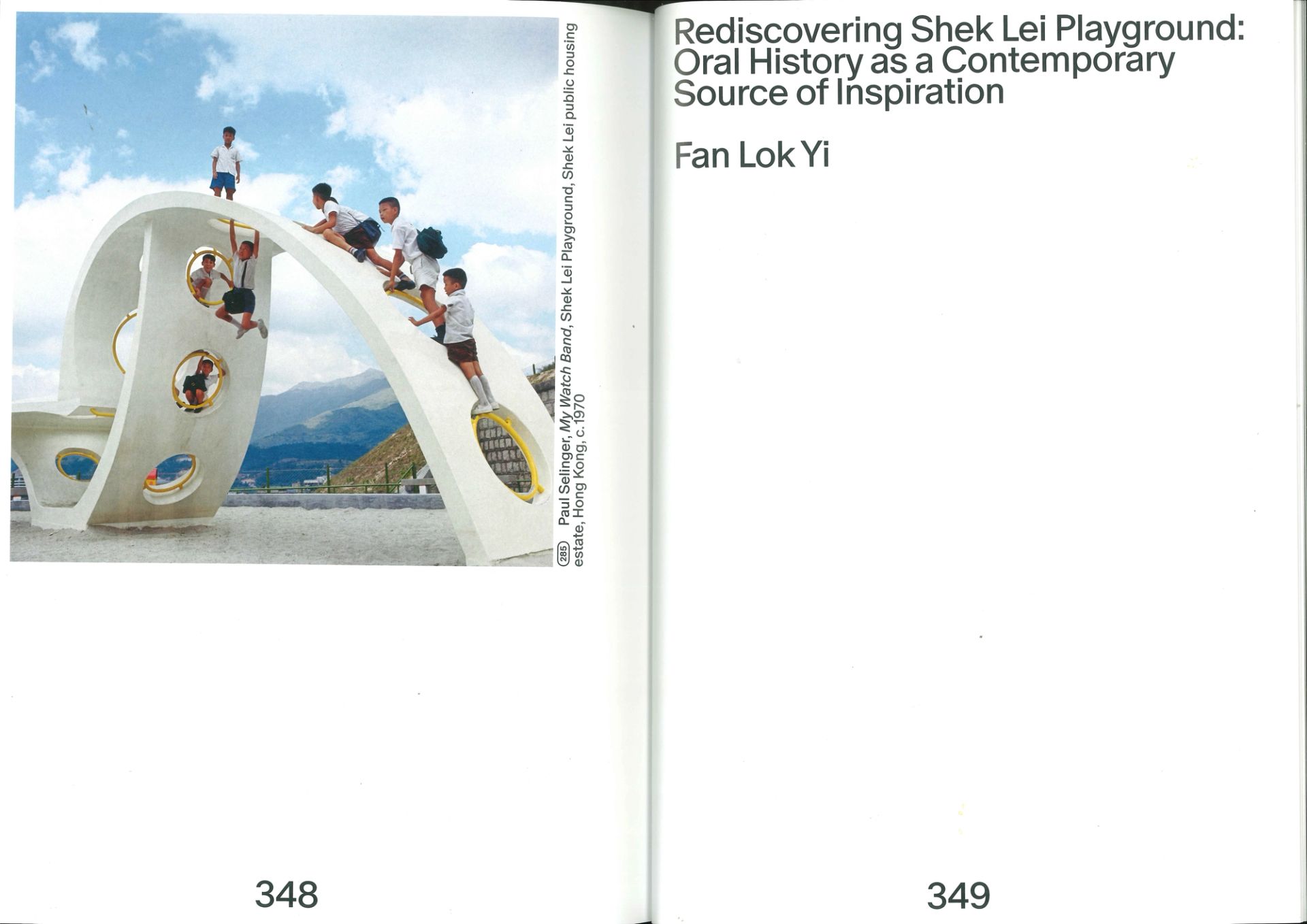
Scanned spread from The Playground Project, pp. 348. Image credits as printed.
Was Selinger successful in reaching his goal? Did his playground have the desired influence on the children who would once frequent it? Such questions can only be answered by way of oral history, since the feelings and experiences of playground users seldom, if ever, feature in grand historical narratives, and neither are architectural drawings or even photographs capable of fully capturing such subtle yet telling details.
All the interviewees expressed admiration for the sculptural forms of Shek Lei Playground. According to US patent records,6 Selinger would give names to his play sculptures. The largest, a ribbon-like piece with round holes, for example, was named My Watch Band. These names were not displayed on site, however, and were thus unknown to playground visitors.
For obvious reasons, many residents referred to the playground as Three-level Park or Sandpit, whereas children made up imaginative names for individual play sculptures. Currently employed in the creative industry sector, Jumbo Tsang, who would frequent the playground in the early 1970s, recalled how she would create her own fantasy world: “I imagined the Darts were rockets. Sam’s Handkerchief was a spaceship. The entire playground was an alien base.”
Besides the attractive forms, some interviewees commented on the slides’ smooth and comfortably cool terrazzo-like surfaces. Children would also come up with different ways of maximising the fun. “Sometimes we would grab a piece of cardboard and slide down sitting on it. We could go faster this way. We learnt that by watching other children …”, said Candy Lee, a former Shek Lei resident born in the 1980s. “We would also bring a piece of cloth and wipe the slide down before playing on it. I don’t remember if we invented that practice on our own, or was it my mum? It was probably my mum, as she didn’t want us to dirty our pants.”
Lau Wang Tat, an art teacher and ceramic artist who spent his childhood and teenage years in Shek Lei from the 1970s to 1990s, contributes an especially fascinating example of the playground’s influence. Though Lau left Shek Lei Estate in the 1990s, the playground remains a recurring theme in his drawings and ceramics. During our interview, he showed me detailed pencil sketches of the playground and nearby buildings, an ink drawing with marbled patterns in watercolours, and small ceramic sculptures of Shek Lei Playground’s darts, all of which were created from memory. “I want to reconstruct this playground in my own way. I hope to do a project or put up an exhibition…”, Lau explained. “I don’t have special feelings for other playgrounds. Firstly, other playgrounds are not as closely related to me. Secondly, Shek Lei Playground was unique in terms of its design, textures, and proportions [of play sculptures]. I never got tired of it.”
Children were not the only users and admirers of the sculpture park. Several former Shek Lei residents shared with us family photographs that were taken at Shek Lei Playground. Some remarked that due to the size of their families and overcrowded living conditions they preferred taking photos in the spacious playground, where the sculptures and murals provided an interesting backdrop.
According to a South China Morning Post article dated 7 May 1970,7 Selinger, who had meanwhile returned to California, planned to build similar playgrounds in the United States. Did any of his plans come to fruition? Tapping into the designer’s side of the story entailed contacting those with whom the artist had been personally acquainted. Through the Internet, I managed to get in touch with Matthew, Selinger’s younger son.
I flew to the US in the early summer of 2018 to meet Matthew and his wife Michelle in San Francisco. Matthew was born after his parents had left Hong Kong, and so he never experienced Shek Lei Playground or the city in the 1960s and 1970s. We focused on the periods before and after, on what had brought Paul to live in Korea and Hong Kong, and what he did upon returning to the States.
After this meeting, Matthew went through his father’s belongings and discovered dozens of slides showing his projects from different periods, including Shek Lei Playground, a large steel sculpture commissioned by Caltex, a solo exhibition in Hong Kong, and wooden play sculptures in various parks around the US. Not all images were related to Shek Lei, but together they reflected an evolution with respect to the style, material, and scale of Selinger’s works dating from the 1960s until his retirement in the 2000s. All this proved very helpful for my understanding of his art practice in relation to historical and cultural contexts.
Given that Hong Kong’s playgrounds have become increasingly generic in recent decades, among other things due to overdependence on proprietary equipment, risk-averse management, and a culture of complaint, the rediscovery of Shek Lei Playground could not be timelier, reminding us of the adventurous spirit and risk-taking attitude that was once so characteristic of the city. It is a welcome inspiration to create designs from ideas that resonate with children and the community, rather than confining our imagination to catalogue product lists. Is it possible to refresh our understanding of playgrounds as sophisticated public spaces that bring joy to people, rather than relying on collections of prescriptive equipment?
"Is it possible to refresh our understanding of playgrounds as sophisticated public spaces that bring joy to people."
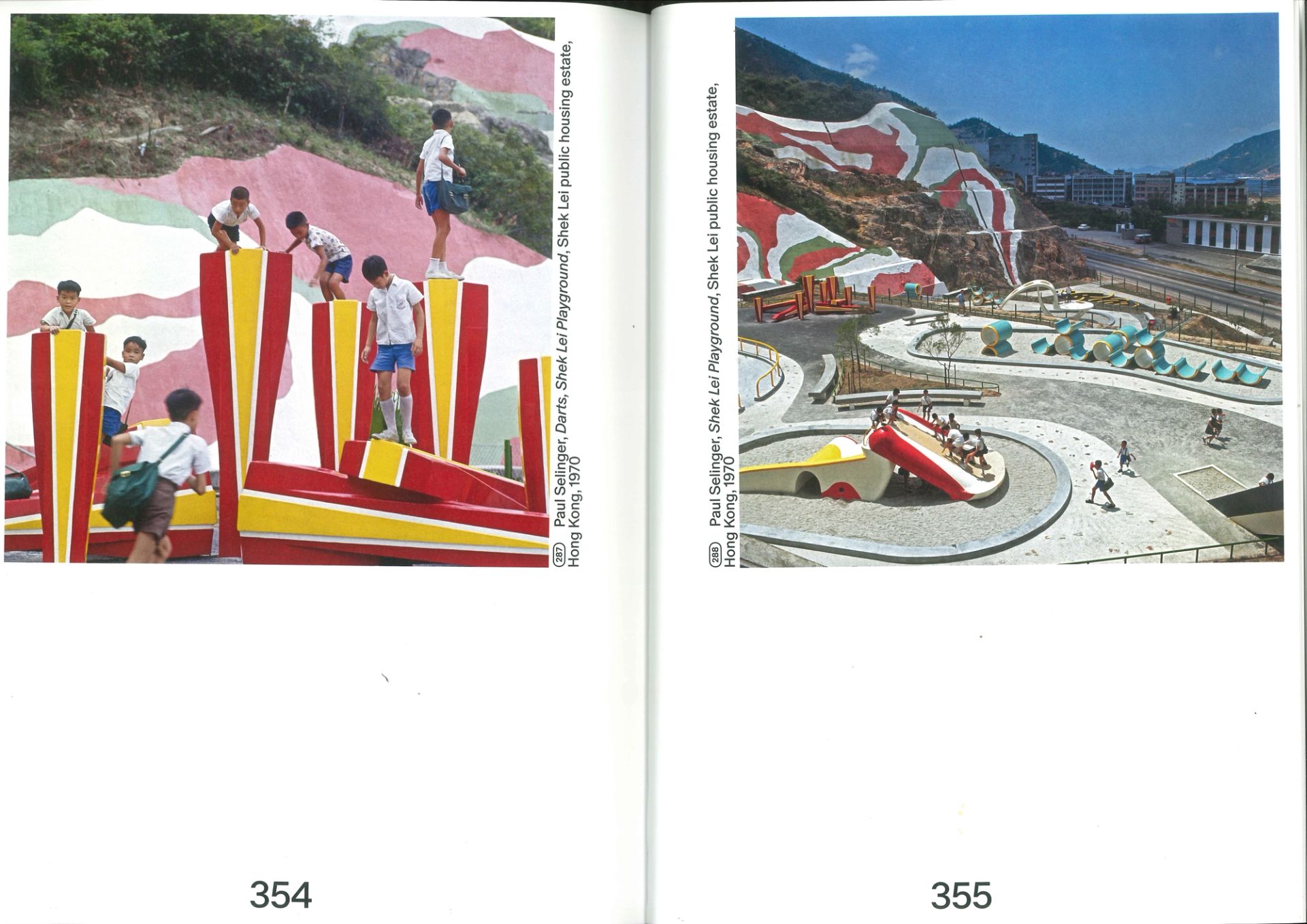
Scanned spread from The Playground Project, pp. 354–355. Image credits as printed.
Five years have gone by since I first saw photographs of Shek Lei Playground. I have written articles long and short, given talks to audiences ranging from primary school students to professional designers, and, in 2021, published The Abstract Playscapes of Hong Kong. I believe that Selinger’s beautiful sculpture park has meanwhile become the most talked-about case study in the history of children’s playgrounds in Hong Kong.
To keep the stories of playgrounds alive and relevant, it is not enough to just write and talk about them though. Following my publishing project, I started organising guided walks around three different neighbourhoods. My hope is that through this kind of knowledge sharing, participants will come to read the place in which they live differently and become more sensitive to their surroundings. I invited my interviewee Lau Wang Tat and his collaborator Siu Kam Han to host ceramic and cyanotype workshops. Adults and children were asked to make mini ceramic playgrounds based on their experience or imagination.
With the help of architectural drawings and photographs, physical models were built to help us understand the spatial experience and design features at Sha Kok Estate playground (built in the early 1980s), another abstract playground almost completely rebuilt and refitted with new proprietary equipment.
Finding high-quality photographs of the abstract playgrounds proved very difficult. Therefore I exhibited my research findings alongside scale models of several ground-breaking, though barely discussed local playgrounds from the 1960s to 1980s.8 These events were not only fun and engaging. They were also attempts to provide participants with the tools and vocabulary to keep history alive.
BOOK
Now in its third and expanded edition, The Playground Project (Park Books, 3rd ed. 2023) edited by Gabriela Burkhalter, became an instant classic when first published in 2018. As such, this volume reinvigorates a wealth of ideas from the mid-twentieth century period of optimism and experimentation to inspire architects, designers, students, children, and political actors today. It offers many previously unpublished images, numerous new portraits, especially of female protagonists of the time, as well as findings from the latest research on playground design.
BIOS
Gabriela Burkhalter is a political scientist and urban planner based in Basel, Switzerland. She is a researcher, writer, and adviser in the fields of play, architecture, and public space. She documents the history of playgrounds and is the curator and editor of The Playground Project, a travelling exhibition and catalogue. The Playground Project was originally conceived for the 2013 Carnegie International, Pittsburgh, and evolved into a playable version for Kunsthalle Zürich in 2016 and other museums.
Helen Fan (Fan Lok Yi) is a curator and artist based in Hong Kong. She works to reveal the connections between urban space, history, and the environment through research and collaborative artistic processes. Currently the Senior Curator of Make A Difference Institute, she has curated numerous community and cultural projects, including The University of Play series (2018, 2020–2021) and the Nature in the City series (2019). Her book, The Abstract Playscapes of Hong Kong (Brownie Publishing) was published in 2023.
All images are scanned spread from The Playground Project. Image credits as printed.
NOTES | The Playground Project (Introduction)
1. Marjory Allen and Mary Nicholson, Memoirs of an Uneducated Lady. Lady Allen of Hurtwood, Thames and Hudson, London 1975, p. 196.
2. Marjory Allen, Baroness Allen of Hurtwood née Gill, known as Lady Allen of Hurtwood (1897–1976), English landscape architect and champion of children’s rights and early childhood education.
3. Carl Theodor Sørensen, Danish landscape architect who formulated the multifarious social tasks of public green areas as early as 1931.
4. Robert Rauschenberg (1925–2008), US American artist, who launched the non-profit Experiments in Arts and Technology in 1966.
5. Robert Rauschenberg, “Proposal for Public Parks”, presented at the meeting of the New York City Cultural Commission, spring 1968, published in: TECHNE 1 (1) / 1969.
NOTES | Rediscovering Shek Lei Playground
1. Hong Kong: Report for the Year 1969, Hong Kong Government Press, Hong Kong 1970.
2. Rotary International, The Rotarian 121/August 1972.
3. Wong Yu-hin Sampson, 50 Years ago, Avant-Garde Playground: American Architect Claimed Hong Kong Was More Open than the United States! [translated from Chinese], https://www.hk01.com, 28 February 2017.
4. The play equipment Witch’s Hat was manufactured by Wicksteed, a British company.
5. Kai Tak Estate was developed by the Hong Kong Housing Society, a non-profit organisation founded in 1948 to tackle the post-war housing shortage. Kwun Lung Lau, another Hong Kong Housing Society estate, was developed between 1967 and 1968. Both estates had similar playground sculptures and equipment.
6. Catalog of Copyright Entries, third series, vol. 24, Part 7–11A, No. 2, Copyright Office, Library of Congress, Washington 1970, p. 356. https://archive.org/details/catalogofco1970324711libr/page/356/mode/1up?view=theater.
7. Sheila Wyndham, “If You Can’t Bear to See Blood”, South China Morning Post 5, HK diary.
For more about the project, see: Our Abstract Playscapes, https://abstractplayscapes.wordpress.com.