This conversation is part of an editorial partnership developed to mark the tenth anniversary of the M+ / Design Trust Research Fellowship, featuring a series of contributions by former fellows and invited practitioners reflecting on the programme's legacy and ongoing impact.
Federica Zambeletti/KOOZ Thank you for joining us. Let’s start on the topic of play, which is frequently treated as something informal or even peripheral to the planning of space. What happens when we take play seriously, as a means to think about public space? More broadly, what can play help us to understand about the way we inhabit, shape and share the city?
Gabriela Burkhalter The idea of play in the city is actually very old, but play spaces were not always considered separately. In general, play was just a regular activity that did not receive much attention. At some point, the playground was recognised as a means of educating and controlling children; later still — and this is the most important point for me — it was recognised as a creative hub. It was recognised that children are able to engage with the urban environment and play a role in creating a vibrant city. When cars came to dominate the city in the middle of the twentieth century, playgrounds became an important concern. It's somewhat contradictory that we now think of playgrounds as vital spaces for children, but they only received this prominence to protect children from traffic.
At the same time, we became aware of the role of 'free' space for the community. Children are a truly vulnerable group in cities today. In a sense, they represent other vulnerable groups, which should make us question how we share urban space — not only with children, but also with the elderly, people with different abilities, and marginalised communities.
"The playground was recognised as a means of educating and controlling children; later still — and this is the most important point for me — it was recognised as a creative hub."
KOOZ I'm interested in what drew you, Helen and Sampson, to the specific playground that you selected in Hong Kong, and how you engaged its specific history with a wider ecology of play.
Helen Lok Yi Fan It was a happy accident! I've always had a general interest in Modernist architecture, but not specifically on playgrounds. So it was by accident that I came across these stunning images of a 1960s playground in Shek Lei. Sampson and I were both born in the 1980s; we grew up playing with standardised parks and play structures. Hong Kong didn't have an adventure playground until last year, when the first one opened — so what we found was totally new to us. Looking at those photos, I was shocked that such designs had been built in Hong Kong back in the sixties and seventies; that piqued my curiosity, and I just couldn't help digging into the history of playground development in Hong Kong — especially Shek Lei.
Sampson Wong I believe Helen was working on a community program at that time as a curator; while looking at the history of a neighborhood, she came across some governmental archives of images. They were generic documents, but she spotted images of a strange structure on the mountain. If we had discovered these photos today, we might have thought they were made with AI — that’s how unusual they were for the time.
Helen and I also visited the Brutalist Playground installation, by Assemble in London. Even though Helen’s research was not focused on play at the start, we were intrigued by the fact that people are talking about brutalist playgrounds, and we wondered whether such spaces were ever built in Hong Kong.
Through the research, we discovered a rising interest in modernist and abstract playground design, from the 1950s through to the seventies — followed by their demise and the turn towards more standardised play equipment. The spirit and intention of making unique playgrounds has experienced a rebirth in the 21st century. We had the impression that Hong Kong was not overly involved in that story, but we came to realise that it was; this was a pattern, rather than something unique.
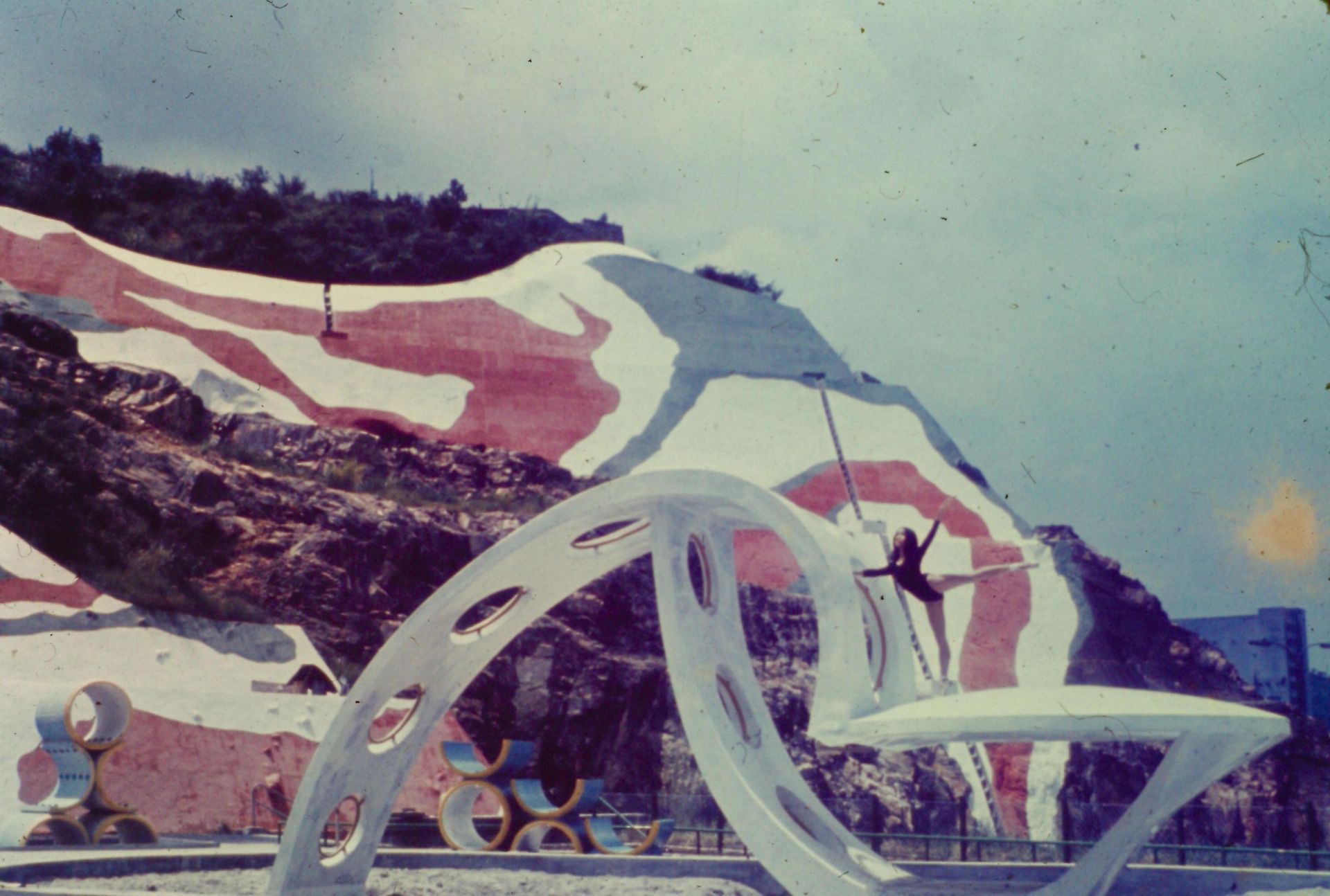
Shek Lei Playground, Hong Kong, 1969. Designed by Paul Selinger. Photo: Paul Selinger. Courtesy of Matthew Selinger.
HLYF The Shek Lei playground that we encountered was designed by Paul Selinger, an American artist who was living in Hong Kong at the time. We came to learn that in the 1960s, many European and American artists actually worked in Hong Kong, on commissions to create public art; for example, creating murals in hotel lobbies.
Today, in terms of playground or landscape design, everything has been hyper-institutionalised and professionalised. Back in the sixties, the profession of landscape designer was not broadly understood; there was a certain freedom for an artist like Selinger. He simply approached the government and proposed to build a playground for children living in the nearby housing estate — this is unimaginable today.
KOOZ Gabriela, you began by framing playground design as a partial byproduct of vehicular traffic in cities, with incredible experimentation in the postwar decades. Following the advent of standardisation in the late twentieth century, many playful collaborations with artists gave way to specialised companies. Can we talk about the importance of that experimental period, in relation to The Playground Project, which archives and examines the historic and ongoing development of playground design?
GB Like Helen, I think that period was exceptional — not only in terms of experimentation in playground design, but also in art, architecture and society more broadly. Upon discovering experimental playgrounds, both in images and in reality, I had similar experiences to Helen's. I couldn't believe that so many ideas were actually built, which would not be possible today.
The mission of The Playground Project is, on the one hand, to compile an archive of experimental post-war playgrounds. Historically, such places were considered a sideline of urban design and were therefore rarely preserved. While many buildings are recognised as part of urban heritage, playgrounds rarely are — that's the sad part. I wanted to document the variety of approaches and recognise the dedicated individuals behind them. Everyone I met was strongly engaged with the challenge of designing playground spaces. Often, people worked for free as playgrounds rarely commanded a large budget — they were more of an idealistic undertaking, which I found quite inspiring.
Conversely, playground design has been approached as a category of artwork in its own right, which can diverge significantly from the norm in terms of how playgrounds should function. For instance, Michael Grossert's playground at Aumatten Primary School in Reinach, Switzerland, was constructed entirely from concrete. Reflecting on it now, it's not the safest play space — yet it's an artistic design proposition for a specific space that can be handed over to children.
Like Helen, I didn’t initially have a strong interest in playground design, but having children and living in Basel made me realise what an interesting design challenge they present to the city.. Ideally, the archive would provide examples for young designers today, but this creative freedom is no longer possible due to safety requirements. This is the result of the increasing focus on child safety rather than freedom. However, I hope The Playground Project will still invite all sorts of people to create something in this spirit — not exactly as it happened in the sixties and seventies, but we can learn what play means in our own time. I believe this is still possible.
KOOZ Due in part to the scarcity of archival information — to which Gabriela alluded — I believe you started talking with the people who had engaged with the Shek Lei playground during its lifespan, either as children or as adults. Could we hear about the importance of these oral histories?
HLYF One interesting aspect of this research project is how it changed my ideas about what playgrounds are and the possibilities they can present. In the case of Shek Lei, Selinger did indeed perceive it as a work of art; as a sculptor, he approached it as a sculptural project. That's already very different from the idea I had: in Hong Kong, playgrounds are largely viewed as functional facilities that governments are obliged to provide, according to certain urban planning standards.
At Shek Lei, Selinger designed the park according to the landscape; he was given a site across three levels with a steep, ugly slope left over from excavation. From archival interviews, we learned more about his approach towards the site itself as a large-scale artwork; he actually named every sculptural feature, although he never labelled any of them. In turn, the people who played there came up with names of their own for every sculpture. They also made up names for the park; some people call it the three-level park, or the sand pit, or the space park; visitors were free to interpret what the space meant to them, which is a really beautiful offer. It was not only used by the children; in the evening, older people would catch up with neighbours and during festivals, people would place lit candles on the play-sculptures.
Sampson wrote an article about the project and put out a call for interviewees in 2016, and we had an overwhelming response from people who used to live in the area. Everyone was eager to share their memories of Shek Lei, and that level of excitement and sentiment was really moving.
SWSome people have bad memories of living in public housing estates — but with playgrounds, it has all been very positive, and its legacy is still unfolding. For example, Helen encountered an artist whose career was inspired by his childhood memories of that playground — he became a sculptor. I think the legacy of the twentieth century is particularly loaded; in the nostalgic celebration of Brutalist architecture, the point is in the realisation that we can't go back to the idealism of a particular era. Yet around the playground, there’s more positivity; it feels like the comments and memories people share could actually generate something new.
"In the nostalgic celebration of Brutalist architecture, the point is in the realisation that we can't go back to the idealism of a particular era."
HLYF I also think that playgrounds are especially tactile spaces. They don't have to be overly functional in a productive sense, so designs can be very experimental: it’s about creating experiences. As a visitor, you need to touch, climb on and physically handle the space. If you go to the bank, you generally do your bank business; normally, you don't touch the walls (unless perhaps you’re an architect!) In this sense, playgrounds provide a very intimate and physical experience. Even though the design of such spaces is historically overlooked, they're actually very important to many people.
KOOZ As Helen and Sampson pursued their fellowship, the Design Trust Future Studio initiated several projects around meaningful play, ultimately building four micro-playgrounds. Marisa, you were involved in the research, design and support for these spaces in Hong Kong; could you talk about your path on this project since 2017, and the importance of play in the city?
Marisa Yiu Thank you. I grew up in 1970s Hong Kong, with memories of very different, neighborhood playgrounds. When you ask what play means to us, we see play as a basic human right that should be accessible to all demographics and communities. Yet the questions that come up — as an architect, curator or leading the Design Trust foundation — revolve around questions of who designs our city, who makes decisions and what are the design briefs, guidelines and policies behind them?
When Sampson and Helen submitted their M+/Design Trust Research fellowship proposal about this particularly radical playground, it sparked a lot of discussion. At the same time, I was already building this mentorship community studio, to unpack the possibilities of 1500 public spaces, within the dense city of Hong Kong, where affordability means that people are living in ever-smaller spaces. There was an urgency to address that, and we used the word ‘play’ to open that concern up to a larger audience — not only to the creatives — to participate in designing our city; but also to claim back the potential of small parks, and even drive the transformation of policy. We created a whole series of radical, mobile, construction-skip parks that could be moved around the city, to allow children (and adults) in various neighbourhoods the opportunity to play in them.
According to Hong Kong guidelines, those wonderful merry-go-rounds were banned due to insurance and liability issues; I used to love those as a child growing up, as well as reaching roughly 12 to 20 feet (about 3.5 to 6 meters) tall tall slides. The rush of adrenaline, the ability to get your hands and knees dirty, building a community together with friends and neighbors — all of that was really lacking. I also remember being inspired by examples abroad: visiting Berlin, seeing upcycled car tires as swings, to experiencing the 2012 innovative Sydney Darling Quarter development and designers investing in water-play.
"The rush of adrenaline, the ability to get your hands and knees dirty, building a community together with friends and neighbors — all of that was really lacking."
This began our critical process of thinking about “smallness” hence the DESIGN TRUST FUTURES STUDIO project theme “Play is for the People”; it allowed us to reflect on the high number of subdivided flats and micro-apartments, a phenomenon that became common from the early 2000s onwards. The booming property market, created a lot of friction and difficulties for all communities in terms of access to play; for us, it was especially important to push for inclusive playgrounds for disadvantaged communities and for universal access.
Today, there are some amazing nonprofits in Hong Kong — like Playright, and individuals like our research fellows Helen and Sampson — who are shaping a new understanding of the importance of the public realm. Over the last 12 years, Design Trust has been championing much of this work through grant-giving, working alongside many passionate people. Gabriela’s observation is right: we all volunteered for endless unpaid nights, to advocate and build agency for change. We found four pilot test sites across Hong Kong and conducted a lot of analysis on the ground, as well as speaking with architects and politicians with decades of years of experience to workshop together. I hope we were useful and good partners because we are neutral; with no political agenda, other than asking ourselves: can design empower people to participate?
I recently received a letter from the owners and managers of this public park in Tsuen Wan district that we revitalised at ‘Yi Pei Square Playground’ that was transformed into a vibrant ‘Communal Living Room’ micro-park, which officially reopened in April 2021, a beautiful site in the courtyard surrounded by 1970s housing blocks; that intervention is past its five year mark now. They told us that the park is so popular that it is becoming over-used, as the conditions are also deteriorating, they asked us what we might do next. It is very successful example, firstly of introducing new plant species for increasing greening ratios and secondly, in creating customised playground equipment, designed to enable elderly visitors and young people to enjoy the space together; however, upkeep and maintenance is important
Thinking about the work that we all do, in response to Hong Kong’s specific issues and climate, the concerns are very layered. It is a really important way to bring communities together — hence the complex stakeholder meetings. One of our mini playgrounds required 300 meetings from start to finish; what would have been a one-year process turned into a three and a half years! We have shown possibilities, and I always look back to Shek Lei playground to remind us to think about how design revolutions might happen: the combination of public and private stakeholders, with bottom-up grassroots activations, which succeeded in driving engagement within the neighborhood community but can be long lasting.
KOOZ Helen, you have written beautifully about how to keep the stories of playgrounds alive and relevant — while Sampson has taken on the act of walking as a way to embed oneself in the city. Could you share some of these reflections?
HLYF Many people would say it's very difficult to drive any change in Hong Kong; perhaps it’s all the bureaucracy. The first step towards change is to gain knowledge: for example, if you want to change playgrounds, you could start by reading Gabriela's book in order to learn about historical examples. You would find that playgrounds have always been more than just spaces for children to play; they're actually multifaceted social spaces for social, educational and design experiments. You also have to learn from experience and see these sites for yourself: if I didn't go to Switzerland, I would never have known about that sculptural primary school courtyard that Gabriela mentioned.
"Playgrounds have always been more than just spaces for children to play; they're actually multifaceted social spaces for social, educational and design experiments."
SW A few years ago I met the artist Shirley Tse, who was representing Hong Kong at the Venice Biennale of Art at the time. We had a conversation about observing the street, how people play with the city and how non-functional relationships with the urban fabric inspired her to create the sculpture. Specifically, we talked about how people play badminton everywhere in Hong Kong — not in courts, but in public space. These people playfully transform the city, imaginatively turning public space into sporting arenas. Having been interested in designated playgrounds, we are also very interested in the ways that everyone can playfully engage with the city.
Back in the sixties, the architect Aldo Van Eyck stated that he would view the whole city as a playground. Now that I'm interested in walks, people often assume that it’s something to do with health or well-being. I'm actually much more interested in experimental walking, in which the walk itself is treated like a game. Recently I heard about someone who walked along the route of the MTR (Mass Transit Railway) on the ground.
KOOZ Your research demonstrates that for a play space to be successful, it needs to be one that accepts and is generous to a range of different communities. Yet if such sites are becoming more standardised, how do we reclaim the city as a playful space?
GB For me, the playground as such is a somewhat lost typology today — precisely because it's so regulated; indeed childhood is increasingly regulated, and children are constantly supervised by parents and caregivers. In fact, I see more potential in what you suggest: something like the playful city, where one can find niches that offer the freedom to play. The playground no longer offers much freedom; not unless it’s in a semi private space, or if the landscape is raw, lacking standardised ‘play’ equipment. In such locations, there may still be an aspect of adventure; elsewhere we have to find other ways.
Of course, I like the idea of the non-functional city; it's a beautiful image and I think we should engage different groups of professionals — including architects and landscape architects — to spread such ideas, so more people can contribute to make space more playful. What we can see now are spaces where people can work out, as they do in the gym but in public space. Apparently people love and use these facilities, but the goal is fitness: it's highly functional, lacking the openness required for different actors and activities.
Another aspect of society in Europe is that our urban populations are getting older, and by this less playful. Perhaps it’s different in Hong Kong; in Switzerland you can feel it more and more.
HLYF We're facing a similar situation in Hong Kong — a very serious ageing issue.
MY Hong Kong itself is actually 75% countryside; technically only 25% of the city is densely urbanised, so our focus was always on ‘acupunctural’ spaces. Even the smallest park, is an external space to relax, to breathe, to play, or to get away from your family. I have young children, they are super athletic and of course we need to cater for that demographic — but I also have parents in their eighties. Particularly in Asian cities, there's such an intense demand for urbanisation: what else can happen in playground spaces that exceed the basic needs?
"Particularly in Asian cities, there's such an intense demand for urbanisation: what else can happen in playground spaces that exceed the basic needs?"
Another project we did called “Sitting-Out Area under Hill Road Flyover” attempts to show respect for cultural traditions: the chess tables are fitted with comfortable seats, allowing older visitors to play their games and facilitate intergenerational play. We have also built some pilot playgrounds that actually share collective memories on their surfaces — allowing all visitors but particularly those with visual impairments to ‘read’ and learn about local history. In this way, playgrounds also become didactic learning devices; more of us, want to know about historic contexts and the cultural identities of neighbourhoods. Another team of young park designers, mentored by Sam Jacob studio, looked at colour studies to aid in decriminalising a specific area yet provide a playful contrast to the surrounding area. Gabriela, do you know of any examples or studies that allow for multiple users to share the space of play — let’s say between calmer and messier spaces?
GB I’m not currently based in a research position, so I may be unaware of the most recent innovations; what I can see in Europe is a growing tendency towards designated child-free space. It's a little bewildering; society is increasingly sectioning itself into different groups. It’s true that an adult without a child may not feel so comfortable around playgrounds, purely because it could be perceived by others as being suspicious. Yet public space in general is a major focus, as more people wish to enjoy life outdoors. Urban dwellers are more aware of the potential of their specific city — look at the proliferation of activities on waterfronts, in public squares or as in Basel, in the public fountains, where children and young people like to bathe in the summer. The fountain was not built for this purpose, but it is spontaneously taken over.; this doesn't require any design. I see more potential in such spontaneous and temporary initatives that come from the bottom up:to take a piece of city and transform it into a more open and accessible space. That's where I see change: beyond the playground.
"I see more potential in such spontaneous and temporary initatives that come from the bottom up:to take a piece of city and transform it into a more open and accessible space."
SW I would add to Gabriela's point about the hope or potential that activation by play could reframe existing features in the city; there may be no need for new designs. I’m also intrigued by games; specifically mobile phones and computer games that have been invented to playfully interact with and ‘use’ the city. For example, the mobile app Pikmin, released by Nintendo, which requires a group of people to act upon the surface of an earth-like planet. In navigating the city, I think gaming could be another platform to showcase human creativity.
HLYF Recently, I’ve noticed a very curious revival on the streets of Hong Kong and Taiwan: people are playing spinning tops in public. We had been worried — as many people are — about the doomscrolling habits of the younger generation; right now, you can see plastic arenas outside stores where people have spinning-top battles — it's quite an amazing and incongruous scene. Many people — adults and elders as well as children — have been coming out to play together.
One thing I learned from our historical research is to appreciate ambiguity; as Gabriela said, today everything appears to be clearly defined. In one of the micro-parks supported by Design Trust, there is an artificial landscape of play mounds. Small children like to clamber up on them, while others use the mounds to sit and relax; the space is inclusive in the sense that it serves people of different ages and abilities, for different purposes. This can be described as design with a high level of affordance, in terms of the actionable possibility that an environment can offer its users. In the future, we need to consider how to design in a way that embraces ambiguity, as we encourage wider, intergenerational exchange.
"One thing I learned from our historical research is to appreciate ambiguity."
KOOZ The need for ambiguity is a wonderful point on which to close our conversation today. Thank you so much for sharing your thoughts on play, it has been a delight.
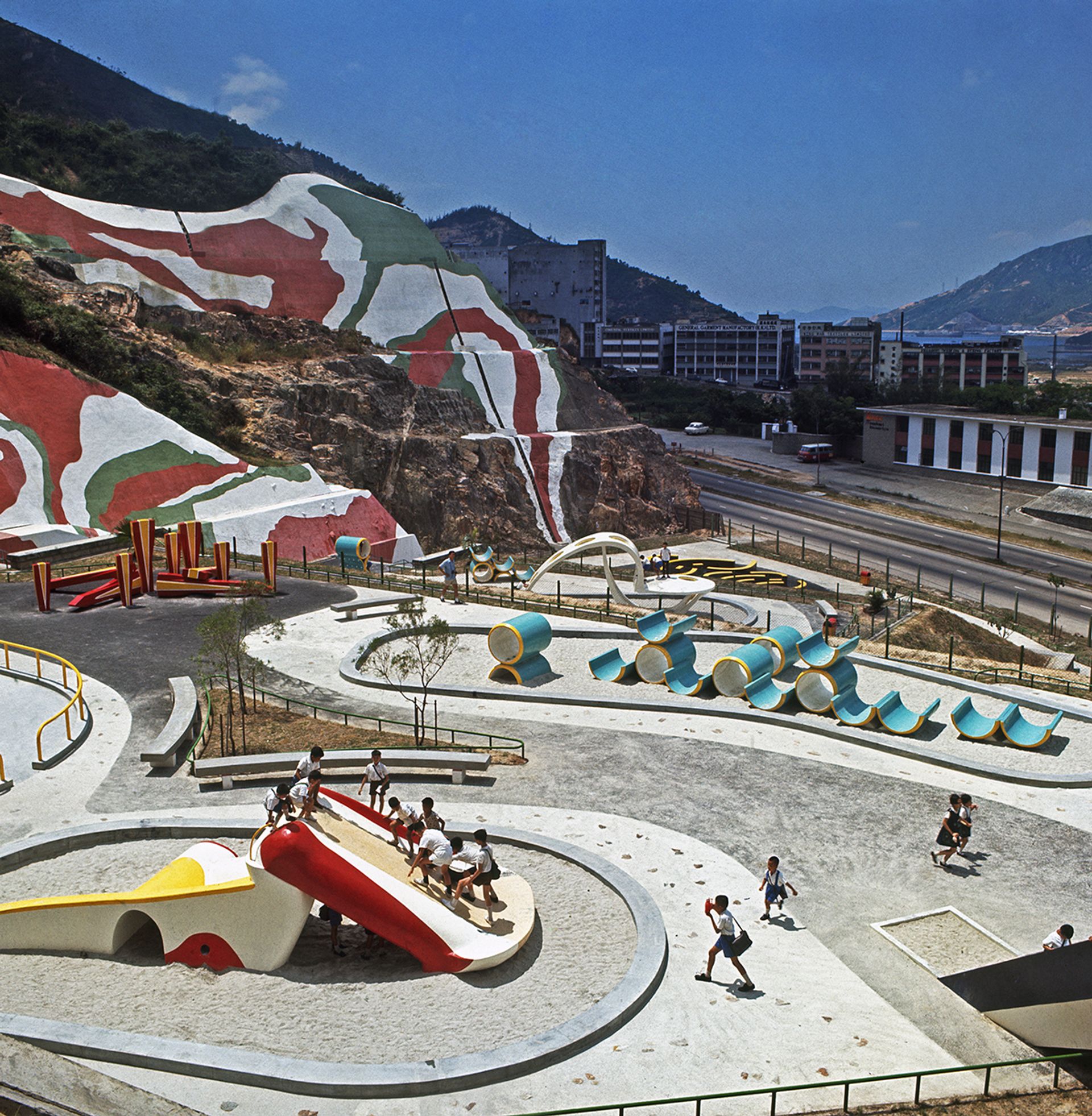
Shek Lei Playground, Hong Kong, 1969. Photo: HKSAR Government / Paul Selinger, c/o Matthew Selinger.
About
The M+ / Design Trust Research Fellowship (2015–2025) was a pioneering decade-long collaboration between M+ and Design Trust that supported original curatorial and scholarly research into design and architecture across Hong Kong, the Greater Bay Area, and Asia through a transnational lens. Bringing together fourteen research initiatives over ten years, the fellowship fostered critical investigations into regional histories, cultural production, and contemporary practices, significantly contributing to the broader discourse on design and architecture in Asia and informing future research, exhibitions, and collections at M+
M+ is Asia’s global museum of contemporary visual culture. Located in Hong Kong’s West Kowloon Cultural District (WestK), it is dedicated to collecting, exhibiting, and interpreting visual art, design and architecture, moving image, and Hong Kong visual culture of the twentieth and twenty-first centuries. The museum stewards a multidisciplinary permanent collection that includes objects from regions across Asia and beyond. Today, M+ is a nexus for researching and presenting contemporary visual culture, inspiring thought and curiosity.
Design Trust was established as a grant-funding and community platform in 2014 by Hong Kong Ambassadors of Design, a registered charity in Hong Kong since 2007. Design Trust supports creative projects that develop expertise and build research initiatives and content related to Hong Kong and the Greater Bay Area. Working across a multiplicity of design disciplines, from graphics, media, and architecture to the built environment, Design Trust aims to actively accelerate creative research, design, and the development of meaningful projects that advocate for the positive role of design.
BIOS
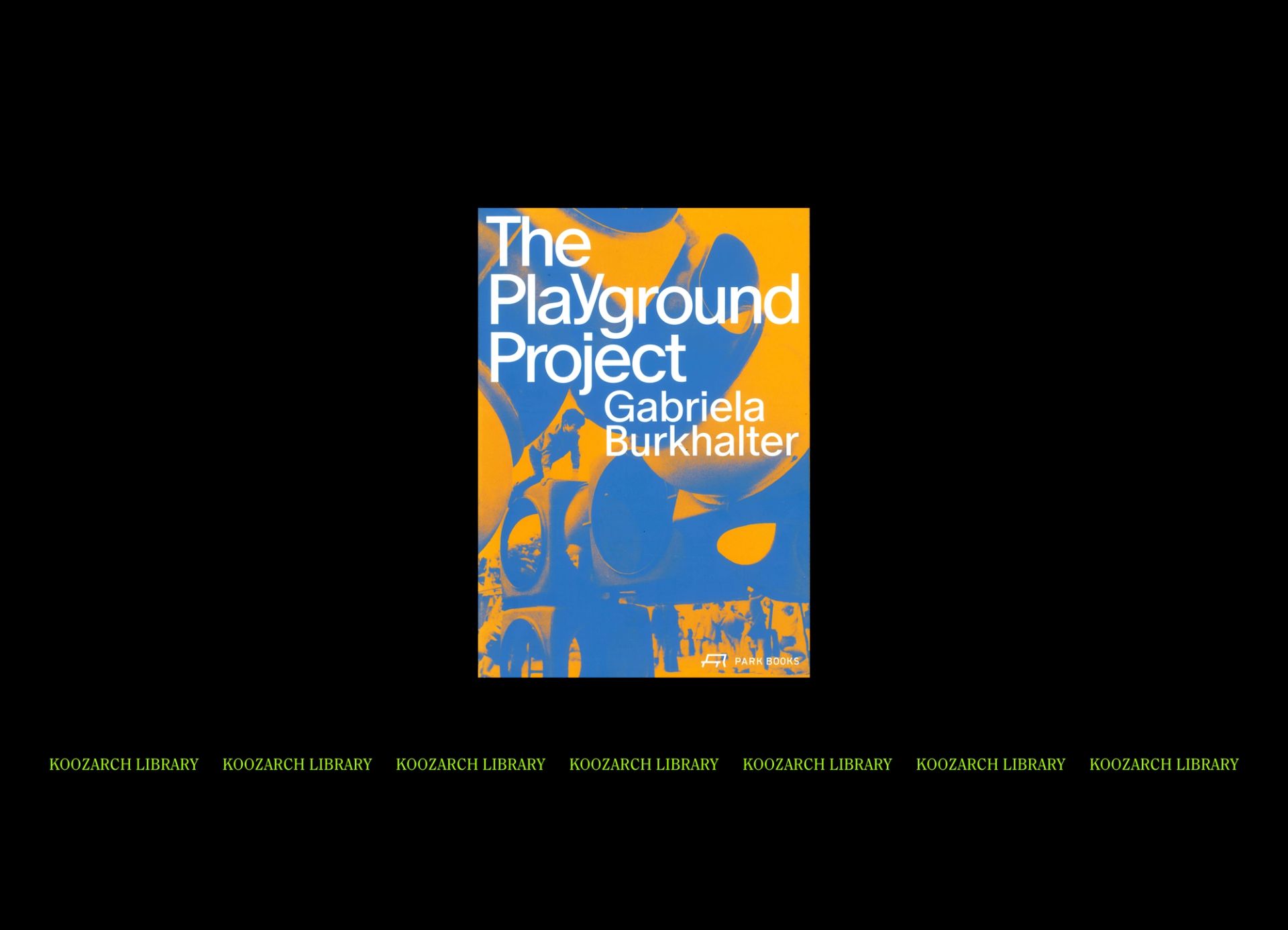
Gabriela Burkhalter is a Swiss urban planner and political scientist specialising in play, architecture, and public space through curatorial research and advisory work. Since 2008, she has documented the history of playgrounds through her open-access archive, Architektur für Kinder: The Playground Project. She is also the curator and editor of The Playground Project travelling exhibition and catalogue (Park Books, Zurich, 2023).
Helen Fan (Fan Lok Yi) is a curator and artist based in Hong Kong. She works to reveal the connections between urban space, history, and the environment through research and collaborative artistic processes. Currently the Senior Curator of Make A Difference Institute, she has curated numerous community and cultural projects, including The University of Play series (2018, 2020 – 2021) and the Nature in the City series (2019).
Sampson Wong is a writer, artist and urbanist from Hong Kong who runs the Strollology Project to promote urban walks and to explore the possibilities of urban walks. His books include Hong Kong Strollology, Urban Strollology, This City is Hong Kong and Learnign to Stroll.
Marisa Yiu is the Co-founder and Executive Director of the DESIGN TRUST initiative, which supports creative and research content related to Hong Kong and the Greater Bay Area within an international context. She has been instrumental in shaping the growth of the NGO since 2014, creating the Design Trust Futures Studio programme. Yiu is also trained as an architect and Founding Partner of award winning practice ESKYIU. Yiu was the Chief Curator of the 2009 Hong Kong & Shenzhen Bi-City Biennale of Urbanism\Architecture located at the West Kowloon waterfront; and curated Studio-X Shenzhen.
Federica Zambeletti is the founder and managing director of KoozArch. She is an architect, researcher and digital curator whose interests lie at the intersection between art, architecture and regenerative practices. In 2015 Federica founded KoozArch with the ambition of creating a space where to research, explore and discuss architecture beyond the limits of its built form. Federica is an Architectural Association School of Architecture in London alumni.