Charles Teyssou Before we begin, I should tell you that the reenactment of Soft Space at Stavanger Secession worked incredibly well. It was hugely popular. We had architects, students, and many children — probably the children of architects.
What was especially interesting was the psychological reaction people had to the installation. At first, when the foam only reached about one meter in height, it felt playful and euphoric. But once it continued growing beyond that point, people became anxious. They started wondering where it would stop, how the form could be exceeded, whether the structure would swallow the space entirely. The foam started invading the windows, climbing the walls, entering the architecture itself. The atmosphere shifted from excitement to genuine unease. It was a fascinating experience.
Wolf dPrix Soft Space was fundamentally a statement. We wanted to show that space could be built instantly. We created about 1,300 cubic meters of space in one minute, so nobody should tell us that architecture necessarily requires decades to exist. We don’t need a hundred years to build a cathedral, as in former times. Architecture can emerge immediately. The fact that Soft Space occupied the façade and spilled into the street was also important. The cars were covered; the city itself became absorbed into the work. Yet the central statement remained: there is no reason that architecture must take a long time to appear.
The same principle applied to Hard Space, where heartbeat-triggered explosions generated spatial conditions. Human movement altered the environment directly. If your heartbeat accelerated because you were excited, the explosions accelerated as well. If you relaxed, the rhythm slowed down. We were trying to demonstrate that architecture should be connected to the body, to the people inhabiting the space, transforming it through movement. At that time, we were extremely optimistic about the future. We believed environments could be transformed within minutes — not through violence or war, but through positive transformation.
"We believed environments could be transformed within minutes — not through violence or war, but through positive transformation."
Intellectual Beginnings — Vienna, London, Los Angeles
CT I wanted to return to the beginnings of Coop Himmelb(l)au, especially the importance of Günther Feuerstein’s Club Seminar. You often mention it as a formative moment.
WdPFeuerstein was the assistant of one of our professors at the Technical University in Vienna. At that time, architecture was dominated by rational systems. Everything had to fit into a rigid structural grid — seven metres fifty by seven metres fifty. Rational architecture was considered the only legitimate architecture. But Feuerstein introduced us to entirely different possibilities. He gave a lecture series called Contemporary Architecture and through him, we discovered architects outside Austria and outside Europe: Paolo Soleri, Bruce Goff, vernacular architecture, Architecture Without Architects. That became our point of departure.
The Technical University was a mass institution with nearly one thousand architecture students. Feuerstein believed that meaningful ideas could only emerge within smaller groups. So he assembled around fifteen or twenty students whom he considered especially talented. We met regularly to discuss projects and speculate about the future of architecture. That was the Club Seminar.
CT Were you already in contact with the Italian radical architects at that point?
WdP Not right away. We were initially much more oriented towards London and the Architectural Association. Archigram was far more influential for us than the Italian radicals. To us, many Italian radical architects remained tied to the authoritarian monumentalism inherited from the Mussolini period. Only Superstudio truly escaped that rigidity by introducing philosophical speculation into architecture. We were also interested in Ant Farm in America. This is especially true for projects like driving a dragster through a wall of televisions.
CT You studied first in Vienna, then London, then Los Angeles. What did each city give you intellectually?
WdP We wanted to meet Archigram, so London was important for us. The AA was probably the most influential architecture school in the world at that time. We met Peter Cook there, and later became close friends. Then we became interested in the American scene. We had an exhibition in New York and met people like Michael Sorkin, Lebbeus Woods, and Steven Holl.
In Los Angeles, I encountered Morphosis, Eric Owen Moss, and the SCI-Arc environment. I was invited to teach at SCI-Arc. At the same time, an extraordinary client commissioned us to build a house in California. He was a Viennese psychoanalyst living in San Francisco. He told us, “I have read your texts. Build whatever you want. Find the site yourselves.” So I drove from San Francisco to San Diego searching for the location.
What fascinated me was that we never discussed the formal appearance of the house. We never said it should be steel, wood, or concrete. We discussed atmosphere. One day, I suddenly felt the house psychologically before I could visualise it architecturally. I drew the first sketch with my eyes closed because I did not want to produce a conventional architectural drawing. I wanted a psychological drawing. The pen became almost like a seismograph registering emotion. We immediately transformed the sketch into a small model, then measured the model and produced plans. The structure was technically extremely ambitious.
When we submitted it, the engineers said the steel frame could not be welded the way we imagined. So we built the steel structure in Austria, transported it to London for an exhibition, then shipped it to Los Angeles. But during the exhibition, the client died. His children did not want the house. So the project ended there. But that experience is one reason I remained in Los Angeles and continued teaching at SCI-Arc.
Psychology, Freud, and Deconstructivism
CT Psychology appears absolutely central to your work. In several interviews you refer to the German term Entwerfen. Could you explain what this means for you?
WdP German is sometimes more precise than English when it comes to psychology. First, remember that we are Viennese architects. Freud was part of our intellectual education from a very early age. Even in high school we studied psychoanalysis and the unconscious. I still think deconstructivism is deeply rooted in Freud, not only Derrida. Derrida himself inherited many ideas from Freud.
Both Freud and Derrida argued that every artistic work contains unconscious elements — hidden zones, blind spots, fragments that emerge without deliberate control. American interpretations of deconstructivism misunderstood this entirely. They reduced it to fragmented form-making. But for me the important issue was always the unconscious dimension. That is why the sketch for the California house mattered so much. The drawing with closed eyes wasn’t just a stylistic gesture; it was an attempt to access another psychological register.
CT It made me think about surrealism, especially the tension between automatic writing and Dalí’s paranoid-critical method.
WdP Freud would reject the idea that the unconscious is a method. Our entire daily life is already ruled by the unconscious. Of course, architecture requires practical systems and technical procedures. But architecture becomes banal when it only follows efficiency, economics, and geometric rationality. The profession became trapped in self-fulfilling prophecies.
Architects explain architecture through methods instead of emotion. That is why so many buildings are stupid. We wanted to break those rules. We believed architecture needed emotional intensity. And we also believed architecture had to absorb influences from outside itself. I often use the example of Pep Guardiola. He transformed football by importing movements from basketball, handball, and ice hockey. We tried to do the same with architecture. Why should architects only look at Greek temples? Why not racing cars, machines, music, aeronautics? If architects only think architecturally, then only architecture comes out.
"Architects explain architecture through methods instead of emotion. That is why so many buildings are stupid."
Surrealism, Kiesler, and Keith Richards
CT Were there specific surrealist or proto-surrealist architectural experiments that inspired you — for example, Kurt Schwitters’ Merzbau or Frederick Kiesler’s Endless House?
WdP Kiesler was essential. If someone asks me who our role models were, I often answer provocatively: Keith Richards. People never understood this. At that time, postmodern architects constantly referred to other architects. I wanted to escape that. But if we speak seriously, our great heroes were Piranesi, Kiesler, and Corbusier.
CT I was interested in the comparison with Keith Richards while preparing for this interview — not in the sense of “architect as rock star”, but methodologically. Could we compare architectural composition to the way Richards constructs riffs?
WdP Absolutely. But the most important thing is teamwork. Coop Himmelb(l)au always functioned collectively. We figured out that when our kids are playing in the sandbox, one of them would build something and the other would not destroy it, as many children do. Instead, they would add another piece and continue it. That became the method we used. Whoever moved faster in a particular phase took the lead. I drew faster; Helmut built models faster. We constantly extended one another’s work. That gave our process enormous speed.
Poetry, Manifestos, and Emotional Architecture
CT The first time I encountered your work was through Anthony Vidler’s Warped Space. I remember being struck by lines such as architecture needing “the straightforwardness of the path of a bullet in the dealer’s head on 42nd Street.” You also wrote manifestos such as The Poetry of Desolation or The Blazing Wing. Writing in your work seems autonomous. It does not merely illustrate buildings. What role does poetry play in your practice?
WdPThere are two ways to describe architecture. One is technical. That’s easy. But before renderings and digital simulations existed, clients could not fully understand drawings or models. So I tried instead to describe the feeling of entering the building. That is why I used metaphors. Not “steel,” “glass,” or “concrete,” but sensations. The goal was for the client to emotionally anticipate the future experience of the building. Sometimes, clients later told me the finished building felt even more intense than the text itself. That was the greatest compliment possible.
CT Yet your texts are also extremely dark. You wrote that architecture should bleed, tear, burn…
WdP The famous sentence is: “Architecture must blaze.” We were reacting against the banality of postmodernism. We wanted architecture capable of producing emotion. Cold like ice. Burning like fire. At the same time, some texts were directed against authoritarian urban conditions. For example, cities full of beautiful green lawns where signs prohibited people from walking. I said it was better to have asphalt people could step on than grass one is forbidden to touch. That was not provocation for its own sake. It was a demand for freedom. We also advocated imperfect materials. Trash materials. Unfinished architecture. We often built only the Rohbau, the raw structural shell, and allowed inhabitants to complete it themselves.
"It was better to have asphalt people could step on than grass one is forbidden to touch. That was not provocation for its own sake. It was a demand for freedom."
White Suit, Accident, and Instability
CT I wanted to return to the notion of accident. I initially understood White Suit as somehow broadcasting catastrophe.
WDP No, no. White Suit was a project about extending media physically. We designed a pneumatic helmet and vest connected to audiovisual systems. One program transmitted erotic sensations. The other simulated a car crash. The helmet delivered smells and sounds. The pneumatic vest physically compressed the body. We wanted to enlarge visual information into total sensory experience.
CT What interests me is that your architecture still seems to preserve traces of collision or wreckage. For example, at the Red Angel Bar in Vienna, metal beams appear to burst violently through the architecture. Your buildings often seem psychologically unstable — which is revolutionary because architecture traditionally tries to project solidity. John Ruskin argued that buildings should morally communicate permanence and strength. Your architecture often does the opposite.
WdP You are right and wrong, at the same time. My line is always: everybody is right, but nothing is correct. The Red Angel was conceived as a stage. The owner already had the name “Red Angel”, so I designed an angel-like figure bursting through the doorway and extending its wings over the performers. The gesture is not aggressive: the wall simply stood in the way of the idea. Architecture always poses a choice: Is the existing wall stronger than your idea, or is your idea stronger than the wall? Many architects stop at the wall. We preferred to drill through it. You can always solve the problem technically — the real issue is conceptual courage. Of course, sometimes the existing structure is stronger and you accept it. But in our generation, we refused to automatically bow down to the past.
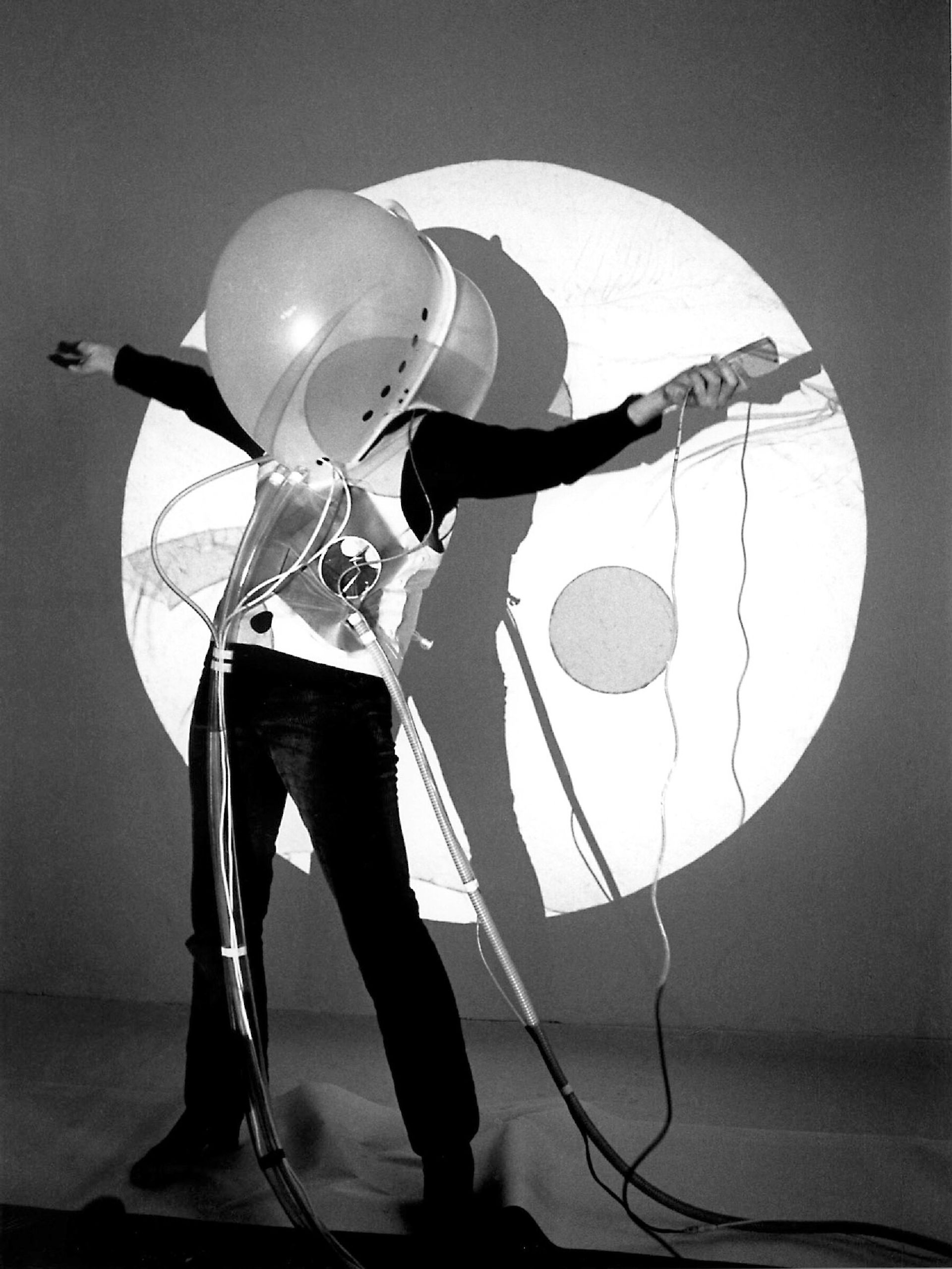
Coop Himmelb(l)au, The White Suit, 1969. Credit Hagen Ernstbrunner.
Architecture Today and the Crisis of the Profession
CT Through Stavanger Secession we are trying to create a space where architects can experiment again. Many architecture festivals today feel academic or institutional, while architecture remains deeply tied to power. What would constitute a truly transgressive architectural position in 2026?
WdP I am eighty-three years old; I have already said everything I wanted to say. Now, it is the responsibility of younger architects. What worries me is that the power of architects has become extremely weak. The profession risks disappearing if younger generations do not reinvent it. They must avoid becoming trapped by fashionable theory or fashionable material research. Architecture must rediscover what space means socially. Throughout history you can always read political systems through architecture. Buildings reveal whether societies are authoritarian, democratic, aristocratic, capitalist.
"I have already said everything I wanted to say. Now, it is the responsibility of younger architects."
When I was young, I never imagined we would arrive at a moment where money and right-wing power structures would dominate so completely. Young architects must ask why buildings are being constructed. Who benefits from them? Too often, architecture serves investors rather than inhabitants. I still believe what I believed in 1968: that architecture should serve an open society. Trial and error. Experimentation. The people terrified of instability are the same people who desire authoritarian certainty.
Pernille Dybvig Would you elaborate on the use of the unconscious, and particularly on what you call “the subconscious moment of conception”? It seems as though you are trying to minimize the distance between this moment and its completion — do you imagine this proximity as something of which people become conscious upon entering your buildings?
WdP I would not use the word ‘conception’ — the important term is Entwerfen. The prefix “ent” in German refers to processes linked to the unconscious. And “werfen” means “to throw.” I often compare this to a whale. The whale emerges from deep underwater. A mammal. At the instant it breaks through the surface, gravity appears suspended. For one moment, thirty or forty tons can fly. Gravity has always been the enemy of architects. The Gothic cathedrals already tried to escape gravity. Today, with outer space and new perceptions of orientation, the traditional one-point perspective is obsolete. Why should architecture remain imprisoned within old systems forever?
Sometimes foundations are necessary. But what matters is what you build upon them. Even our name, Himmelb(l)au, refers to this idea. It means “blue sky,” but not as the colour. It refers to architecture becoming mutable, like clouds. Like the scene in Hamlet where a cloud constantly transforms, from a camel to a crocodile. Architecture should remain open to transformation.
CT That is a beautiful conclusion. Thank you very much for this conversation.
WdP Very good. Thank you very much — and thank you again for reenacting Soft Space.
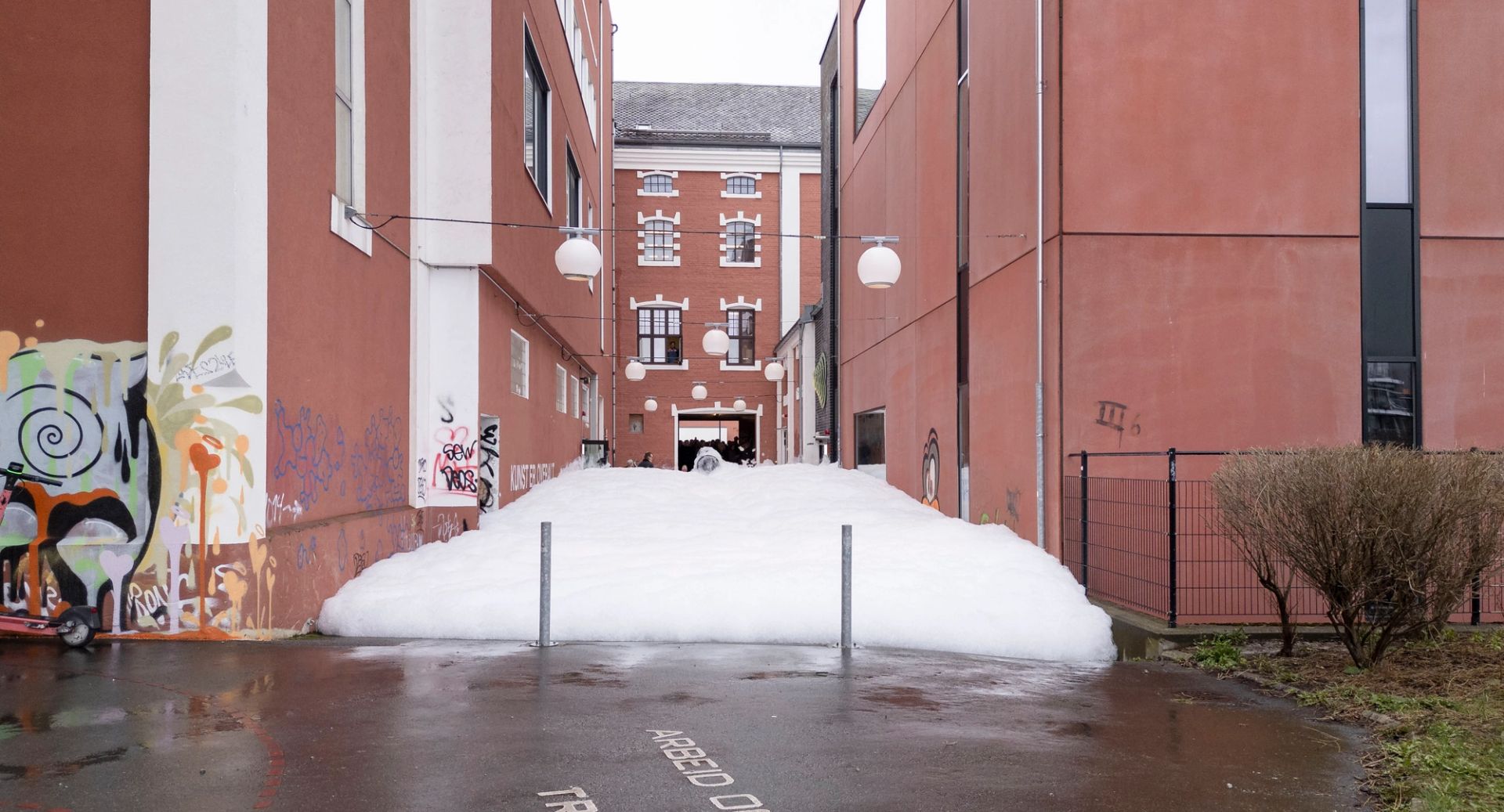
Recreation of Soft Space (1970) at the opening of Stavanger Secession 2026 - To Live and Think Like Pigs. Credit photo Bitmap / Markus Johansson
BIOS
Pernille Dybvig is a Norwegian Berlin-based art historian and writer, and the executive director and curator of Stavanger Secession
Charles Teyssou is a Paris-based curator, writer and artistic director of Stavanger Secession. In collaboration with Pierre Alexandre Mateos, recent projects include Paris Orbital, a public program at the Pinault Collection—Bourse de Commerce focused on the links between Parisian mythologies and pulp culture, and the co-edited publication Cruising Pavilions: Architecture, Dissident Sex and Cruising Cultures (Spector Books, 2026). In 2020 they curated an exhibition dedicated to Jacques de Bascher at the Kunsthalle Bern and at Treize in Paris.
Wolf dPrix is an Austrian architect and co-founder of Coop Himmelb(l)au — established in 1968 with Helmut Swiczinsky and Michael Holzer, as an alternative to the linear architectural thinking of the time. He is counted among the originators of deconstructivism in architecture. Embracing imbalance, distortion, fragmentation and chaos, its highly-acclaimed projects include the Musée des Confluences in Lyon; BMW Welt in Munich; Dalian International Conference Center in China and the Groninger Museum in the Netherlands. Prix has received many accolades and held academic positions at institutions including Harvard, Columbia, and SCI-Arc as well as the University for Applied Arts in Vienna.
ABOUT
Stavanger Secession is a cross-disciplinary platform connecting art, cinema, and architecture. Founded in 2023, it returns each year to examine secessionism, the founding act of every avant-garde. It is curated by Charles Teyssou and Pernille Dybvig.