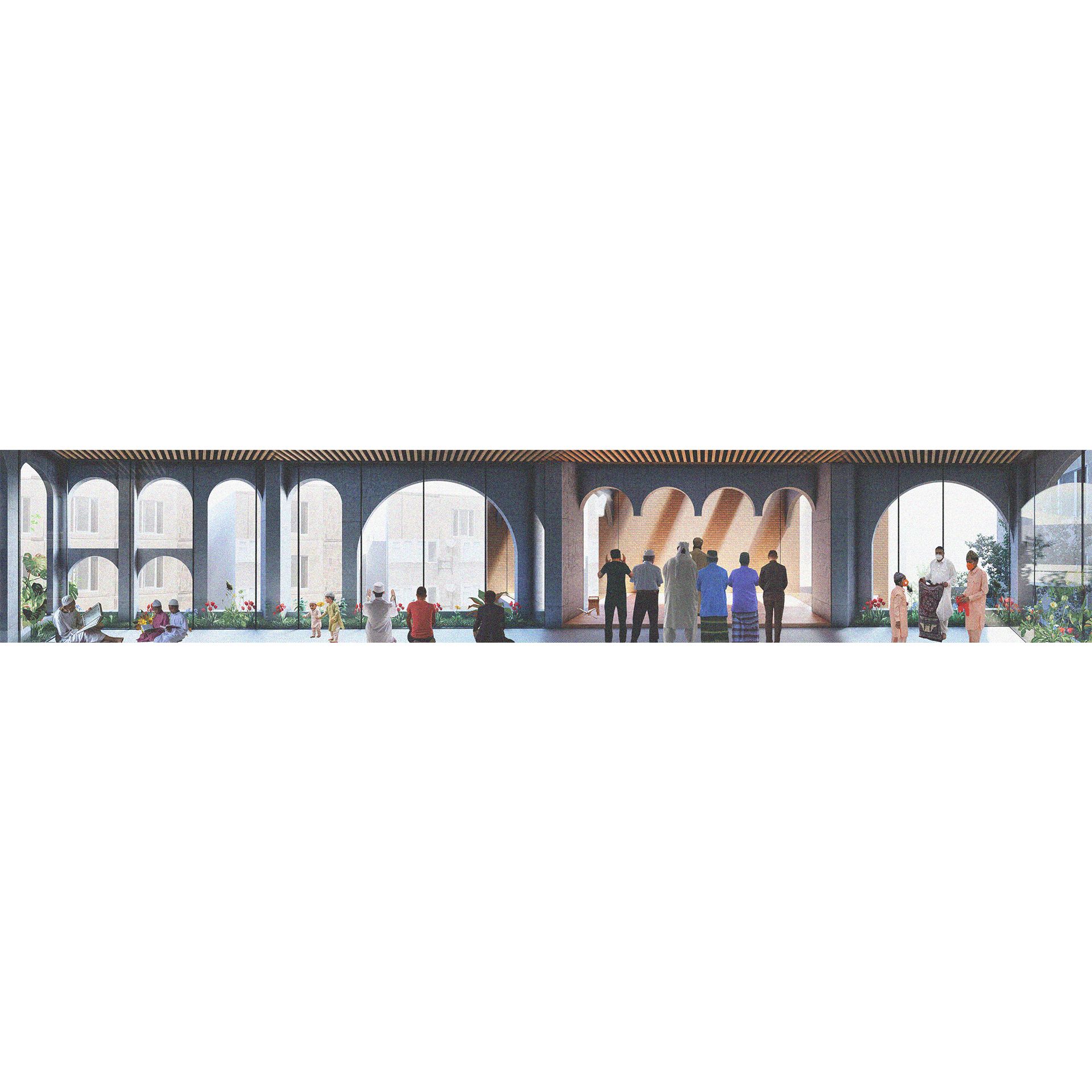
We contemplate the idea of using the mosque not only as a prayer hall but also as an urban living space; creating a "Common Place" for the community to meet, share and prosper. The ambiance of the mosque is a free-flowing, democratic public place. Furthermore, the mosque is designed to be celebrated as a verdant and breezy urban space, a rare liberating experience in this overcrowded city. With time the mosque will become a place of memories for the community, a part of their quintessential stories.
KOOZ What prompted the project?
AH | SH | PAK | UA The project is a competition entry for the design of a small local neighborhood mosque arranged by “Build Bangladesh”. The aim of the competition is to design a modern, practical, and functional mosque for the neighbourhood of Baganbari, Malibagh. The main purpose of this competition is to get a more efficient and realistic design solution for the future mosque which will serve the expected population growth of the neighbourhood in a better way. We always have a keen interest in projects that promotes inclusiveness and giving back to the community to which it belongs. This project seems like a perfect opportunity for us to explore the potential of a mosque as a public space.
KOOZ What questions does the project raise and which does it address?
AH | SH | PAK | UA Set against the backdrop of residential buildings, the site of the competition is relatively small. Most of the buildings are 3 to 6 stories, and users of this mosque are mostly from this residential area. The width of the road is 3m, and people from this area mainly use a Rickshaw or Bike, but most users come by pedestrian to the mosque. There is no water body in this area and with very less greenery. The immediate question the site raised is how to organize the traditional subdivision of the mosque programs which historically are arranged horizontally as the site is inadequate in size. The second question is how it can incorporate informal spaces which can result in public engagement and a breathing space for the community in a traditional mosque setting of formal prayer spaces. Lack of open space in the neighbourhood makes this mosque expected to be a public facility for various activities We searched for possible scenarios of arranging the mosque programs keeping the traditionality intact. The concept made us focus that a mosque can also house small functions required by the community and thus resulting in a democratic open public space what we referred to as ‘A Common Place’.
We think that contemporary mosque architecture should be more concerned with spatial qualities rather than with decoration.
KOOZ How does the project approach and redefine the relationship between the mosque and the community?
AH | SH | PAK | UA The religion of Islam is built upon an understanding of the relationship between humans and nature. Many verses in the Quran urge Muslims to think deeply about creation and the miracles of the universe. Fasting, prayer, and all other forms of worship in Islam are regulated according to the sun and the moon. As a major part of the Islamic rituals, Muslims go to mosques to pray five times a day. Historically, Muslims didn’t go to mosques only to pray, they also went there to gather, discuss, and learn about Islam and all other aspects of life. The first mosque in Islam is the house of the prophet Mohammed, which was built in the 7th century in Medina, Saudi Arabia. It is the perfect example of a simple and functional mosque. Its vernacular architecture resembled the concepts embraced by Islam, such as a minimal lifestyle, the clustered community, and shared prosperity. Islam prioritizes equity, charity, and public welfare before considering the extravagant details.
Inspired by this belief, we think that contemporary mosque architecture should be more concerned with spatial qualities rather than with decoration. To start with the simple and rectangular form seeks to transmit a message of integrity, clarity, and purity, away from weird or strident forms. We designed the prayer space as column-free, to preserve the continuity of the lines formed by worshipers, who prostrate themselves during prayer. Curtain walls and skylights allowed natural light to change the ambiance of the prayer hall and engender an inspiring atmosphere for prayer. The prayer space is designed to be more inviting by increasing the transparency of the building enclosure and increasing the visibility from the outside. Solid walls are reduced to the requirements of function and security. Natural vegetation is invited inside the space to celebrate divine creation instead of depicting it on the walls. Natural materials, rough or polished, can be forthrightly used for finishes throughout the mosque as the purest way to embrace the human connection with the Earth. Natural ventilation is ensured into the prayer hall through operable windows to sustain a healthy and uplifting environment. Besides, this mosque consistently promotes the pilgrim’s essential concept, the world as a public and social entity. The scheme focuses on increasing public space in a dense environment; opening up the ground floor and connecting it with the street to ensure the mosque can become a part of the community activities. The mosque programs are divided into two parts. The ground floor, basement, and the mezzanine together form a community center that can be used for a variety of purposes like recreation, library space, festival, etc. Service zones including ablution spaces, kitchen spaces and office spaces are placed in the basement. We tried to create an inviting yet ensuring calm and silent prayer space by lifting the prayer space from the ground to create a separation from the crowd. The scheme seeks to be introverted and extroverted at the same time, with the calm tranquility of the upper floors contrasted by the use of the ground floor as a public space, interacting with the surrounding environment.
KOOZ How do you define notions of "common" and "place"?
AH | SH | PAK | UA We intend to use the mosque space as an independent one. The idea of ‘Common’ is pertaining or belonging equally to an entire community. The essence of ‘Place’ in spatial design lies in understanding the cultural and human characteristics of physical space. In abstract, physical terms, space is a bounded or purposeful void with the potential of physically linking things, it only becomes a place when it is given a contextual meaning derived from cultural or regional content. We tried to establish a connection between people and place. To make a place better design is not a priority rather providing a wide range of activities and incorporating physical, cultural, and social identities that define a place are our primary objectives during the design process.
As problem solvers, we always ask “what if” and then push on as new realities unfold.
KOOZ How does the project explore the integration of this new space within the city?
AH | SH | PAK | UA The site context is straightforward and the design relates to it in its own way – intimate and natural towards the main street, a magnificent interior prayer hall, and closed at the back of the site. The different elements of the Mosque act together to form a collective/holistic gesture. Much like the worshipers themselves – a series of individuals coming together to form a diverse, yet harmonious whole.
KOOZ What is for you the potential of the architectural imagination?
AH | SH | PAK | UA “A great building must begin with the immeasurable, must go through measurable means when it is being designed, and in the end, must be unmeasured” Louis Isadore Kahn
I always find this quote intriguing. It taught me so much about how to approach a project in a certain way; full of possibilities and dreams, yet conclude the project in a quantifiable manner. As architects/designers, we are blessed enough to hold onto and exercise imagination with much of what we do. We are often not afraid to let our imaginations run wild, allowing us to visualize new possibilities. As problem solvers, we always ask “what if” and then push on as new realities unfold. The process of architectural imagination has the potential to involve individual subjectivities and cultural movements; communicate to the audience through imagery and drawings.
Bio
Asad Hossen currently works as an urban designer in ‘Atelier Alternative Architecture’ based in Shenzhen, China. He completed his Bachelor studies At BRAC University in Bangladesh; was awarded ADB scholarship to study for Masters of Urban Design at the University of Hongkong.
Architect and urban designer trained in Bangladesh and Malaysia, Sumaya Hasan is skilled in sustainable and environmentally responsive design and construction. Professionally experienced in architectural and interior design and construction. Have a strong interest in research-based on urban design along with architecture.
Prinia Abbasi Khanm are Uzma Alam are partners of Atelier Archsacpe, a team of young architects, striving to provide personalized solutions for your home & business. The studio prioritizes functionality, aesthetics, sustainability; working for people and community is a passion. Social & ecological equilibrium through the design and collaboration of different professionals is the founding principle.