This piece is part of KoozArch Issue #06 Serve and Protest.
Shumi Bose/KOOZ Gauri, thanks for making time for us. Today we'll be talking about your work at SITU on domicide, and particularly the exhibition Patterns of Life with the data researcher and illustrator Mona Chalabi. But let's start with a bit about you, and you can bring us into that project.
Gauri Bahuguna Sure. My name is Gauri Bahugana, and I studied architecture at Columbia GSAPP for seven years. Somewhere in that process, I became increasingly disillusioned with what I was spending my time on. What I did appreciate was the process before the designing — the research and investigation, trying to understand the conditions of whatever place. That was my way into this broader world of visual investigations. Also I got very lucky: there was a job opening at SITU NYC when I was looking; I'm very grateful, because this work feels like it’s fulfilling a purpose. This project with Mona is actually the first time that I returned to something more architectural, directly engaging with the built environment. So it felt like a strange homecoming, in a sense.
KOOZ How did this project of research on domicide — that is specifically the willful and mass destruction of homes — come about?
GB We were approached by Mona Chalabi; the Cooper Hewitt Museum had approached her to participate in the Smithsonian Design Triennial in 2024, which was titled Making Home. Her idea at the time was to focus on homes destroyed — specifically destroyed by US imperialism, for lack of a better word. She was thinking about lenticular images, as well as to reconstruct parts of the home at full scale. As SITU has a fabrication division, somebody recommended us to Mona — but it soon became less about fabrication; instead there were a lot of common or overlapping research interests.
Firstly, this was a show about homes and domesticity in the United States. We wanted to be a little provocative, in terms of challenging this idealized version of home in the United States. It's such a big part of the myth of the American Dream: the dream of home ownership and private property, where you really get to express yourself. In other parts of the show, the home is actually presented and built up to be all of these things. So for us, this piece was about the responsibility of the United States as being the primary un-maker of homes across the world, across time and space, really. The urgency was to somehow capture the systemic nature of what is described by the term domicide, in this case systemic nature of US bombing campaigns — but in doing so, not lose the individual and personal stories. This is often what happens in a news reporting context, where everything becomes a statistic; even if it is specific instances that get reported on, it's only through this lens of misery and destruction. Our aim, and Mona’s too, was to highlight the more personal memories of the home itself, to build a fuller picture of what these places were before they were flattened into sites of tragedy.
"Our aim, and Mona’s too, was to highlight the more personal memories of the home itself, to build a fuller picture of what these places were before they were flattened into sites of tragedy."
KOOZ So with the exhibition title Patterns of Life, you evoke how these homes have indeed been lived in, rather than how they're destroyed. But you’re also making a play on the military resonance of that term as well. Could you expand on that?
GB A helpful way might be through this project itself, or how we honed in on what ultimately got made. The initial concept was to do seven homes in seven different cities; budget and time whittled that down to three. Then it was a case of looking for families who would be willing to participate, but also finding cases where there's enough information about a particular strike or campaign itself. One aspect of the research was to make a reconstruction of the home and the personal dimensions of that place, but the other aspect was a reconstruction of the narratives given by the military agents involved with this particular destruction. We needed cases that obviously the families would like to participate, cross-related with information available online. For instance, we settled on Mosul in Iraq, with the case of Basim and his family home. The strikes in Mosul were quite ‘famous’; there was a lot of reporting on that specific case, and the back and forth of the legal documents, particularly in The New York Times.
Of course, the term ‘patterns of life’ is used quite frequently within the US military, in detecting and determining which zones to strike. In this case, there was no more than 95 minutes of remote surveillance, in 15-30 minute intervals, on the site of Basim’s home, within which they determined that there were no patterns of life consistent with human activities. This is because they're looking in the afternoon, and in Mosul, people are not necessarily outside in the afternoon in Iraq; there were cars visible in the surveillance, but no groups of people. This is a very flawed logic based on flimsy surveillance, and the sheer carelessness of destruction becomes really clear in the documents. They tend to repeat this language around patterns of life, rules of engagement and how these calculations — literal calculations — are made as to whether or not to strike a particular location.
So that phrase obviously stayed with us, because it's about domesticity as well — relating back to the position we wanted to take with this project for Making Home. What does a pattern of life even mean? The surveillance shows cars coming in and out, so they would assume that there are men present in the area. But the presence of men doesn't qualify as domesticity, it’s not proof.
"What does a pattern of life even mean? The surveillance shows cars coming in and out, so they would assume that there are men present in the area. But the presence of men doesn't qualify as domesticity, it’s not proof."
KOOZ How strange and horrific to learn about another way in which gender is instrumentalised… In this sense, the visibility of women would serve as a reason not to strike —
GB Right, they might be useful — but not worth any money, as per the official calculation on how much to compensate people based on which family members are lost. Evidently, a female child is worth the least amount of money; in fact, a car is worth the most. From SITU’s perspective, this is part of our research practice: open-source investigation, trying to find documents that are available and making connections. There are so many details of how the American military operates in these contexts that we wanted to look at. In this case, that would be trying to figure out what specific bombs or planes were used in the destruction of these homes. We were just trying to get as complete a picture as possible of the decision making behind each of the strikes that we looked at. Mona, in the meantime, was focused on gathering the actual stories about the specific homes and their inhabitants, so she spoke with and interviewed each of the family members.
KOOZ The exhibition at Cooper Hewitt took place last year, but can you talk us through its components and the way these stories were shared?
GB We presented the story of three homes: one was Basim’s house in Mosul in Iraq; the second was Osman’s home in Manbij, Syria, and another was located in the Gaza Strip. Contacting and interviewing the family of X in Gaza — who wishes not to be named for security reasons — was a delicate thing to do, and it is very brave of them to share their story, while dealing with the grief of losing their home very, very recently. At the same time, Mona also wanted to focus on drawing this very lively and colourful imagery of life before the strike — that was a little different from her usual data-driven journalism, which is necessarily fact-based.
KOOZ Yes, certainly the images we see are more akin to informative illustrations, whereas this endeavour sounds more narrative or evocative in its ambitions.
GB Completely, it’s narrative based — and because we're dealing with memory, so much of it is unreliable and fragile. That came up when we selected the materials for the exhibition, like the silk and its transparency. The installation is structured so that on three sides of each model, the building that was destroyed is reconstructed, based on whatever material we could get, like photographs from the family and satellite imagery.
The fourth side of each model is cut in section, and the home of each family is rendered by a series of suspended, translucent silk panels, on which we printed Mona's illustrations. They show the cherished objects and remembered items that came up in these interviews.
The conversations Mona had with those families were obviously helpful when it came to building the models. People would sketch out their homes and through a series of questions, share stories of their lives, over time. The families affected are all multi-generational, so there are many perspectives in remembering. For example, in the Gaza home, the living room is very detailed because we had a photograph from the family of what it looked like before. But Osman did not have any photographs of his home in Manbij, so it became more about the memories he could recall and the descriptions that he and his family could share.
KOOZ How did you guys deal with this translation between so-called ‘hard’ data and that which is not recoverable — materially or emotionally? How does imagination play into the architecture you’re recreating — was there any contact between you as the designer and the families providing the stories?
GB There was some back and forth, mainly through Mona and Sam Rabiyah, another member at SITU, who were in direct contact with the families. It was challenging, not just in a technical sense but also emotionally and personally. When you're making something like this, you want to be as true to the stories as you can, but sometimes there's so little material that you have to extrapolate. So in finding that balance between what we made based on stories, it was helpful to be able to share with the families and through Mona, to ask for more information or clarification.
Yes, in your instinct to fill in some of the gaps left by testimony, that task of representation becomes a huge responsibility. I was wondering about that process of feedback and the types of material shared.
There were a lot of sketches from the family members themselves. Mona would have video calls with them, and they would talk about their homes. There were obviously written notes, but also pen sketches. In Syria, Osman has actually reconstructed his home on the same site, so he was actually in this new apartment. He shared this selfie video walking around and that was pretty confusing, so we had to get back in touch to get a sketch. It was very recursive; as we were making, we wanted to make sure that we kept participants in the loop about everything, also to reassure people about how things were being used or presented.
There is a tension about reconstructing what is fragile or destroyed with fresh, new materials. The visual language that you create in the exhibition is, of course, due to Mona’s drawing style — but it also allows for that slight distance. You're not recreating rubble, for instance.
No, totally, and that was very important for Mona and for us. Many of these geographies are often depicted as nothing more than piles of rubble. Then you get a bunch of numbers thrown at you.
In fact in order to reconstruct these homes, we're actually redoing a lot of steps that the military would have taken — using the same remote sensing — for its target analysis approval. For instance in remodelling the homes, it felt important to rebuild this thing that had been destroyed, to accompany those less tangible histories.. We wanted to keep the tension between the cold architectural reconstruction versus the interior life of those homes, which we wanted to be much more softer, complimentary to Mona's illustration style; that was pretty intentional. To contextualise what this work was for, we also worked with the UN special rapporteur on the right to adequate housing, Balakrishnan Rajagopal.
Speaking of the UN, am I right in stating that the concept of domicide is something that is currently under review? Genocide is an established and defined term but domicide and even ecocide are under review, per the UN. How can the agency of architectural or spatial visualization further complex cases in favour of human or planetary rights?
In this particular project, for both SITU and Mona, our work is essentially trying to make things more accessible for different audiences. That's why there was actually a good synergy from the start. The ultimate goal is how to make this complexity legible to an audience with a frankly limited attention span. I think architectural thinking is useful, specifically in an oversaturated image economy, where everything is very quickly flattened; you get a flood of two-dimensional images, but the wider context gets a bit washed out.
There’s an extra layer of engagement in providing 3D versions of homes for this particular domicide advocacy campaign. Bringing back the geospatial environment — with any incident or condition that we're investigating — becomes helpful for human perception, to ground and project themselves into the experience of a place: immersive, seems like almost the right word here, but not quite.
Reaching people on a relatable level is an end-goal in itself. This said, a lot of your work aims to assist in the long game of effective larger, systemic change. How do you think Patterns of Life might work in that sense?
Our number one ambition was the idea to actually expand the notion of what a house is, because in international law, the only thing that is protected is property, which is so different. How do you disentangle home from property? That's a big part of the thesis of this project. Certain populations get reduced to statistics and tragedy, but the only way that they can seek recourse is through property damage laws, which are pretty limited. For every person that we spoke to, the acknowledgement that a home is so much more than just a physical shelter is extremely important. Especially for survivors of domicide, just having that loss acknowledged is meaningful, otherwise you're really ripping out the histories of people, their families and communities. A lot more is lost than the brick and mortar that comes down, and that was a huge part of what we wanted to make accessible with the research. It's not so much about the definition of domicide, or the very real statistics about how the United States is bombing these places. It's more so. What does that mean for the people who lose those homes, but also the ones that kind of sit back and watch this system continue.
"The acknowledgement that a home is so much more than just a physical shelter is extremely important. Especially for survivors of domicide, just having that loss acknowledged is meaningful, otherwise you're really ripping out the histories of people, their families and communities."
You mentioned the agency of taking what is a drone’s eye view — a flattened perspective — and mobilising techniques of visualisation, providing a depth of dimension and human relatability. Though trained as an architect, you are described as a computational designer, right? I wonder if people associate that with the humanitarian narratives that you're actually dealing with.
Well, writing any kind of resume is always like, how much time do you have? Computational designer, I guess, is the current stand in, but basically that disillusionment with the business of architecture grew in grad school, I realised I'm not really interested in making buildings. But Grasshopper was kind of interesting; also the physics engines, like Unreal and Unity. Breaking things down into modes of parametric thinking became super interesting to me.
I think it was the ability to take in discrete units of information, and then by processing them, and you get something that is three dimensional, or it's like you're using information to make something that is more than just the sum of its parts. I can use the example of what I'm working on currently. We're looking at migrant detention facilities and systems within the United States, and the economy of the whole detention tent system. How are they deciding how many beds to put in there? Obviously it's all in a document somewhere, it follows some legal guidelines. So reading the OSHA temporary labour camp standards, for example, I can translate that there ought to be 36 inches between each bed; now, if you reduce that number, you can fit in more beds. That becomes a script, where I can create a simulation of what a detention centre might look like with different parameters; changing those parameters, you can visualize things in a different way. So you can draw a boundary of a site, calculate and model a detention tent or camp based on that information, using these regulations. That, for me, was the power of these tools: you can take information and make it spatial, it becomes a useful way to present an idea.
It works as an extremely strong storytelling tool, whether that’s projective or analytical. How far is one able to go computationally; how hard is it to hold space — for want of a better term — for the unquantifiable things, like the particularity of each home, or the weight of memory that you've spoken about?
That’s a pretty recurring anxiety or concern for me with this work — it can look really slick and that can actually derail from what we're trying to do. It becomes about the wow: look at this 3D technology, the animations, the aesthetics of Osint (Open Source Intelligence). You put a red box on something, and now this is a fact, or becomes important information — that's all noise and in this project, we really didn't want that to be the focus. This is what guided the decision making on how the architectural part of the model came to be, in terms of the scale, and the presence of wall panels. For instance, the installation consisted of three model homes in a corridor, surrounded by vinyl wall panels of Mona's illustrations of the skylines of each of the cities, but the percentage of homes that were destroyed are grayed out, so it's an illustrated data visualization; this is at a macro level. Over seventy percent of the homes in Gaza were destroyed, and so the same proportion of that skyline was grayed out. We had a lot of debates about what to display; of course, we had all of this research about military documents and so on. Mona felt pretty strongly about not putting any of that on the wall, which was ultimately the right decision, because it becomes an information overload and a distraction from the personal stories. Again, we wanted to weight the exhibition towards spending time with the emotional impact of the work, rather than going home with all these facts in your head.
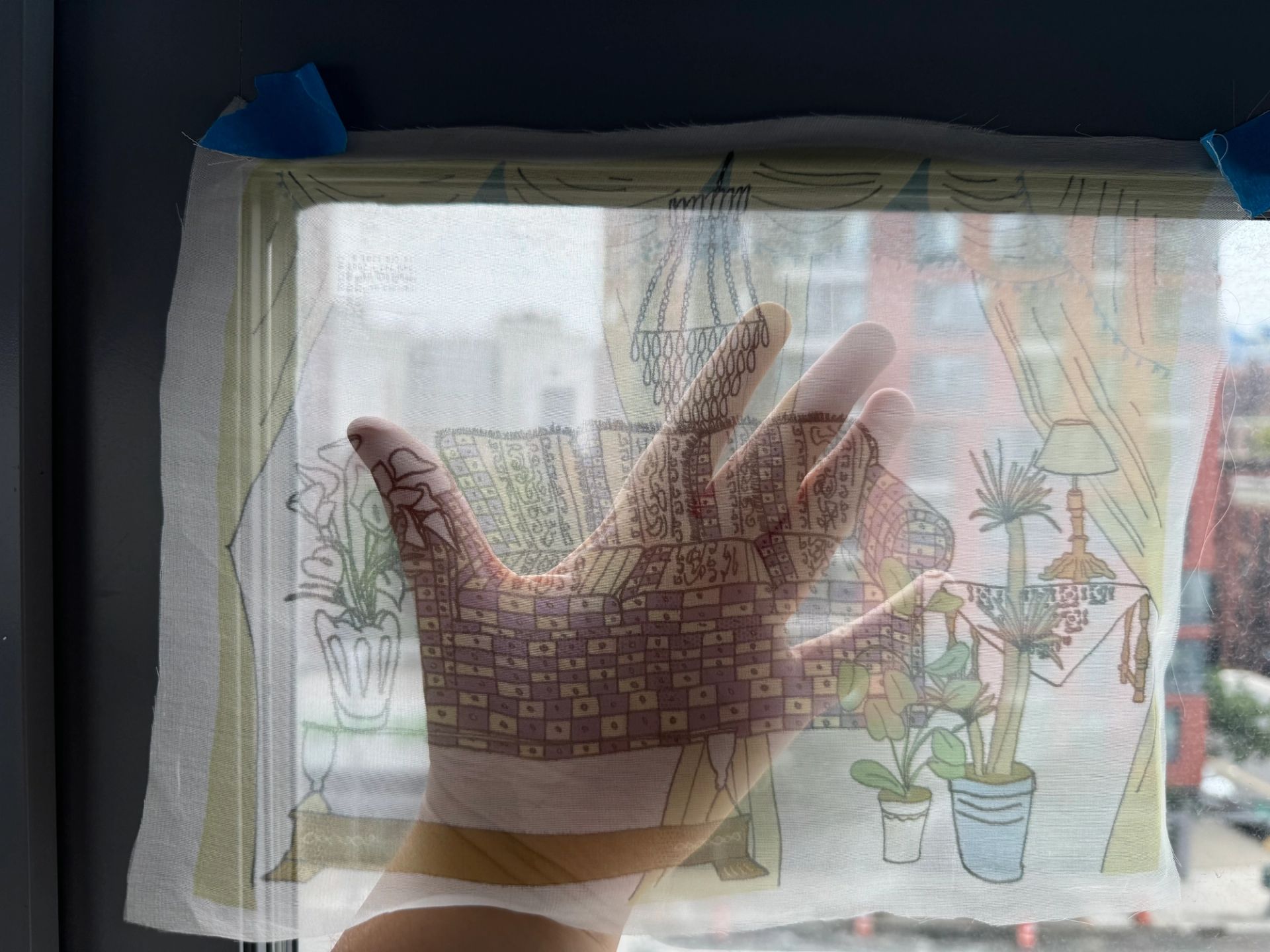
Maquette detail from ‘Patterns of Life’ at the Making Home Smithsonian Design Triennale, with drawings by Mona Chalabi printed on translucent fabric. Courtesy the author
So that experience is carefully calibrated not only in order to showcase Mona’s incredible drawings, but also to allow these testimonies and their resonance to come through. That's a brave decision; to let an exhibition be experience-oriented and have enough faith in the affect takes courage. As you say, there's much more information that you, as a designer, had to process in order to develop this project. What can you tell us about your experience that doesn’t fit in the exhibition?
One major takeaway for me is the basic awareness that there's no international law protecting homes as opposed to property. That was pretty major. Besides that, the military is propped up; we have very high quality intelligence, and everything is precision-based; in all their investigations, they hardly ever find themselves at fault, which is really not surprising. But if you peel back the curtain and start looking through all of these documents, you can find wads of information. For whatever reason, I started digesting a much greater volume of cases than was necessary. The ACLU has an amazing archive of all of the compensation claims that were filed, from around 2005 until 2009 from Afghanistan and Iraq. Time and time after again, these claims are denied, denied, denied, denied — so many of these claims that the US has bombed someone’s home..
Looking into the system of how these determinations are made, or what is deemed legal is mind-boggling. More often than not, the identification and legitimacy of a target is based on very limited surveillance. It's an intentional accountability sink, where no one person is responsible. Systemic oversight becomes this catch-all excuse to dismiss any claims of compensation, not that monetary compensation is the only way to seek recourse. That became important for us: we started off with a matrix of information that we could find about each home, where one column was tangible losses, and the other was the intangible losses, which came up in the interviews with Mona. So, not to emphasize the conflict, but the system that claims to have the best intelligence in the world is really quite flimsy.
A second point would relate to the Gaza case. Almost the entire city, as we know, has been flattened, and so to find specific information about one small neighbourhood was quite challenging. For whatever reason, the IDF posts its drone strikes on its social media feed, so I went down a rabbit hole to see if we could find the particular strike that destroyed this specific home. It was completely unnecessary for me to do that, but in doing this work, there's a compulsion to witness or take in as much as you can. Controlling the volume of how much makes it through to the exhibition was an interesting exercise, and it was helpful to have people pull us back to the focus on these families and their homes.
My very real gratitude for that physical and psychological labour. Thank you so much for sharing this work Gauri, and for your time today.
"I went down a rabbit hole to see if we could find the particular strike that destroyed this specific home [...] in doing this work, there's a compulsion to witness or take in as much as you can."
Bios
Gauri Bahuguna is a computational designer and Deputy Director at SITU Research.. In her current role, Gauri makes complex human rights cases accessible to wider audiences by wrangling large and diverse datasets into visually compelling interactive web platforms and videos. Projects she has led include an investigation on human rights violations against protesters in Sudan, surveillance along the Southern US Border, and ISIL’s crimes against humanity in Iraq. Additionally, Gauri teaches at the Cooper Union School of Art, and has given lectures at Carnegie Mellon, NYU, and The New School.
Mona Chalabi is an award-winning writer and illustrator who uses data as the foundation for her work, translating complex statistics into visually digestible information. Mona has earned a Pulitzer Prize, a fellowship at the British Science Association, an Emmy nomination and recognition from the Royal Statistical Society. Her art has been exhibited at the Smithsonian Design Museum, the Tate, the Brooklyn Museum, and the Design Museum. Her work can also be found at The New Yorker, The Guardian, Netflix, NPR, the BBC and National Geographic.
Shumi Bose is chief editor at KoozArch. She is an educator, curator and editor in the field of architecture and architectural history. She is a Senior Lecturer in architectural history at Central Saint Martins and also teaches at the Royal College of Art, the Architectural Association and the School of Architecture at Syracuse University in London. She has curated exhibitions at the Venice Biennale of Architecture, the Victoria and Albert Museum and the Royal Institute of British Architects. In 2020 she founded Holdspace, a digital platform for extracurricular discussions in architectural education, and currently serves as trustee for the Architecture Foundation.