‘The era of culture wars is over’, UK Culture Secretary Lisa Nandy announced in her first speech after the Keir Starmer government won power in the July 2024 general election. She promised an end to polarisation and divisive narratives. Within a year, she was attacking musicians for supporting Palestine and calling for heads to roll at the BBC for commissioning a documentary on the suffering of children in the Gaza genocide, because it was narrated (but not in any other way shaped) by the young son of a Hamas agriculture official. Her increasingly authoritarian government has, likewise, rolled back trans rights and become embroiled in debates about how racism affects different racialised groups, as well as the impact of migrants on British society. Prime Minister Starmer warned the country risks becoming an ‘island of strangers’. In so doing he echoed, inadvertently or otherwise, Enoch Powell’s infamously racist 1968 ‘Rivers of Blood’ speech.
Snapping at Labour’s heels, the Reform party in the UK has, after local election success in 2025, made a priority of dismantling what limited diversity, equity, and inclusion (DEI) units existed at county level and of stopping Pride flags being flown from its town halls. Labour has also signed into law a measure that makes it an imprisonable offence to climb certain war memorials — not damage, mind, simply climb. If there is any doubt that persistent rumours of the death of the culture wars were greatly exaggerated, then look here.
Much of this dutifully echoes the endless culture wars of the US, where Donald Trump’s second presidential term has rebooted a process of historical manipulation alongside his campaign of repression. On the very day that Trump came into office, he revived a Biden-cancelled executive order from his first term, ‘Promoting Beautiful Federal Civic Architecture’, which demanded that the government’s architectural commissions respect ‘traditional and classical architectural heritage’. A gilded neo-classical ballroom for the White House looks set to be one of the first fruits.
On the very day that Trump came into office, he revived a Biden-cancelled executive order from his first term, ‘Promoting Beautiful Federal Civic Architecture’, which demanded that the government’s architectural commissions respect ‘traditional and classical architectural heritage’.
Two months later, his executive order ‘Restoring Truth and Sanity to American History’ fulminated against ‘a concerted and widespread effort to rewrite our Nation’s history, replacing objective facts with a distorted narrative driven by ideology rather than truth’.1 In this looking glass world, Independence Park in Philadelphia and the Smithsonian museums in Washington, DC, are seen as undermining the foundations of Western civilisation with ideas such as ‘the view that race is not a biological reality but a social construct’. Among the president’s demands are that the Smithsonian’s American Women’s History Museum ‘do not recognize men as women in any respect in the Museum’.2
Similarly, in a move to reverse the removal of some contested monuments, those Confederate statues within the Department of Interior’s control which have been removed or changed ‘to perpetuate a false reconstruction of American history’ are to be reinstated. Action is to be taken against descriptions that disparage Americans living or dead ‘including persons living in colonial times’ and instead ‘focus on the greatness … of the American people or … the beauty, abundance and grandeur of the American landscape’.3
An early action saw the newly imposed regime at the US National Parks Service erase all mention of transgender people from its web page for the Stonewall National Monument in New York. The site, designated in 2016, consists of the Stonewall Inn and the street and Christopher Park opposite. Within the triangular pocket park stands George Segal’s 1992 statue that itself constitutes a literal whitewashing of the leading role played by gender non-conforming and queer people of colour in the Stonewall Riots. Just in time for Valentine’s Day, the web text about the uprising was revised, excising the words ‘transgender’ and ‘queer’ and censoring the content on the various flags for LGBTQ+ identity groups.4 The spiteful discrimination is only matched by its prioritised pettiness.
The changes came amid a Republican push at federal and state level to eviscerate DEI, recognise only two biological sexes, remove gender-affirming care, and menace drag performances. Months later during New York’s Pride festivities, two teenagers shot each other dead, close to the Stonewall Inn. At the time of writing this does not appear to have been a hate crime — unlike the 2023 shooting of a Californian shop owner flying the Pride flag — but it reflects an increasingly febrile atmosphere, the street violence, and chaos on which fascism thrives, a place where masked ICE agents are shooting activists on America’s streets and progressive books are removed from library shelves. Just days before the Pride shootings, in the summer of 2025, the US Secretary of War Pete Hegseth announced that its ship named for the assassinated gay San Francisco politician Harvey Milk was to be renamed. Cultural symbols remain intensely weaponised. The Heritage Foundation’s white Christian nationalist Project 2025 is being rolled out before our eyes.
Just days before the Pride shootings, in the summer of 2025, the US Secretary of War Pete Hegseth announced that its ship named for the assassinated gay San Francisco politician Harvey Milk was to be renamed. Cultural symbols remain intensely weaponised.
This assault on US history and progress is only matched by the neglect of actual historical places. Cuts to the Liberty Park workforce in Philadelphia have forced partial closure of several historic buildings including Independence Hall, while the National Parks Service overall has lost about a quarter of its full-time staff. It is a deregulatory impetus that began before Trump took office. In Florida, Republican moves to bar the removal of Confederate memorials are matched by Ron DeSantis administration laws that increase some protections for historic buildings except for those on waterfronts at risk of flooding and which are highly sought after by developers for demolition and luxury redevelopment.
Perhaps the most bizarre incarnation of built environment culture wars, however, is the Right’s campaign against ‘15-minute cities’, the unremarkable European town planning policy that seeks to ensure people can more easily walk or cycle to facilities in urban neighbourhoods. With links to the Far Right, anti-vaxxers, and other conspiracy theorists, thousands were mobilised against the plans in the UK and traffic cameras destroyed in the name of preventing the World Economic Forum’s ‘Great Reset’ intent on controlling our lives and movement. In the UK, at least one Conservative Government minister, Transport Secretary Mark Harper, bought in to the craziness.5 In 2024, Oxford City Council was forced to remove mention of the 15-minute cities from its Local Plan because the concept had become too toxic and its staff were being abused.6
At the same time, ‘great replacement’ theory claims of white genocide and no-go areas ratcheted up. Former Home Secretary Suella Braverman was among the UK politicians arguing that ‘we need to wake up to what we are sleep-walking into: a ghettoised society where free expression and British values are diluted. Where sharia law, the Islamist mob and anti-Semites take over communities’.7 Crazed. Unevidenced. But such views are increasingly mainstream. A 2024 poll showed a majority of her fellow Tories believing that there are areas of European cities under Sharia law that are no-go areas for non-Muslims.8
Amid the madness, there have been some small wins: Despite Prime Minister Keir Starmer’s initial embrace of the beauty agenda in housing policy, we have seen the closure of the government Office for Place, infested with acolytes of Sir Roger Scruton, Create Streets, and their atavistic beauty agenda (although the ‘beauty’ word still appears in some government planning guidance).
Yet one of the most persistent responses by liberal politicians to these dangerous follies has been more statues. After the Black Lives Matters protests of 2020, the Mayor of London set up a Commission for Diversity in the Public Realm — of which this writer was a member until resigning. The emphasis was firmly on new public artworks commemorating various minority groups — including a welcome and much-delayed memorial to the victims of the transatlantic slave trade (although this remains a London rather than national memorial). However, it is clear that there is no political will to meaningfully transform problem monuments. Elsewhere, too, transformations to remove the misplaced honours of public memorials such as that successfully implemented in Bolzano-Bozen have been vanishingly few. The polarised remove/retain binary is still in place.
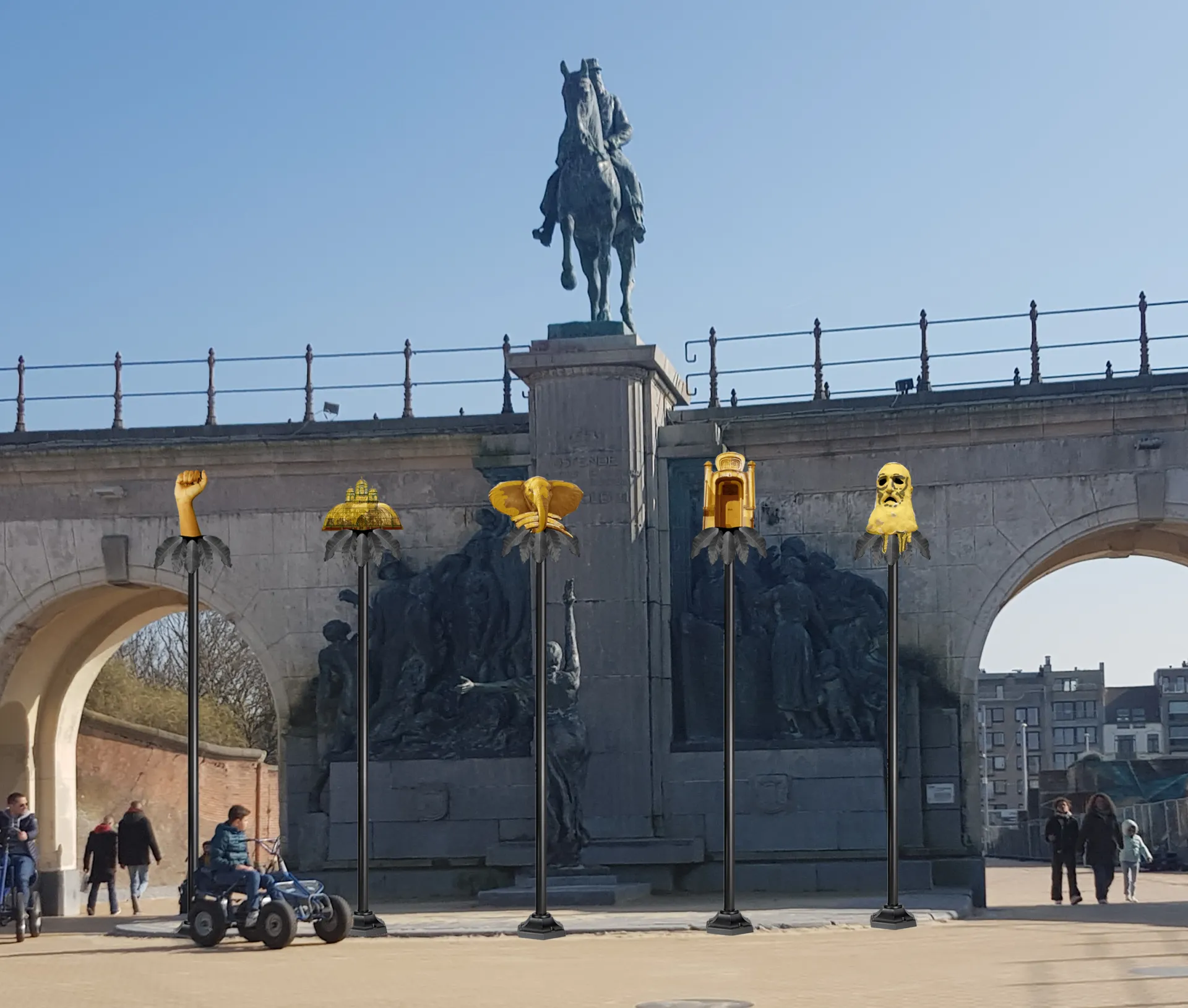
Proposal for artistic intervention at Statue of Leopold II, Ostende’, 2025 © Hew Locke
What we see more generally are retained statues and inadequate information plaques supposedly ‘contextualising’ problem monuments rather than addressing them forcefully and at scale to undo undue honour. It is no surprise that weak or cynical responses such as plaques lead some activists to conclude that the total removal of problematic monuments is still the only way forward. Even those transformations that have been mooted often falter, such as Hew Locke’s counter-memorial to an equestrian statue of the genocidaire King Leopold II in Ostend, Belgium. His installation of five pillars topped with gold sculptures referencing colonial history, which do not even touch the original monument, was commissioned by the city council but abruptly cancelled by an incoming administration.9
Instead, as in London, the emphasis in the public realm internationally has mostly seen attempts to alter the commemorative landscape by commissioning new artworks and memorials. Both Left and Right have consequently found themselves participating in a statuary arms race that only those with the deepest pockets and political connections can realistically win. President Trump, for example, revived his plan for a National Garden for American Heroes as ‘America’s answer to this reckless attempt to erase our heroes, values, and entire way of life’, re-routing cancelled National Endowment grants to pay for some 250 figurative sculptures: ‘The statues should be in the classical style, lifelike, and created from marble, granite, bronze, copper, or brass.’ Nothing degenerate to see here. Astonishingly, Hannah Arendt is among the candidates for immortalisation, alongside Alex Trebek, the Canadian host of quiz show Jeopardy! No one expects logic.
And while Montgomery, Alabama, may now have its National Memorial for Peace and Justice (the National Lynching Memorial), over in the state of Arkansas, with Roe v. Wade struck down, a Monument to Unborn Children at the State Capitol is being commissioned to commemorate aborted fetuses. One artist’s proposal was for a marble sarcophagus carved with wombs. Another competition entry featured a blindfolded fetus balanced on an umbilical cord pedestal. The winner will sit alongside the Capitol’s sculpture depicting the Ten Commandments.
Whatever the dignity and rightness of the Montgomery initiative, we must understand the limits of these aesthetic and pedagogical interventions; monuments do little to alter the material fortunes of people of colour in the States either way. There is no peace, no justice. This situation is only worsening despite the expenditure on public art. So how to respond?
Some of the reluctance to engage in substantive transformation of problem monuments might stem from a contemporary art world unwilling to engage with outmoded methods of traditional, permanent public memorialisation by proposing something equally permanent as a response. Yet even guerrilla or temporary interventions are relatively rare (at least for the moment — such fashions appear to ebb and flow). This is somewhat surprising given contemporary art’s interest in the transient and in practices which are more focused on ideas than an object’s materiality and whose longevity may be predicated not on preserving the original fabric but in protocols or scores for display, on the regular physical renewal of component elements, or on purposeful decay.
As we have found, though, the temporary response usually means that a problem memorial remains unchallenged permanently unless there is a sustained programme to maintain interventions. The counter-monument, the challenge, otherwise becomes once more invisible to the public over time — for good or ill.
As we have found, though, the temporary response usually means that a problem memorial remains unchallenged permanently unless there is a sustained programme to maintain interventions.
Despite or because authenticity demands acceptance of the passage of time, questions of durability are more complex in the public realm than when curating or conserving within a gallery environment. This is another reason why, as discussed above, the transfer of problem objects to a museum is not as unproblematic as it first appears and why the ‘sitedness’ of a public monument matters. As sculptor Richard Serra noted, form and meaning are inseparable from site — hence the furore back in 1989 when his piece Tilted Arc was removed from a remodelled Federal Plaza in New York with whose physicality it engaged. The piece itself remains in a government warehouse. Even its display inside a museum would not replicate its former interaction with the public realm, and Serra regarded the artwork as being destroyed. Likewise, an altar-piece displayed in a church does not have the same purpose as one displayed in a gallery.
The important point is recognising that there is always a link between the object itself and its context. Both matter to the unity and authenticity of the experience, to how we understand it. Of course, not all artworks are equally site-specific or sensitive to a particular place, but resistance and memory in the streets matters.
And, as we have seen, meaning and a monument’s reception change over time. Pierre Nora observed that places can become lieux de mémoire, sites of memory, precisely where there are no longer active milieux de mémoire, actual environments of remembering.10 Sitedness, too, emerges over time, especially perhaps in the case of ‘unintentional’ monuments rather than purposeful memorials. Ruins, for example, are naturally at home in the rain and the wind rather than mummified in art institutions where decay is arrested and different issues of authenticity then arise.11
Solutions always need thinking about on a case-by-case basis. The point is to take charge of history, to intervene rather than be passive in its face. To recognise that the meaning of objects is influenced by their physical and temporal context and that their meaning is unstable is to emphasise rather than diminish the importance of preserving historical evidence in order that we can interpret and re-interpret it as necessary over time. Post-Covid, one could move the statue of vaccination pioneer Edward Jenner back to Trafalgar Square. The change of context would not notably affect our understanding of Jenner — although it would increase our appreciation of his importance — but would dilute the militarism of the square, changing the context in which the memorial is understood rather than vice versa.
All such gestures, however, need to be considered within the wider political context. Given the failures to make material differences whether economically or to anti-discrimination, sections of the Left are beginning to question the value of identity-led politics and battles over symbols altogether. In 2025, British broadcaster Ash Sarkar — a ‘literal communist’ — released her book Minority Rule: Adventures in the Culture War.12 Her argument is that, without a material class analysis on which to hang it off, identity politics leads to a political dead end. Worse, in a fractured society with an atomised media landscape, liberal identity politics has individualism written through its core like a stick of seaside rock.
Some comments on Leftist YouTube took Sarkar to task for her apparent proclamation of the ‘death of woke’. Wasn’t this a parallel to the Democrat party machine hand-wringing at Trump’s victory — blaming it on blue-haired young activists forgetting the economy in favour of DEI policies? Instead, what she is correctly pointing to is that the mantle of victimhood can just as easily be adopted by nationalist identitarians, not simply as traditional divide and rule tactics but as a strategic misdirection of blame for failing economies and an asset-stripped public sector by the actual ruling minority.
Although Sarkar shows little evident interest in the architectural or material heritage, she argues, as this book does, that the necessary project is to re-focus rather than abandon ‘woke’, crucially by re-attaching it to class and to Marxist historical materialism, because when identity is unmoored from material conditions and attached only to symbols, it is then easy for those hostile to a progressive agenda to hijack its tactics — memorialisation included. Statue arms races ensue.
None of this is to say that symbols don’t matter. In these Gramscian wars of position they do. The creation of a true counter-hegemony — as opposed to liberal gesture politics — matters. It matters especially where oppression in the cultural sphere is not simply a competition about dominant narratives in the public realm but about resisting attempts to erase group identities. New York’s Stonewall symbolic statue may matter less than the reality of the ‘urinary leash’ that the Right seeks to impose on trans people in its attempts to exclude them from public toilets and so public life, but it still matters. The ‘flagshagging’ campaign, run by Far Right groups from the summer of 2025, to ‘raise the colours’ by running England and Union flags up suburban lampposts and painting them on roundabouts is not just about nationalist symbolism, still less patriotism, but about intimidation, with not just symbolic but real world effects, instilling fear and control in the streets (a classic Far Right and Fascist tactic) and in so doing attempting to enforce segregation in much the same way as many a Confederate military marker.13
In actual wars, and notably those with a settler-colonial character, this can take the form of cultural genocide or at least cultural cleansing, where the oppressor is seeking to destroy an established pattern of life in order to replace it with another. As Raphael Lemkin, the Genocide Convention’s initial author, conceived it:
Genocide has two phases: one, destruction of the national pattern of the oppressed group; the other, the imposition of the national pattern of the oppressor. This imposition, in turn, may be made upon the oppressed population which is allowed to remain or upon the territory alone, after removal of the population and the colonization by the oppressor’s own nationals.14
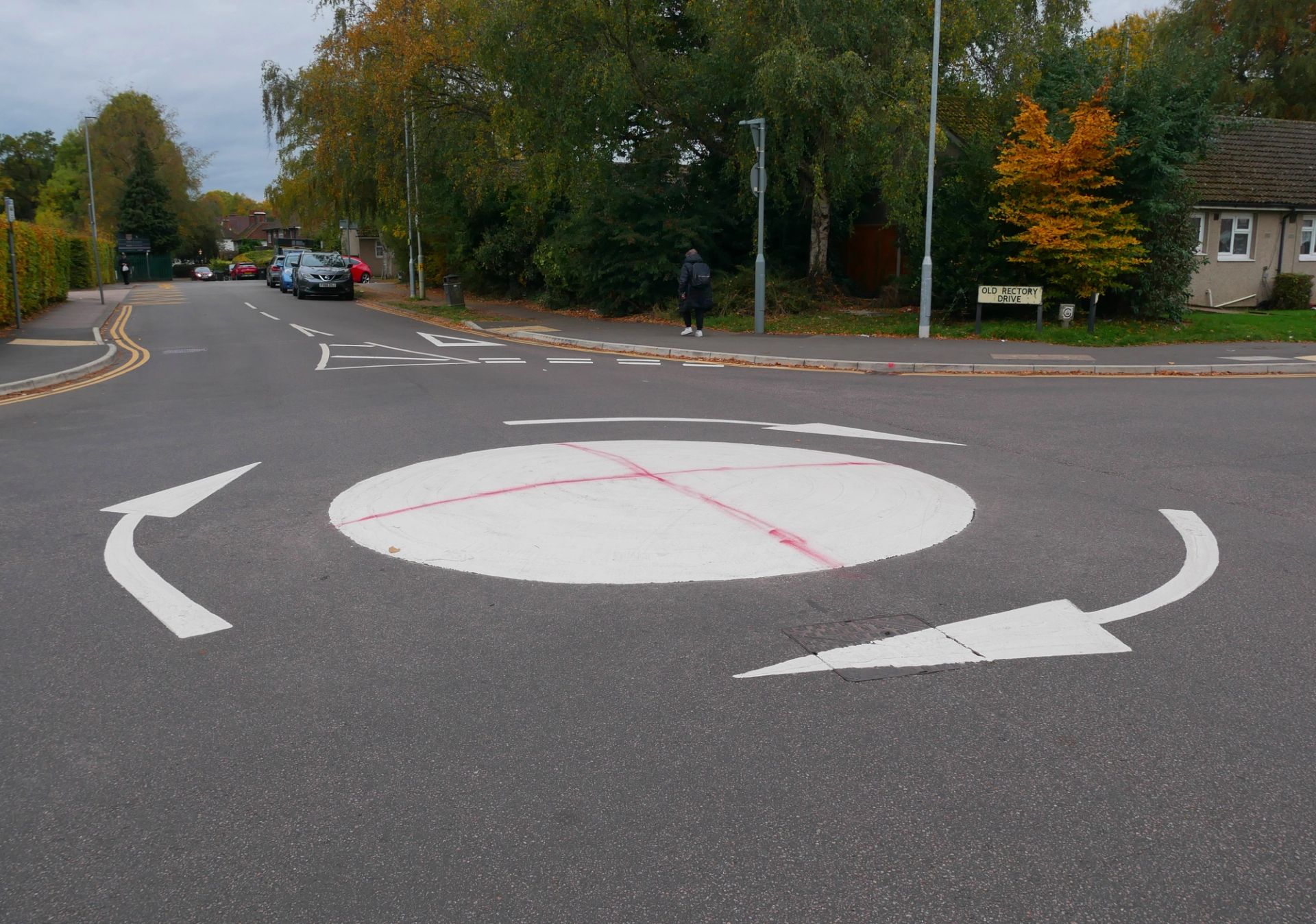
A spray-painted flag of Saint George on a roundabout in Hatfield, part of the 2025 Operation Raise the Colours campaign.
Culture is central to the original concept of genocide, but this has been ignored or dismissed since as valuing art over life. The focus today is on mass murder in ways that miss the original conceptual purpose and thus an understanding of genocide’s aims and methods.
As was set out in the first edition of this book, examples of cultural genocide are ever with us — from the former Yugoslavia to the fate of the Uighur in China. To that foul record we can now add Gaza. Countless human rights organisations and genocide scholars, and hundreds of thousands taking to the streets, have understood that a genocide is, at the time of writing, still underway. The scope of this goes beyond the shelling, sniping, engineered starvation, destruction of the health system, and other obvious attacks on the group body. A 2024 Amnesty International report is among many that have addressed attacks on culture as recognition of an attack on identity and the conditions of life. The report includes a section on the deliberate erasure of Palestinian cultural sites, including places of worship, education, theatres, archives, cemeteries, and archaeology. These are the material traces that demonstrate that the land has been home to Palestinian people since at least the Bronze Age. A UN Human Rights Council report set out a similar catalogue:
By mid-December [2023], Israeli bombs and shells had destroyed or severely damaged most life-sustaining infrastructure, including 77 per cent of health-care facilities, 68 per cent of the telecommunications infrastructure, large numbers of municipal services (72), commercial and industrial sites (76), almost half of all roads, over 60 per cent of Gaza’s 439,000 homes, 68 per cent of residential buildings, all universities and 60 per cent of other educational facilities, including 13 libraries. Israel has also destroyed at least 195 heritage sites, 208 mosques, 3 churches and the Central Archives of Gaza.15
Historic Gaza City has been reduced to apocalyptic ruins. The Palestinian cultural authority set out the destruction of 207 buildings of cultural or historical significance, including 144 in the old city. Among the casualties has been the al-Omari mosque, the oldest and largest mosque in the territory and originally a Byzantine church, the 700-year-old Hamam al-Samara bathhouse, and the Greek Orthodox Church of Saint Porphyrius, with its origins as far back as 425 CE and described as the third oldest church in the world. The proposed World Heritage Site at Anthedon Harbour, Gaza’s first known seaport, was bulldozed.
A July 2025 report by Israeli human rights organisation B’Tselem, which for decades has been documenting the targeted demolition of Palestinian homes across the Occupied Territories, stated the destruction of schools had reached 90 percent by April 2025, that IDF troops had looted antiquities and museum holdings and had carried out the deliberate arson of the archives building.16 A BBC Verify report the same month found that entire towns, once home to tens of thousands of Gazans, had been systemically bulldozed by Israel over the previous weeks, leaving no structures standing. B’Tselem and Forensic Architecture have warned that a similar pattern of urban erasure is being observed in the West Bank and with rampant home demolitions in East Jerusalem. Domicide. Scholasticide. Urbicide. The UN Human Rights Council found that ‘by analysing the patterns of violence and Israeli policies in its onslaught on Gaza, the present report concludes that there are reasonable grounds to believe that the threshold indicating that Israel has committed genocide has been met’.
Even so, while there has been increased reporting on the destruction of heritage as part of a comprehensive campaign of erasure of the Palestinians, there remains a lack of recognition that cultural targeting is an integral component of genocide. Cultural destruction isn’t written into international law, because of deliberate resistance from settler-colonial nations to culture’s inclusion in the 1948 Genocide Convention. Only the ‘biological’ clauses were retained in the final version of the Convention: killing, serious bodily or mental harm, destructive conditions of life, preventing births, forcible removal of children. However, taking cultural targeting into account helps us understand more clearly when genocide is happening, because genocide seeks to erase the identity of a group — as a group rather than as individuals within that group — and in a given place. It can also help demonstrate intent — a crucial test in proving genocide.
Usefully, South Africa’s interim submission to the International Court of Justice in early 2024 addressed the destruction of culture as part of the calculated destruction of the ‘conditions of life’ clause — an accepted component of genocide. This might be another way of trying to lever culture back into the official genocide framework. It would fit with Lemkin’s original concept of culture as a ‘derived need’.
In his work on colonialism, Lemkin also argued that forcible assimilation can be tantamount to genocide. This is different from gradual peacetime cultural change where, say, the decline of a minority language may be regrettable but may not be intentional or genocidal. Admittedly, sometimes the boundaries between cultural oppression or dominance and genocide are not always clear-cut; it might be that mass slaughter must also be present to some degree at least in order reach the threshold. Either way, we are well beyond the point that cultural destruction in places such as Palestine should be seen for exactly what it is, as a full component of genocide — one of its integral aims and methods — rather than patterns of cultural destruction simply supplying evidence of it.
It is true that you can assemble all the material evidence, all the physical facts you desire, but we live in a moment where too many people are just not persuadable by any of it, preferring their own conspiracies. But to have any chance at rationality, the facts at least need to be available. In July 2025, Zarah Sultana, the former Labour MP turned independent, complained that Hansard — the official record of the UK Parliament’s proceedings — doctored her speech in which she said, ‘We are all Palestine Action’, referencing the direct action group recently proscribed as a terrorist organisation.17 Officially, it is as if she never said it at all.
We may have reached the point that Hannah Arendt identified as the totalitarian environment, where people no longer care about the difference between fact and fiction, truth and falsity. If so, safeguarding the evidence of the historical fact, the material evidential record, doesn’t matter less; it matters more than ever for any future reckoning.
We may have reached the point that Hannah Arendt identified as the totalitarian environment, where people no longer care about the difference between fact and fiction, truth and falsity.
BOOK
In Monumental Lies: Culture Wars and the Truth about the Past (Verso, 2026), Robert Bevan raises important questions about memory, material and cultural politics. Originally published in 2022, the book is reissued as a paperback with a poignant afterword, following the genocidal acts wrought upon Palestine since 2023. Monumental Lies exposes the truths buried at contested heritage sites, underlining the need to safeguard the material evidence of history from both malign defenders and over-enthusiastic erasure. Bevan challenges us to rethink our relationship with such contested spaces, from colonial statues to ethno-nationalist narratives about beauty and tradition.
BIO
Robert Bevan is an award-winning journalist, author, and heritage consultant. He has been the architecture critic for the London Evening Standard and the Australian Financial Review and a former editor of Building Design. Author of the acclaimed title ‘The Destruction of Memory: Architecture at War’ (Reaktion Books, 2007), he is a member of ICOMOS, the heritage body that advises UNESCO, and the Blue Shield, which addresses heritage in crisis.
NOTES
1 Exec. Order No. 14253, ‘Restoring Truth and Sanity to American History’, 27 March 2025, whitehouse.gov.
2 Ibid.
3 Ibid.
4 Helen Stoilas, ‘Mentions of “Transgender” and “Queer” Removed from US Government’s Website Dedicated to Stonewall National Monument’, The Art Newspaper, 14 February 2025, theartnewspaper.com.
5 Marco Silva, ‘15 Minute Cities: How They Got Caught in Conspiracy Theories’, BBC, 3 October 2023, bbc.com.
6 Ellie Ames, ‘ “Toxic” 15-Minute City Phrase Cut from Oxford Local Plan’, LocalGov, 8 March 2024, localgov.co.uk.
7 Suella Braverman, ‘Islamists Are Bullying Britain into Submission’, suellabraverman.co.uk.
8 Kiran Stacey, ‘More than Half of Tory Members in Poll Say Islam a Threat to British Way of Life’, The Guardian, 28 February 2024.
9 Eileen Kinsella, ‘Hew Locke Speaks Out After Belgian City Cancels Sculpture Commission’, artnet, 20 June 2025.
10 Pierre Nora, ‘Between Memory and History: Les lieux de mémoire’, Representations 26, 1989, 7–24.
11 Zoltan Somhegyi, unpublished paper on ‘sitedness’ delivered at the Aesthetics and the Management of Heritage conference, Churchill College, Cambridge, 10 July 2025.
12 Ash Sarkar, Minority Rule: Adventures in the Culture War, London, Bloomsbury, 2025.
13 Joe Mulhall, ‘ “Operation Raise the Colours” Organised by Well-Known Far-Right Extremists’, Hope Not Hate, 22 August 25, hopenothate.org.uk.
14 Raphael Lemkin, Axis Rule in Occupied Europe: Laws of Occupation, Analysis of Government, Proposals for Redress, Washington DC: Carnegie Endowment for International Peace, Division of International Law, 1944, 79.
15 UN Human Rights Council, Fifty-fifth session, 26 February–5 April 2024, Agenda item 2, ‘Human Rights Situation in the Occupied Palestinian Territory, Including East Jerusalem, and the Obligation to Ensure Accountability and Justice’, Human Rights Council Resolution (A/HRC/RES/55/28).
16 B’Tselem, Our Genocide, Jerusalem: B’Tselem, 27 July 2025.
17 Xander Elliards, ‘MP’s “We Are Palestine Action” Comment Edited Out of Hansard’, The National, 8 July 2025.