Merve Bedir Thank you for joining us. I’ll open on a personal note: I was teaching in Hong Kong when the movement, led by the young generation, took shape there in 2019. In that movement, architecture’s common sense was also unsettled; the way the city had been designed and built was transformed in real time non-stop for almost a year. I’m interested in what this means for architecture and its pedagogy. Understanding architecture is an essential part of the production of space; we know it intuitively, by living together, and at school. It’s never neutral, it aligns with movements and struggles, and it participates in the formation of public consciousness. It is vital to recognise what young people ask for their future, what they desire and what they feel should be accountable. Architectural education cannot be separated from this.
Let’s start with introductions.
"It is vital to recognise what young people ask for their future, what they desire and what they feel should be accountable. Architectural education cannot be separated from this."
Student 1We’re choosing to shield our names at this moment, but we are both third-year undergraduate students at the architecture faculty at the University of Belgrade, one of Serbia’s state-funded schools. We have been participating in the ongoing student-led protests since December 2024. I attended the first student plenum — a meeting that any student is free to attend — by chance, and immediately understood the importance of the issues at stake. But no one believed how important and how big it would actually become.
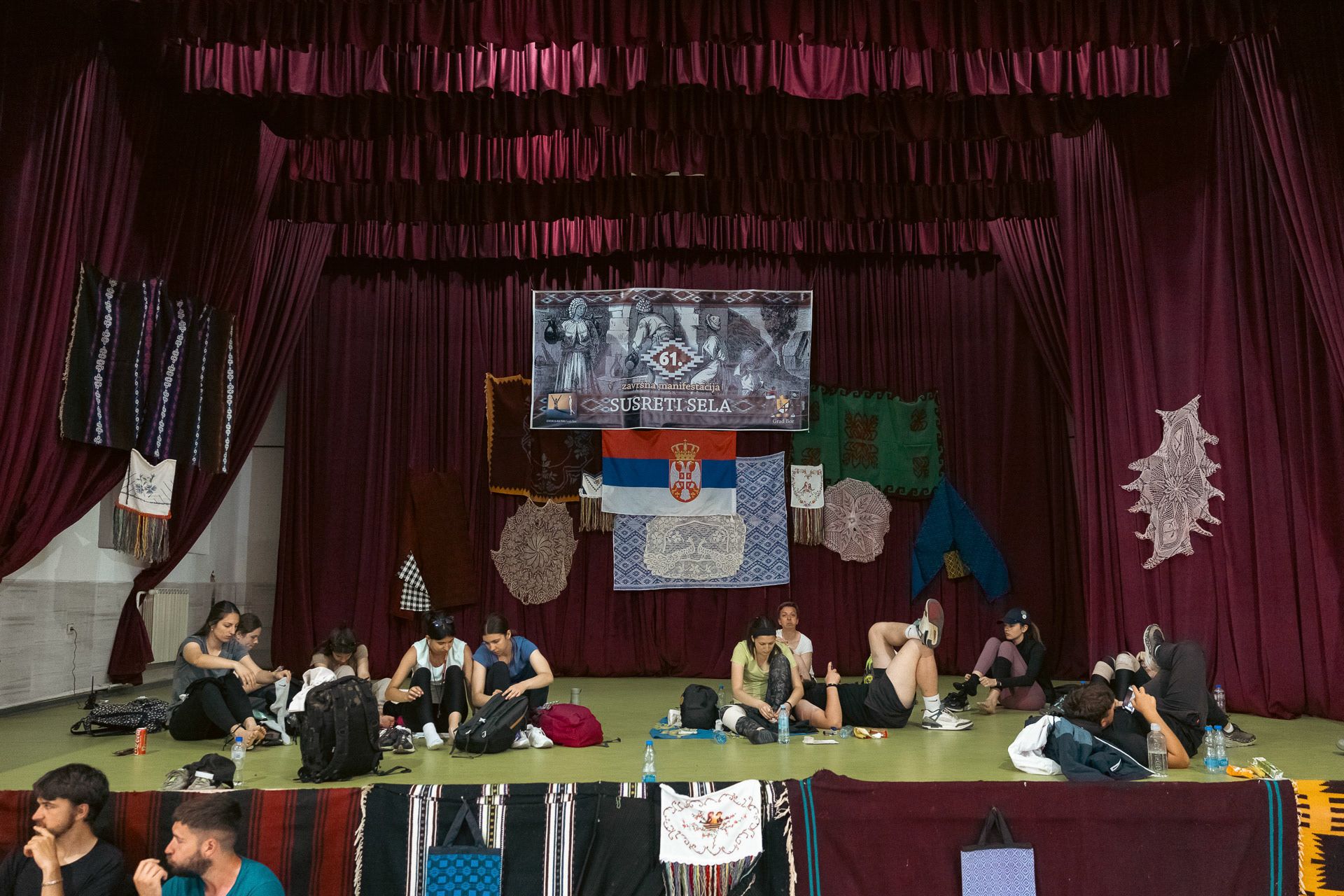
Students sleeping in a village cultural center during a break in student marches across Serbia
Student 2 My participation in the movement also goes back to the beginning. The whole movement started after the collapse of the canopy at the main railway station of Novi Sad. This disaster was overshadowed by the fact that the whole station was renovated without transparency and opened without permits that are usually required before the public has access to a site following construction.
Soon after that collapse — which caused sixteen deaths — students from the Faculty of Dramatic Arts in Belgrade staged their first protest. They held a sixteen-minute silence in front of their faculty and were physically attacked by people who were later found out to be local council members of the municipality of Belgrade.
That started a whole wave of rebellion, protest and call for change. Architecture was among the first faculties to have our own plenary session. About four or five hundred students gathered — too many to fit in the lecture theatre — and we decided to mount further blockades. Personally, studying architecture played an important part in my awareness of how the world around me works. That’s when I really started to care more about my world, gaining the courage to inform myself and speak out.
MB What does care mean for you, in this context?
Student 2 I think it ties into what you said. I realised somewhere along the course of my studies — before the blockade — that I have the power to make the world my own, and find agency here in Serbia, where I want to be. That's a big thing here: a lot of people dream of studying and eventually making their career abroad, because conditions here are not always favourable. But I never wanted to do that: I want to stay and make a future for myself here — I want that future for everyone around me. That's how I would define care.
Student 1 I agree. Care is a good word to introduce, and love is a big part of it too. This is a fight that was brewing for a long time within all of us; it surfaced, and became a crucial part of our lives. None of us would be who we are now if it was not for this movement. Before that moment, I never considered myself to be patriotic — but I couldn't imagine a more patriotic act than being a part of this change. Fundamentally it means loving the country, loving its people enough to fight for change, to fight to shape our space into something that is not only liveable, but that people are happy to live in.
I have been a part of this struggle from day one and it's been a hard journey, but I have never once felt that I lost out; I have only gained. I gained a lot of wonderful people who are also ready to fight for that change and I gained respect for our people, and I gained a lot of self confidence through all of this.
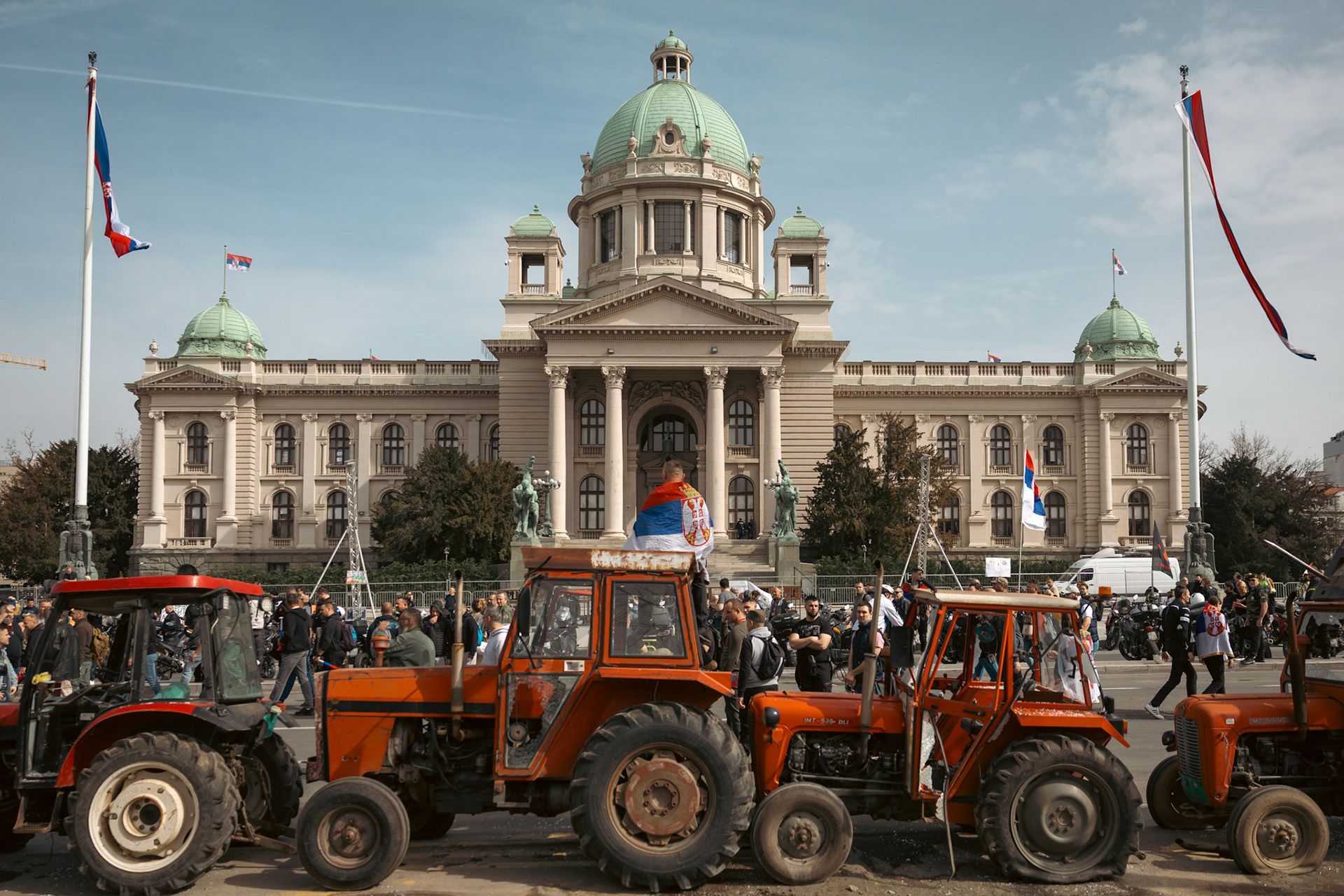
March 15th, protest in front of the National Assembly
MB I'm in Istanbul now, where we have witnessed an increasing polarisation around patriotism over the last two decades. For whom do we feel responsible, or obligated towards? In Serbia, as elsewhere, the government is trying to criminalise the movement based on that very claim to patriotism. Could you articulate your own ideas around that?
Student 1 We have a lot of extremists in our country, and patriotism has certainly been used against us in this movement. Over the past few months, we started using the slogan "Students win”, which can now be seen everywhere across the city. In response, our government launched their own slogan "Serbia wins” — effectively putting a divide between students and Serbia, on opposite sides of this fight. When I talk about patriotism, I see it as a love for our cities and for our people — not the extremist version of patriotism that has become popular and sometimes toxic in our environment.
"When I talk about patriotism, I see it as a love for our cities and for our people."
Teacher I would add something on this faceted notion of patriotism. I’m a researcher and an educator, and have been teaching in Belgrade for over fifteen years. As an early millennial or late generation X, I remember growing up through the Balkan conflicts in the 1990s. These were my teenage years, my coming of age. I didn't relate to the flag because it was always abused in the context of warfare, framing as patriotic those acts that were actually harmful. It strikes me that the current student movement has revived my country’s flag for me; all of a sudden I felt emotional, because students were the ones taking up the flag — which was so powerful. Many peers have shared how this movement literally resurrected the concept of patriotic acts for us. Previously, I would say I'm from Belgrade, to distance myself from the acts of the state. Also present during the protest is solidarity — distinct from care, solidarity is rather relational; it comes from empathy for the other. Paradoxically, the regime is actually mirroring, or mimicking student actions, while positioning the movement as being against the state — a complex propaganda strategy. So the most patriotic movement in years is considered a betrayal.
"Many peers have shared how this movement literally resurrected the concept of patriotic acts for us — distinct from care, solidarity is rather relational; it comes from empathy for the other."
MB This speaks not only to the way a movement transforms over time (where an opportunity presents itself for politics to provoke polarisation), but also how it is perceived by the society, its tactics and strategies of response. What were the early messages?
Student 1 At the beginning, we defined four demands, starting with justice for the victims of the tragedy, and for the students who were attacked. We wanted to find out who is responsible for these injustices, for them to be held accountable. We wanted the documentation of the canopy reconstruction published as a public document — as it should be — and for the violent attacks to be prosecuted.
Student 2 The third demand is the one people usually forget. During the first protest in Novi Sad, people were attacked and arrested; one of the demands was for their charges to be dropped, while the fourth was a quality of life request for the students — increase in the state budget for education, especially for universities.
Student 1 Later, the protests on 15 March 2025 led to a fifth demand, which was to investigate the use of a military weapon against protesters. This was the sound cannon, a high frequency transmitter that was used to destroy the protest during a scheduled sixteen minutes of silence.
Teacher This was done to disperse the huge crowd and to create turmoil, including potential stampedes. This turned the silent protest into something chaotic and dangerous.
Student 1 They attacked us at our most vulnerable and emotional time during that protest, which was also the biggest gathering at the time. After that, we saw a lot of manipulation from the media — still ongoing — claiming that the government didn't use the sound cannon, or even that the students must have staged it themselves, as a performance or manipulation tactic. After a few months, we basically rolled our demands into one: namely, a call for elections, as the only democratic way to bring change to this country. We still haven't had them, but that is what our fight is focused on right now. [Editor’s Note: On 09 September — several weeks after this conversation was recorded — current Serbian President Aleksandar Vucic announced the date of a snap election as October 25 2026, following nearly two years of student-led protests.]
TeacherThere is a recognition that an institutional shift is not going to happen while this party is in power. The regime is apparently still toying with this idea; the media strategy is deliberately constructed to confuse, overwhelm and ultimately to tire people out. Consequently, I really enjoy the vitality behind the student movement. Since it's organised in plenum, everyone can take part; when someone burns out, someone else kicks in. This horizontality of the organisation is beautiful and in my view, it has kept the flame burning. You can't manufacture that energy in any hierarchy; it takes too much time and responsibility.
KOOZ Many citizens have witnessed multiple cycles of mobilisation and protest for systemic changes, which flare up and die down: against the invasion of Afghanistan, against Brexit, for abortion rights, for Black Lives Matter and for Palestine. It’s harder to observe galvanisation on a longer duration; while there is abundant inspiration, energy and optimism, I would recognise a little cynicism as well.
Teacher If we're continuing this conversation on generational lines, I think we underestimated this one. People assume that young people are embedded in their black mirror, scrolling their hours away — but here they are. They are observing all the time, even if they might seem self-absorbed. There are real needs — and real fears. I can’t imagine how frightening it is to grow up in an age where everything in the world seems to be collapsing around them. Where is the optimism for them? Yet this moment and this movement was indeed optimistic. The statement was something like: We will stand our grounds and you can’t do this to us: it was amazing how students both self-mobilised and mobilised us, to rallies and marches — intercity marches, with one university going on foot to the next city and the next university.
"It was amazing how students both self-mobilised and mobilised us, to rallies and marches."
Student 1 Technology provided us with the means to communicate instantly with people all over the country, in different cities, and to inform people about the protests through social media. It's our own voice that everyone has been able to hear. Our protests today are distinct from past decades in this sense and it's a big asset in this fight. Of course, it has its flaws. We are vulnerable to spies embedded within our official groups and communications, especially as everything is very transparent — which is how we want to be.
As for the marches, for me they were perhaps the most influential thing in my life. I marched to Novi Sad twice; the first time in February of last year and then again in November, one year after the tragedy. It’s hard to describe to a person who hasn't experienced it, walking eighty kilometres from Belgrade to Novi Sad and then on to the next city; I'm thinking of all of the people that we met on our way. For the first march, we set off as a group of a few hundred people; in the end we arrived as a few thousand. The second march was much bigger; while going through villages and small towns, we witnessed their way of life and their struggles too. They came out in the street and joined us. It was wonderful to feel that support, the love that they had for us and that we had for them. We marched for all of them.
MB While the zborovi (public assemblies)- provide a form of logistical and infrastructural support, there's also a clear attempt to recreate connections along the urban-rural nexus and an understanding of different localities, and with peers at other universities. This starts to create a different bond outside the public’s common sense, reminding us of our radical interdependencies, which has been voided and appropriated since the 2000s if not earlier. Do you see this as a way to keep moving?
Student 1 It's a big point. Our organisation has a programme called “A Student in Every Village”, which has been running for the last year. This allows us to reach numerous villages and small towns across the country. We sit in the street so anyone can come and talk to us, ask us questions about anything that concerns them; there's even a door-to-door campaign. We inform people about our fight, trying to create an equal level between the rural and the urban. Protests can be centralised in big cities where there are already a lot of students and the will to fight, but I think there’s been a huge shift in the smaller parts of our country. The fight has moved everywhere, in every corner of our country.
Student 2 I personally didn't attend the intercity marches, but I've heard a lot from those who experienced them and it was especially important in the less developed parts of the country. Picking up on what you mentioned about the zborovi or citizen parliaments, these are self-organised sessions, in parallel with the students' plenary. The people hang posters around their neighbourhood to meet and discuss their issues; it's an action that was started by students and spread through the whole country, so now every municipality has its own zbor, or assembly. In fact, they are especially active outside of Belgrade and in cities where there are no universities; students who travel from there to study elsewhere start gathering in their own region, and then local citizens take it over.
"It's an action that was started by students and spread through the whole country, so now every municipality has its own zbor, or assembly."
Student 1 On the point of cynicism, there is the generational gap that we already mentioned — especially within families. A lot of students had to face their grandmothers and grandfathers, who believed the accusations of the pro-regime media: that we are paid to do all of this, or that someone is manipulating us. It took some time for us to gain the trust of the older generations, who tend to have a more conformist way of thinking. We have a national legacy full of disappointment, fear and tragedy, so it's hard to find the courage to believe that things could actually change. But these campaigns and events where we talk to people have made a big difference. It's been wonderful to hear that older people have even organised their own protests and joined our struggle.
Teacher Historically speaking, Serbia has been fully or partially ruled by other people for ages: the Ottoman Empire, the Austro-Hungarian Empire. Between the vacillation of large empires and the big state, you could only decide whether to lean into power and follow along, or whether to rebel. It might sound stereotypical but over drinks with friends, everyone is against (any) government — but then you go to work and conform to the most ridiculous of rules. Everything is top-down and you follow. You have a job, a home, everything is settled for you; you are just one piece of the machine, and you do what you're told to do.
This also has to do with responsibility — because freedom implies responsibility. Older generations have inherited the belief that we can't do anything; they have learned to feel helpless. The regime controls the vast majority of the media, especially television — which is still the main channel of information for older people. From this perspective the only problem is the blockades staged by the students. They interpreted the sixteen-minute silent protest as blocking prosperity. So propaganda is fuelled by this learned incapacity and refusal to take responsibility.
MB I'm thinking of Ackbar Abbas’ words on the reason to keep moving — not because of abundant hope, but in order not to give in to despair. So how to keep momentum? How to hold onto hope, cultivating responsibility and desire? You mentioned that the movement is democratic. When I talk about democracy in the Netherlands, where I live, I don't mean elections or individual votes; I talk about a democratic movement and practice, referring to the Syrians who started moving in the 2010s. Democratic practice is about this continuous struggle. It is about criticality and taking responsibility — which includes asking for it.
"Democratic practice is about this continuous struggle. It is about criticality and taking responsibility — which includes asking for it."
Student 1 In terms of momentum, it's definitely a game of endurance. It's been almost two years since the Novi Sad tragedy, and the movement is still very much alive. I think that the most important anchor for this endurance has been the silent protests. While emotions fade, and unfortunately, memory fades, we need constant reminders of what happened, and why we should still be angry about it. Every day for almost two years, we have held a sixteen minute silence at 11:52AM — the exact moment when the Novi Sad canopy collapsed.
For a while, there were a lot of protests, maybe even too many, at times — and people got tired. How to keep the fire going is a psychological question, as people can get accustomed to almost anything. The horizontal organisation and fluidity in our movement means that people are free to have periods where they are either more or less active. But we fight with silence while they fight us with sound cannons — and with media cannons, every day.
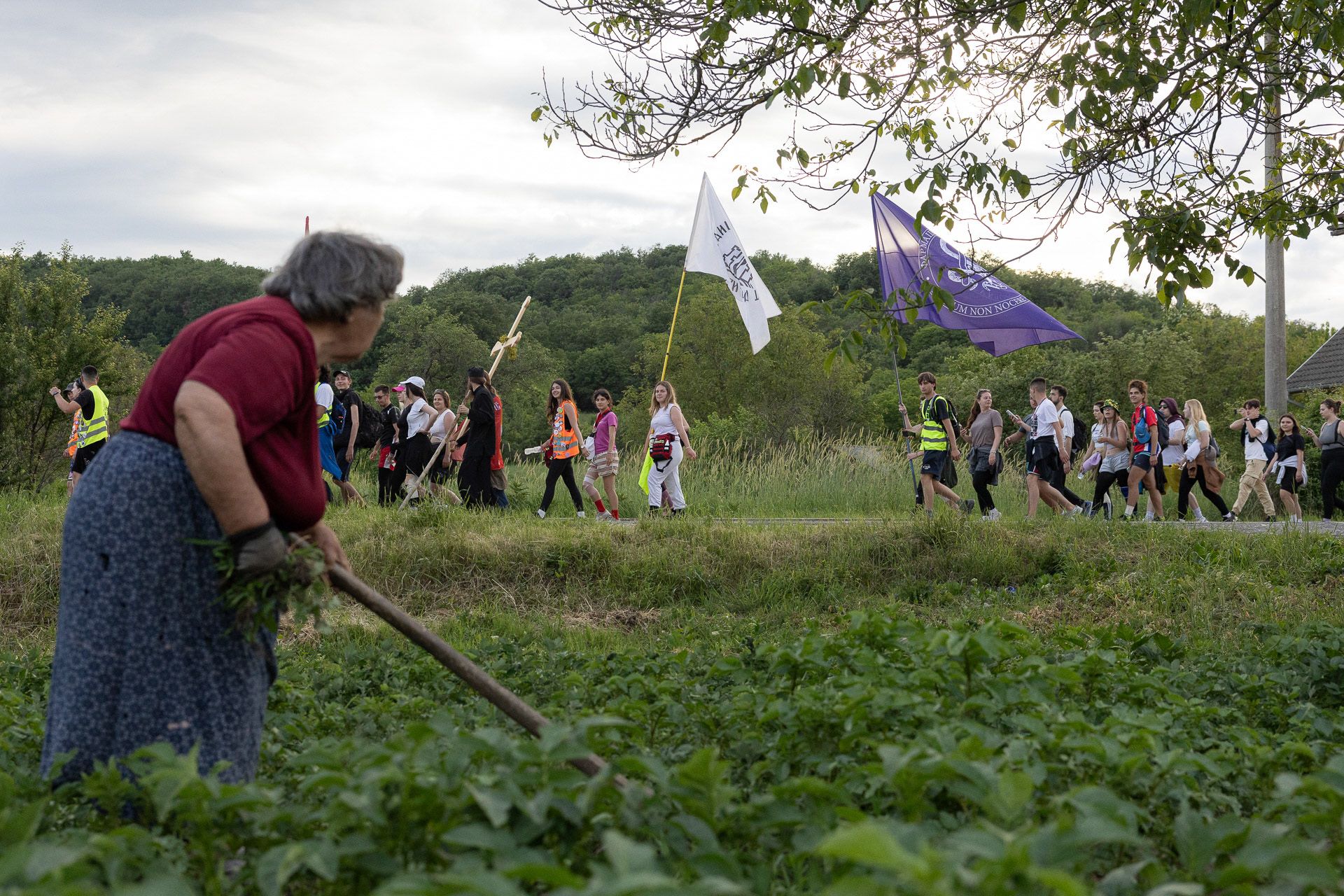
Student march across Serbia / walking hundreds of kilometers to reach every part of the country
"We fight with silence while they fight us with sound cannons — and with media cannons, every day."
MB I wonder if there are echoes of a socialist or even Communist legacy in things like the ‘student in every village’ programme. How far should we think of this movement in relation to class? Is it necessary to think in these terms?
KOOZ To add another parallel, the recent student movement in India was exhilarating, but nevertheless stratified through the inherited biases of religion, caste and — as in Indian society more broadly — the issue of class. Does class play into the struggle in Serbia, or is that absence also coloured by a cultural legacy of socialism?
Teacher I would say that class is definitely not a major part of it. But there's another kind of stratification in our case, arranged along a political spectrum: from heavy pro-EU sentiment to a more traditional aspect — with many shades in between. There's also a Slavic Orthodox traditional, or even pro-Russian sentiment in some parts, ranging through to more strongly citizen-driven and socially liberal values.
Student 1 At the very beginning, we defined ourselves as one body, without a designated ideology that fits all of us. It gathered many people and their different beliefs. We are connected through the most important principle, which is the fight for our people and a better quality of life.
Teacher This brings us back to the cause, which is both more elusive and more substantial. Students have demanded that institutions resume their actual work. We have good laws; we have a decent constitution, our matters of state are relatively well arranged — on paper. Students took up the constitution like an operational manual, finding conditions, loopholes and things to question. The move to reset the political system by simply readdressing our constitutional rules is something that somehow blurs all these strata.
KOOZ You mention the intercity marches, which position the movement at a certain scale. Thinking of the fabric of Belgrade, are there any specific sites or urban phenomena that have become meaningful to the movement?
Student 2 There are certain sites that I would recall, for example the constitutional court, where many protests were held for various reasons — including the purported misuse of the constitution. The general staff building was previously regarded as an important site of cultural heritage, but this listing has been taken away unconstitutionally.
PS Trump's son-in-law had his sights set on buying and developing this historically important Modernist heritage building, which was bombed by NATO in 1999. It has been standing there ever since as a piece of cultural heritage. Now these guys seem to think it best to turn it into a luxury hotel. This is what’s happening in Belgrade.
MB As is happening in Albania, and other places that don't make it to the media. We also remember the news on plans for Gaza by the very same people.
TeacherIt's a turbo-capitalist logic. That deal triggered a flash mob performance of joining hands around the building and drawing a symbolic ring of red paint around it. But certain specialised institutions — like the Institute for the Protection of Cultural Monuments of Serbia— have not granted permission for the project — there are some sparks of light in the darkness. But they have been compromised and exposed since, and there's a backlash against them already.
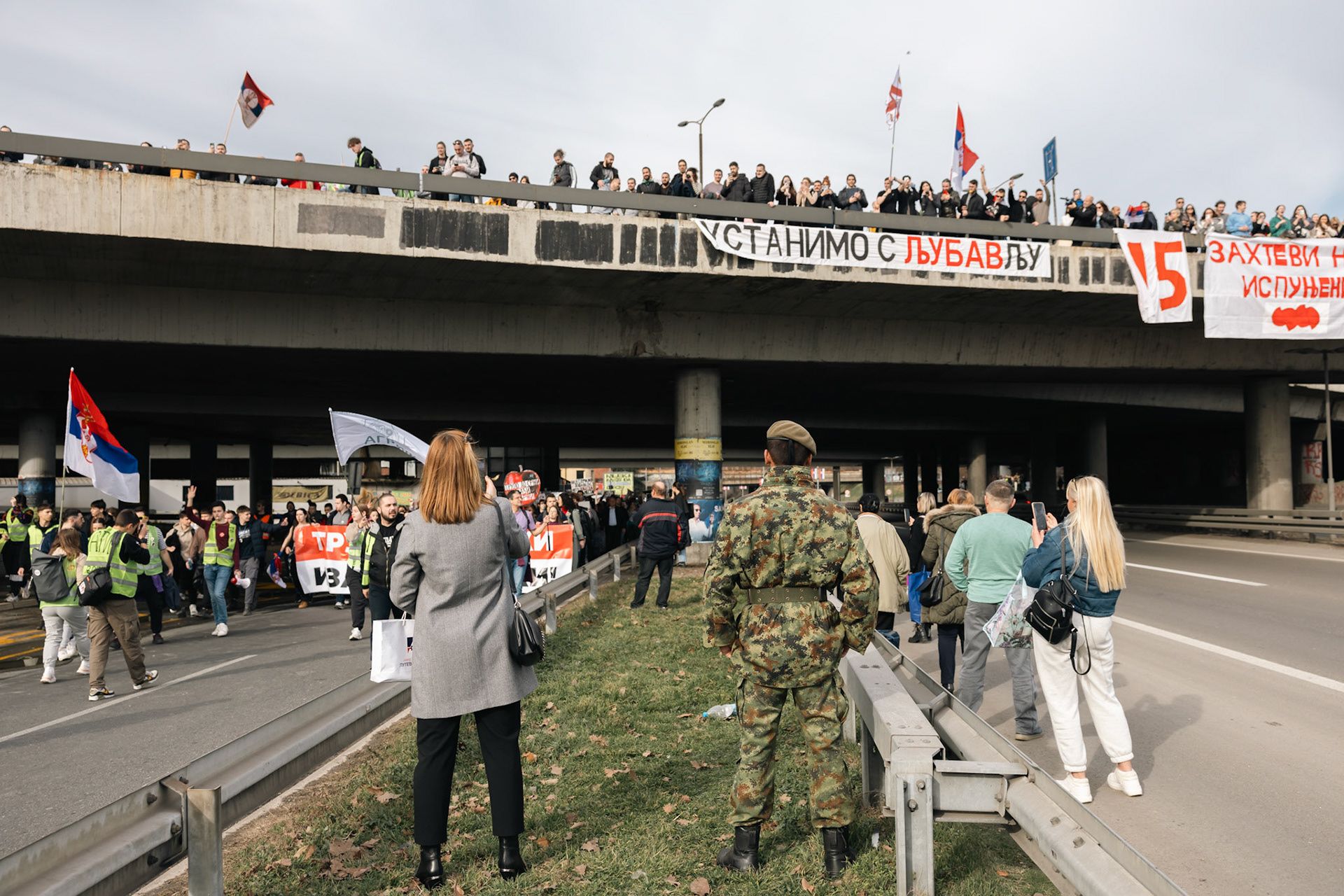
Blockade of one of the main roads in January 2025 / Autokomanda
Student 1 Slavija Square is the place where we had most of our big protests — it's where everything converges, after blockades, demonstrations or walks. It’s also where a lot of our institutions are located, so even if we didn't intend to go, we would end up there. It's something like the heart of our city; if people know about our protests, they probably saw pictures from there. That space has shaped us and our protests, while our protests have shaped that space.
The way that I am personally attached towards my own city has a special resonance now. I will always know it as a place of fighting for and demanding justice. As architects, we have a special role in this fight, because of the way that it started and because of the way that corruption is visible in our city. It's very often demonstrated through our architecture: in the destruction of old national monuments, in building the forthcoming Expo site, in developing the Belgrade waterfront. Physical architecture carries signs of the corruption that we endure. They are destroying our city part by part, and a question I ask myself is: what would they have to do for it not to be the same city anymore? We are trying to reclaim it and fighting for it to remain the city that it is.
MB Our curriculums include public space and heritage within an expertise of architecture, and thus frame them in design, history and theory, and preservation as specialisations. Do you find this conception of heritage meaningful, or does your perspective come from a larger critique of a new worlding of the city by the neocolonial development and corruption?
Student 1 We have felt very connected to our heritage during this movement. My colleagues and I helped to make exhibitions that our faculty organised, about our brutalist and socialist architectural heritage — the buildings that shape our country and our culture.
Student 2It's also a part of architectural studies. When I realised how certain buildings have shaped the country and the city I live in — especially in terms of the Modernist heritage mentioned — I felt that there was a point in history when we were really good at something: making architecture — something we should preserve. For example, take the expo scheduled to take place next year in Belgrade — this was the excuse used to abandon the historic fairground, built during one of the most architecturally impressive periods. That event was moved to a new site while the historic fairground was largely designated and protected as cultural heritage. However, the historic site has now been included within Belgrade Waterfront Masterplan — so what could happen now is the demolition of all historic buildings that are not specifically designated as cultural monuments, soon to be replaced by residential towers.
It's important to respect the city as it is, the way it was built and the way it has built us. That doesn’t mean clinging on to the past necessarily, but it's about recognising what is important, representative and valuable — and preserving it. It’s also about trying to develop the city further in the same spirit, with the same attention and the same expertise in which it was once built. Now, the city is being built for capital, motivated only by the largest possible profit. I don't think that there is a lot of care in how the city is being created anymore, which is maybe a failure of the profession. We have a responsibility to pay attention to the people who will be affected by what we design and create. I hope that becomes more important by the time I enter professional practice, which will be soon. I would like this generation of architects to have more agency and more empathy.
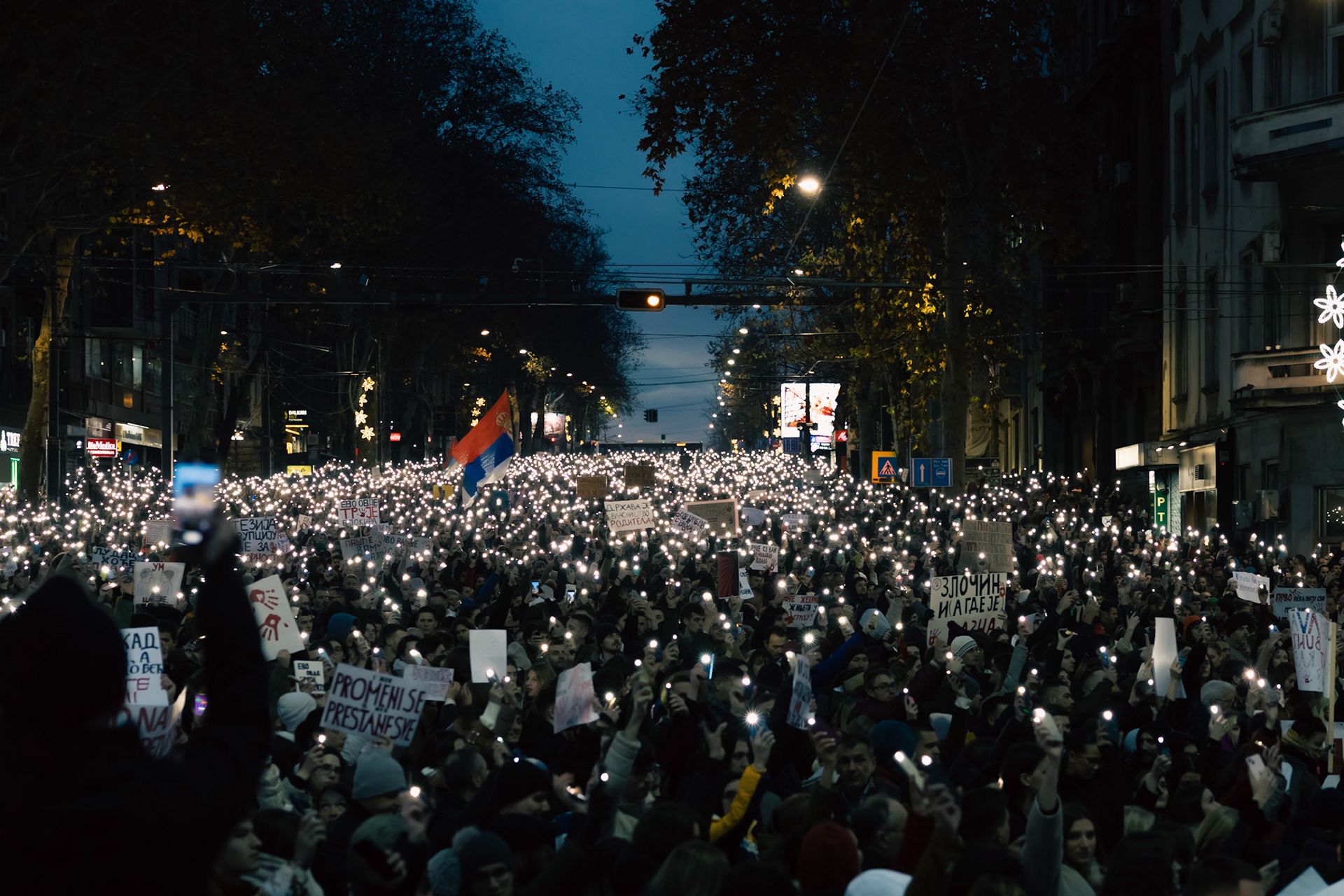
The first protest at Slavija
"We have a responsibility to pay attention to the people who will be affected by what we design and create."
KOOZ As a society, I wonder if we require a powerful engagement with the city every few generations — whereby we rename our squares, we remember different things, we choose which values are carried forward. We mark the spot where this battle was fought, that struggle was won, or where something previously standing was then demolished. It's unfortunate that such engagements tend to emerge under conditions of violence and oppression, but perhaps this recurrent intensity is necessary so that we can continue to reclaim the city.
Student 2 I think it's important to see the city as your own, to really feel it as a part of who you are and part of who you will become. That's why it's so important to educate ourselves and also for the university and our teachers to educate us in that manner: to think about space with reflection, with access to truthful information and the right to make choices — and with a view towards the impacts we will have on the future.
MB The act of seeing each other across our struggles and desires to help us feel connected. That sense is important to recognise, every single time it is felt. Thank you all.
BIOS
The Student Movement in Serbia is a self-organized group of students from all state universities, united in the struggle for a better future for our people. The movement has been active since late 2024, following the collapse of the canopy of the Novi Sad Railway station. Following a wave of public outcry, members organised the blockade of over sixty faculties across Serbia, as an act of protest against the pervasive corruption of the state regime. Since then, it has held numerous critical protests, marches and events; its goal is the imminent initiation of fair and democratic parliamentary elections in Serbia, as part of a wider fight to build a lawful and responsible society. Editor’s Note: On 09 September, Serbian President Aleksandar Vucic announced October 25 as the date for a snap election, following nearly two years of student-led protests.
Merve Bedir is an architect based in the Netherlands. She is the founder of iSKELE, as well as the co-founder of Aformal Academy in Pearl River Delta region, Kitchen Workshop in Gaziantep and Center for Spatial Justice in Istanbul. Her work focuses on infrastructures of hospitality and mobility, and the capacity of embodied collective intelligence in architecture. Having gained her PhD at Delft University of Technology, she has taught at Hong Kong University, École Polytechnique Fédérale de Lausanne and Columbia GSAPP.