Shumi Bose/KOOZ Thank you all for being here, to see what parallels and cross-pollinations we can find on the theme of Systems’ Hack. I understand Material Cultures has just moved house — how’s that been?
Paloma Gormley Thanks, yes; we’re settling into our new space at Tipping Point East: a project that was co-founded by Material Cultures, RESOLVE Collective and Yes Make as a centre for bioregional and circular thinking in relation to the built environment. RESOLVE runs a material store, which redistributes materials from the cultural sector to communities, while Yes Make are recovering materials from building sites across the city. So we are based here and carry out all our research and design work from here: working on prototypes, test builds and running our learning programmes — we just had 36 students from Central Saint Martins on site for seven weeks.
KOOZ That sounds undeniably commonsensical, to recycle excess material — yet it has involved hacking of a system that would otherwise create waste. Looking beyond the design of buildings and towards the systems they entail: which systems do you intend to address, and which are obliquely drawn into your work?
Jingru (Cyan) ChengIf we have to name one system, it's probably the system of value. Our starting point is really about breaking up that glossy image of the iconic building or site. For instance, the Jewel Changi Airport in Singapore, particularly the engineered waterfall: for us, that building is made as a spectacle— and the image of this spectacle has assumed its own life, if you like. The image travels everywhere, it reaches a much wider audience than the actual building. On the other hand, if you have to nominate one image that represents Singapore, that would be it. We've seen this image all over the world: the building-as-image becomes a tool or an apparatus for nation building.
"If we have to name one system, it's probably the system of value. Our starting point is really about breaking up that glossy image of the iconic building or site."
We try to address what lies behind that. In the case of Changi, that’s an image that signifies the ability to control tropical weather; to really engineer the environment in pursuit of a certain vision of prosperity. That image speaks to the — perhaps subconscious — collective imagination or desire, so that's our starting point. How can we break that image? Our method wasn’t conceived as a system hack, obviously. We tried hard to restrain ourselves from abstract criticism: instead, we go on a journey to understand what makes that image possible. This is done through really getting into those landscapes: the land, the river, the forest, the infrastructure, and encountering all the labour involved to make things possible. In a way, we try to take in all the support systems that make that image possible, in an embodied process.
Chen Zhan We both quit our jobs to give space for long term projects like what Cyan just mentioned. The project is called Tracing Sand. We see it as a pilgrimage of two recovering architects following sand and water along the Mekong River Basin in Southeast Asia, seeking to reconnect with the fundamental elements of the built environment. Such a nomadic way of journeying across territories enables us to look beyond the red line boundary of a given site that frames architecture as an isolated object.. This is our own small act of rebellion against the normative systems within the practice of architecture.
But unexpectedly, through that, we recently found a way of returning: a water campaign collaborating with the Indigenous Karen community living in the Vajiralongkorn Dam Reservoir in western Thailand, whose ancestral forest lands were submerged following the dam construction in the 1980s. Today, many displaced villagers live on floating rafts above their flooded homes, their lives rising and falling with the dam’s cyclical water releases. But this slow and engaged way of working is not possible in a conventional, client-commissioned model. Through fieldwork and discovery through our own movement, new projects emerge for the benefit of the community.
JCC In terms of our own rebellion, as Chen was saying, if tracing began as an act of leaving and reckoning, then the water campaign with the Karen community is our point of returning.
The overall tracing sand journey is actually also at this moment of returning: to its contexts, and to the communities at its core. Beyond revealing those relations, we are using the exhibition as a platform for engagement. Through the Singapore Biennale, we launched the water campaign to support the Karen community. In parallel, Hydroelectric Spectre transformed Bangkok Kunsthalle into an overnight sonic encounter with the power grid, allowing audiences to bodily sense the infrastructure linking the city to the Karen community on the reservoir. Both Bangkok and Singapore are key nodes of consumption in the increasingly integrated power grids across national borders in Southeast Asia. We hope to direct attention and even material support from these cultural centers towards the community that's embedded in those systems. In this sense, operating at strategic points, within the massive intangible network that we surface through our journeys, constitutes a territorial constellation — a systems’ hack perhaps.
KOOZ The work of Material Cultures has always acknowledged the embeddedness of construction materials within larger ecological, agricultural and economic systems. What have you found in terms of how architects can intervene in those systems — beyond or perhaps before specification?
PG I guess we've found that it's not possible to be passive. At least, not if you want the system to shift. There is scope for intervention at pretty much every stage and every point of action within a project — then it's just about how much capacity, energy and resource there is within a given project to go down those routes. The possibility is infinite, and the potential impact is extraordinary. That's why I find this field of work so optimistic and hopeful, because there is so much capacity in the system for change, there's a lot that can be done.
Conventionally, the way that we make buildings is incredibly damaging, often in ways that are invisible — largely because we conceive of the site of architecture as the sole construction site, rather than the many contingent places and sets of relationships. The impacts on ecologies, on societies, on health and the human body are really not registered within the system of architecture — there is no value system for them. Like many things within the capitalist framework, these effects are seen as externalities, irrelevant as long as they are out of sight. Part of our work is about bringing those impacts into the frame and in doing so, to start to reimagine different sets of relationships.
Some of the frameworks that we find useful are concepts like bioregionalism, which essentially proposes that we think about architecture as an act of building within a territory; that territory, rather than being defined in terms of national borders, could be defined in terms of its ecology and geology. There is a logic of construction that can be drawn from place once you think about it as a bioregion. But we've also made our bio regions much more complex; they're not intact as humans have reconfigured pretty much every ecosystem, geology and landscape in the world. So our bioregions are also very layered; a huge wealth of plants and materials have shifted many thousands of miles, which informs a new kind of territorial materiality.
It's quite a complex picture, but also quite an exciting one: we can begin to imagine how to rebuild our systems of thinking and can see how inherently — by shortening those supply chains — you can bring things back within the frame of what's visible. In that process, we can acknowledge the relationships between how we make, what we are drawing upon and what our impact is on the people and other forms of organic life. We have been researching plants as a source of building material — everything from grasses to trees and again, it's a really complex picture. It’s not as simple as sticking loads of carbon sequestering bio-based materials in buildings — although if you’re looking in pure carbon offset terms, it can seem that way.
"We've found that it's not possible to be passive. At least, not if you want the system to shift. There is scope for intervention at pretty much every stage."
KOOZ Can you take us through a particular project, to demonstrate the complexity that you’ve encountered?
PG Perhaps on the more theoretical end, together with ARUP we did a study for Yorkshire and North East England, looking at what it would mean to meet the demand for housing over the next fifty years using only bio-based materials, rather than things like concrete block and polyurethane foam. It’s quite amazing that this was commissioned by a relatively small local authority governmental body, because it's super progressive work. We looked at what it means in terms of land use — shifting what is grown and where — but also on the economy, jobs and skills, essentially demonstrating viability. We don’t need a massive shift, in terms of the crops: many of the fibre crops that we consider using for insulation are already produced through growing grain. At least in Scotland, we have enough timber to supply the construction of housing, particularly for lightweight timber frames rather than CLT — it's all quite viable, the transition is reliable and can be clearly mapped out. There are net gains almost across the board, in terms of making construction sites less impactful on health, creating more resilient jobs in the UK, and investing in farming in a way that can enable more regenerative or agroecological practices to be integrated.
Another project might speak to the complexity of the relationship between landscapes and materials. We recently worked with the Wellcome Trust on the design for an exhibition about water. Often in exhibition displays, you’re obliged to using panels or sheet materials: there’s always a very tight program, with rapid installation and strike out: that's the nature of exhibitions. Everyone uses MDF (medium density fibreboard) because in many ways, it’s an appropriate material for the context. We explored substituting that MDF out for different types of sheet material, and in the end we came through with three. One of these is a hemp board with a bio-based resin; another is a straw-based board with a lime binder, and the third — maybe the most exciting — is a paludi-culture board drawn from wetlands. This product is made in the same way of paper, with no synthetic binder whatsoever — it holds itself together mechanically because of the way the fibers are processed and has all of the properties of MDF. So this sheet has the potential to contribute to the restoration of wetlands, which are some of our biggest terrestrial carbon stores. Wetlands hold peat which is a specific type of decomposed plant matter. Many peatlands across the world have been drained for crop production because the soil is very fertile, but draining them means the peat begins to degrade and the carbon is released back into the atmosphere. By rewetting peatlands and bringing large grazing animals back in you can begin to restore wetlands and reboot the processes through which peat is created — but currently there is no perceived economic benefit in doing that, if you're a landowner. A product like the wetland board can provide that incentive, whilst enabling the regeneration to happen as you need to manage the reeds and grasses in order to keep these cycles going — so drawing upon materials from these landscapes is a very viable and positive thing to do.
KOOZ Both Field 0 and Material Cultures have been making work a multivalent network of processes and actors. The project ‘Tracing Sand’ shares a similar regard for the transformed landscapes, which make those prized images of architecture possible. Particularly, you evoke a sense of durational time within these transformations, from the geological time it takes to make sand, to the instantaneous experience of a certain sound. Can you talk about this sense of transformation over time?
JCC A lot of what Paloma just shared resonates on so many levels with our experience of ‘Tracing Sand’. What continues to be fascinating about that project is how we were able to work across two incredible scales. At one scale, we more or less literally trace sand: we follow the Mekong River across a huge stretch of territory. We're talking about where the river starts: from the Tibetan Plateau, the Himalayas, and then through Laos, Thailand, Cambodia and Vietnam to enter the sea from that delta. Through the process of extraction, some of that sand becomes part of Singapore — part of its territory — and turning into glass and concrete.
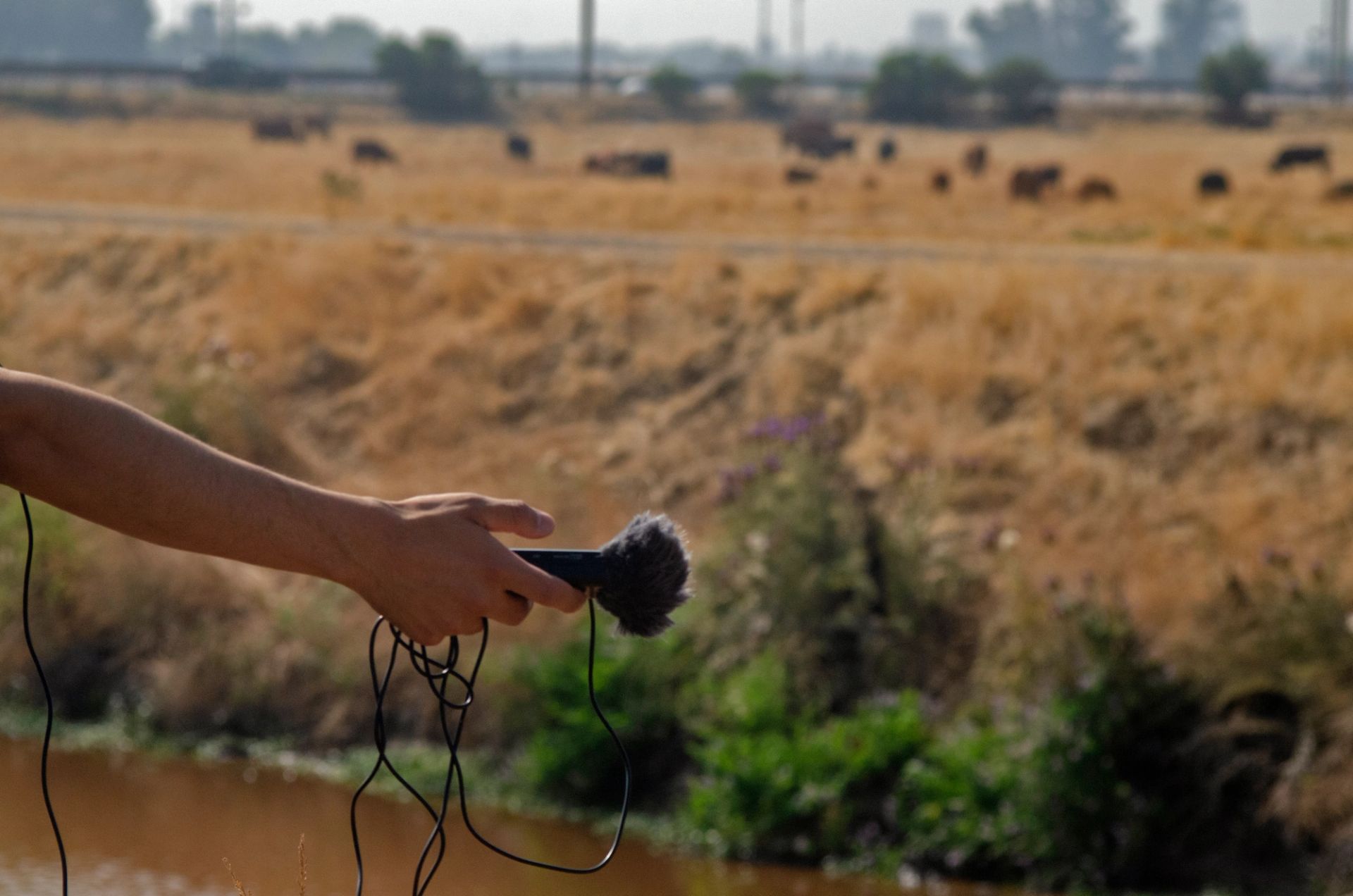
So on one hand, there's this huge stretch of territory, thinking about one single grain of sand. At the same time, we are re-experiencing that journey through the body — for instance, at a sand mine in Laos. Just watching the dredging boats take sand out from the Mekong riverbed, sand cascading from the steel structure, forming a mound that grows slowly but steadily: the sound resonates like a pulse, a rhythmic hum from the very heart of the earth. We stood there and listened to that for half a day. Turning all these questions about extraction into a bodily sensation; extraction is no longer an abstraction. That vibration or resonance that we felt in our bodies is something we have experienced on many occasions; the whole journey can be discussed through that deep territorial connection of geological time and simultaneously, how that feels in your body.
We learned about another dimension of time from Wang Shu and Lu Wenyu, in a conversation about river sand. They were talking about a newly completed rammed earth wall in Hangzhou National Archives of Publications and Culture in China, which was fifteen metres high. Lu Wenyu told us they have to reserve river sand for this construction; no other type of sand would do. For context, the most common type of sand used by contractors in China is mechanical, made by literally crushing rock into the size of sand grains. When we went to see the project, we noticed the shine or lustre on the rammed earth wall and suddenly it hit us: river sand has been washed over by rushing waters for hundreds of years, so that what remains is the hardest mineral component, producing that shine. There’s time in that process, whereas when you crush the rock mechanically, you’re accelerating hundreds of years through an industrial process — and it just won't do. Sometimes geological records lie in minor detail, another kind of temporal dimension that we observed.
CZ Our pattern of living these days also tells us something about time, as we often follow the rhythm of the natural cycles — all our trips are planned according to the rainy season, the dry season, you have to just work with it. That really helps us to resist any designerly ego — sometimes you want to get things done quickly, but you have to really slow down and live at a different pace. That’s a really unexpected turn that emerged from all of our fieldwork.
KOOZ This practice has a certain insistence on experience; in making ecological and social consequences not only visible but visceral, you try to produce not only impact but affect. Is that fair?
JCC That's a nice way to put it. Actually relating to Paloma’s statement of bringing impact back into the frame, that's definitely an ambition that we share. The way we hope to do it is perversely informed by my research background; all my experience in research makes me believe that what we are dealing with is often not a question of comprehension. Understanding something is hardly enough if we are talking about the political will to make change. What we are asking is whether people can feel about a place rather than know about it.
That's also how it worked for us. The intellectual framing of the project was formed early in the process, but being in the field has made it part of us. And we hope to share the moments that moved us most during our journey, even making it possible for people to feel a version of that for themselves. That has become our approach to activating our field research: rather than representing what we've seen, we try to create a condition for people to feel it for themselves.
"Turning all these questions about extraction into a bodily sensation; extraction is no longer an abstraction.[...] rather than representing what we've seen, we try to create a condition for people to feel it for themselves."
KOOZ Paloma, how does being in the field or conducting field research change what happens in the practice?
PG Yeah, it does so profoundly. I really resonate with what Cyan and Chen shared about the impact of emotional and bodily connection. We can often intellectualise this stuff and it can be enjoyable to do so. But the physical realities are actually so much more interesting and revealing than the conceptual frame. As soon as people are physically in contact with the materials that we've been discussing, you can feel the connection and excitement.
We now do a lot of work creating opportunities for that connection to happen, developing learning programmes underpinned by the importance of experiencing things in real life. Lots of those programmes mirror our own research methodologies. When we undertake a piece of research or make a building, one of the first things we'll do is talk to people. Each of our building projects have a core thesis at the heart of them. For example with Flat House, the question was: how do you grow a house with hemp? This plant seems to have all these miraculous qualities, both agriculturally and in construction; we wanted to see how we can prefigure and assist with a system of construction.
KOOZ Do those questions tend to come from fieldwork — or do your questions come first, later resolved through fieldwork?
PG We definitely don't sit in our office and think about what the question might be. We usually dive into projects, and the questions reveal themselves through getting involved. Flat House began with conversations with a hemp farmer who taught us so much. We began to understand how much we could conceivably grow on the land that was available, what it would mean to process it, what kinds of equipment that might involve… We learned that we would need to get an ancient Massey Ferguson combine harvester as they're built like pack-horses; they're the only harvesters that are strong enough to deal with a fibre as strong as hemp. And we continued to learn along each step of the process. I was there on the day that we seeded the field with the hemp to grow the plants; I was there at the processing factory that we took it to in Yorkshire, collecting the fibers as they dropped out of a shute. When you follow the journey of your materials the problems reveal themselves, but only when you allow that intimacy, and you speak to the people who interface with material realities at every point along the way.
That project also involved working very closely with Will Stanwix, a builder-maker who has spent his entire life working closely with materials like hemp-lime and clay. . We grew the hemp for the house in the field next to the site, which couldn't have been closer, but then it had to do a lap of the country in order to be processed into panels — it became very clear that we need regional processing infrastructure. The factory we used to separate the fibres of the plant from the shiv produced a very different quality of hemp shiv to what you would conventionally order in plastic bags from France — which meant we had to adapt the way we installed it but also that it had more structural integrity These specificities require a nuanced understanding and ability to adapt to that variation. This is exactly the kind of nuance and adaptability that has been designed out of the contemporary construction industry. Part of what we're trying to do is to work out how to design these things back into the system.
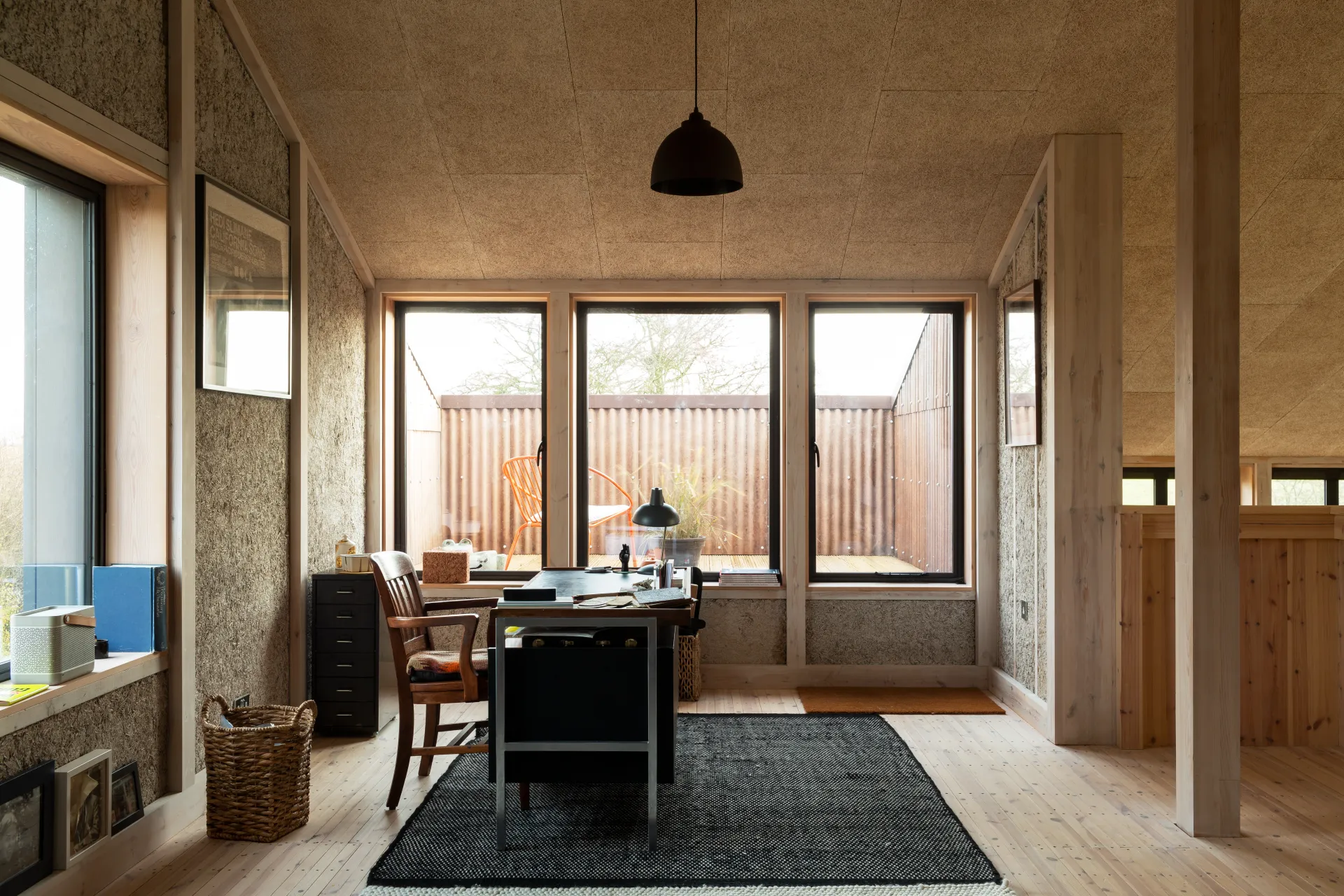
Flat House, by Material Cultures. Photo © Oskar Proctor.
KOOZ It's not a regular day's work for an architect to watch seeds being sown. For Field-0, the importance of fieldwork is built into the name —
JCC That's what we do. As we traced all the relations of the supply of material and energy, one could easily be paralysed by it, because the problems are too massive. What do you do with all that? But when we met the Karen people who live on water yet lack access to clean drinking water, the water campaign felt natural, like a calling. This whole project emerged from the field itself, and has been shepherded by the Thai Forest Tradition temples and our local collaborators PuPla TriKaewprasert — allowing us to answer the community’s needs.
"We can often intellectualise this stuff and it can be enjoyable to do so. But the physical realities are actually so much more interesting and revealing than the conceptual frame."
KOOZ There's also potential for extraction when it comes to shifting ecological and social relations. How does the conversation around extraction come up for you and the Material Cultures team?
PG It comes up all the time. We even made a film called ‘Extraction’, and it’s also the name of a chapter that we wrote in a Material Reform, the primer that we published in 2022. The system in which we live is predicated on extraction as a mode of operation: we extract from the ground and from each other. It’s a fundamental question for Material Cultures: how do we shift those relationships, and is it even possible to avoid extraction?
We're still very much in the process of unpacking how extraction plays out in construction. While looking for potential opportunities for change, you often encounter systems and protocols that are really confounding. We’ve been leaning into agroecology or regenerative agriculture, because it offers such a clear opportunity for impact and change. The way that we farm in the UK is incredibly damaging; industrial farming is responsible for 80% of biodiversity loss in Europe, so shifting that is a massive priority. We think architecture and construction can be usefully allied here too. My colleague Summer Islam’s thesis research is revealing that it's also not a simple picture — you can't just substitute industrial farming for regenerative forms of farming and see net benefits. Ultimately, regenerative farming systems occupy more land than industrial ones do, and they are less productive. It depends on your metrics again, but it's not a clear win. Whenever we think we've hit on a headline solution, it always turns out to be more complicated.
It's massive, this act of working through complex problems in an interdisciplinary way and this is the challenge of our generation. The fact that there is so much to do, and that it can be so impactful should be really galvanising — there's so much scope for collaboration across sectors, for impact and change. Working in a meaningfully interdisciplinary way can be a challenge; normally, what's being described is the relationship between architects and engineers or contractors — but we need to go deeper than that to really transform the way we do things.
KOOZ We're not obliged to come up with easy answers or neat solutions. If post-enlightenment can be characterised by compartmentalising and categories of extraction, perhaps our task is negotiating with the ensuing mesh of entanglement. The plurality of the theme ‘Systems’ Hack’ suggests the same.
CZ One way for us to approach hacking is to continue to think about how we practice. For example in the water campaign: what can we do to move those extractive relationships towards repair? The other questions are about how we might transfer the knowledge that we gained in the field — and how can learning through the journey itself become a new way to train the next generation of architects? It's not easy to bring people along on a journey. How can we translate that into different forms of learning, and resetting modes of architectural thinking?
"One way for us to approach hacking is to continue to think about how we practice."
JCC Yeah, we definitely need to be bold enough on the ground to try things out — but since we're talking about a systems’ hack, we also need a whole ecosystem to support these efforts. We want to place hope in remaking the knowledge system. The challenge is massive; if we're talking about a systems’ hack, we need intervention at every stage and we need so many actors to work together. We don't just need better architects, we need better clients, better policy-makers, better users — we need a whole team. We feel that we could do that by starting in schools, and we remain hopeful in that forum. It is a constant consideration about the field-based method and the journey itself: how could that become pedagogical? How could these forms of knowing, learning and practising become integrated into architectural education?
KOOZ It’s worth underlining what you both suggest here: the idea of using your practice as a way to hack the profession or role of architects — and even architectural education. Indeed you’ve all designed non-normative modes of practice, which is admirable in itself.
JCC Yeah, hacking what practice could be: that's a very nice way to sum it up.
PG Yeah. I think that work is becoming more conscious as we grow as an organisation. Working out what that looks like and how it's formalised has been a huge preoccupation. We're obsessed with ‘templating’ things now, even our policy work: we publish it all in the hope that it might be useful for people to take to their own bosses to demonstrate that there are other ways of doing things, or for other organisations to draw from, wherever it seems useful. A lot of the policy work that we've developed has actually been drawn from the art world, because almost everything that we could find as a starting point coming from the architecture world was relatively cruel.
KOOZ So kindness hacking, even kindness maxxing. It has been wonderful sharing your overlapping currents and concerns, thank you all so much.
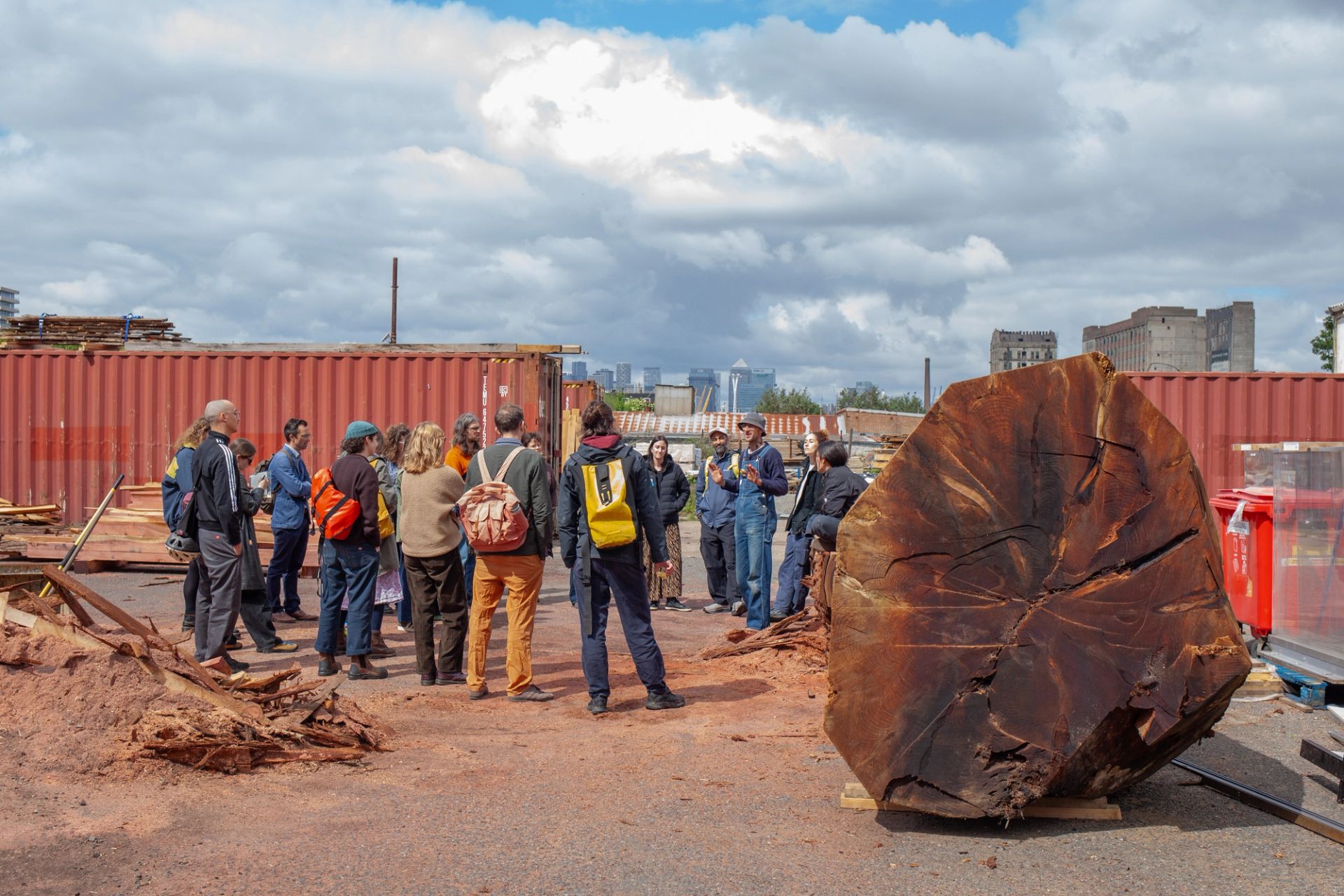
Tipping Point East, home to Yes Make, RESOLVE Collective and Material Cultures, site tour. Photo © Michael Sabuni.
ABOUT
OBEL is a foundation that recognises and rewards architecture’s potential to act as tangible agents of change that contribute positively to social and ecological development globally. Founded in 2019, OBEL values the plurality of architecture as a practice through expanding who and what defines our built environment. Through various activities, OBEL supports influential ideas and approaches that can spearhead and seed future developments, while driving architectural discourse and education.
BIOS
Jingru (Cyan) Cheng works across architecture, anthropology, and filmmaking. Her practice follows drifting bodies — from rural migrant workers to forms of water — to confront intensified social injustice and ecological crisis. Cyan was awarded the Harvard GSD’s 2023 Wheelwright Prize for TRACING SAND and received two commendations from the RIBA (Royal Institute of British Architects) President’s Awards for Research in 2020 and 2018. Cyan holds a PhD by Design from the Architectural Association and currently teaches at the Royal College of Art in London.
Chen Zhan is an architect, anthropologist, and independent filmmaker, trained at the Architectural Association and SOAS University of London. As a UK-registered architect, Chen has worked at Heatherwick Studio on high-profile projects since 2011, including the Maggie’s Cancer Care Centre in Leeds, Changi Airport Terminal 5 in Singapore, Google Gradient Canopy in California and the Bund Finance Centre in Shanghai.
field-0 is a research-based practice initiated by Jingru (Cyan) Cheng and Chen Zhan that operates at the intersection of architecture, anthropology, art, and filmmaking. Through long-term fieldwork, moving-image research, exhibitions, and publications, the practice investigates planetary interconnectedness by tracing the relationships between materials, infrastructures, ecologies, labour, and territory. Rather than treating architecture as a discrete object, field-0 examines the flows and systems that produce the built environment, often focusing on the movements of water, sand, energy, and extraction across landscapes. Their ongoing work across Southeast Asia explores how environmental transformation can be understood through embodied, situated, and sensorial forms of inquiry.
Paloma Gormley is a co-director of Material Cultures, founded in 2019, alongside George Massoud and Summer Islam. She began her professional career in 2009 working very directly with materials, designing and constructing structures and small buildings together with Lettice Drake under the banner of Practice Architecture. Her work advocates for adaptation of alternative methods and materials, with a strong focus on education and collaboration. She’s been working on projects with Arup, Bauhaus Earth, ETH, and other institutions.
Material Cultures is a London-based research and design practice founded by Summer Islam, George Massoud and Paloma Gormley. Working across architecture, agriculture, and construction, the practice investigates how buildings can be made from regenerative, bio-based, and locally sourced materials. Their work challenges the environmental and economic systems underpinning contemporary construction, focusing on how architecture can support new relationships between land, resource extraction, farming, and material production. Through research, prototyping, teaching, and built projects, Material Cultures advocates for a transition from industrial supply chains toward place-based material economies.