Federica Zambeletti / KOOZ You’ve described your film ‘Nothing Is More Mysterious. A Fact That Is Well Explained’ as emerging from your time in Holland, your research into stilleven or still life, and what you call “indoor life.” Could you tell us what you mean by this phrase, and how it became the starting point for the film?
Anna Franceschini When I moved to the Netherlands, I became aware that I was spending much more time indoors than I had before. It seemed like a very ordinary change, almost a practical consequence of the climate, but it also made me attentive to a particular culture of interiors. I learned the Dutch word gezellig — something close to “cosy” — which seemed to describe a very specific quality of domestic life. At the same time, I was looking for a place to film that could bring together two strands of my research: mechanics and industrial processes, and the tradition of stilleven, or still life.
I eventually came across the Pianola Museum in the centre of Amsterdam; a small, dusty, old-fashioned civic museum, literally lined from floor to ceiling with perforated paper rolls — the scores for the player pianos — many of which are still functioning. It immediately struck me as the perfect cinematic setting: an interior resembling the parlour of a private home, animated by a collection of automata originally designed to entertain bourgeois drawing rooms. It allowed me to explore mechanics as a moment of animation of matter and automation as a small spectacle for the eye, while also thinking about cinema itself as a machine.
KOOZ Do you see the museum as a place where objects become more still, or where they acquire another kind of life?
AF I feel as though I can say, with a reasonable degree of certainty, that once objects are ‘museified’, they become completely paralysed — or perhaps hibernated. That doesn’t make them any less interesting or significant. It simply means that bringing them to life requires a different strategy of animation; perhaps even a genuine re-animation, as though bringing them back from an afterlife.
What interests me is precisely the question of what kind of cinematic strategies these paralysed objects can foster. Every filmmaker or artist might find a different one. In this film, I found movement: the long, moving takes, the perforated paper scroll slowly unspooling. In the film we saw earlier, it was the passing of light that brought the museum and its objects to life. So rather than diminishing the object, this state of paralysis can actually generate another way of looking at it — and another way of making cinema.
KOOZ The film seems constantly on the threshold between the inanimate and the animate. Given your fascination with animation, where does that sense of an object coming to life begin for you?
AF It’s a distinctly cinematic sensation, essentially tied to movement. For me, these objects never really come to life; what fascinates me is the appearance of life, and the fact that the trick behind it remains visible. In this case, cinema itself is the trick — the apparatus that reanimates things that otherwise appear still.
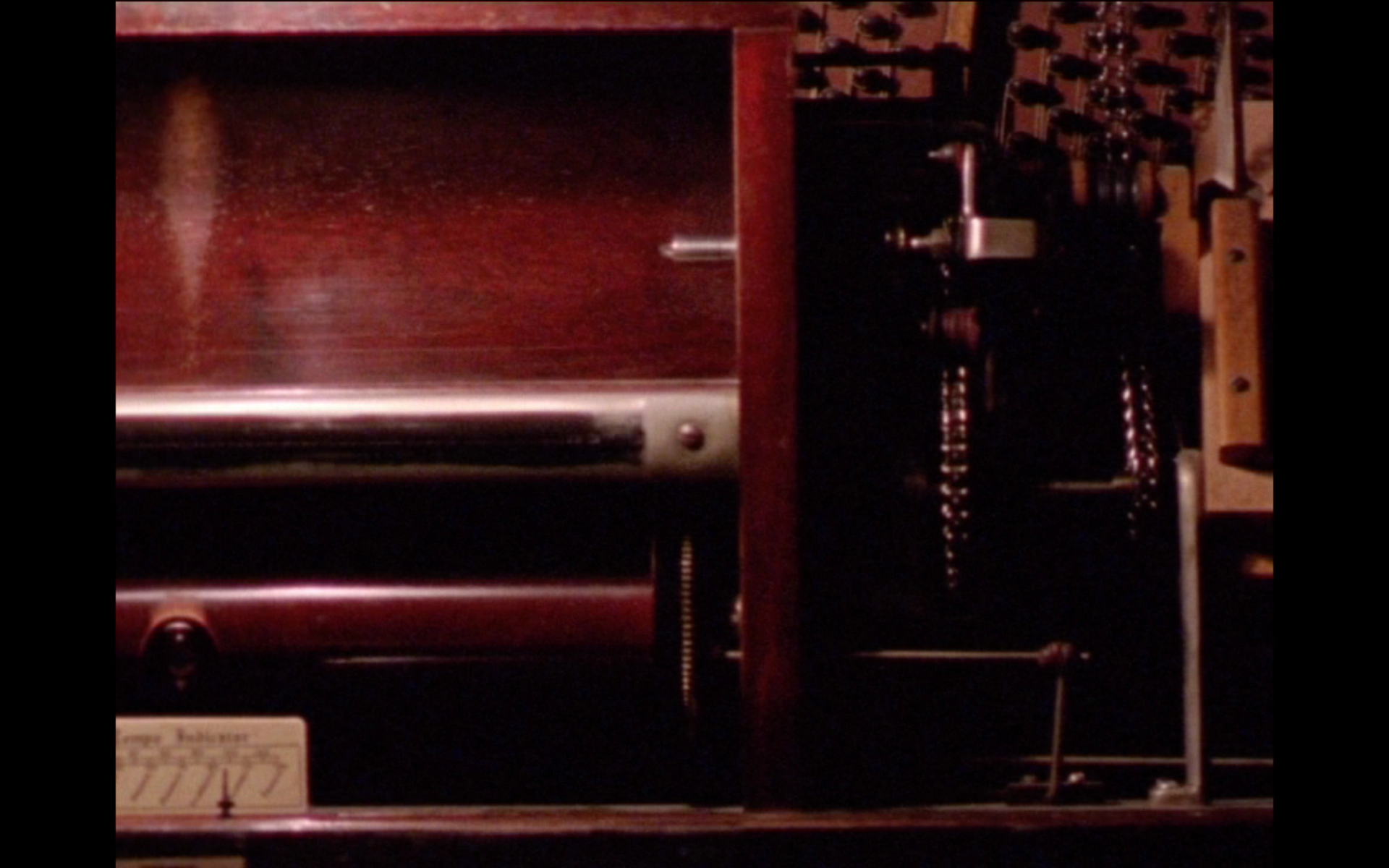
Nothing Is More Mysterious. A Fact That Is Well Explained, directed by Anna Franceschini, 2010. Film still courtesy of the artist, Vistamare Milan/Pescara and Emanuela Campoli Paris/Milan.
In the film, this animation happens in two different ways. The first is produced by the camera: two contiguous tracking shots move horizontally through the space. In a way, this relates to the title, Nothing Is More Mysterious. A Fact That Is Well Explained. The camera seems to explain the space very clearly — it is a long, figurative take — yet because it remains so close to what it is filming, you never quite understand where you are.
In the second half, this horizontal movement is countered by a vertical one, generated not by the camera but by the mechanical pianola itself, as the perforated paper roll passes through it. Those tiny holes are literally music: an algorithm that the machine reads and transforms into sound. And there is another, less visible movement taking place throughout: even when the camera is still, the 16mm film continues to run through it and be exposed. So the objects are never fully alive, but that doesn’t really matter. What interests me is how cinema can produce this appearance of life, transforming something apparently still into something in motion.
KOOZ In Nothing Is More Mysterious, the movement of the film encounters the mechanical notation of the pianola. How do you understand the relationship between these two different ways of organizing movement and time?
AF As far as movement is concerned, the film brings two recording devices — or perhaps two expressive machines — into confrontation: the cinema apparatus and the pianola. One produces images, the other music, but both depend upon something passing mechanically through them. There is a parallel between the passage of the film through the camera and the passage of the perforated paper roll through its mechanical reader; between the horizontal movement of the camera and the vertical unfolding of the paper as it unwinds from its spool. The pianola has this kind of ghost pianist behind it, just as cinema has its own apparatus operating behind the image.
This also relates to the film’s organisation of time, which is fundamentally circular. There is the circularity of the shots, the rotation and unfolding of the paper roll, and the continuous passage of the 16mm film through the camera. Despite a faint narrative suggestion — the gradual revelation of a space, its décor, and an “ending” that is essentially a visual piece of music — the film works as an imperfect loop. It can keep beginning again. For me, repetition becomes a source of strength rather than a weakness: these different circular movements continually produce images, music and the appearance of life.
KOOZ The loop recurs throughout your practice, both cinematically and mechanically (ie. in works such as Villa Straylight). What does the loop allow you to do that a beginning and an end cannot?
AF I really like the way this question is phrased: what does a beginning and an end prevent me from doing? A clear, well-defined beginning and end offer a kind of salvation. They give you time afterwards — perhaps to cry, laugh or think. The loop, by contrast, is a non-cathartic device. There is no escape from it.
I've come to realise that my work — perhaps more evidently in my kinetic sculptures, but also in moving images — has a lot to do with exhaustion. The vision itself becomes tired through repetition, and the machines I produce increasingly seem tired of themselves. Villa Straylight, Nights Out and All Those Stuffed Shirts— an more recent installation of shirt-ironing machines staged at the Milan Triennale in 2023— are exhausting visions; in All Those Stuffed Shirts, the machines literally “faint” at regular intervals.
"I've come to realise that my work has a lot to do with exhaustion. The vision itself becomes tired through repetition, and the machines I produce increasingly seem tired of themselves."
The loop is also the temporality of machinery: of industrial capitalism, the assembly line, automation and the recursiveness of algorithms. It is something we are subjected to, and something that doesn’t operate on a human scale. But at the same time, circularity belongs to nature and to the recurrence of life itself. That contradiction interests me: whether technical or natural, the loop confronts us with a temporality that exceeds us, something we cannot quite measure against our own experience. A beginning and an end might belong to a more human, and perhaps consoling, dimension; the loop does not.
KOOZ As we’re talking about music, and about the loop as something that carries a sense of exhaustion: I wonder whether there is also a sound which, for you, expresses the continuous condition of exhaustion that many of us seem to find ourselves in today?
AF Responding instinctively, rather than intellectually, I think I associate exhaustion with frequencies at the extremes. Very low frequencies, in particular, can be physically tiring for me, but perhaps very high-pitched frequencies too. Noise itself doesn’t necessarily exhaust me; sometimes it is something I actively want around me.
"I associate exhaustion with frequencies at the extremes."
Watching this work again today — projected in a space for the first time in perhaps ten years — I was struck by the way a silent film resonates with the room around it. There was something beautiful about listening to its silence in this particular space, surrounded by wood. At a certain point, it felt as though the film belonged acoustically to the room. So perhaps exhaustion, for me, is less about noise than about frequency: sounds at the edges of what the body can comfortably sustain.
KOOZ Your work has often questioned what we consider “cinematic.” Does bringing cinema into contact with music open up new possibilities for you?
AF What interested me was not so much bringing cinema into contact with music as bringing together two different recording systems. On the one hand, there is the passage of the 16mm film through the camera; on the other, the passage of the perforated paper roll through the mechanical reading of the pianola. Both are temporal devices. They record, organise and unfold time through movement. What interested me was the pianola as a machine. It is a machine that organises time through a coded sequence, just as cinema does through the succession of frames. Bringing these two mechanisms into dialogue allowed me to reflect on the relationship between two different machines for producing movement and time. In the film, music is approached not so much as sound, but as notation, mechanism and movement.
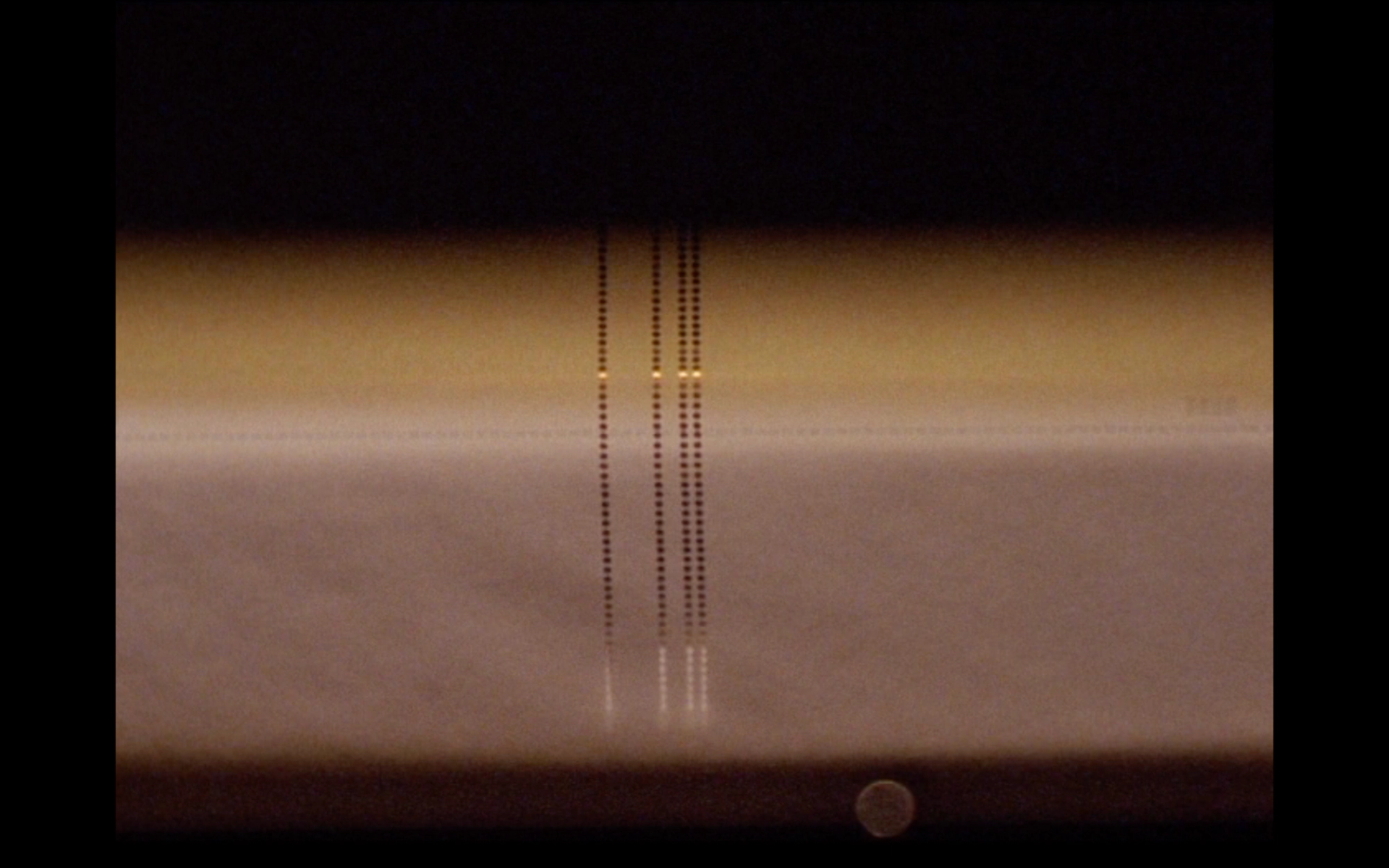
Nothing Is More Mysterious. A Fact That Is Well Explained, directed by Anna Franceschini, 2010. Film still courtesy of the artist, Vistamare Milan/Pescara and Emanuela Campoli Paris/Milan.
KOOZ If we begin to think of music not only as sound, how might that change the way we listen—and ultimately, the way we attune ourselves to the world around us?
AF I think it might initiate a different way of listening, but also a different way of understanding our relationship with sound — something that belongs not only to perception, but to another cognitive level of the mind. We might think, for instance, about the relationship between music and mathematics, which has been explored from Pythagoras onwards.
This film itself is structured through a series of self-imposed rules. The height of the camera, the choice of lens, the insistence that almost everything remain in focus — these decisions create a kind of mathematical structure. The perforated paper roll operates in a similar way: the holes are a sequence, a proto-algorithm, read mechanically by the pianola and translated into music. So perhaps thinking about music beyond sound means recognising these other forms through which it can exist — as number, sequence, movement or information — and expanding what we understand listening to be.
Skarlet Smatana We often depend on artists to act as both analysts and mirrors of society. In museums, there is currently a great deal of discussion around how we might “activate” objects and installations, and how the public might become more meaningfully involved in encountering them. Your film approaches this question of activation through cinema. If you were to present the work today, what would your ideal context be? How do you imagine the relationship between the film, the space in which it is shown, and its viewer?
AF This question is a battlefield for me. What might appear to be a very passive form of display — the cinematic theatre — is not necessarily passive at all. It gives you space and time to develop your own thoughts about what you are seeing. There is also a social dimension to this. We experience a museum very differently at a crowded opening than we do alone, calmly, on a weekday. In a cinema, many of those social relationships are temporarily suspended. For me, that can create a space of liberty: apparent passivity becomes a very active cognitive space.
This relationship between the viewer and the object on display is something I think about a lot in my work. With kinetic sculpture, for instance, I sometimes deliberately use a kind of 360-degree display, which can feel almost obscene to me because everything is exposed. It recalls the storefront window, which is another longstanding fascination of mine. But I don’t think there is a single solution. The relationship between viewer, work and display has to be reconsidered case by case, space by space, occasion by occasion.
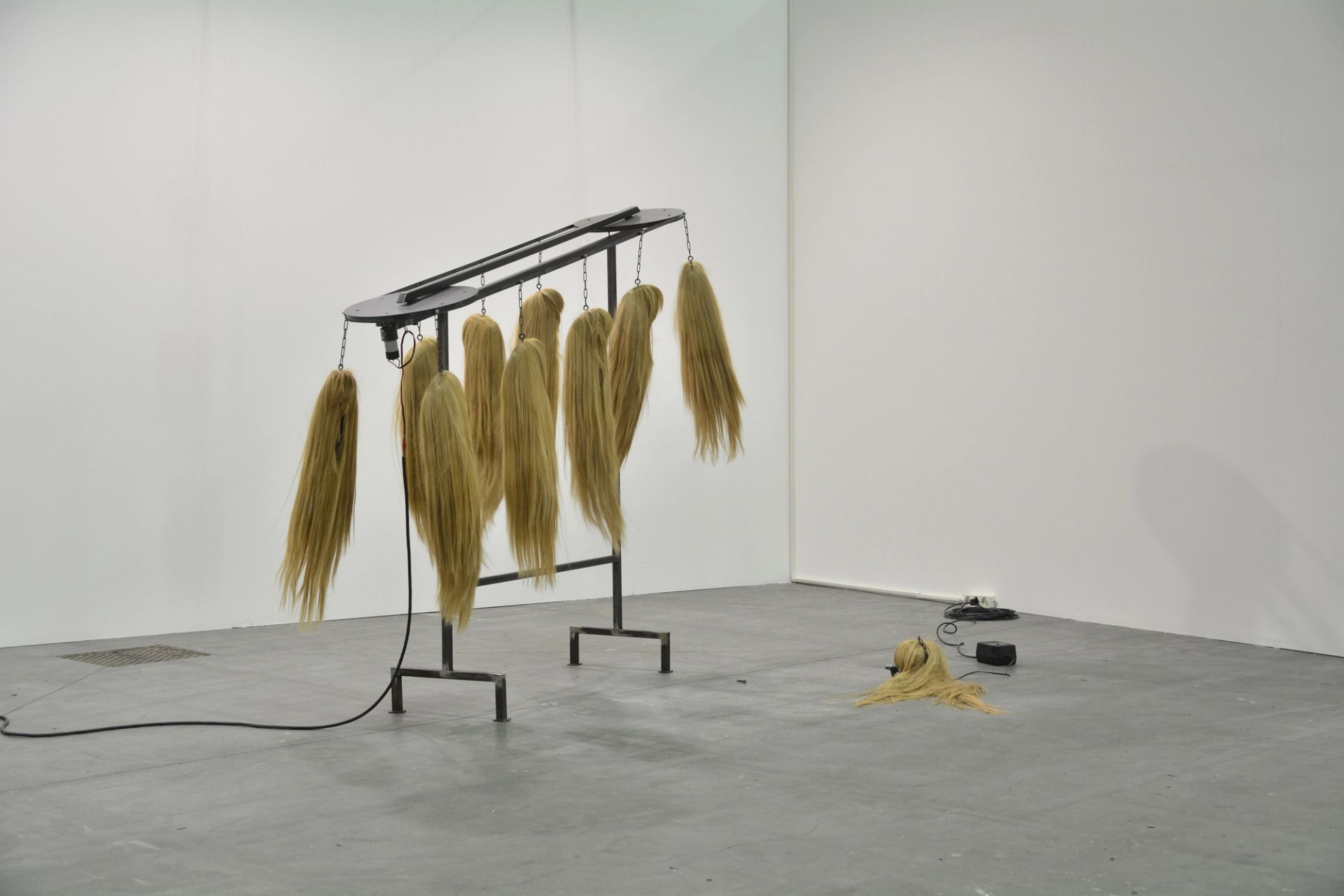
Villa Straylight by Anna Franceschini, 2019. Installation view of the solo presentation at Present Future, Artissima 2019. Photograph © Roberto Sala. Courtesy of the artist and Vistamare Milan/Pescara.
KOOZ Leonardo, perhaps I could bring you into this discussion: through Fondazione In Between Art Film you have thought extensively about the relationship between moving-image works, their viewers, and the spaces in which they are encountered. What does it mean to craft a space for moving images today?
Leonardo Bigazzi The way we experience moving images in everyday life — on phones, laptops and screens at home — makes the question of embodiment particularly relevant when we enter a cinema or museum. I think there is an increasing desire for a more physical, embodied relationship with the moving image precisely because so much of our everyday encounter with it is comparatively disembodied.
At Fondazione In Between Art Film, this has become an ongoing area of research. We work closely with artists, architects and designers to create specific environments for encountering works, rather than treating display as something neutral. In exhibitions such as Penumbra, Nebula and Canicola, we have tried to use exhibition design to intensify that embodied relationship between moving image, space and viewer. There is no definitive answer, but the question feels increasingly urgent given how continuously we are exposed to moving images outside these spaces.
Stefano Rabolli Pansera I was very interested in your reference to mathematics; one of the reasons we selected this work is that it seems to operate almost like a Bach fugue. In a fugue, repetition never takes you back to exactly the same place; each recurrence produces an unexpected development. Your film seems to work in a similar way. Its conclusion is particularly revealing because the mechanism sustaining the repetition is finally exposed: the structure disappears and suddenly we see the machinery behind the illusion. Perhaps the film can therefore be understood not simply as containing music, but as being structured musically — almost as a fugue itself.
AF Thank you; Bach is an important reference for me, even though I’m not a musician. I’m fascinated by forms such as the canon, and more broadly by the mathematical structures underlying Baroque music: the way repetition can operate according to a set of rules and nevertheless continue to produce variation.
There is also something almost epic about the ending of this film. The roll completely unspools and the mechanism reveals itself: Okay, the trick is over; now you know how it works. But I think your comment also points to something important that we haven’t discussed enough. The loop is not only frightening or exhausting; it is also addictive. There is enormous pleasure in repetition. Perhaps that is precisely what makes the loop so powerful: we can be exhausted by it and seduced by it at the same time.
KOOZ Anna, thank you ever so much for this wonderful exchange.
"There is enormous pleasure in repetition. Perhaps that is precisely what makes the loop so powerful: we can be exhausted by it and seduced by it at the same time."
BIO
Anna Franceschini is an artist, filmmaker and researcher. She works on the filmic representation of objects and the cinematic qualities of showcases for commodities. She is a fellow of the Rijksakademie in Amsterdam and of the Italian Academy for Advanced Studies at Columbia University and her videos and films have been shown at the Rotterdam Film Festival, Locarno Film Festival and Torino Film Festival amongst others.
Federica Zambeletti is the founder and managing director of KoozArch. She is an architect, researcher and digital curator whose interests lie at the intersection between art, architecture and regenerative practices. In 2015 Federica founded KoozArch with the ambition of creating a space where to research, explore and discuss architecture beyond the limits of its built form. Federica is an Architectural Association School of Architecture in London alumni.
ABOUT
The St. Moritz Art Film Festival (SMAFF) is an annual international event held in the Swiss Engadin Valley that explores the intersection of contemporary moving images, visual art, and audiovisual culture. Founded by Stefano Rabolli Pansera, SMAFF investigates how cinematic and moving-image languages can challenge dominant narratives, addressing contemporary philosophical questions, and experiments with alternative storytelling. Each yearly edition is anchored to a specific thematic inquiry fostering cross-disciplinary dialogue between emerging creators, established artists, filmmakers, curators, and collectors.