This conversation is part of a series produced in collaboration with Me AndOther Me as part of their ongoing WebRTC BackRooms project, a podcast deep-scrolling into XR, AI, and the future of hanging out in the spatial internet. You can listen to the full episode via our podcast channels or watch the video version on the Me AndOther Me Substack page.
This episode traces Simone C Niquille’s research into computer vision, synthetic data, and the politics of how machines learn to perceive bodies and spaces. Moving through projects including Home School, Sorting Song, Regarding the Pain of SpotMini, and The Beauty and the Beep, the conversation explores virtual model homes, autonomous robots, training datasets, and the assumptions embedded in categories such as “chair,” “room,” and “home.” Throughout the episode, we ask: if the map is not the territory, can the dataset ever be the home? The discussion situates machine vision within larger questions of language, architecture, categorisation, and technological power, examining what disappears when lived environments are translated into fixed categories, and how we might preserve ambiguity, curiosity, and the possibility of not knowing.
Me AndOther Me In a quiet suburban living room, a chair named Bertil searches for a place to sit. Amid everyday objects, the only beast here is the low hum of smart devices. Their notification beeps echo like digital crickets in the night. A Boston Dynamics SpotMini robot practices climbing the stairs of a makeshift model house next door. The scene is at once ordinary and surreal. A banana peel nearly topples our wandering chair, a treadmill whirs endlessly with no one on it, and a child's toy pony lies inexplicably in the hallway.
These uncanny domestic vignettes are fragments from Simone Niquille's research-driven practice: synthetic imaginations of computer vision, where homes are turned into training grounds for algorithms. But what does it mean to teach a machine what a home is? How do our living rooms and kitchens become stages for computational seeing? What defines a home: the furniture, the inhabitants, or the rituals performed within it? Can virtual training models ever capture the complexity of real life?
Our guest today, Simone Niquille, is a designer and researcher whose work investigates computation as a new optics. Their practice questions how these systems represent bodies and spaces, advocating for non-binary technologies and challenging machine learning's tendency to validate assumptions and reduce reality to fixed categories. Simone's projects unfold as experimental films, immersive simulations, and critical essays that make visible the hidden infrastructures of machine vision. In this episode of WebRTC BackRooms, we wander with Simone through virtual homes and data backrooms, exploring how their workings illuminate the politics of seeing in spaces we often consider private.
Thank you so much for being with us today. Let's begin at the center of your research: your work often concentrates on the idea of the home, a space assumed to be very personal, yet nowadays, especially in the Global North, it is filled with smart objects, cameras, and artificial-intelligence devices. You have noted that an autonomous robot in a domestic space needs to be taught, and I'm quoting you, 'what a chair is, what the dining room is, and of course, what a human is.' What first got you interested in looking at the home through the lens of machine vision?
Simone Niquille Thanks for having me in this strange and wonderful space, a kind of living room. My work on computer vision and the home started around 2017 or 2018. It was a departure from earlier work I had been doing, which mainly focused on face recognition and its political implications.
That earlier work was around 2012 and 2013, when the major NSA and Snowden revelations had just taken place. I found myself in an in-between moment when the technology still needed explaining. After Snowden, it took on an entirely different public and societal meaning. It was no longer understood simply as a technology there for your convenience, helping you tag friends in Facebook photos; it could also be used against you, or simply as a tool of power. It became important to be aware of who wielded that power, and how citizens could find themselves in a weaker position in relation to these technologies.
A lot of that work drew me into body measurements and the ways bodies have been captured, used statistically, and measured in early policing techniques by Alphonse Bertillon in the nineteenth century. That involved measuring the human body, as well as mugshot photography and creating identification cards for people who had been arrested, so that repeat offenders could be identified. I became interested in this history of the body as an object of capture.
That drew me into the world of ergonomics. Again, it is not really a binary but a complex web: these technologies move through different disciplines and applications, whether entertainment, surveillance, state use, and so on. Ergonomics similarly has a huge role in design, product design, and architecture. I made an exhibition for the Venice Biennale in 2018 around this, drawing parallels between ideas of perspective drawing and the ways bodies are represented. Beautiful renderings from around 1830 show bodies enmeshed in volumetric geometric forms so they could be positioned freely in drawings, in an attempt to capture reality as convincingly as possible.
All of that work eventually drew me, through various detours, to architecture, the home, and the built environment. The home in particular freed me to talk about these questions without having to show the body. Ergonomics was important because the body was implied in the objects within the home. The chair you are sitting on has a particular type of body in mind, or a very average, standardised body expected to sit on it.
I no longer had to show that body directly. I had found it frustrating that, when making films and images, I kept having to create digital bodies and therefore reproduce my own critique. I couldn't move beyond the body we already understand. Architecture became a really interesting site for this research and, coupled with computer vision, a perfect environment for this work.
M&OM A major theme in your practice is synthetic data. When we talk about training computer-vision systems for autonomous robots that inhabit domestic spaces, it is difficult to gather real images from private homes for obvious privacy reasons. Researchers have therefore turned to virtual domestic spaces as training-data environments. Can you explain what these synthetic indoor training datasets are, and how you go about assembling a model home from 3D files?
SN My research started with a YouTube video from Boston Dynamics, a robotics company that was, and perhaps still is, quite well known for posting videos of its robots doing all kinds of silly things, even though the technology behind them could be frightening. There was a robot called Atlas, a humanoid, and many of these robots were developed to assist soldiers in the U.S. military, mainly by carrying loads that a human couldn't carry into places a vehicle couldn't reach.
In 2016, I believe, the company released a video announcing a new product called SpotMini. It was a robot dog that became quite well known. They wanted to launch it as their first product for something approaching a mass market — perhaps that is saying too much — but at least for an audience very different from the military.
In the video, we see the robot dog walking through a house set inside a warehouse. It is clearly not an actual house, but a scenography built both for filming and to showcase the robot dog's abilities. That raised a lot of questions for me: why a house, and who would live in it? It seemed to indicate a future customer they had in mind, because I really couldn't fathom who would buy this thing.
I remodelled the house in Blender and realised I didn't have to model much myself. I could pull many elements directly from the SketchUp Warehouse, an online store of 3D assets. That pointed to how standardised much of this already was. A lot of the furniture was IKEA. The house looked like an early Sears kit house that you could order from a catalog in the U.S. in the 1910s.
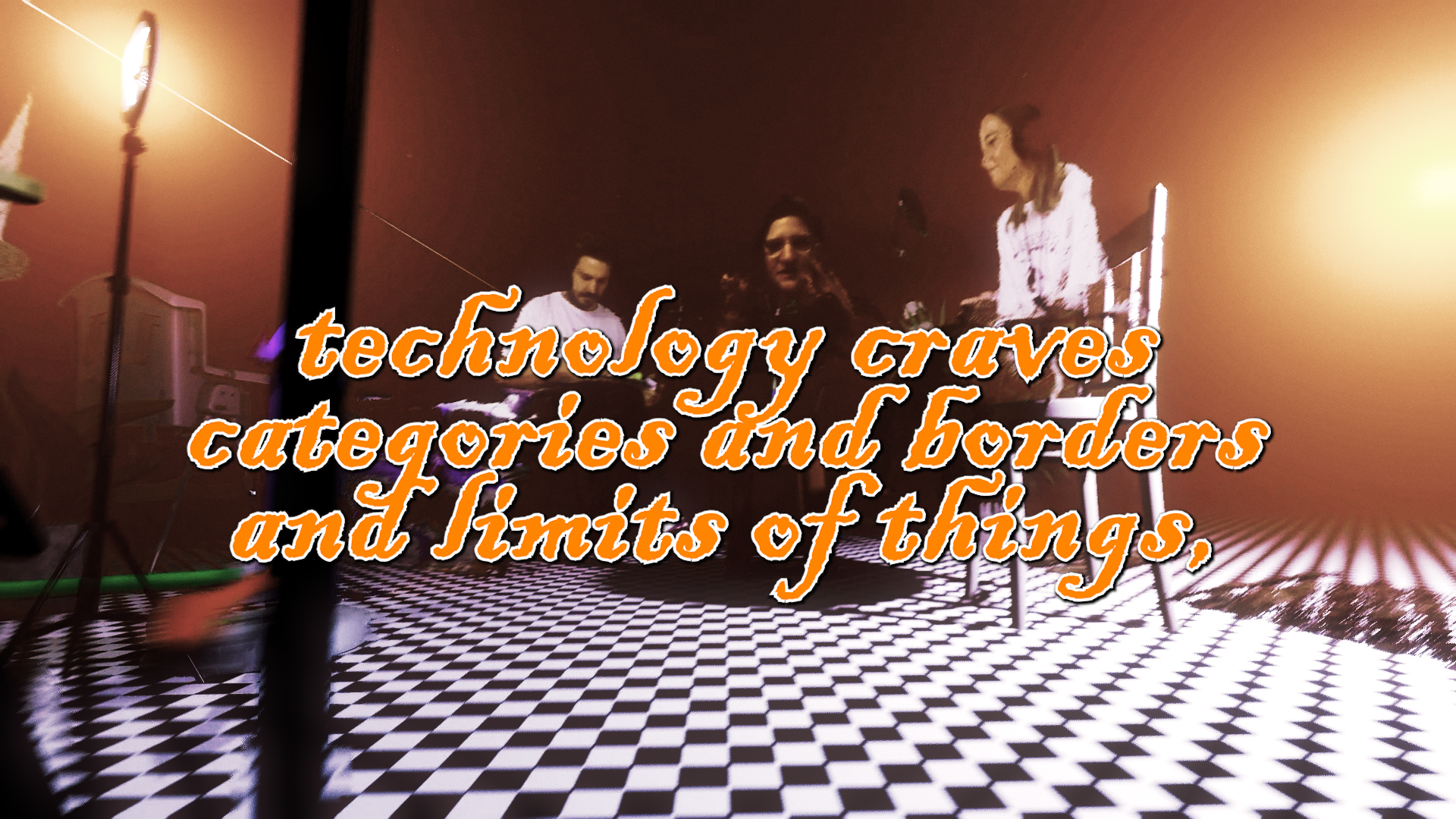
That led me to ask: what are computer-vision devices being developed for the home actually trained on? How do you define such a subjective, loose, and private term as 'home' for a technology that craves categories, borders, and limits? It needs to understand, navigate, and function in a world. That brought me to a dataset called SceneNet RGB-D.
"How do you define such a subjective, loose, and private term as 'home' for a technology that craves categories, borders, and limits?"
This was around 2016. The technology has changed enormously since then, both in how these datasets look and how they are assembled. SceneNet at that time was, quite literally, a series of folders filled with 3D models, alongside folders of textures. The researchers used a simple algorithm to generate rooms. For example, it might say that a bathroom has a high probability of containing a sink.
Rooms were generated through those rules, and a virtual camera then filmed them. The frames from those films became the image-training database. The synthetic part of these training datasets therefore lay largely in how the rooms were assembled so that they could be virtually filmed and still produce two-dimensional images — PNGs, JPEGs — which then became the training dataset. At that point, it wasn't yet the case that the robot itself would move through a virtual environment.
M&OM And nowadays they do move through virtual environments as part of the training process?
SN To some extent. What's interesting is that, back then, the data was scraped. The SketchUp Warehouse was one of the main sources. The dataset includes some very obscure objects, a lot of weapons — not only pistols but swords, medieval swords, some of them bloody. That raises the question of why these objects are part of a domestic dataset. At the same time, it points to a possible source: some may have been game assets pulled from elsewhere on the internet.
Today, other players offer synthetic datasets. Unity, for example, entered this space a few years ago. It can pull assets from its own game store, build virtual environments, and sell those environments or images of them to clients, effectively offering its own synthetic world. Facebook has also been interested in this area. They have a platform called Home3D, I believe.
M&OM And Project Aria…
SN Yes, exactly. That one as well. What we see is a shift from research datasets towards proprietary corporate datasets. SceneNet RGB-D was developed at Imperial College London and sponsored by Dyson, the vacuum-cleaner company. I was interested in it because I had access to it: the data had been scraped from public resources. Of course, copyright restrictions applied, but the researchers could not simply own those source materials, so they made the dataset public for research purposes.
By contrast, much of the work now is being done by companies such as Boston Dynamics, where there is no access to the training datasets. SceneNet therefore remains an interesting and important object of study for me, precisely because with many contemporary datasets we can only assume what they contain.
M&OM These datasets are limited both in what they include and in how they categorise things. What do you see as the architectural, but also cultural, consequences of training machines to perceive our world — particularly the domestic environment — through pre-categorised visual data that exists only in certain forms and comes from certain parts of the world?
SN SceneNet was particularly interesting because it had clearly defined room categories: in other words, it encoded an answer to the question of what kinds of rooms a home contains. If I recall correctly, there were perhaps four or five categories: bedrooms, offices, kitchens, bathrooms, and so on.
What interested me was that there was already an assumption that a certain kind of house constitutes a home. What happens to all the other kinds of homes? This points to something that is true of many training datasets: trying to encompass the entirety of the world is an insane undertaking and probably impossible.
Nevertheless, there is an idea that data can provide a portrait of reality sufficiently viable to train computer-vision technologies, whether for self-driving cars or, in this case, vacuum cleaners and Ring door cameras. These systems tend to function well in highly specific environments or use cases, where you can be precise about the data you need and the questions you want to pose to the system.
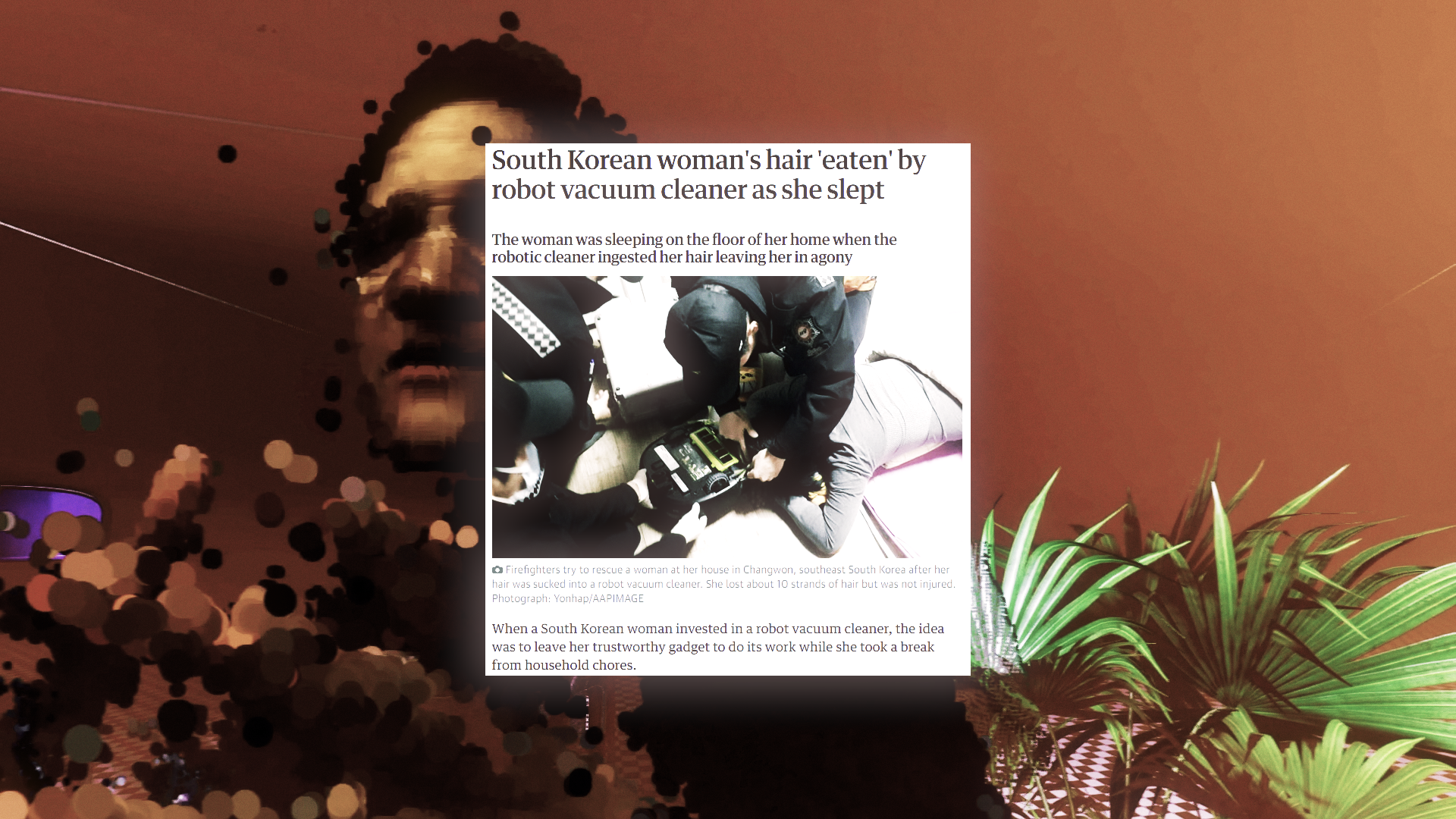
A 2015 Guardian article was always important to me. Its headline said that a vacuum cleaner had eaten a South Korean woman's hair. The image showed a woman lying on her stomach on the floor, with a Roomba tangled in her hair and several men trying to disentangle her from it.
What was problematic to me was that the headline assigned agency to the vacuum cleaner. Looking more closely at the image, you realise that she is sleeping on what may be a futon, certainly not on a bed you would find in an IKEA catalog in the West. The image points to assumptions about culture, rituals, sleeping and waking times, labor conditions, how someone lives, and how daily routines are organised. All of those assumptions become part of these machines.
The machine itself doesn't carry that agency. The agency lies much more in the assumptions built into it. This is where categorisation begins to fall apart.
"The image points to assumptions about culture, rituals, sleeping and waking times, labor conditions, how someone lives, and how daily routines are organised."
M&OM Maybe you can tell us a little about your film and research around Home School. I'm thinking about these lines from the film: “The limits of my language mean the limits of my world. The limits of my categories mean the limits of my world. The limits of my data mean the limits of my world. And I'm left with a million questions. Language fails me.”
I think these lines summarise the situation very well. Language and labeling can become tools of exclusion: they define what is legible within a system rather than necessarily allowing for inclusion. Could you tell us how the film began and what ideas were behind it?
SN Before getting to the film, one thing that always strikes me is how the questions I encounter around training datasets are, to some extent, philosophical questions, yet they are often rendered as technical problems and approached within one discipline rather than interdisciplinarily.
Between Home School and Sorting Song, the first two films in the Model Home trilogy, I had a conversation with the psychologist and linguist Eleanor Rosch. Over the course of her career, she proposed the concept of 'fuzzy boundaries' in linguistics. To some extent, this sounds obvious because it is largely how we use language: we are in conversation and negotiation, so a word is not a fixed proposition or static noun.
If we say 'chair', we may be referring to the object, but we may also simply mean that we need somewhere to sit. If no chair is available, that could be a stone. These negotiations happen constantly, often without us noticing, through language and our capacities with language. Even if you are somewhere where you don't speak the local language fluently, there are still ways to navigate.
The way language — or labeling — is applied in training datasets removes much of that negotiation because it tries to fix categories and draw clear borders between them. Of course, the system needs those boundaries in order to navigate a space. If a vacuum cleaner is going to move through your room, it needs a way to decide what it is encountering.
There are developments around this. Roomba, for example, offers an app through which, if the vacuum cleaner encounters something it doesn't know, you can tell it whether it is a sock, a cable, or whatever else is lying around. The system then adapts to the way you use your space and learns what it might encounter. But these are workarounds for things humans, and language itself, are very good at, because language is fluid.
With Home School, as my first film in this series, I was simply amazed by the idea of trying to fix such a fluid and intimate space as a home synthetically. I used the 3D models, floor plans, and furniture from SceneNet RGB-D to build a scenography, and had a first-person virtual camera move through it. A child reads the voice-over, and you are never quite sure whether the voice is talking to itself or to the viewer.
As it moves through the space, the voice uses the dataset's labels and words to identify, or attempt to identify, the things it encounters. The film ends with the questions you quoted, realising that perhaps its world is too limited: it doesn't really know what it is navigating. It borrows from Ludwig Wittgenstein's proposition that language can be a limiting factor in our understanding and perspective on the world — not the world at large, but our own map, our own territory.
M&OM Hehe, since you are the expert, which vacuum cleaner is best? If you had to recommend one to us, which would you choose?
SN Hahaha, I would go for the most ridiculous one. CES in Las Vegas is always a wonderful moment of absurdity and things nobody needs. The 2025 edition had robots that still looked like disc-shaped Roombas, but with little arms that slowly rose out of them. They could pick things up and bring them to a bin or wherever you had told them to collect objects that were in their way or that they couldn't recognise.
I thought that was wonderful and bizarre. A disc roving around your home is already strange; adding a little arm somehow makes it even better. It's very gentle.
M&OM Sorry for the question, ha. I've wanted to ask you this for a long time.
SN Of course, hehe. Every once in a while I do think, 'Wait, why am I looking at all these vacuum cleaners? What am I doing?' But there are also wonderful models with a little leg that comes out underneath to push them up a small step — not a staircase, that would be too daring — but a raised threshold between, say, a kitchen and a living room.
To me, all these attempts give the robots personalities. For the developers, it is probably simply about access: removing debris or reaching a space the device otherwise couldn't climb into. But it makes them so silly, which is great.
M&OM You also talk about other kinds of robots as companions in the home, for example in The Beauty and the Beep, your recent film in which we follow Bertil, a humble chair wandering through a smart home in search of a place to sit.
SN The Beauty and the Beep is, in some ways, a way for me to close the circle of the Model Home projects. It draws on a lot of the work I did in Regarding the Pain of SpotMini, which is about the Boston Dynamics video I mentioned earlier, where SpotMini is presented as a new robot wandering through a house.
The title Regarding the Pain of SpotMini draws on Susan Sontag's book of essays Regarding the Pain of Others. There are also Boston Dynamics videos where, in one particular example, a person attacks the SpotMini robot with a hockey stick, pulling it and trying to prevent it from opening a door and walking through. That raises questions of empathy: what am I looking at? Am I watching someone inflict pain on an object? Certainly. But to what extent is the object sentient, especially when its marketing simultaneously claims a form of intelligence?
"To what extent is the object sentient, especially when its marketing simultaneously claims a form of intelligence?"
The banana was important too because it appears in the original SpotMini video. The robot comes around a corner and is about to climb a flight of stairs when a banana peel has deliberately been placed in its path, so it slips and falls. I can only speculate about the scriptwriting, but it does several things. On one hand, it is almost slapstick. The banana peel became a comic motif in early silent film and comedy, and it is also embedded in pop culture — Mario Kart, for example, uses banana peels to disrupt other drivers.
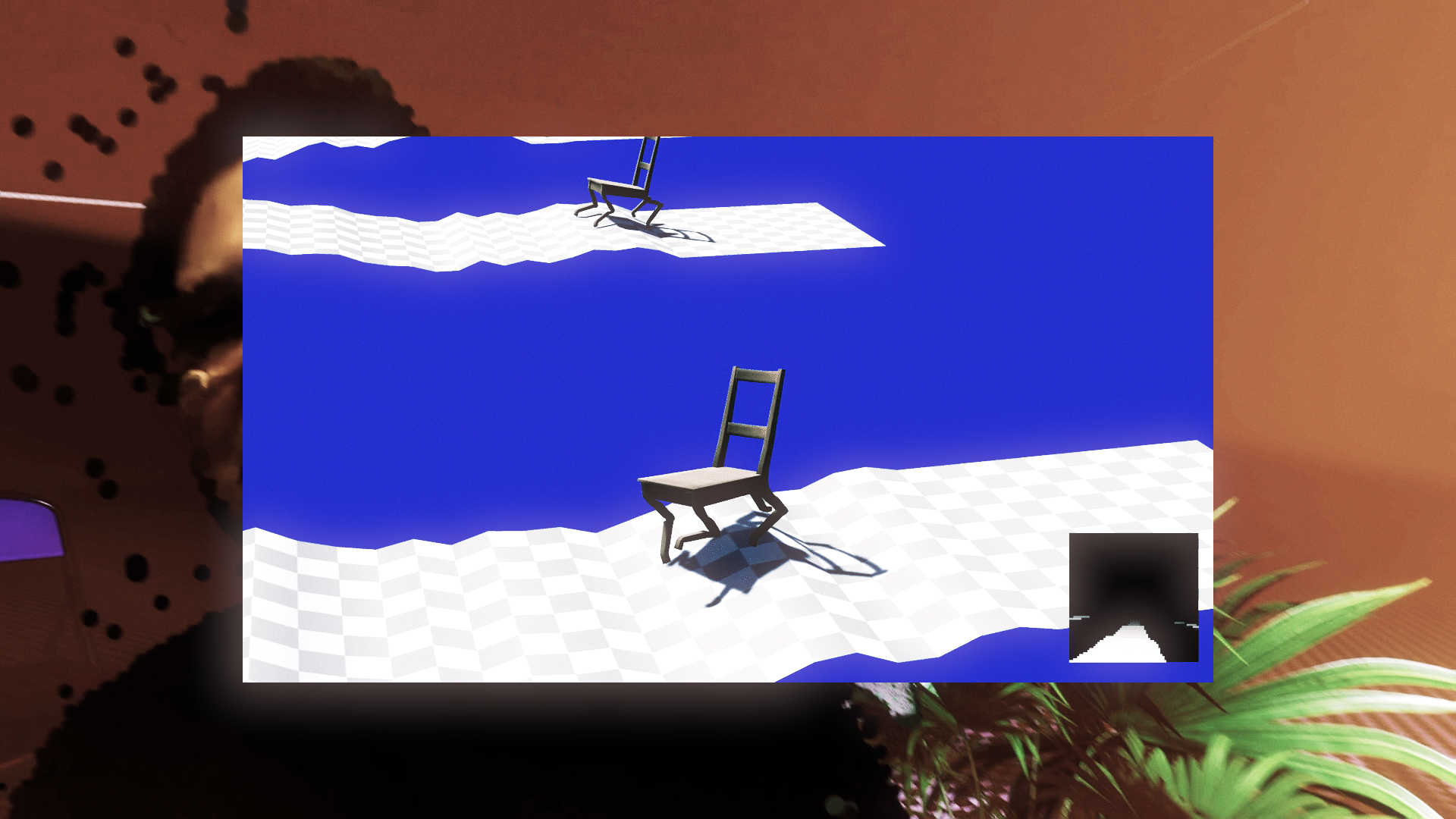
For me, the banana became important because it made SpotMini more relatable. It falls, and you almost feel bad for it. At the same time, it is a frightening object that makes a very loud noise. I carried that object over into The Beauty and the Beep, where instead of SpotMini we have the chair Bertil. Bertil can walk, and I trained it to walk using machine learning in the Unity game engine.
Bertil moves through the same — “same” in quotation marks — remodelled house I made from the SpotMini video. I placed some of the same objects in the environment: mostly IKEA furniture, the banana, and new elements like the treadmill.
I added the treadmill because, around the same time, OpenAI released one of its first AI-generated videos. It was mocked because a man is running one way while the treadmill belt moves in the other, a complete misunderstanding by the generative-AI model of how the physics works. Why should it understand? It is imitating an image. The treadmill became a way of rooting the film in 2024, when this technology was suddenly springing up everywhere.
Bertil itself is an IKEA chair. The model is called Bertil, and it was advertised in the 2006 IKEA catalog. It looks completely unremarkable: almost as if you typed a chair emoji — an archetypal birchwood chair with four legs and a backrest.
That 2006 moment mattered because it was the first time IKEA used a synthetic image in its catalog, and the image succeeded precisely because nobody noticed. Bertil sits at the beginning of the company's shift away from traditional product photography towards rendered imagery. To do that, IKEA had to model its products at different resolutions, from detailed fabric close-ups to wider shots and full room scenes.
I found that fascinating because it seemed only a matter of time before IKEA might use this data to create its own computer-vision systems or automated home appliances. Everyone else was craving data, and Boston Dynamics had already populated its model home with IKEA furniture, so why wouldn't the source itself make use of those models? There have been rumors for a year or two that IKEA is moving in that direction, although we haven't seen actual products yet.
Bertil is therefore an important piece of almost pop culture for me: an infamous, very boring object that carries a great deal of significance in terms of how our world is shaped, perhaps hiding in plain sight without us really recognising it.
M&OM You ask: if the map is not the territory, is the dataset the home? There is an obvious gap between the tidy simulation environments represented by these model homes and the chaotic, rich, ambiguous, and subjective reality each of us lives in. How do you approach that tension? Is there a risk that designers, architects, and engineers begin to confuse these clean data models with the real world?
SN I'm less interested in projecting into the future than in looking at how things are being built now: who is already making these assumptions, why, and to what extent. Some of those assumptions, as we've seen with linguistics, also happen inside academic bubbles where disciplines don't talk to one another. That is not new, of course.
For me, the question is about being careful and attentive in documenting what's being developed and annotating it where possible, because it is very easy for it to be forgotten and then absorbed into an actual application. Many of the training datasets and technologies I research don't yet have a clearly defined application.
Because of that, I'm not sure the main question is how they will change the way we design. It is more fundamental: what kinds of spaces are we going to end up living in?
What I'm keen on doing in my work, and also in teaching, is keeping people asking questions. It can sound banal — if you don't understand something, you ask — but I do think a threshold is being removed, especially with AI chatbots that allow us to answer questions seamlessly in conversation so that we don't appear not to know something. Who dares to ask a question at a lecture?
I'm interested in preserving that sense of wonder and curiosity, and in embracing not being an expert. Perhaps that allows us to keep some of the complexity of how things are made rather than simply pointing fingers and saying, 'my profession changed because of a certain technology,' or 'I can't practice in a certain way because I don't know how to use a piece of software.'
It is much more entangled than that. We need a certain vulnerability that lets us not know everything, explore, and negotiate together — even at the risk of sounding idealistic. I think we need to create spaces for that.
M&OM I meant the question more in relation to, for example, large investors who have for years been building housing and offices in increasingly standardised ways. In architecture, artificial-intelligence systems are already appearing that help organise floor plans according to specified requirements: a certain number of square meters, a certain number of flats, and a set of restrictions. The system then generates quick spatial options.
I can imagine a point where these different fields begin to collaborate: on one hand, the housing provider, and on the other, the companies providing the furniture and domestic systems.
SNAbsolutely. That's what it feels like with IKEA. If they are creating much of the furniture that already appears in these datasets, for multiple reasons, and at the same time producing their own highly detailed 3D models, why wouldn't they use that dataset to create products of their own, or collaborate with Dyson, Roomba, iRobot, or others? I agree that this feels like a matter of time.
The same applies specifically to architecture as a discipline. If we think about BIM, workflows have already been standardised for many different reasons. My question isn't simply that this was bad and that this is why we ended up with the world we have now. There can always be a use case where standardisation is useful.
The question is why we push it to such a scale. Why does a certain type of work or design begin to appear everywhere? The reasons are complex: perhaps there isn't funding to create different kinds of housing, or there are so many regulations that it becomes easier to press a button that generates something according to those regulations than to think creatively around them.
The frightening scenario is one in which the convenient answer is always to automate, and things become standardised because automation removes friction from getting them done.
One of my favorite examples is the Japanese-American architects Arakawa and Gins. Some of their buildings became well known, but many designs were never built because they were categorised as sculpture rather than architecture — perhaps the floor was too sloped, or there was no handrail. They refused to adapt them because they insisted that they were making architecture, not sculpture, and would not compromise on that.
Those are interesting moments of friction, moments of refusal: 'No, I don't want to build within a fixed understanding of what the built environment can be. I want to expand what it can be.' If we hold ourselves back and succumb to the ease of automated processes, we may end up with a world that works seamlessly — but what's the point if it sucks? I don't think that's the world we want to inhabit.
"We may end up with a world that works seamlessly — but what's the point if it sucks?"
In one research paper, some computer scientists refer to 'daily life noise': all the things missing from these datasets, like the sock that the robot with the arm is now picking up at CES, or the random things people have lying around their houses. To me, 'daily life noise' is the stuff on the fringes, the things that aren't automated. But it isn't really noise. It's just life.
If we're interested in 'clean data' and 'clean datasets', where clean simply means without friction, then I think we're in trouble. The attraction is obvious: it makes things efficient, seamless, and faster, at least to some extent. But for whom? That's another question.
M&OM For whom is a big question.
SN Exactly. It's the looming question. I always find it funny that this model house probably doesn't need any cleaning because it is already so perfect.
Talking about automated vacuum cleaners also brings us back to hygiene. Architecture is not immune to the history of how technologies — such as the washing machine or the fitted kitchen — dramatically changed ideas of what a clean house or household should be. This feels similar: the threshold of what is considered acceptable keeps rising. But we are still talking about private space. Why aren't we embracing a certain intimacy and letting people live as they want?
M&OM Are there new projects or research directions you're focusing on right now that you would like to tell us about?
SNThe chair continues. Across the three films in Model Home, I've always worked with child actors for the voice-overs because I was interested in asking questions that, from an adult voice, might sound banal or easy to dismiss. When a child asks them, that can be startling.
The chair walks on, but now I'm curious whether I can purposefully make something for children. Can the chair carry stories about machine learning and pop culture for children, while also speaking to an adult audience?
I also want to make it more explicit that much of my obsession with computer vision comes from a queer perspective on the idea of being read as a body and an identity in society in a particular way. Standardisation is the death of a lot of nuance there. In the worst cases, there have been terrible examples of face recognition being used as a kind of 'gaydar', which is horrifying.
I'm trying to find storylines with and through machine learning, and through this absurd character of a chair that is incredibly annoyed that people want to sit on it. It is asking: ‘Why? Why do you want that? Don't just assume I'm a chair. I'm not furniture.’
That also means rethinking the idea of 'furniture' as a slur: saying that someone is 'part of the furniture' of a company because they have been there forever. I'm interested in reconfiguring how we use that language, and in finding different ways of looking. Those are the next steps: figuring out where else the chair can tell a story.
SN Thanks so much for having me.
M&OM Thank you so much, Simone. This was lovely. Thank you for taking the time. Have a nice weekend.
SN You too.
This Conversation is an excerpt from the episode The BackRoom of Domestic Datasets & Ambiguous Dwelling w/Simone Niquille from the WebRTC BackRooms Podcast by Me AndOther Me. You can listen to the full episode below, through Koozarch’s podcast channels or by watching the video version on the Me AndOtherMe Substack page or here.
BIOS
Simone C. Niquille is a designer and researcher whose work investigates how computation functions as a contemporary optical system. Working with vision technologies such as computer vision, 3D animation, computational photography, and synthetic training datasets, their practice examines how images no longer simply represent the world but actively organise perception, legibility, and reality itself. Engaging these systems from within, Niquille critiques machine learning as a tool for stabilising assumptions and instrumentalising difference, advocating instead for non-binary technological imaginaries. They teach and conduct research across design, architecture, and critical software, and are currently a PhD researcher within the ARTILACS graduate school at HFBK Hamburg. Their work has been exhibited and published internationally.
Me AndOther Me is a new media-driven artistic and architectural research studio exploring the future of our spatial experiences and communication through practical applications of social mixed reality experiences focused on online culture, counter-platforms, and the spatial web. The studio is directed by Innsbruck-based architects, educators and researchers Cenk Güzelis and Anna Pompermaier. They are interested in how social media and the internet have evolved to accommodate online communities in networked virtual spaces that have become alternative places to practice social and cultural activities, and how these virtual spaces affect the architecture of our social lives and social selves.
PODCAST CREDITS
Direction & Production: Me AndOther MeVirtual Camera: Cenk Güzeliş, Luca Lazzari, Viktoria Märkl, Lilly Krüger, Ruben Ungerathen, Adrian Weiss, Linus MemmelTechnical Setup: Me AndOther Me, Luca LazzariSound Design: Paul Böhm aka Brootworth
Audio Mix: Kristaps Andris AustersVolumetric Streaming: Me AndOther Me, Marek Simonik (Record3D)Text: Me AndOther Me
Thanks to the ORF III Cultural Advisory Board. Produced with the support of the Federal Ministry for Housing, Arts, Culture, Media and Sport as part of the funding program Pixel, Bytes + Film.