This conversation is part of an editorial partnership developed to mark the tenth anniversary of the M+ / Design Trust Research Fellowship, featuring a series of contributions by former fellows and invited practitioners reflecting on the programme's legacy and ongoing impact.
Flora Weil I'm so happy to have this conversation with Wendi because we began to articulate our projects around the same time, and there were a lot of parallel thought processes — it's a really great opportunity to reflect on that together.
Federica Zambeletti/KOOZ Well, let’s start from there. Flora, at what point in your practice did the M+ Research Fellowship come along, and how did those two years enable you to develop your work?
FW When the fellowship started, I was at a pretty chaotic moment in my life, and the world felt very chaotic too. I was reading a lot about big ideas like ecology and technology and China. Among the people I read to help me make sense of this space were the geographer Jesse Rodenbiker and anthropologists such as Jerry C. Zee and Aihwa Ong.
I was also drawn to this region as a collision of worlds: a place where I could learn about China, but also about definitions of ecology, infrastructure, and technology that I had never encountered before. I have Chinese parents but grew up in France, so I always wanted to find a way to articulate this sprawling idea and identity that is China. I entered the fellowship with a hunch that it would be meaningful, both intellectually and personally.
Alongside this introspective intention, there was also a desire to expand the project beyond my own perspective. Over the course of this project, I had the chance to go back and forth to the region through multiple research trips, and I realised that I wanted to portray it as something that was nearly impossible to hold through a single perspective. That was the strange trajectory of the project: it came from a very personal place, and then gradually grew outwards and formed a network connected to a myriad of other people, systems, and voices — including Wendi, whom it was truly wonderful to meet.
KOOZ I love this idea of the impossibility of doing such a project alone, and wanting to hold a multitude of perspectives. Wendi, how did your perspective enter the project? You've engaged with a number residencies and fellowships, but where did you find yourself when you encountered Flora's research?
Wendi Yan We were introduced after Flora’s first research visit to Lanzhou, in early 2024. It’s so interesting to hear what you just said, Flora, because I was also beginning to think and read a lot more about the history of science in China. For several months before I met Flora, I had this revelation: I never tried to learn more about what happened in my own country. So I started reading more about the history of science in China, specifically how knowledge was exchanged between East and West, broadly speaking.
When Flora and I met, we had so much to talk about, but we were approaching things from such different perspectives. We were both thinking about how different cosmologies influence the way technologies are imagined, and looking for specific reference points to ground ourselves in that understanding. For Flora, that involved extensive visits to sites in multiple places in China, and meeting all these people, while I was trying to ground myself in historical archives and details.
"We were both thinking about how different cosmologies influence the way technologies are imagined, and looking for specific reference points to ground ourselves in that understanding."
FW I think we shared a very similar impulse. One of my main sources of inspiration was the Dunhuang Star Atlas, a famous document found in the Dunhuang caves, that I was fascinated by in perhaps the same way Wendi thinks about knowledge and history. On one hand, it was the first complete star atlas of the world — an extremely precise and accurate document — and on the other side of the same document is this divination map, a cloud divination system used for governance decisions and war strategies.
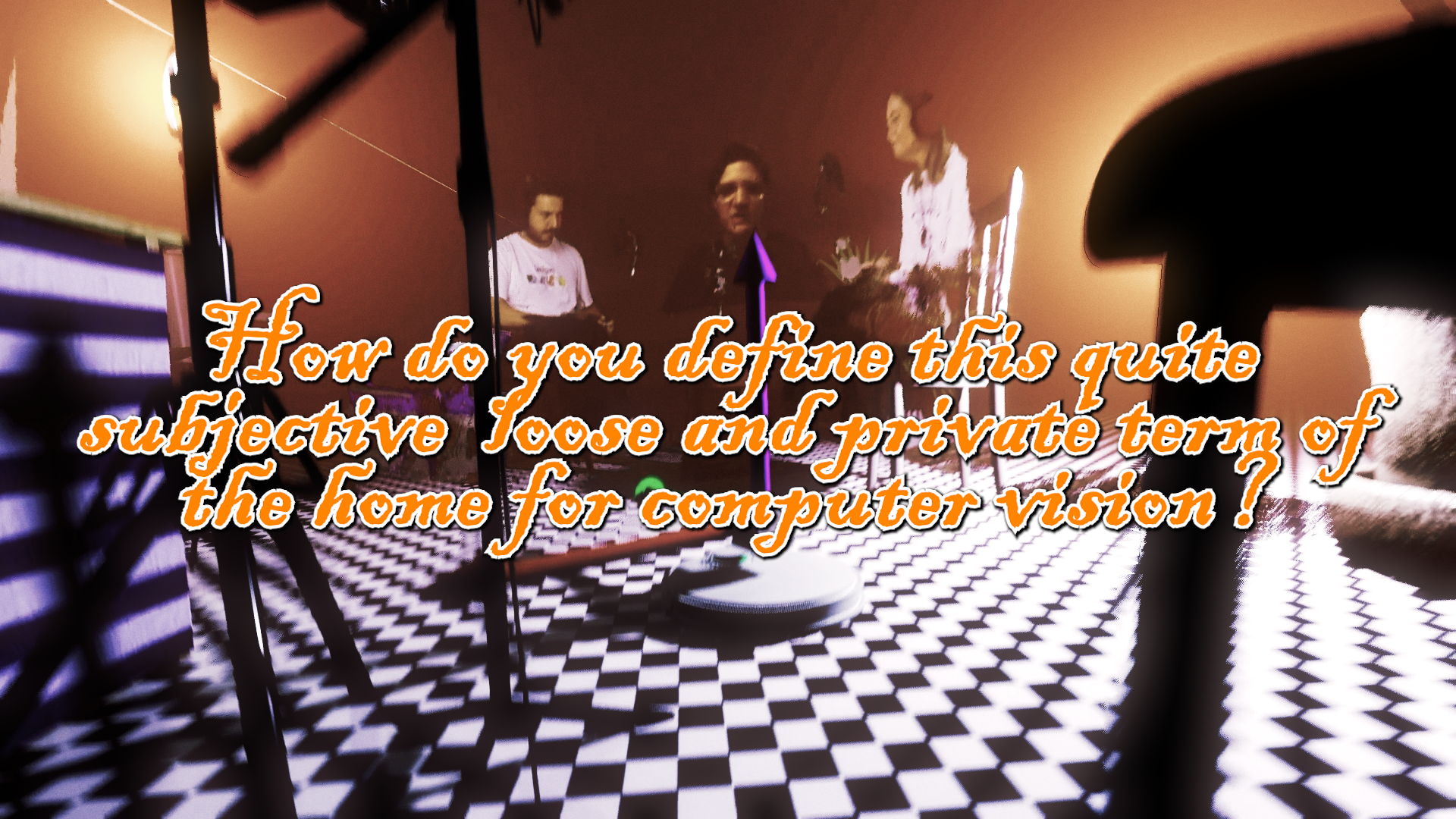
This duality rewired my brain and was also a source of inspiration for the format of the Design in Rising Winds atlas. You enter the atlas first as a geographic map, looking at interviews, recordings, and documents, and tracing the routes that I took over the course of the fieldwork. Suddenly the map transforms into a divination tool, and you can look at it through the eyes of a bug or a cloud or a demon, or through the perspectives of the diverse artists I invited to reinterpret the project. I’m fascinated with ways of thinking that coexist or that escape a static, singular point of view, which is something I see in Wendi’s work too. When I look at her films, I see the same desire to collapse truth and imagination, fact and fiction.
KOOZ Before moving on to the output, I’d like to stay with methodology for a moment. We’ve heard about both the importance of direct engagement through site visits and the role of the wider network of actors and infrastructures that made the research possible. What informed your choice of sites in China, and how did those experiences shape the narratives and ways of producing and sharing knowledge that underpin the project?
FW Firstly, the project is very heavily oriented through collaborations with other people. A key person I met early on was Dr Ruishan Chen, an eminent geography and design professor at Shanghai Jiao Tong University — a colleague who became a friend and collaborator, and who introduced me to that region because he grew up there. An organic and intricate network of people grew from there, and every time I met someone new — whether it's a scientist or a tree farmer or a herder — I guess I came with the awareness that I was a guest and hoped to embed the same humility in the narration of the research.
In the beginning, I had the rather designerly intentions of a master plan: Within the first moments of my first trip, I knew that I had to approach it differently. What became a strangely poetic thread throughout this project was actually my fascination with the Chinese character for wind. In the middle of this character lies the character for ‘bug’, and the moment I noticed this, everything kind of shifted. Really, it tells us that you know the smallest, most peripheral and insignificant seeming things can actually shape planetary forces.
"... the smallest, most peripheral and insignificant seeming things can actually shape planetary forces."
So I wanted to spend time paying attention to things that seem peripheral; to people who seem unimportant. There was a desire to bring the periphery into the view, and also to look beyond the categories and boundaries that had structured my thought until then. This was something I was constantly confronted with when trying to “visit” the Great Green Wall. Where is the Great Green Wall, actually? It's actually not a single place and it's not just a policy, it's not really “contained” anywhere: it's been described by Jerry Zee as a massive weather engineering apparatus, but it's neither vegetation nor machine. It's partially composed of carbon credit apps, planned migration movements, herds of cattle, parasites — a gamified terraforming mass of shrubs. It’s almost an idea that is also a weather engine; for me, it completely blurs the boundaries of what I thought of as clear categories like technology, nature, or the human.
KOOZ You initially set out to pinpoint and make sense of a particular phenomenon, but encountering the Great Green Wall seems to have challenged the very premise of that approach. As a designer, how did you then navigate these systems, and what tools, methods, or modes of engagement did you develop to unpack their spatial complexity?
FW Well this highly nuanced phenomenon completely exploded the definition of what design is for me, I guess. One thing that was very liberating and relieving was understanding that there doesn't really need to be an object or a solution. Rather, it’s a process of [re]orientation — a process of movement. Sorry, when I hear myself talk about this project, I sound a bit like a yoga teacher! But I often describe this project as a proposal for design as a philosophy of movement, but one important note to emphasise is that it’s not aimless movement. It's about adjusting or moving with a lot of intention. One example, and I always return to it, is the herders I met in Inner Mongolia.
WY Yes, you should talk about that!
FW I went on this trip to Inner Mongolia — to a region north of Gansu and Qinghai an extremely desertifying region — with an incredible political ecologist called Annah Zhu, who taught me a lot. On this trip, local Mongolian ecologists showed us this incredible system devised by local herders, in response to grazing bans that were imposed by the government. Essentially, much of Inner Mongolia is rapidly desertifying, which by consequence generates massive sandstorms, primarily because there's no grass to hold the sand on the ground. So the government banned the grazing of grass for long periods — but this policy was massively threatening to the livelihood of the Inner Mongolians, an ethnic minority who mostly herd goats.
Instead of accepting their fate, all of these families pooled their money together, and built shared hydroponic grass farms inside of the largest facilities. During the grazing periods — which would sometimes last multiple months — they would run what they called “herd kindergartens”, where each family would bring their herds around to graze on the soilless grass. That system was surprisingly clever: it actually allowed the community to double their fattening seasons, so it was economically beneficial as well.
That's not the only example: Jerry C. Zee also writes about the booming Chinese medicine economy in these deserted regions. In this case, people use the shrubs planted for sand control as infrastructure for growing parasites — symbiotic rhizomes— which they then sell as Chinese medicine. It’s a form of adaptation that is obviously incredibly creative and subversive, but that still contributes towards a very long-term plan that is ultimately collectively committed to. What I'm trying to say is that design is a form of movement — but it has to be oriented or intentional for it to have impact, or to benefit society collectively.
"design is a form of movement — but it has to be oriented or intentional for it to have impact, or to benefit society collectively."
WY I revisited your essay recently and this is a perfect moment to recall that you cited Jerry Zee's discussion of how desert winds create experimental worlds. When I read that, it really made me think about this example with the hydroponics farm. As you got to meet the people involved in every layer, but also to discover this very ground-up kind of way of thinking, the project became an anthropological investigation into how people are managing the available resources within timelines of nature and of their own economic system.
KOOZ Design is very much this idea of movement of ideas. Wendi, your text informed and added to Flora’s, but then you kept developing until it evolved into Dream of Walnut Palaces. How did contributing to Flora's research enable you to start articulating these ideas?
WY Yeah, this collaboration really meant a lot to me at the time, Flora — you might be the main person alongside whom I was thinking about many similar things, investigating questions through our own methodologies. I was similarly driven by the question of other imaginations that become possible through using, living with, and devising technologies — what does technology even mean? I gravitated towards looking into history, and the specific historical episodes I was looking at around that time were the 1780s between Beijing and Paris — which was also crazy.
FW We are triangulating together!
WY I was very fascinated by missionaries from Europe — mostly German and French missionaries in Beijing at the time — who were translating Chinese medicinal knowledge, music and philosophical texts from Chinese to French. I started daydreaming about whether a Chinese scholar could take the same trip in the opposite direction, from Beijing to Paris, bringing his own culture into this moment at the height of Enlightenment, when a lot of the modern scientific values were beginning to be established. What if he became friends with Antoine Lavoisier, the ‘father of modern chemistry’ and they start doing experiments together?
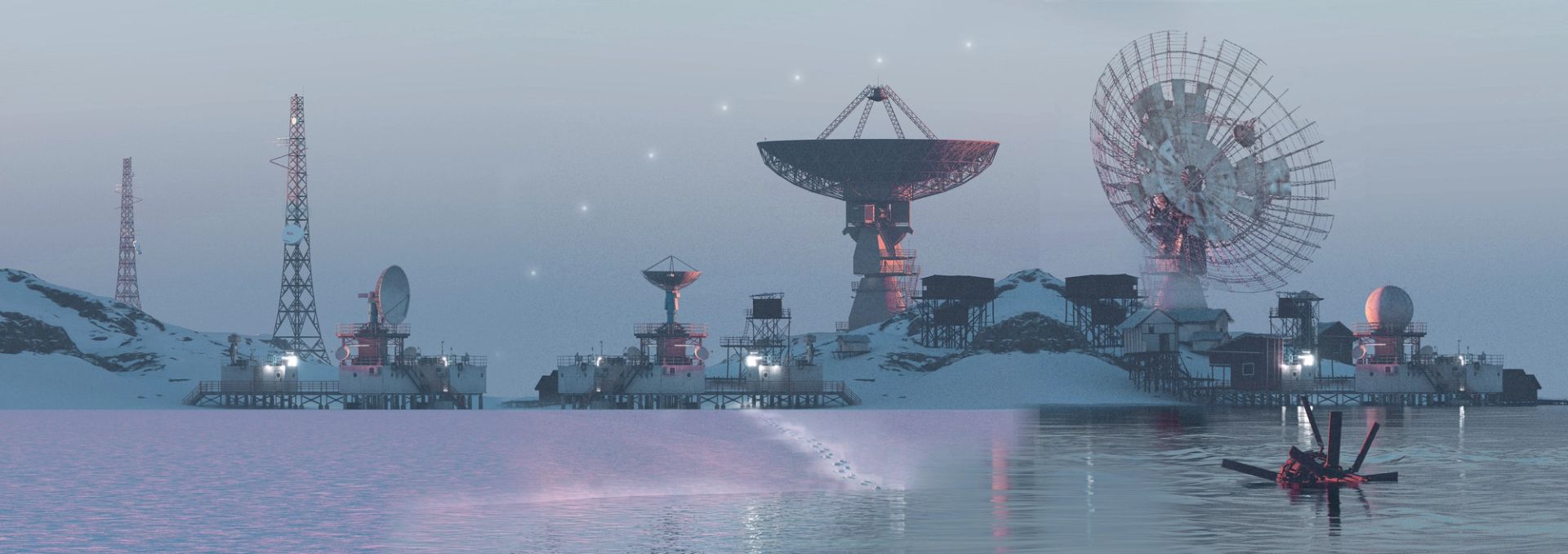
I was still fleshing out these ideas when I was working on this project with Flora. I grounded that work in my imagined satellite, the ‘site’ where I was thinking about how to apply some of the ideas that I learned from history and from these figures. I made a decision not to be strictly factual when it came to inventing and imagining this satellite. I was more interested in exposing how, within Chinese cosmology, there are basic principles and presumptions about the cosmos that are so fundamentally different from what we are taught when learning about astronomy, or even astrophysics. I wanted to be a bit more absurd in devising the satellite — for example, there are hydraulic operations between yin and yang energy — while also borrowing the language of videos from NASA that explain how a space vehicle works, where they break satellites down to different components.
"within Chinese cosmology, there are basic principles and presumptions about the cosmos that are so fundamentally different from what we are taught when learning about astronomy, or even astrophysics."
It was a very fun exercise that I was doing with Flora; right after that, I got the opportunity to submit a project to the VH Awards which became Dream of Walnut Palaces. I wanted to bring this project into a more extensive investigation, looking at the details of the material culture and sociological organisations; everything from the diagrams, the objects, and places to the vehicles, the instruments involved, going as much into detail as possible.
KOOZ We began with how your interest started with reading, and even specific books from different disciplines — yet your projects have metabolised through a series of mediums, one of which is speculation. What do these formats mean for the research? For instance, what can a speculative video hold in relation to an academic essay, or in relation to a website?
WY Well, I can make one quick point, again in reference to something Flora wrote in that same essay: you describe being in Inner Mongolia with a driver who was sharing local stories, and how fiction and science intertwine, how their difference dissolves in this landscape. Recently I've been reading about imagination in relation to the history of science, and stumbled upon this really interesting article by Lorraine Daston, about the ‘fear and loathing’ of imagination in science.
I have this emergent idea that the history of science is a history of the imagination — but also the fear of imagination. Flora’s writing and its mention of this story makes me think about the different modes of approaching ‘truth’ — sometimes that means using fiction, so to speak, to magnify what is truthful.
FW … Totally. Lately, I've been looking at paintings a lot. Maybe because I'm a bit tired of tech, I have an urge to look at something analogue. I was looking at this painting the other day and I felt like it was rewiring my brain; looking at this still image was creating new spaces of thought, tickling parts of my brain and new landscapes that I didn't know about. I guess in a similar way, I had hoped the atlas would produce a similar effect: I wanted viewers to look at the same terrain, but feel like something counterintuitive was happening, in a way that reflects the very contradictions of the topic that I was researching. I wanted the medium to require viewers to meet the work halfway, and the process of designing something like that is something I'm still figuring out.
KOOZ That's super interesting, and it brings me back to another of Wendi’s projects — the Revival Fund. That project utilises a totally different language from the speculative CGI of the ‘Walnut Palaces’; could you discuss the tension of working between these interfaces?
WY Wow, nobody asks me about this — thank you. Honestly, I feel really grateful for Aishwarya Khanduja, who helped me to seed this structure. She has a nonprofit called Analogue, which gives grants to some amazing projects, especially projects that are not necessarily legible in a traditional sense. Making the film for the VH Award, I realised that if I really count the amount of time I spent reading — including the months before meeting Flora — that was almost a two-year research project in its own right. A bit of funding boost can go a long way for people to concentrate on research and develop their ideas more deeply.
Working with Aishwarya, we were able to unlock a bit of this capacity. You don't want to take money from any random person; something that Aishwarya mentions a lot is how money carries frequency, and you want to make sure that it comes from the right place and the right intention. This process has been a very interesting experience; the projects we support are not just also about reading history books or devising an experiment — it involves thinking about what comes after that and how ideas and research take on a life of their own beyond us. I'm not just saying this because we're talking now, but I was actually looking back on Flora’s website and sharing that with the people I'm working with right now, as one of the inspirations of how you might build a research artifact of some sort, what are the different ways of sharing that visually and textually.
FW Here’s a small anecdote: before I went on my trips, I had never been to Western China; I hadn't actually spent that much time in China at all, except with my own family. I was so new to this place and my mom told me, ‘Remember that in China, the real currency is not money, but relations.’ Chinese people understand that the value of a relationship or of an introduction is much grander and higher than anything with a monetary value. So when someone introduces you to a person who might be helpful for your project, you should return the favour by introducing them to someone else — so that slowly, the web of relations becomes stronger.
"when someone introduces you to a person who might be helpful for your project, you should return the favour by introducing them to someone else — so that slowly, the web of relations becomes stronger."
KOOZ One of the luxuries of the M+ Design Trust Fellowship, as a research initiative, is that it doesn't demand a predetermined outcome. From our very first conversations with Ikko, Marisa and Shirley what came across most strongly was the emphasis on connection: on building an infrastructure of people and a form of reciprocity. If research and design are understood as practices that remain in motion, to what extent is a project ever truly finished?
FW Yeah, actually, it was wonderful doing this fellowship; not only was Sunny Cheung a really great interlocutor, but the Fellowship itself gave us the ability to do long, slow, open-ended research. For example, the topic of ecology in China — including projects like the Three-North Shelterbelt — is at first something that appears to be highly optimised and measurable. One of the great initiatives of ecological advancement in China is something called the Beautiful China Initiative, for which the Chinese Academy of Sciences has created a ‘Beauty Index’ that would tabulate the beauty of Chinese landscapes. Then there is Ant Forest, an app embedded in the Alipay wallet which turns your everyday actions into carbon credit points; these can then be converted into trees planted for you in the desert, which then convert back into carbon credits for the company or the country. It's only through slow, open-ended research — a lot of time looking at mundane relationships, having mundane conversations — that you're able to go to a much deeper level and see that there's much more than this form of optimization taking place.
One example that you can find in the Atlas is a three-month long WeChat conversation that I had with FaHua Ying, an organic desert farmer. Every day, I asked him to send me a picture and a short text — something he's doing, or anything he is thinking about. So there’s an archive of these super-mundane messages: today I herded the chickens, today I cut my hair, and so on. These slow, mundane interactions taught me a lot throughout the project that can't be felt immediately.
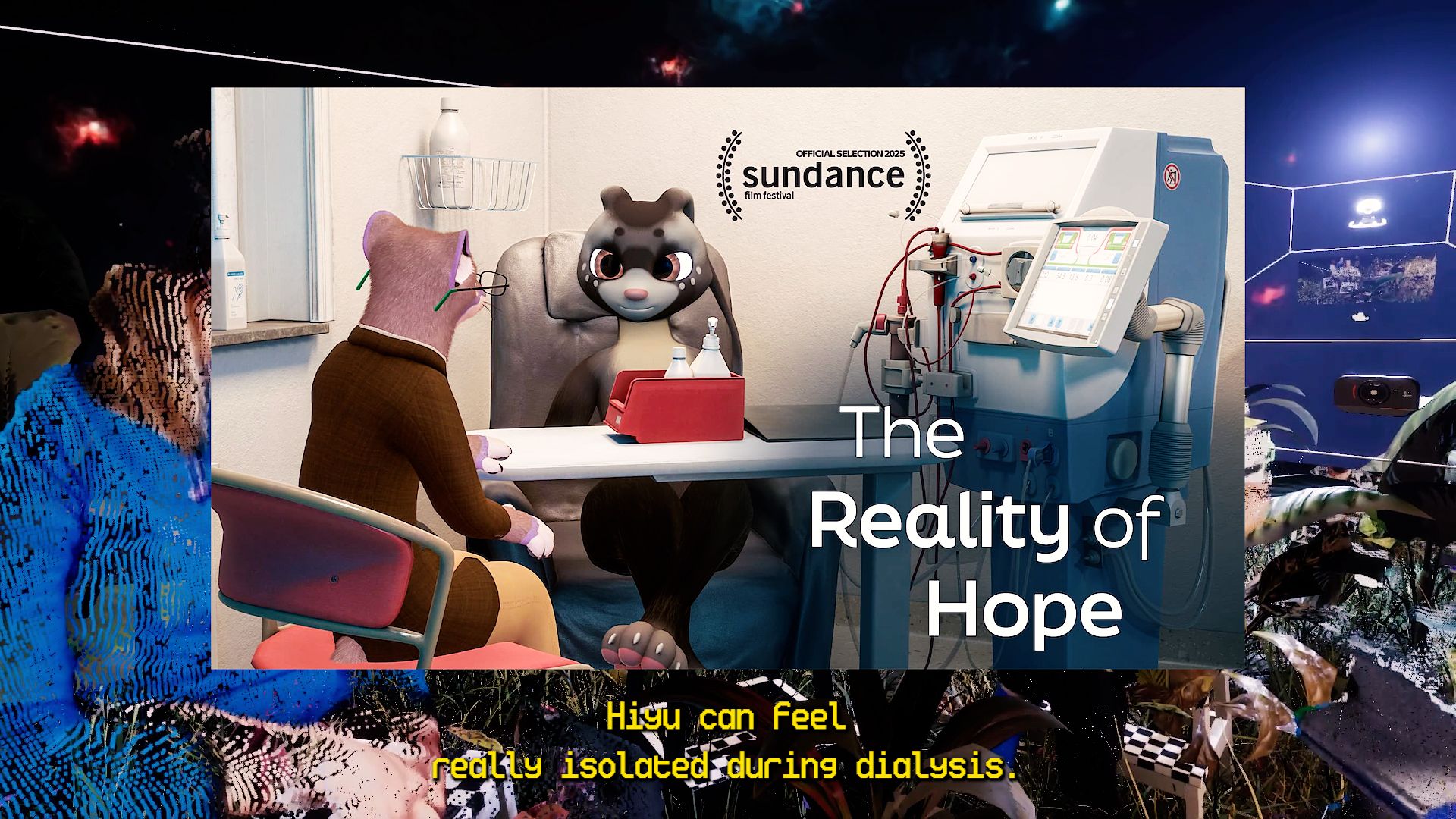
Following that, I'm actually doing a new residency now. This one is funded by the Eon Foundation, hosted by E-WERK Luckenwalde and the Akademie der Künst in Germany — and the focus of my research is still the same region. I wanted to extend this project through another format, so right now I'm making a performance piece, performed by autonomous agents. The story is inspired by a lot of the things that I found during my research; for example, one of the characters in the cast is a parasite.
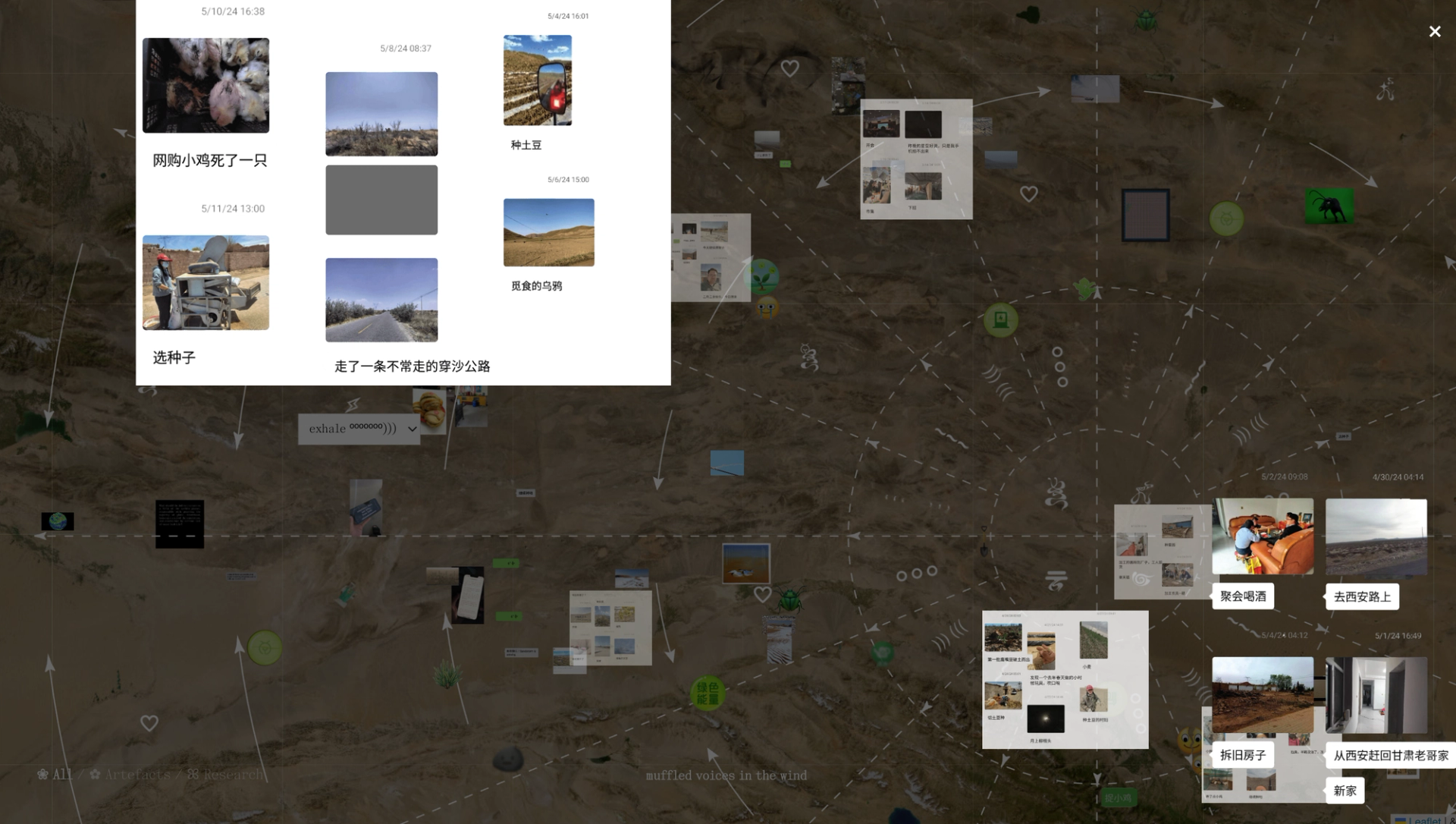
Excerpt from the Atlas. One contribution to the Atlas takes the form of a three-month WeChat conversation between Flora Weil and the organic desert farmer FaHua Ying. Each day, Flora invited FaHua Ying to send a photograph and a short reflection—something he was doing or thinking about. The resulting archive of seemingly ordinary moments—herding chickens, cutting his hair, and other everyday observations—became a record of slow, sustained exchange, revealing forms of knowledge that emerge gradually rather than all at once.
KOOZ Looking at the two formats mentioned throughout this conversation, there’s the essay — a very personal thesis and perspective — and the Atlas, which one can navigate freely, establishing new connections. There's something beautiful in that interrelation. Wendi, your work has developed through 2024’s A Magnetist Dreams of Universal Healing, then Dream of Walnut Palaces in 2025. Are those ideas around modes of knowledge production still at the centre of your practice?
WY Well, I’ve moved forward in my timeline, and in the past year I got really into the history of science and translation in the late 19th century, from Western languages and Japanese into Chinese. I think the research became more about language as its own worldbuilding techniques or tools. I stumbled upon some fascinating texts by Chinese scholars in the early 20th century, who were trying to make sense of scientific and technical texts that entered into the country. They were trying to integrate or synthesise that with Buddhist geography and also older Chinese philosophy, so everything combines into one thing. I'm trying to rewrite this early Chinese sci-fi story from 1905 as a multi-episode animation series that I want to make too. I
FW We're really always thinking in parallel, because recently I’ve been thinking about language a lot, I even invented a language for this performance piece I'm working on. It’s not at all rigorous, but this invented language is also inspired by the bilingual scripts that were found in Dunhuang and other very early Chinese cosmologic texts where they describe how in the beginning, there were five categories of bugs, or chong. In this description, the world is divided into five types of bugs: furry, feathered, scaled, armored, and naked— and then humans fit into the category of naked bugs. Which brings me back to my obsession with the character wind (bug) - we are in the end just naked, vulnerable, exposed bugs.
KOOZ This goes back to your recognition of the bug at the center of the character for wind. I also love this triangulation of research, design and movement, and the practice of design as something that needs to evolve, that is not fixed. Sunny, you’ve been quietly observing — I wonder if you have any reflections to share.
Sunny Cheung I’ve been making a lot of notes and thoughts about the ideas of invention, about fact and fiction, and how the imagination plays a definite role in science. This brought to mind a book that I read a couple of years ago called Metaphysical Experiments: Physics and the Invention of the Universe, by Bjørn Ekeberg. He talks about how physicists might invent things like the Higgs Boson particle, and then we invent tools to test and prove these possibilities. But by inventing the tools to monitor these specific mathematical probabilities, we've actually invented a story which continues, so fiction continues to fuel science, if that makes sense.
WY I’m definitely adding that to my suggested readings list. I met an experimental physicist last week who was talking about dreams — that ideas for his engineering projects sometimes come through by way of dreaming, which upon studying turns out to be a relatively common thing in the history of physics.
KOOZ Well, we are talking about speculation, and this is a beautiful note on which to end.
FW Thank you so much for this amazing conversation.
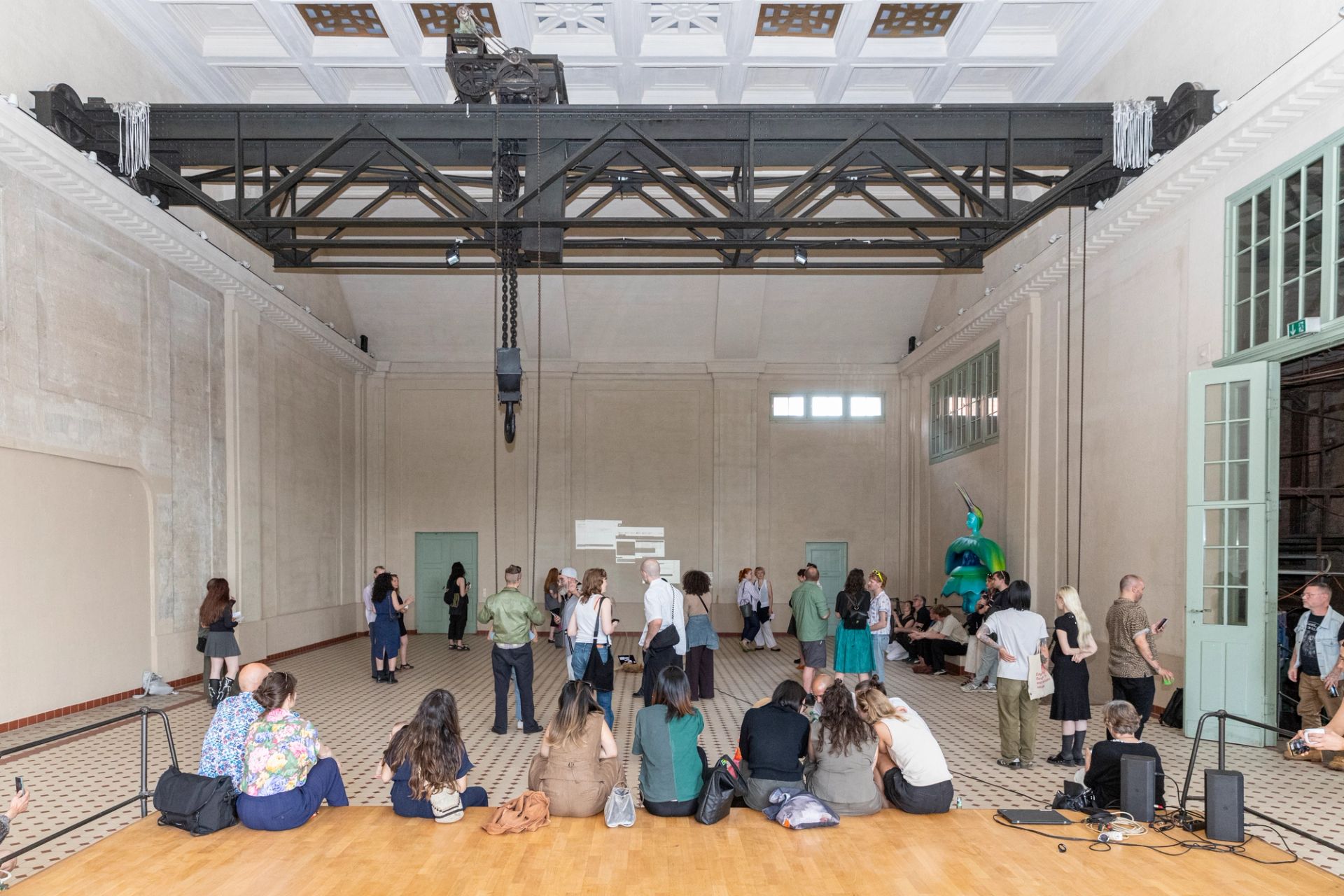
First screening of Flora Weil's agentic performance, developed during her Human–Machine Fellowship at E-WERK Luckenwalde, co-funded by the E.ON Foundation and Akademie der Künste. Building on Design in Rising Winds, the work continues her exploration of world-making, maps, identities and digital interfaces shaped by the movements of the region. Created in collaboration with artist Lima Ernst, the sound piece sets the tempo for a performance enacted by AI agents whose personas draw on Western Chinese organisms, ghosts and women who reminded her of her own family.
About
The M+ / Design Trust Research Fellowship (2015–2025) was a pioneering decade-long collaboration between M+ and Design Trust that supported original curatorial and scholarly research into design and architecture across Hong Kong, the Greater Bay Area, and Asia through a transnational lens. Bringing together fourteen research initiatives over ten years, the fellowship fostered critical investigations into regional histories, cultural production, and contemporary practices, significantly contributing to the broader discourse on design and architecture in Asia and informing future research, exhibitions, and collections at M+
M+ is Asia’s global museum of contemporary visual culture. Located in Hong Kong’s West Kowloon Cultural District (WestK), it is dedicated to collecting, exhibiting, and interpreting visual art, design and architecture, moving image, and Hong Kong visual culture of the twentieth and twenty-first centuries. The museum stewards a multidisciplinary permanent collection that includes objects from regions across Asia and beyond. Today, M+ is a nexus for researching and presenting contemporary visual culture, inspiring thought and curiosity.
Design Trust was established as a grant-funding and community platform in 2014 by Hong Kong Ambassadors of Design, a registered charity in Hong Kong since 2007. Design Trust supports creative projects that develop expertise and build research initiatives and content related to Hong Kong and the Greater Bay Area. Working across a multiplicity of design disciplines, from graphics, media, and architecture to the built environment, Design Trust aims to actively accelerate creative research, design, and the development of meaningful projects that advocate for the positive role of design.
Bios
Sunny Cheung is a Curator of Design and Architecture at M+, Hong Kong’s museum of visual culture, where he specialises in digital art and immersive installations. He has worked at the Barbican Centre, the Victoria and Albert Museum, and the Liverpool Biennial. His curatorial projects include Beeple’s HUMAN ONE, Pipilotti Rist’s Hand Me Your Trust, and A.A. Murakami’s Floating World, reflecting his commitment to exploring the intersection of technology and contemporary art.
Flora Weil is an interdisciplinary technologist, designer, and researcher whose practice connects ecology, anthropology, philosophy, and game design. She co-runs Nephila, a creative studio building open-source tools for experimental worldbuilding. She was a recipient of the M+ / Design Museum Research Fellowship in 2023. Weil is currently developing a project centered on the Gobi Desert, using autonomous browser agents to trace how trade, wind, migration, and love shape both environmental, machine and human systems.
Wendi Yan is an artist, writer and technologist. She uses CGI software to simulate alternative scientific progress through videos and games, and writes about the history and future of scientific discovery. Wendi was an inaugural Steve Jobs Archive Fellow and the Grand Prix recipient of the 6th VH Award by Hyundai Motor Group. She directs the Revival Fund, an experimental grant program restoring lost research.
Federica Zambeletti is the founder and managing director of KoozArch. She is an architect, researcher and digital curator whose interests lie at the intersection between art, architecture and regenerative practices. In 2015 Federica founded KoozArch with the ambition of creating a space where to research, explore and discuss architecture beyond the limits of its built form. Federica is an Architectural Association School of Architecture in London alumni.