Federica Zambeletti / KOOZ It's an absolute pleasure to hold this conversation, on the occasion of SMAFF 2026, to share your perspective on the magic of your video Silvesterchläusen. I want to start with something that lies at the heart of the tradition of Silvesterchläusen itself, and its slight contradictions. The rituals around the Silvesterchläusen — a Swiss tradition related to Saint Sylvester, involving masked and ornately costumed characters in New Year’s revelry — are performed with extraordinary precision and commitment, yet its exact origins remain uncertain. What happens to a ritual when its performance survives beyond the knowledge of why it began?
Andrew Norman Wilson It becomes even more dependent on faith. It seems that this tradition — performed to celebrate the New Year — is not necessarily attached to any specific doctrine. Some people attach belief systems to it, often due to the region in which it takes place; others speculate that it has pagan origins, or even just a monetary agenda. According to one theory, people who needed money would make costumes with elaborate headpieces to mark the new year; men and boys would go from house to house asking for money; in return, they would perform in the costumes that they had laboured over, singing, dancing and showing off. Without any agreed-upon or specific belief system attached to it, I find that the Silvesterchläusen tradition takes on even more mysticism, and that's why I was originally interested in it. There is an absence of a unified belief system behind the practice of making work — yet it brings people together. Once I learned about its ambiguous background, and the sheer leap of faith that everyone takes — especially in a rather conservative part of the country — to celebrate the new year in this labour, time and resource intensive manner, I found it quite beautiful; that’s not something that you see much of in the United States.
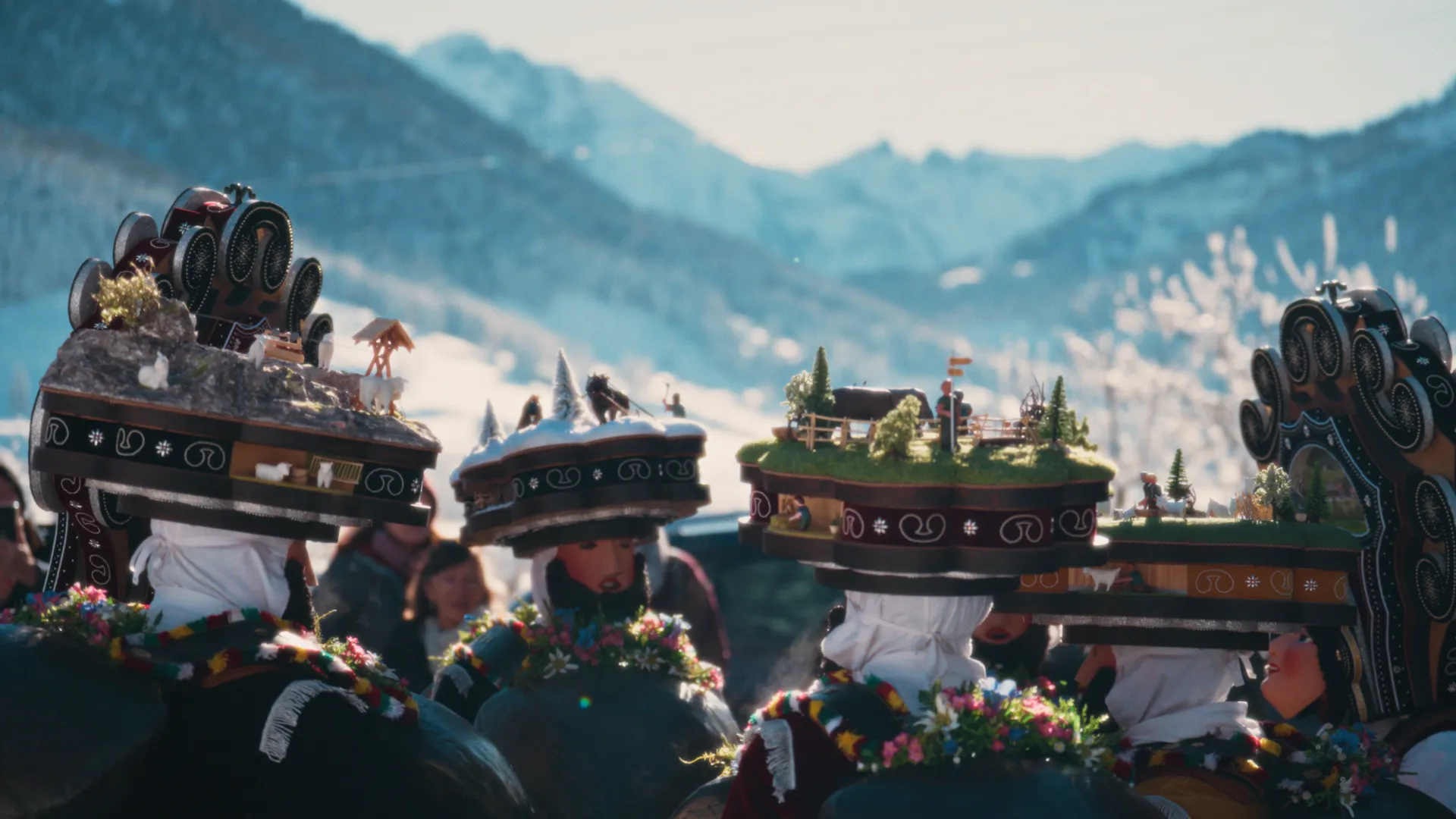
Silvesterchlausen, directed by Andrew Norman Wilson, 2025. Film still courtesy of the artist.
KOOZ You made the film last year; could you reflect on the value of looking at these traditions right now, in the present context?
ANWIt bears a relationship to a lot of what we see in art and film these days, I think. In terms of culture, narratives have fractured; we have fewer monolithic cultural entities — there’s no more Michael Jackson or Elvis Presley. Certainly this is true of the religious aspects of society, both in Switzerland and across the United States where I live. So despite how different the people in the film are from my own context and way of life — they’re mostly farm and factory workers in the most conservative part of Switzerland, within a highly religious community — their traditions bring together not only the town but also people from all over the country and beyond. Again, it's difficult to ascribe any particular motivation or agenda to it; there's just something beautiful about how these men and boys who, without their masks, are quite masculine, make these extremely ornate costumes and take months out of every year to do so. It all demonstrates the incredible pull that the practice has on people.
I think it's emblematic of the power of art, to an extent. I think the Silvesterchlausen gets at what I find myself looking for in art — not a simple gesture that presents an identity construct or a political argument; but rather an involuted and labour-intensive process of making that demonstrates both what humans are capable of and that which we can never know. In the case of Silvesterchläusen, the proof is in the pudding — by which I mean the actual materiality of the work — and it’s not tied to a particular orthodoxy. That opens up a more imaginative space whereby each ‘schuppel’, which is the name given to each group of chlause, can create their own narratives and bring their own subjective interpretations of the ritual to the larger tradition. Again, rather than an identity or an argument, this creates a clear energy that can’t be described in language.
"I think the Silvesterchläusen gets at what I find myself looking for in art — not a simple gesture that presents an identity construct or a political argument; but rather an involuted and labour intensive process of making that demonstrates both what humans are capable of and that which we can never know."
KOOZ There’s a beauty to the ritual as a genuine community building exercise, something that we desperately need today. It’s quite incredible to think about such painstaking, labour-intensive making processes for something that is performed only twice a year, in quick succession — yet in the moment of performance, it really functions to galvanise the people of a region. Talking about the film itself, you also feature several forms of repetition and ritual; of course, the Silvesterchlausen that recurs each year, but also gestures and sounds —
ANW There are various routes which recur throughout. The dancers’ bells establish patterns, and then cinema itself introduces its own structures of repetition and duration. The rituals take place over 20 hours, on two days each year: December 31, marking the end of the year according to the Gregorian calendar, and then January 13, observing the Julian calendar. We began filming at four in the morning at a farm on the outskirts of town, where a schuppel was getting dressed. The schuppel performed three zauerli, which are the wordless yodels that they sing, alternating with three dances that activate their bells.
This same pattern takes place at each house, and afterwards the schuppel is served with mulled wine and water. Then they move on to the next house, and do that over and again throughout the day, getting progressively more intoxicated from drinking mulled wine at each stop. Sometimes the villagers give the chlaus coins. They continue to perform as they walk between houses, twirling and bouncing to ensure that the bells announce their approach, summoning the inhabitants of the next house to the front door.
So the ritual circumscribes the community and the village. Each inhabitant that opens their doors to the chlause gets to witness the same performance as their neighbors saw; later, through the afternoon and into the evening, people start to congregate in the center of the town and eat in the restaurants while the chlaus perform for them. So the celebration has an arc that progresses over the course of the day, with smaller patterns of ritual and repetition throughout, which unfold spatially as well as temporally.
In putting all of that together for the film, I tried to base it around the songs. I didn't want to follow one schuppel because I wanted to show the range of costumes on display on the day that we were shooting. You get an impression of the different costumes, the patterns at play, the songs in their entirety, and the dance sequences. My producer and sound recordist Thomas Rickenmann understood these patterns very well going into the shoot. He made a longer documentary film, also called Silvesterchläusen, which follows not only the progression of a celebration day on New Year's Eve, but also various schuppels’ process of developing costumes and planning their performance.
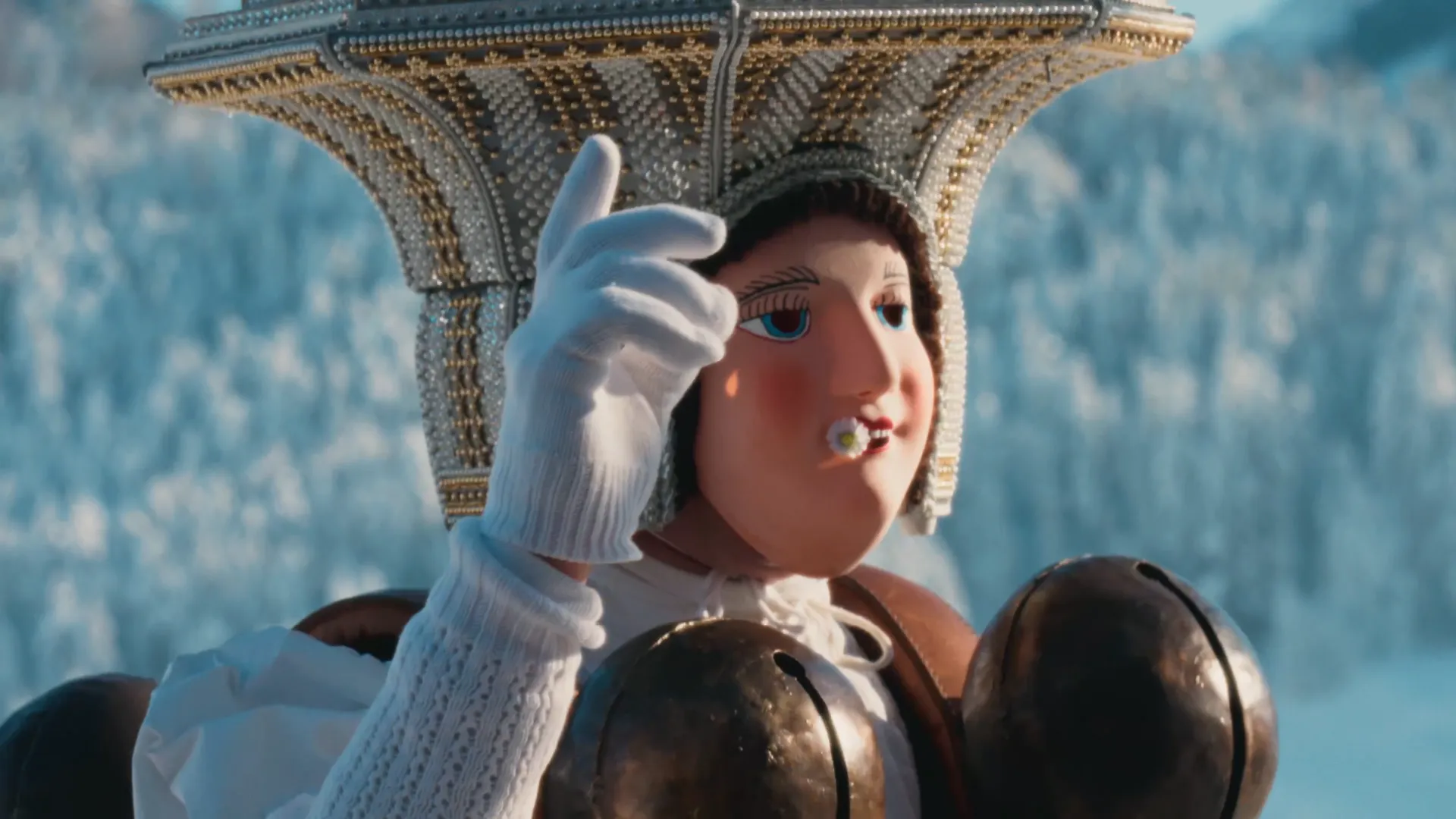
Silvesterchlausen, directed by Andrew Norman Wilson, 2025. Film still courtesy of the artist.
KOOZ That’s quite a commitment. I was thinking about how open these communities are to being documented; is there a veil of privacy around the undertakings of each schuppel, prior to their performance? Did you have to establish trust between the film-making crew and your subjects?
ANW Well, Thomas surely helped to create a bridge between my crew and these schuppels. He gained their trust not only by making his documentary for many months, but also by returning, taking photographs and sharing their stories over years; he’s shown himself to be very dedicated to traditions and rituals of all kinds in the region. Unlike Thomas, I had not intended to shoot the process; our financial limitations meant that we could only shoot for a couple of days, but he was instrumental, even just on the level of language; most participants did not speak that much English, and so he was serving as a translator; he knew where to start and with which schuppel, based on my costume and location preferences. A lot of things that I wanted were influenced by what I had seen in his movies and other documents, so I could direct him to what I wanted to find.
I'm not privy to the conversations that Thomas had with villagers and the various chlause; I don't speak German, much less Swiss German. We had some conversations with some of the performers and community members one week prior to shooting the film; and there’s also a museum in Urnäsch that is largely dedicated to Silvesterchlausen that was very informative. A lot of the subtitles in the film come from those conversations. Rather than interrupting the performances in the video with speech, we decided not to record conversations with the villagers in situ, instead using fragments that emerged from our conversations with performers in the days prior, using them as subtitles.
KOOZ That’s right; the effect was an intriguing dissonance between the soundtrack of the film and the subtitled text on screen; can you talk about that split between the aural experience of the festival, and your discussions around it?
ANWI wanted to give the audience enough context to grasp what I had come to understand, without letting the exposition overwhelm the experience. Some explanation felt necessary to convey the beautifully mystical quality of the ritual, so I tried to take what had been important to my own understanding of the tradition and embed it in the film as unobtrusively as possible. As the filmmaker, that became something I had to negotiate and test with viewers: how much information can I provide before it starts to interfere? I like the idea of listening to the zauerli and looking at the costumes while small pieces of context are doled out for the audience to consider, and then returning to the nonlinguistic experience.
KOOZThey're such different layers of information; visual, aural and textual, each of which has very distinct languages and registers. The theme of SMAFF this year is music, and choreography plays a role in this idea of carrying memory, history, and identity. Watching Silvesterchläusen, I wonder whether the ritual itself might function as a kind of musical score, transmitted not through notation but through bodies, sounds, costumes, and repeated gestures.
ANWThis goes back to what I was saying about how they move through the town and what happens at each home. There’s a definite score to it, even if it would be an atypical one to stage as an opera. The landscape and geography of the town shape much of the movement: the Chläuse don’t perform in the woods; they perform at your front door. And so on.
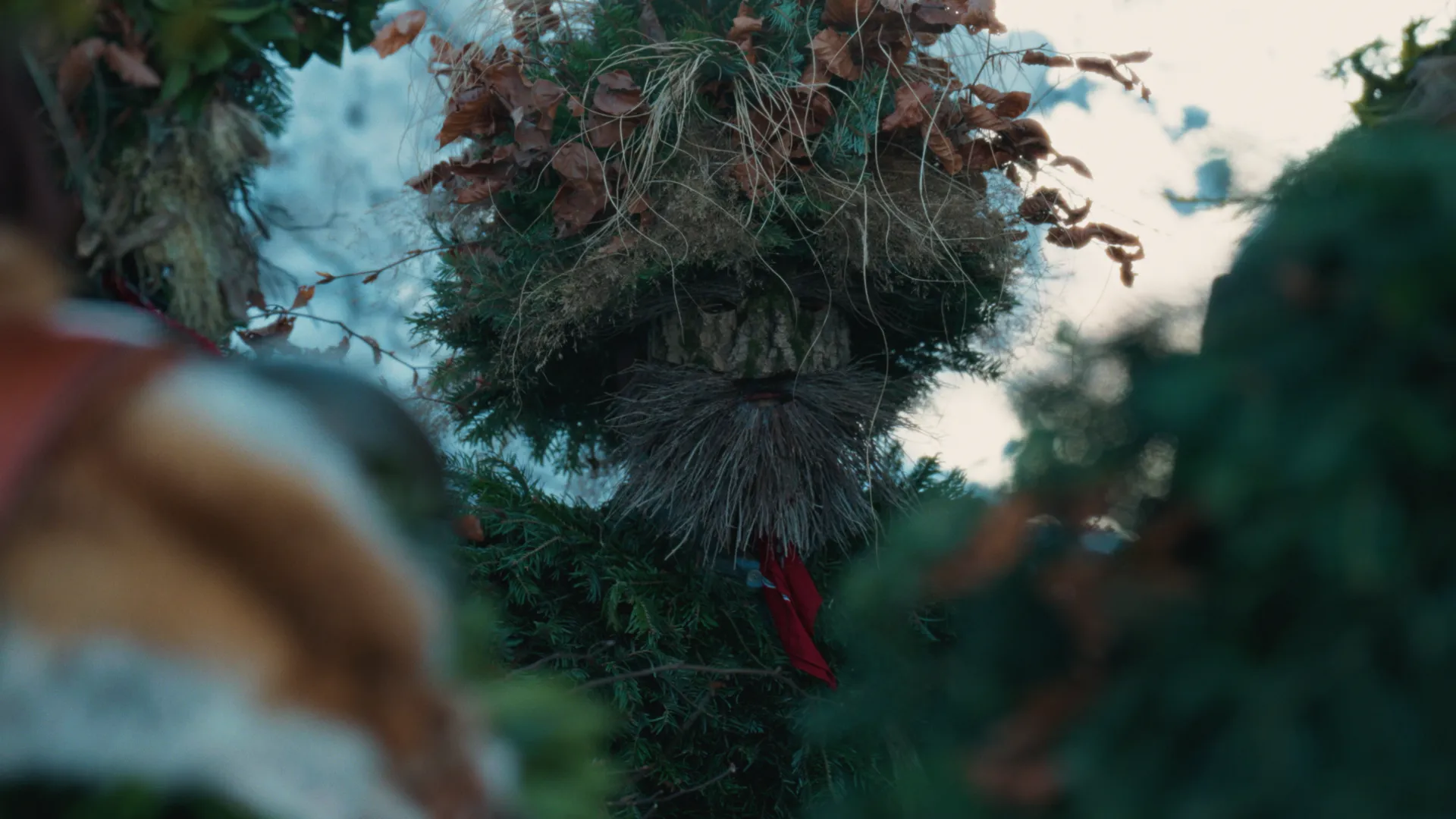
Silvesterchlausen, directed by Andrew Norman Wilson, 2025. Film still courtesy of the artist.
"The landscape and geography of the town shape much of the movement: the Chläuse don’t perform in the woods; they perform at your front door."
What’s especially interesting about a practice rooted in such a small community and carried on annually by hundreds of men is how deeply embodied it is. There’s very little need for external reference. The dancing itself is relatively simple, but the zauerli depend on harmonization, memory, and repetition. As I say this, I realize I’m not actually sure whether they have a formal system of notation. I know the songs are learned over the course of the year, alongside other seasonal singing traditions—such as those associated with bringing the cows up into the mountains in spring—but I don’t know to what extent any of that knowledge is written down.
Another interesting thing I observed was all of the hidden, off-character moments. Following the Chläuse as documentarians, we would see them lift their masks to smoke cigarettes, disappear into the woods to urinate, or briefly step outside the ritual in other mundane ways. I chose not to include those moments in the documentary. For me, the work isn’t really about particular bodies, identities, or biological realities; it’s more about sustaining the myth and the mystery.
"For me, the work isn’t really about particular bodies, identities, or biological realities; it’s more about sustaining the myth and the mystery."
KOOZ Of course. The understanding of a tradition through embodied knowledge and a particular landscape is a beautiful anchor to hold onto, at a moment in which AI is sucking up the best and worst of us, and everything seems to be able to be absorbed in these large language models. Thank you so much for joining us.
ANW Thank you very much, and thanks everyone for watching.
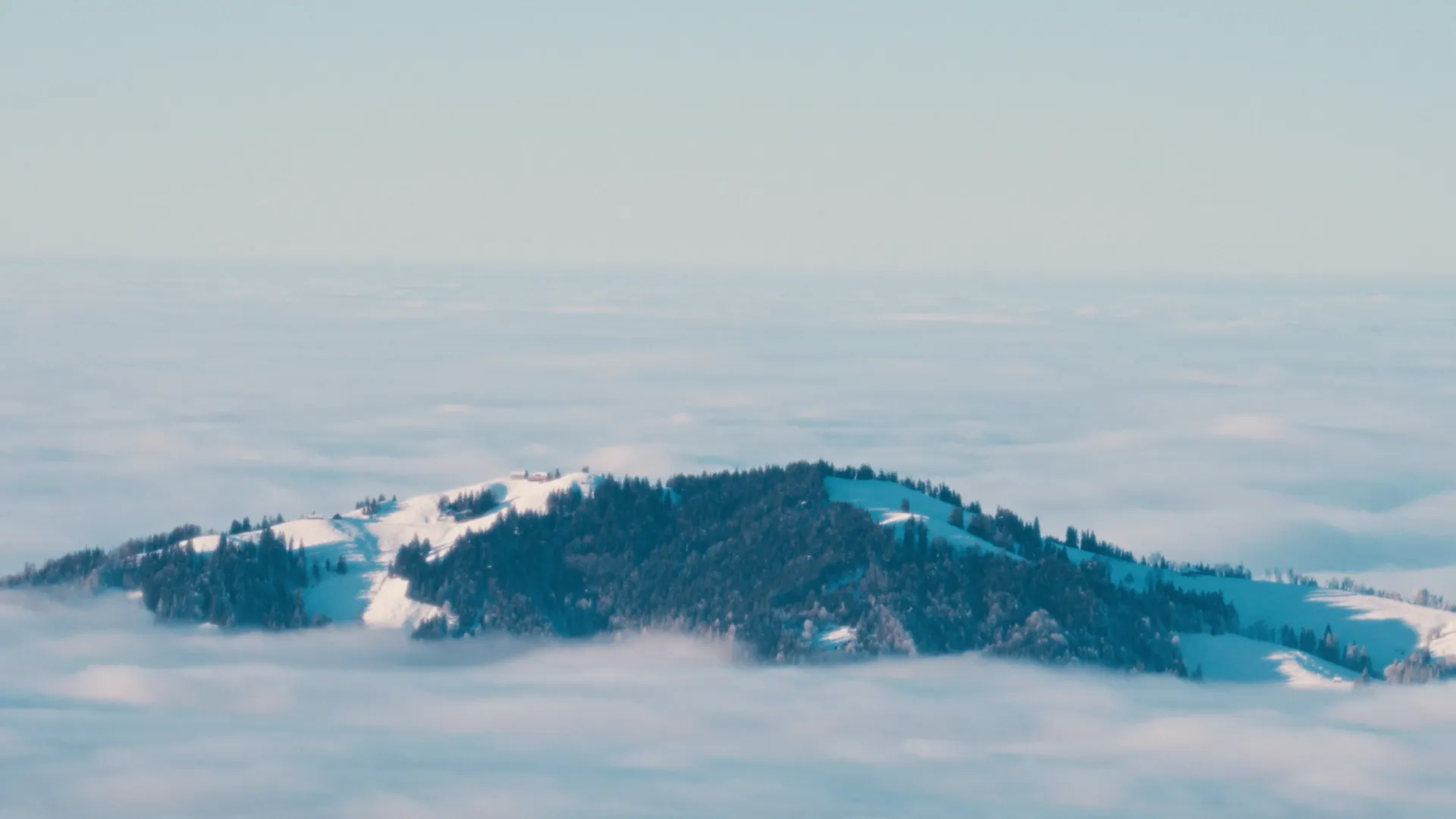
Silvesterchlausen, directed by Andrew Norman Wilson, 2025. Film still courtesy of the artist.
BIOS
Andrew Norman Wilson is an artist, curator, and filmmaker whose practice is mostly based in research and documentary. His works — ranging from videos, sculptures, drawings, and performance lectures, to photography and mixed-media — investigate and critique the aesthetics and inequalities of the corporate world and the myths of technology. Recent works divulge an interest in nonhuman entities, including mosquitoes, dinosaurs, puppets, and oil pumps. His work has been featured in Artforum, ArtReview, BOMB, Frieze, The New Yorker, and Wired; he has taught at UCLA, SAIC, and Cooper Union, and lectured widely.
Federica Zambeletti is the founder and managing director of KoozArch. She is an architect, researcher and digital curator whose interests lie at the intersection between art, architecture and regenerative practices. In 2015 Federica founded KoozArch with the ambition of creating a space where to research, explore and discuss architecture beyond the limits of its built form. Federica is an Architectural Association School of Architecture in London alumni.
ABOUT
The St. Moritz Art Film Festival (SMAFF) is an annual international event held in the Swiss Engadin Valley that explores the intersection of contemporary moving images, visual art, and audiovisual culture. Founded by Stefano Rabolli Pansera, SMAFF investigates how cinematic and moving-image languages can challenge dominant narratives, addressing contemporary philosophical questions, and experiments with alternative storytelling. Each yearly edition is anchored to a specific thematic inquiry fostering cross-disciplinary dialogue between emerging creators, established artists, filmmakers, curators, and collectors.