KOOZ Let’s begin at the very beginning: what was the initial idea or provocation that shaped the exhibition’s framing and its title, How to Enter from the Exit?
Cecilia Casabona The initial provocation emerged from reflecting on forms of working that felt closer to our experiences, shaped by shared disappointments and desires around collaborating (or not collaborating) with art and design institutions, from grant bodies to small and well-established organisations. The first question we asked was: What if we were to make an institution just for us (and for our peers) by ourselves?
This question soon became secondary, as we realised that the starting point was not to make an institution, but to become one. By this we meant gathering together, getting to know each other, working, eating, and planning collectively, and testing different ways of being, working, creating, and thinking — as a shared entity.
What began as a provocation gradually turned into a quite ambitious process — maybe even too ambitious considering our resources and schedule! Later on, we decided to pinpoint the notion of the institution itself, while trying to attach parts of ourselves to it. This meant attempting to do all of the above through a form of hands-on critique, activating both internal and external transformations by starting from what we knew best: making things, writing, and helping to translate one another’s ideas to an audience.
Bianca Schick Usually, the institution is encountered through its front: the website, wall texts, press releases, where values and intentions are articulated. What we kept running into instead was everything behind that front: coordination, documenting, emails, schedules, care work, maintenance. The kinds of work that happen in shared documents, and informal conversations, and that actually keep things running.
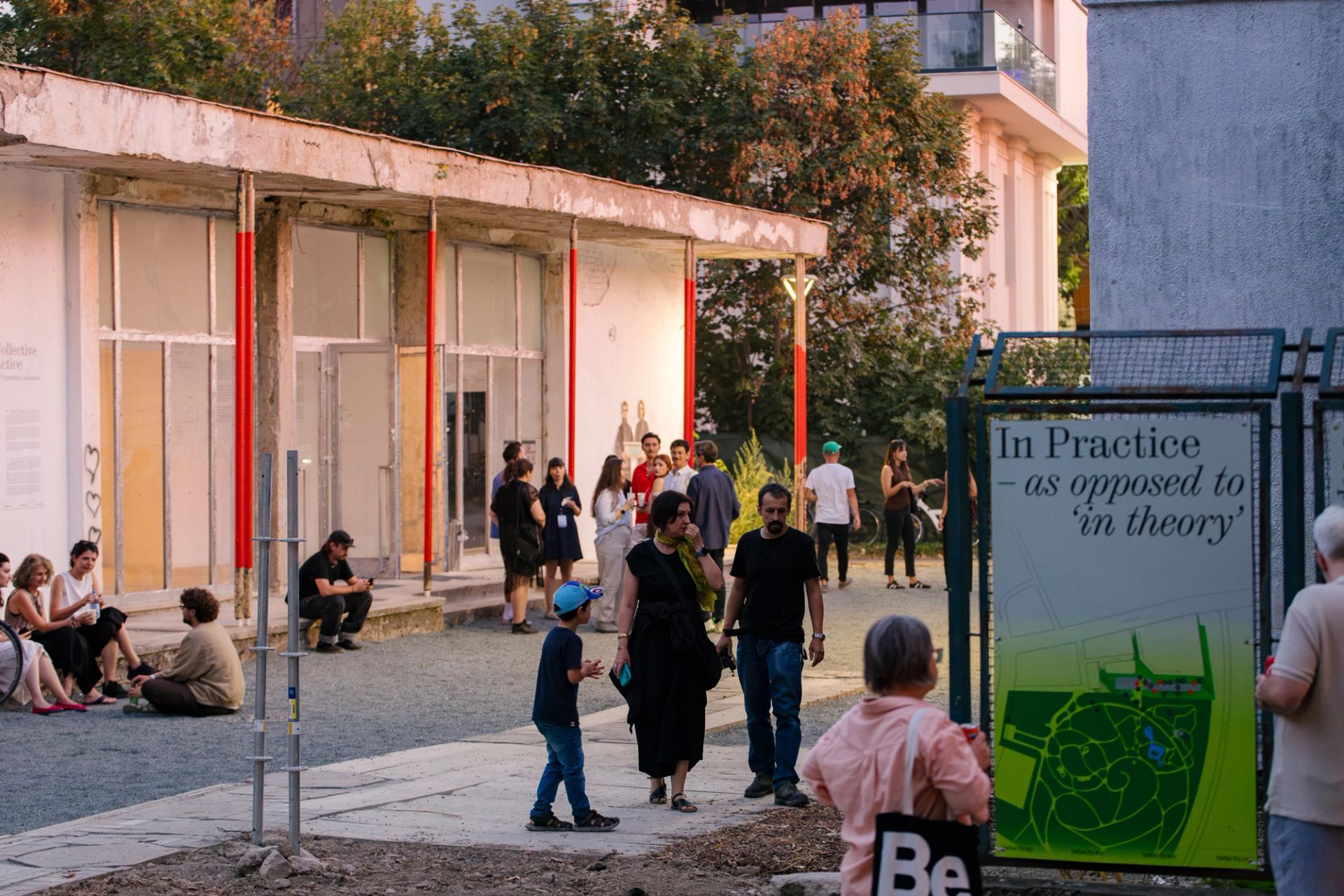
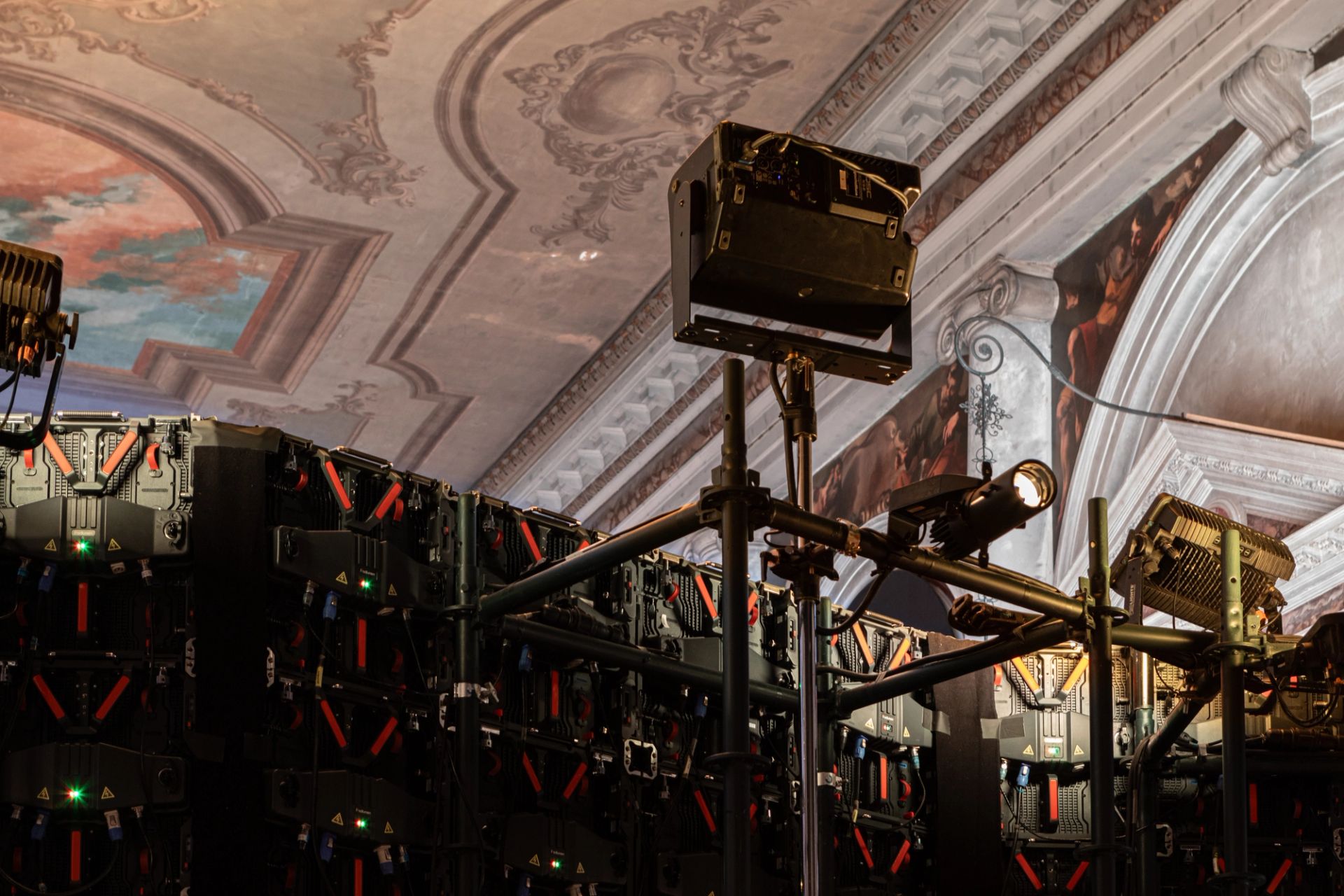
How to Enter from the Exit comes from this confrontation. The exit is not outside the institution but part of its everyday infrastructure. The provocation was to treat this work not as background or support, but as a starting point, which directly shaped the exhibition design developed by Paskamer: a space held in a state of “loading,” where backstage material and shared documents sit alongside the individual projects.
"The exit is not outside the institution but part of its everyday infrastructure. The provocation was to treat this work not as background or support, but as a starting point."
KOOZ The title suggests an inversion of expected pathways — so what, in your view, constitutes “the exit” within current institutional structures, and what does it mean to imagine entry through that space instead?
CC The title connects to longer conversations around institutional critique, but largely through a refusal of it as a framing. Rather than positioning critique as something external or oppositional, we were interested in what happens when you remain inside the institution and work with its constraints. The focus was not on exposing or critiquing the institution as such, but on activating what was already there: a space, our skills, a budget, a deadline, and a shared desire.
In this sense, the exit became a space where alternative ways of performing were possible, where the institution could momentarily loosen its representational role and leave room for individual narratives to unfold alongside a collective understanding of what we were trying to do. This space became the exhibition itself; the exhibition became a living theatre, where each participant artist could choose to stage a story from their own perspective.
"Rather than positioning critique as something external or oppositional, we were interested in what happens when you remain inside the institution and work with its constraints."
Noam Youngrak Son In my contribution to the exhibition called The Viral Institution, for example, I was exploring what this question practically means. This work was informed by my urgent search for an exit from the habituated modes of cultural production that relies on an unilateral relationship with institutions. The prototype of “exit” here was a vending machine that valorises my words and memes. In that not-only-fictional framework, it served as a micro-institution that turned the surplus of information I produced into real money (not just cultural capital). So, was it really an exit? When I built my own institution (or became an institution on my own) I didn’t really step outside the system. It still included the same institutions, but also it involved platforms like Substack and Instagram. Just walking away from one institutional context doesn’t automatically mean you’re free; it could turn into the same kind of dependence, another internalisation of the same heteronomy, where you end up being a form of human capital. Nonetheless, the point of the work wasn’t about offering some final escape. It was about making these different economies visible and showing how they connect. By laying them out together, the project became a kind of diagram that helped me move between different audiences and systems of value, without being stuck in just one.
KOOZ The project challenges dominant understandings of institutions as service providers or content producers. What is the potential of rethinking institutions as relational rather than transactional spaces? How does this shift the relationship with the public/s?
NYS In my critique of institutions — or of what you meant by “transactional spaces” more specifically — what has been useful was the framework of the class struggle of “the hacker class” against “the vectoralist class” as theorised by Mckenzie Wark. In generalised terms, the hacker class can here be considered “producers” and the vectoralist class as traders, or brokers, of what is produced. In contrast to this potentiality, the value that the hacker class produces is not theirs because the vectorialist class “possesses the means by which the value of the new can be realised.” 1
In this light, I think the notion of “institutions” emerges from their proximity to the “vectoralist class” — not as a binary of institution/non-institution, but as something more relational. Institutions are vectorialist infrastructures through which the surplus of information produced by the hacker class is accumulated and valorised. The potential for rethinking institutions therefore requires a form of class consciousness that is undermined by the ideology of human capital, which the same institutions in question reproduce. Reconfiguring class relations by recognising cultural institutions as sites of class struggle, rather than marketplaces of cultural capital, is therefore the first step in the work of “rethinking.” Only then might we be able to consider public(s) differently, beyond merely consumeristic relationships. The door is already open!
"Reconfiguring class relations by recognising cultural institutions as sites of class struggle, rather than marketplaces of cultural capital, is therefore the first step in the work of “rethinking.”
Pete Fung To push Noam’s notion one step further, I think we need to demystify institutions as something that is ‘outside of us’, something that is distant and bureaucratically impossible to change. Imagine if we can begin re-framing institutions as a series of collective acts: rituals, exchanges, thinkings, procedures, gatherings, maintenance or recordings — that we all participate and perpetuate one way or another, knowingly and unknowingly. To me, institutions are just people, some of them are living and present; some of them distant and perhaps in the past. The formation of the institutions today is the outcome of many particulates before us. And we need to start thinking about those who come after us as well. We are the institutions, we just need a better understanding of who “we” are and how we could work together. Through this lens, institutions become malleable.
This particular mentality also runs through the curatorial approach of the exhibition; everyone contributes to every step of its making. At a fundamental level, it is an experiment in challenging the dominant disciplinary thinking that is often taken for granted within cultural institutions, and how certain hierarchies have perhaps hindered the possibility of what an exhibition could be.
Within my own contribution, The Office of Social Imaginaries, is also an experiment on its own; how could we open up the creative processes as a way to rethink our relationships with the urgencies of our time. The inception of patenting was supposed to be a commons. Patents are published to protect its author, and also allow others to build off those existing ideas for the betterment of our collective goods. Obviously, under the current capitalistic mode of working and privatisation, the latter is rarely practiced. What if we could see patenting itself as a process of imagining what we need (sometimes before we need them — literally patenting something for the collective goods before it is privatised)? Visitors are invited to pitch their objects, systems and/or methods of needs for the world tomorrow — some critical, some existential, some humorous, yet all relational. The exhibition space became a generative tool for participatory thinking.
"At a fundamental level, it is an experiment in challenging the dominant disciplinary thinking that is often taken for granted within cultural institutions."
Maren Bang Looking at the relational aspect, one of my areas of focus — both within this project and my practice at large — has to do with the levels of transparency between the different actors that constitute an institution: between the institution and the practitioner, the institution and the audience, and between the practitioner and the audience. The metaphor of a theatre with a back-stage and a front-of-house is one entryway into this, where I as a practitioner at times feel like I am not able to penetrate the curtain that separates the two. In more transactional settings, that front–of-house can become the whole relationship — polished statements, deliverables, and controlled narratives — while the back-stage remains unreadable.
Having to imagine the structures behind the mechanisms and dynamics of an institution can be fertile, and it can be fraught. On the one hand, not knowing can allow you to imagine alternatives. On the other hand, not being able to decipher the other’s intention or motivation can leave a layer of paranoia or scepticism that, in unfortunate occasions, creates a distance — where both making and reading become too risk-filled to be done in earnest ways. I believe in the need for friction in order to be truly caught by something, but I have also avoided engaging with institutions, and avoided uttering my opinions and observations, out of fear of being caught in misunderstanding or poor judgment.
For me, the potential of rethinking institutions as relational rather than transactional lies in allowing for peeks between each side of the curtain: towards less defensive behaviours from all sides, and a more fruitful space of exchange. This also shifts the relationship with publics — away from a front-of-house where audiences mainly receive finished content, and towards a situation where the terms of relation (constraints, motivations, maintenance, negotiations) are more readable, so reading doesn’t have to default to suspicion.
I would like to point to Eve Kosofsky Sedgwick’s notion of paranoid and reparative reading here. 2 Paranoid reading seeks to protect itself through suspicion, whereas reparative reading makes room for other affects — curiosity, surprise, even pleasure. That distinction resonates with me in my interactions with art institutions, and in how I imagine an audience meeting work with openness rather than guardedness.
"Having to imagine the structures behind the mechanisms and dynamics of an institution can be fertile, and it can be fraught."
KOOZ At its core, the project asks how a cultural organisation might harness the power of the commons. How does the project address this proposition? What thoughts, practices, or actions have emerged throughout?
PF Before we can ask what cultural organisations could do for the commons, first we need to reflect upon whose commons and for whom. I have been asking this question within my own practice over and over again, who are we doing the work for? Increasingly, I have been feeling a sense of claustrophobia within the cultural landscape, at least from where I am situated at the moment in the central European regions. Is doing work for people that already care enough? When was the last time we engaged within someone who politically didn’t align with us? What’s the point of talking to someone who already cares about the environment to care about the environment? Surely we should be seeking out to those who don’t already.
Not to be too depressing here, I think there are opportunities for us, as practitioners, to be more creative with our mode of engagements beyond the boundary of our work — to fundamentally see our audiences as our collaborators. How could we practice the radical inclusion of all individuals in the process of design’s becoming, rather than through reflection on the designed outcome(s)? Rather than being the provider of solutions, design in this sense holds a flexible role in facilitating individual and collective agencies.
"Before we can ask what cultural organisations could do for the commons, first we need to reflect upon whose commons and for whom."
CC To follow up with Pete’s reasoning, I have often rephrased these questions as: what role does an institution have in supporting and reproducing the commons? Commons are not a fixed resource, but a series of ongoing processes and activities that foster co-creation and coexistence among different entities — in this specific case between artists, institutions, and the locality in which they operate. At the same time, the space that an institution is able to provide is the opportunity to bring these actors together, and give them time and resources.
Within this project, we focused on the activity of working understood as a commoning practice: engaging shared resources, knowledge, spaces, and practices, collectively maintained. Much of this work happened before the exhibition opened, or around it, rather than within its final presentation. It was less about outcomes and more about the labour behind the scenes and the reframing of our roles. Central to this attempt was the intentional blurring of boundaries between curator, artist, designer, institution and audience. Can a “curatorial commons” exist? And under what conditions might curating become a genuinely commoning practice?
We began very simply, by gathering together and experimenting with tools we were inspired by, as well as “inventing” our own. In this process, a sort of shared family lexicon gradually emerged. We constituted what we called “the common pot”: an immaterial and imaginary container in which we placed all the resources made available by our institutional host, Onomatopee, alongside those that each of us chose to share — not as mere resources, but as tools that could circulate, become interchangeable, lose clear authorship, and be transformed into something else completely.
"Central to this attempt was the intentional blurring of boundaries between curator, artist, designer, institution and audience. Can a “curatorial commons” exist?"
KOOZ To rethink institutions as processes rather than fixed structures, what kinds of infrastructures — material, social, or administrative — need to be invented, reconfigured, or perhaps unlearned? If we understand the institution as a verb (“instituting”) rather than a noun, which practices become essential to keeping that verb active and alive?
NYS My “fieldwork” within my institutional affiliation has demonstrated how the open potential of transformative cultural production is obstructed by the infrastructures within and around institutions. I have been using the institution itself as a site of phenomenological observation, through which I can constructively analyse how infrastructures — the stipends, Wi-Fi, the building, windows, weekly dinners, etcetera — fundamentally reorganise our capacity to speculate and make art.
My current tactic, therefore, is one of benign pessimism regarding the possibility of change within these self-regulating negative feedback loops, maintaining dialectical attention to their contradictions while simultaneously seeking fugitive sociality — being “in but not of.” I have been making bitter jokes that my engagement there is akin to that of a white anthropologist, but I think one important qualitative difference is that the axiom of my study is the acknowledgment and consideration of the ontological dependence of the practice itself on the very conditions it is critical of. “Instituting,” in my understanding, is a mirror we inhabit that renders itself visible.
"'Instituting,' in my understanding, is a mirror we inhabit that renders itself visible."
MB To me, one part of instituting is about creating zones where work can emerge even though it might not satisfy the traditional requirements to claim a right to become. I seek out “excuses to produce” — spaces that create room to work intuitively and let meaning emerge through the making. I have been seeing the methodologies that I apply in my artistic practice as a pathway to a testing ground or a rehearsal space, where ideas can be tested, performed, and felt without the pressure of an actual institution awaiting a report or justification.
Through my collective TAMI (The Actual Main Institute), instituting has been framed, among other things, as the action of producing an (imaginary/potential) institution upon demand. It has been the purpose of TAMI to adapt to the needs of artists rather than to have artists adapt to a fixed institution. For instituting to stay active and alive, I believe that flexibility and the ability to fantasise and forgive the impossible are strengths.
If I try to answer the infrastructure part directly: materially, instituting needs time and resources that can hold experimentation without punishing uncertainty; socially, it needs trust and generosity (so relation doesn’t become defensive by default); and administratively, it needs fewer mechanisms that force premature clarity or closure. I see potential in pataphysics and in a suspension of disbelief as tools to reimagine and dream up alternatives to fixed structures. This ability to imagine, play, forgive, and be generous forms a base for attempting to reimagine the institution as something you keep doing, rather than something you merely enter.
KOOZ Over the course of the research, what models of future institutions — looking beyond 2025 — have appeared most compelling, urgent, or necessary? Which aspects of the project do you hope will continue, evolve, or influence future institutional behaviours?
BS As we were working through the project, it became obvious how many different ways of working together were actually needed, and how often we had to adjust them along the way. That made the question of authorship unavoidable. Not to erase it, and not to dissolve everything into a collective “we,” but to let it shift. Sometimes authorship was shared, sometimes individual, sometimes unclear, and sometimes very precise. Curatorial work, artistic and design practices, exhibition design, and graphic design developed in parallel, shaping each other as the project evolved rather than following a top-down order. If something carries forward from this project, I hope it is this approach: institutions allowing different forms of work and responsibility to coexist and influence each other, without forcing them into a single model of collaboration, turning collectivity into an identity or a brand, or flattening it into a single way of working or a single name.
PF To echo this, it is clear that the rigidity of institutions needs to be challenged. We need more imagination, more experimentation, more participation, of and in institutions!
NYS Pushing this question further, its urgency is inseparable from current political realities. The most compelling and urgent model of future institutions to emerge is defined negatively — through the exposure of institutional limits revealed by cultural institutions’ (non)responses to the genocide in Palestine. These responses demonstrate how deeply institutional behavior is governed by financialised risk management, in which political silence is maintained so long as solidarity entails reputational or funding-related risk. From this, I argue for institutions that are structurally capable of acting before political urgency expires — institutions that do not outsource ethics to a future consensus or convert violence into symbolic capital once it becomes safe to do so. I hope this project continues to foreground how institutional courage and accountability must be understood as intrinsic material conditions of cultural production, rather than as matters of the politics of recognition.
Bios
Maren Bang works interdisciplinary with a combination of objects, text, film, and performance, oftentimes using the mechanisms of the field to say something about the field itself. Experimenting with elements from theatre, she explores performance not only as a means for presentation but for production — embodying various narratives while crafting through different mediums and techniques. Her practice addresses topics like control, systems, narratives, and the idea of constructing and reconstructing identities.
Cecilia Casabona is an independent Italian curator working across design and contemporary art. She collaborates with cultural institutions to conceive and deliver exhibitions, public programs, and editorial projects. Her practice spans curatorial development, project coordination, creative content production, and critical writing. Cecilia is currently Associate Curator at Onomatopee Projects in Eindhoven (NL). She also develops self-initiated projects such as un diseño sin Design at La Clínica in Oaxaca, a research and curatorial project that re-examines design beyond Western modernism, and Death-Design-Data, a research project exploring the digital dimensions of design and artistic practices in relation to grief, mourning, and death.
Pete Ho Ching Fung is a designer and educator based between Vancouver and the Netherlands. His research based practice explores how design can be used to critically engage with the complexities of our interdependence: the languages we use, the aesthetics we subscribe to, the institutions we inhabit as well as the way in which we relate to them. His work has been exhibited and published at MIT Press, Kunsthal Aarhus, Helsinki Design Museum, Jan van Eyck Academie, Vancouver Art Gallery, among others. He teaches in MA Social Design at Design Academy Eindhoven and he is currently a design resident with Nieuwe Instituut and cheFare, looking at the social implications of Milan Design Weeks.
Bianca Schick is an artist, designer and cultural worker based between the Netherlands and Italy. Her practice takes the form of projects-as-worlds across film and performance, curating, visual communication, exhibition design, and self-publishing. Her work, both commissioned and self-directed, explores how systems make worlds. She works with closed, human-made environments and the narratives, aesthetics, formats, and images they produce. She co-runs Paskamer, an exhibition design studio and friends-run space.
Noam Youngrak Son is a communication designer, design theorist, and cultural worker. Their design work encompasses small-scale publishing projects, speculative worldbuilding, workshops, lectures, writing, net art, and occasional performative interventions. Son publishes the Archive of Patchy Studies as an experiment in how creative labour — namely artmaking and writing — can sustain its value without institutional mediation. Son has expanded their focus from design to theory in order to critically engage with the ontology of the design industry, media, and broader material culture. This turn is informed by their observations of cultural assemblages that echo the extractive operations of capitalism on racialised and more-than-human populations.
Paskamer is a collaborative exhibition design practice. It grew out of friendship and a shared interest in experimenting with scenographic and performative exhibition formats. The team draws on humour, pop culture, and storytelling, and works across design (spatial/graphic), curation, production, and hosting. Paskamer is Alex Foradori, Jonas Hejduk, Pauline Rip, Bianca Schick.
Notes
1 Citton, The Ecology of Attention, 65; McKenzie Wark, Telesthesia: Communication, Culture and Class (Cambridge: Polity, 2012), 143.
2Eve Kosofsky Sedgwick, “Paranoid Reading and Reparative Reading, or, You’re So Paranoid, You Probably Think This Essay Is About You,” in Touching Feeling: Affect, Pedagogy, Performativity (Duke University Press, 2003), pp. 123–152.