Projects
An exploration of radical imagination, converging theories and contexts into a vision of an alternative future.
Imagine: technological and ecological developments have led to a posthuman condition. Through these developments species other than homo sapiens have gained their own forms of sovereignty. Different species now stand on equal grounds forming a larger family of companion species. Tangible and intangible technologies, flora, fauna and fungi brought various ecosystems into spaces previously solely controlled by humans, forming new forms of independencies and interdependencies. Could such a vision of a non-anthropocentric collective future be viable? Or has our individual and collective imaginations collapsed under neoliberalism?
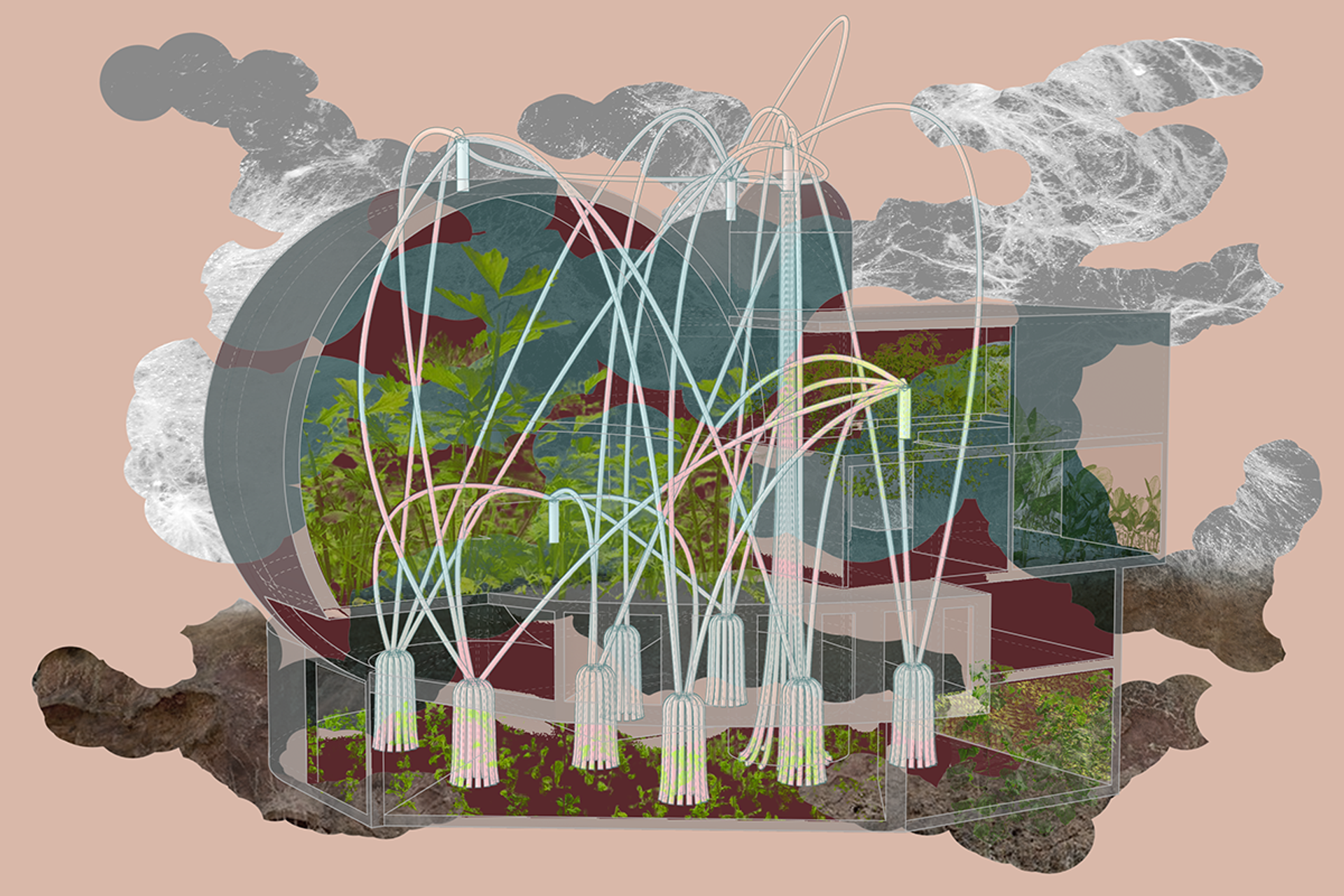
NOTHING EXISTS INDEPENDENTLY – how trees communicate 2021, Germany by Maximiliane Nirschl
NOTHING EXISTS INDEPENDENTLY – how trees communicate is a responsive installation for public spaces. It is an urban landmark that creates a meeting ground and relaxation zone for urbanites and passers-by, while raising awareness about the interconnection of trees and the importance of this to us. Using analogue and digital technology to make the connection and communication between trees perceivable, it allows the audience in greenery-free spaces to reconnect with the cradle of the ecosystem earth. The installation is first of all a multi-sensory urban experience and placemaking project. But it also is a call to discuss how we treat our forests, as we need to consider the complexity we live in – socially and ecologically.
Welcome to the Ü-HOOD 2021, Netherlands, Utrecht by Andrej Antonic, Bernice Ong, Wenqing Xia
In an ever evolving city with new faces and new spaces, we developed a social media application in ‘Welcome to the Ü-HOOD’ that would enable immediate in-neighbourhood interactions with your fellow residents—by this, we mean every possible feature at each site! If walls can have ears, then so might the street lamps in the night. Be a part of this hood, enjoy the exchange, get to know every critter and crevice. And remember to tell us, who else deserves a place in this space? Partake in the hood life!
Interview
KOOZ How would you define 'media architecture' and how does it relate to your project?
Maximiliane Nirschl | For me personally, Media Architecture is about telling stories in and with space. Combining media, technology and spatial design to create unique experiences is a very powerful tool to tell stories and reach people. Media Architecture in public urban spaces especially allows to reach out to urbanites from all ages and backgrounds. It can just pop up in front of the people and animate them to interact with it. For NOTHING EXISTS INDEPENDENTLY – how trees communicate, I use architectural design to create a space that adjusts to the characteristics of the urban built environment and enables people to discover how trees are connected and how they communicate. In this narrative space, the users become their own storytellers.
KOOZ How do you approach and define the notions of "human" and "city"?
Andrej Antonic, Bernice Ong, Wenqing Xia | As developers and users of technological tools, I think we are surely responsible for how we choose to shape our own existence as well as this world in which we live. While selecting to uphold certain values of more-than-human cities in our project, we also acknowledge that we cannot dissociate from the very ‘human’ lens with which we developed our project ‘Welcome to the Ü-HOOD’. Humans can, and must be more ecologically aware even as we focus on our own human needs for survival and growth. I think these can go hand-in-hand. As for the city, we approached it as a social space which mediates and transforms individual bodies and agencies, disparate ideologies, and prevailing tensions through exchange and interactions. ‘Welcome to the Ü-HOOD’ therefore presents a digital mediation of such social exchanges. Through the participation of the players, these online neighbourhoods would develop their own characters over time, and the outcomes may ultimately be wonderful or confronting.
Vilius Balčiūnas | In my project, which is an attempt to imagine an alternative future to the prevailing dystopian visions of today, I approach “human” as only one of the species which make up the cities of tomorrow. Current and historic human exceptionalism has led to dangerously anthropocentric philosophies, actions and imaginations which even go as far as to consider the Anthropocene, characterising humans as a dominant force shaping the whole planet. We know very little about the insanely complex processes of our natural environment and yet we are taking drastic actions with potentially disastrous consequences to those processes. I believe that a change is needed in the dynamics of our relationship with the environment, therefore I embrace a posthuman condition in my project. The posthuman subject is not limited to biology, it also assumes technology into its totality in an equal manner. Thus posthuman condition recognises, that processes of thought and formation of knowledge are not limited to the human subject, but to a multitude of living and technological species. Such narrative consequently impacts the fundamental understanding of what a “city” is or can be. If previously it was seen as a result of solely human actions, now it can be reimagined as a symbiotic system that offers multitudes of diverse interactions between humans, other natural species, and technology.
KOOZ What are the implications of "more than human cities" on our natural environment? How and to what extent can these co-exist with a better understanding of our biodiverse landscape?
Andrej Antonic, Bernice Ong, Wenqing Xia | The inhabitants of our cities are already more-than-human, so what we had hoped to do in our project is to restore some degree of balance through awareness and recognition, even as we pursue our own human needs for belonging and connection. While the turn to more-than-human cities often connotes a de-centering of the human and accommodation of other co-existing species through infrastructure, it is also pertinent to address the ways in which humans seek to locate themselves and others within these landscapes. We note that the approach of more-than-human cities is in fact more closely aligned with traditional ways of viewing the land—with trees, rocks, and native creatures as guide and co-inhabitants—and thus less of an imposition on the current but a restorative turn to the ecological even within an urban cityscape.
Vilius Balčiūnas | I see the natural environment as an integral part of “more than human cities”. To sustain balanced feedback loops that are necessary for life to exist, these parts must co-exist in symbiotic relationships without one assuming total control over the other. In such a scenario, the natural environment might have greater implications for the way we imagine, build and perceive cities that we live in. To answer the question of how and to what extent can the aforementioned parts coexist, we should imagine cities in which the natural environment has at least partially regained its independence. Picture this – flora enters cities no longer as submissive species under the human domain of landscape design or landscape architecture but in its own independent manner, it is then followed by other species of animal and fungi kingdoms, bringing ecosystems into spaces previously solely controlled by humans, forming new forms of independencies and interdependencies. Only by fundamentally rethinking our relation to the environment, by rejecting human exceptionalism, we can achieve co-existence in our cities.
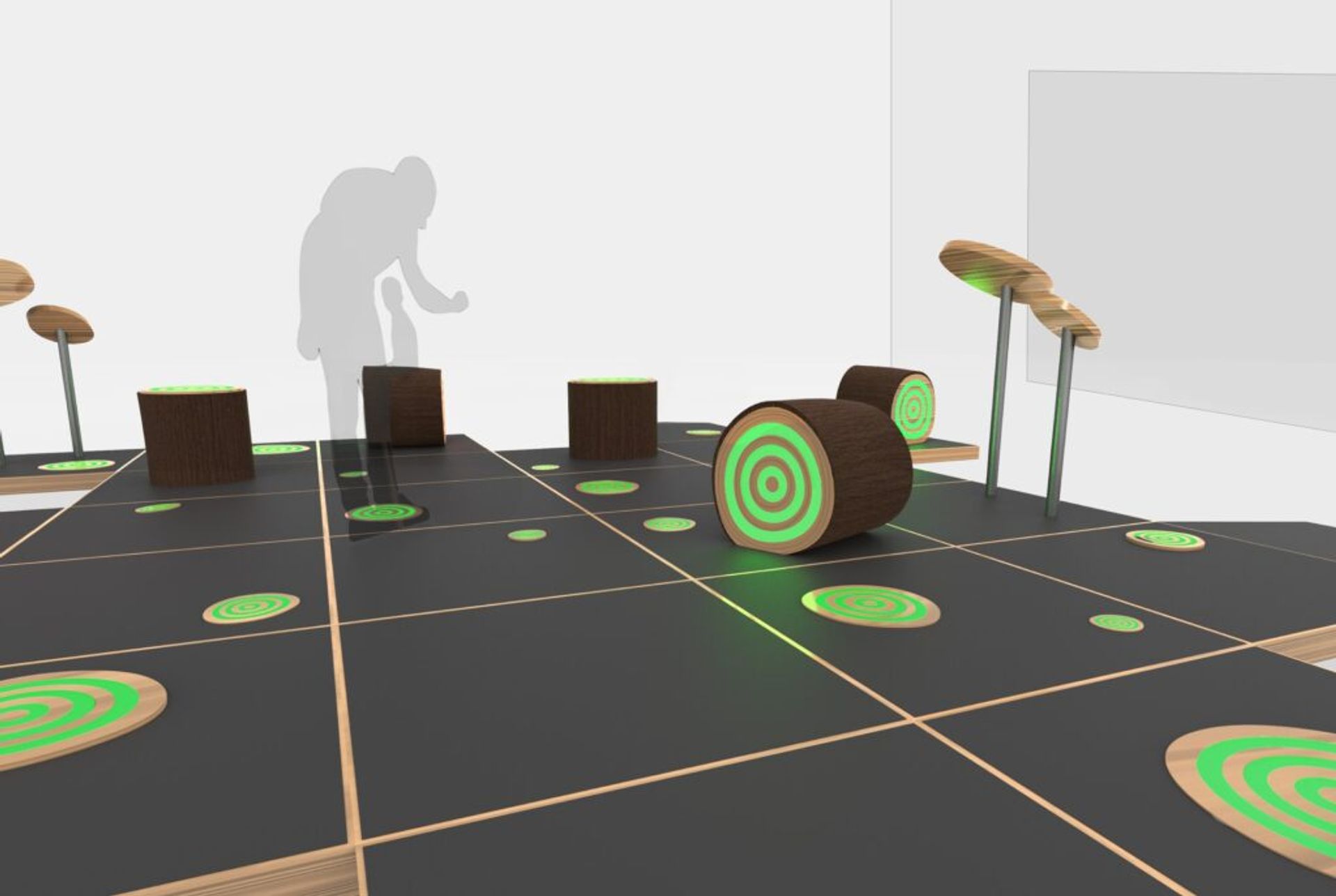
NOTHING EXISTS INDEPENDENTLY - how trees communicate by Maximiliane Nirschl
Bio
The Media Architecture Biennale is the world’s premier event on media architecture, urban interaction design, and urban informatics. This year, due to the ongoing global pandemic the Media Architecture Biennale 20 (MAB20) had to be adapted and re-imagined. Therefore, the MAB20 Program will take place online:
- Workshops | June 24th – 29th | via Zoom
- Online Conference | June 30th – July 2nd | via virtual conference platform
Registrations are now open. For more information visit: www.mab20.org