Shumi Bose/KOOZ Firstly: huge congratulations on receiving the OBEL Award this year! We are delighted to be sharing your remarkable work on Balearic Social Housing Models. May I start by asking you to introduce yourselves, in relation to the project —
Cris Ballester Parets Thank you very much. I was the Managing Director of the Balearic Social Housing Institute (IBAVI) from 2019 until May 2022, and subsequently became Director General for Housing and Architecture for the Balearic Islands. I am an economist; I didn’t know much about architecture before I took my position in housing, so I needed everything explained to me like a child! Later on, this was actually helpful, because I was constantly asking questions and trying to understand why we were making certain decisions, also from the economic and social perspectives of public housing. That’s one of the reasons why we needed architecture and broader economic concerns to really work in parallel, together.
KOOZ Carles, what do you think about that, and what’s your role related to the Balearic Social Housing Model?
Carles Oliver Barceló I'm Carles Oliver. I am an architect; since 2009, I have been an in-house architect at IBAVI, which means that I’m a civil servant. Between 2019 and 2023, Cris appointed me as Chief of Technical Operations, overseeing a team of architects, engineers, surveyors and so on. As architects, we might introduce a certain level of innovation in design, but it takes more than that to make something viable. That's why it was important to have an economist driving this project forward.
The challenge of housing is always one of management: how do we manage the money? How do we justify changing the model? Without the framework to develop our ideas, we might have produced five experimental prototypes, rather than a mass model. Cris was incredible at activating people across the departments [of IBAVI] — from the legal through to the technical departments, working together. In addition, we managed to put together a dream team. Without this incredible group of colleagues working together within civil service, the project would never have become a reality.
In any case, it’s about building trust. While we were working, I was able to place absolute trust in Cris’ ability as an economist — and thank goodness, she trusted me as an architect. This mutual respect and trust for our roles became very important.
KOOZ We’ve already started with something beautiful, on trust and mutual dependency between you as architect and economist. Could you expand on others who became parts of the coalition?
COB I can start with the actors related to construction fields. The first alliance to forge is with environmental consultants. In our case, it was a real game-changer. We needed to define what we consider sustainable and feasible to meet our decarbonisation goals for 2030 and 2050. Also, you need at least to build a coalition with the architects who would design new buildings. For that, you need to provide a very clear brief outlining the challenges, goals, and expectations from the proposed social housing — in fact not only between the architects, but the whole team that involves architects, structural engineers and installation teams. Then, contractors should be ready and able to build what is needed.
In terms of innovation, Cris helped me to be able to define the level of experimentation and risk we could take in design, according to market feasibility of costs related to materials, contractors, and so on. No matter if you design an extremely efficient and sustainable building; if no one can make it, it cannot happen. So we needed to keep a balance between the level of innovation, the potential contractors and the realities of the local industrial landscape. We evaluated both small or big factories within the local territory that we could activate, as long as they met the low-carbon and low-emission conditions as required.
Any design in the world activates a certain mode of construction; by deciding on one solution, you naturally exclude another one. As architects, we have enormous power to decide which solutions or resources we activate. These include the conditions of labour, making sure there is no exploitation. Low carbon materials are all very well in terms of meeting the European Union targets and regulations, while fostering local economies; while retaining local production, it is possible to check on labour conditions. With resources from more remote locations, it can be harder to ensure that no one is exploited during the extraction or transformation of material resources.
"As architects, we have enormous power to decide which solutions or resources we activate."
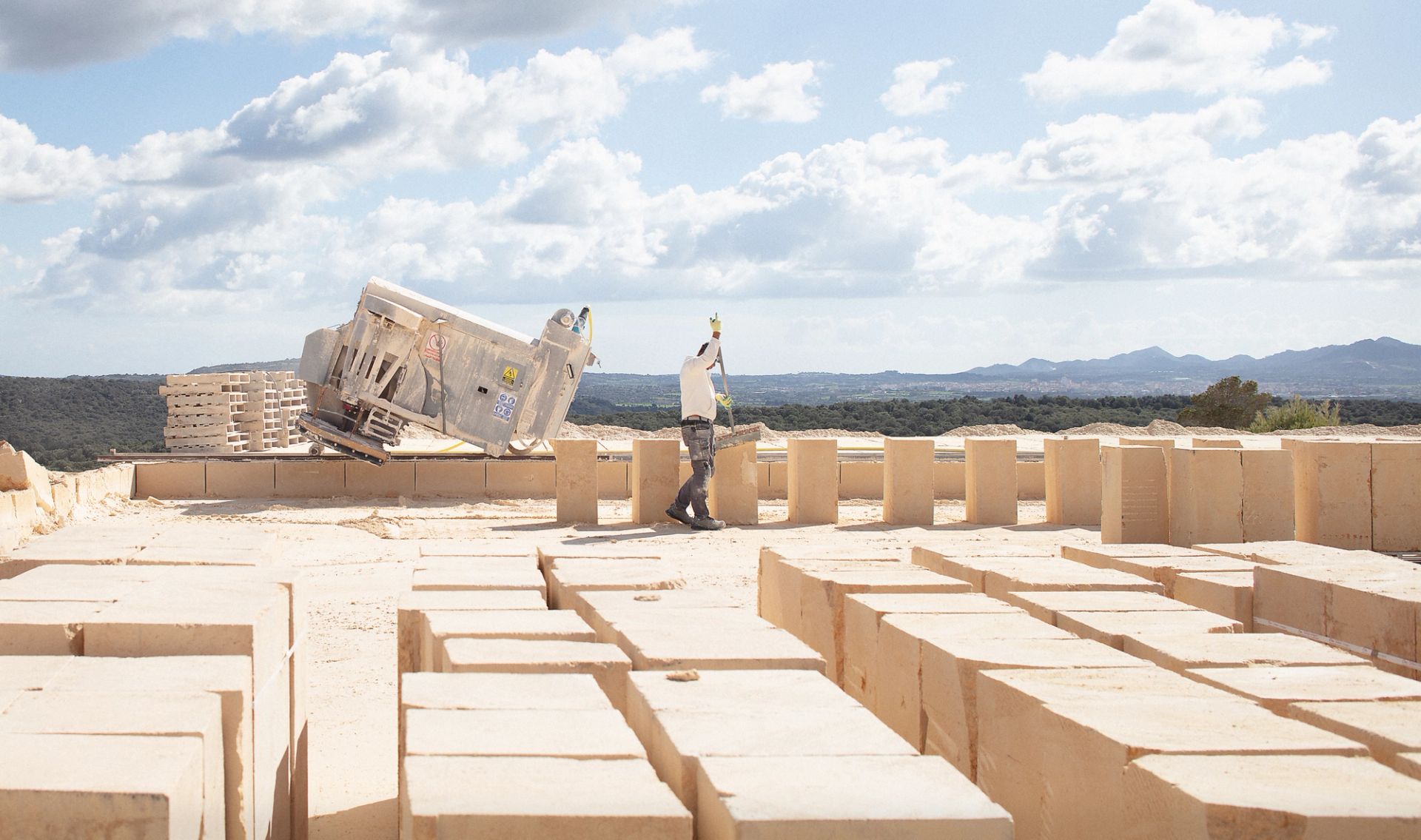
Ca’s Vilafranquer marès sandstone quarry, Petra, Mallorca. From Emissions, developed for the Spanish Pavilion at the 2025 Venice Architecture Biennale, supporting research by Carles Oliver and David Mayol. Photograph by Milena Villalba, 2025.
KOOZ Well, not everybody does pay diligence to that aspect of sustainability, perhaps because it’s slightly less visible and harder to measure. How did the project come about?
CBP When Carles and I first met, I had been given a clear objective. Prior to starting my role in 2019, I didn’t know much about IBAVI; I was told that around 500 homes were under construction, and in four years I should aim to double this. However, when I actually joined the institute, there were 67 dwellings under construction, 58 of which were practically at a standstill. We eventually had to terminate that contract and put the works out to tender again — that was the reality.
To be honest, at that point there was no comprehensive database of IBAVI properties and projects; no clear listing of the location and number of buildings or housing units. Even such a figure would exclude those properties that were occupied without a contract or irregularly occupied. So one of the first challenges in 2019 was simply to get a clear picture of the situation. And one of the few architects in the office — who, I noticed, worked through the summer! — was Carles.
I told him about my dilemma; as I realised the scale of our task, I asked who was directing the technical department. Carles told me that there was nobody in that role, so I offered it to him — after all, here he was. I asked him what he would need to do the job. He spoke about the importance of sustainability, as in Life Reusing Posidonia, a previously-completed project of fourteen homes in Formentera that Carles directed from 2009 to 2017, and told me that in order for him to be involved, similar environmental priorities must be present. That’s okay, I said, but Posidonia had fourteen houses over eight years, while our target was around 1,500 homes in just over three years. For him, the environmental emergency was paramount, but the housing emergency was also urgent.
KOOZ What is the situation around housing — in particular, social housing — in Mallorca today, can you give us a little context?
CBP It is horrible. A very significant part of the working population struggles to access affordable housing. In Palma, the main city of the island, even a room in a shared apartment can cost around six hundred euros a month; there is a real shortage of available homes, and many of those that are available remain unaffordable.
Ultimately, the problems are similar to what you might face anywhere else: the population grows, but the earth does not. Then too, people’s needs are changing; where previously a family may have lived in the same house for years, now more people live separately or alone — and for longer. One very evident issue is that the investment in social housing over the years has not been sufficient to build up the public housing stock that we need, while some homes previously built as protected housing no longer retain that status. This means that some of those earlier investments did not contribute to building a permanent public or protected housing stock.
One small but important point regarding the alliances: once we have our clear objectives, we try to multiply all our goals. In this case, and coming from the field of economics, I wanted us to work out a map of stakeholders.
A map of stakeholders positions all those people, institutions and organisations that had something to do with our project. I personally visited each stakeholder one by one, to share our project, our goals and our dream with them, always asking a very important question: what do you need from us? If you try to meet some of their needs, you can ask them to collaborate to meet your own needs: it’s a win-win strategy. If we didn’t collaborate in this mutually beneficial manner, this model could never have been realised.
Because there was no prior demand for the way that we wanted to build, the market could not immediately offer appropriate materials or construction solutions. So as a public institution, we figured we had the responsibility to consolidate our demands — precisely to incentivise the private market to actually produce more relevant materials, construction solutions and working systems.
KOOZ What does it mean to be a good public client today? Can public commissions become a tool for systemic change?
CBP Well, a public client has three very important tools at its disposal: firstly, we have the funds. And where does public money come from? From public taxes.
Secondly, we have the tools and responsibilities handed to us from the government. IBAVI itself is not a law-making body. For instance, in public procurement we could not simply specify a particular local material or its origin, because within the European Union we have to ensure equal opportunities for all parties to tender for a particular job. What we could do included stipulating the regulations related to climate change in our contracts.
There is an article within those regulations which states that public bodies and institutions must use the highest proportion of low carbon material and local materials as possible — that clause is in black and white. So while it was beyond our capacity to specify materials in that way, we could describe the features of the required material, and these features can respond to the needs that we have. Enthused by a new approach, the legal department was keen to help us find a way to comply with the law while being able to really innovate.
So first, there’s the money. Secondly, we work within the given legal framework. Third, a public client has the potential to change larger systems; it must innovate. If a public client cannot assume a certain level of risk in order to make positive social change, who will? The private sector has a different role and different responsibilities. Public institutions have to be able to lead innovation where there is a clear public interest.
"If a public client cannot assume a certain level of risk in order to make positive social change, who will?"
KOOZ Perfect. Carles, do you have any other observations as to what makes a good public client — from the perspective of an architect?
COB In terms of the architectural design, the first priority is to provide the greatest level of comfort possible, while also reducing energy poverty and using fewer resources. Energy consumption from now to 2050 will increase across the board, including for nuclear and fossil fuels; the transition to greener power cannot substitute for the level and pace of consumption. For example, we don't want to stop at designing buildings that rely on green energy; we want buildings with minimal energy demands. There’s a big difference between a regular building that requires a lot of green energy, and a building that performs with super high efficiency: that's the first principle. The second is how we address comfort; how to provide comfort through the architecture itself — through materials, design, layout, and typology. As Cris said, regulation suggests that public bodies should use low impact, local materials when possible, so the question was: Is it possible to use these materials to increase the level of comfort?
For instance, we learned that with our climate, we don't really need a heating system in winter if you have good insulation. Our real problem was how to face the summer heat effectively, ideally using mass and passive cooling. The paradigm was found through all these low carbon, local materials like sandstone, rammed earth, low carbon bricks and even construction waste — there are many ways to provide real mass.
Very often, sustainable architecture is related to light construction. Wood is a very sustainable material; for us, it was very good for the ceilings and slabs. But we reintroduced load-bearing walls or load-bearing columns made of these relatively fragile, low-carbon massing materials. As these materials have less mechanical resistance than the more conventional concrete, our walls needed to be made thicker — ultimately providing an effective barrier from heat. So that was one of the main logics. Happily, another effect of pursuing thermal comfort using low-carbon local materials is that it even provides a better urban landscape.
KOOZ We recently learned the phrase ‘zebra architecture’, describing the relatively uninspired design-and-build typology that has become common across Spain...
COB Exactly. As Cris said, we are building with public money, so I don't think we have the right to provide ugly buildings that create problems for future generations. I believe it should be mandatory for a public body to promote nice buildings with better life cycles. They should last longer, with less maintenance, and they ought to create decent façades facing the public space.
CBP In any case, who pays for those potentially negative externalities? Society again, through taxes. That’s not responsible, it is out of the question. One point that I will repeat at every opportunity: this should go beyond political ideologies. Of course we can debate different policies and different approaches, but we also have to look at the numbers and the measurable consequences. Generally speaking, two plus two is four. If you’re in government, and you are not taking into account the costs — including the indirect costs of your investments — you are not taking responsibility for the return on these investments.
Regarding comfort and as Carles explained about energy demands in the future, what is the sense of giving high-maintenance houses to people with lower incomes, if they cannot afford the energy bills to live there? Is that decent housing — which is after all a human right? Again, it is a matter of economic and social responsibility.
KOOZ What you describe suggests an intentional critical leverage, which links to the idea of hacking.
CBP Usually, public institutions wait for someone external to innovate, then maybe they award grants for that innovation. Fostering innovation from within the public body is in itself an act of hacking the system. If you look for examples of innovation coming exclusively from within public bodies, they can be hard to find.
"Fostering innovation from within the public body is in itself an act of hacking the system."
KOOZ That’s largely true; there was a drive towards such innovation after the Second World War, but perhaps not since. More recently, the aversion to risk is so high that bold ideas are often pushed out.
COB To add to the question of hacking systems: it is true that when you're working for a public institution, you need figures for everything, from economics to architectural indicators. In our case, the indicators are quantitative, like embodied carbon in construction, or energy demands. But with all these indicators, you can still create very ugly buildings and landscapes. Since we were in a politicised moment, it was hard to make arguments for beauty — something perceived as a luxury. The reality is that beauty must be involved. Everyone wants to live in beautiful cities, and public bodies must set an example in accordance with European directives. When people review our work, they always say how beautiful it is — then you can also explain that it performs better than business as usual.
"The reality is that beauty must be involved."
We hear so much about sustainability in general, but most of us don’t really know what it might mean. But if something is beautiful, it will be persuasive, it’s going to work. We knew that in order to be convincing, to create recognition and interest, it was important that our designs should not be too capricious or weird in terms of personal taste or design authorship; we would have to build towards a more collective appeal and interest. Through the process of selecting the teams of architects — either through open competitions or public tenders — we evaluated not the most reductive fees for architects and their teams, but rather the quality of the proposal and design. In this way, we managed to build a coalition with amazing external architects who were deeply aligned with our goals: that is, to build as sustainably as possible, as much as possible, and as precisely as we can.
For me, this precision means that every element of the building is in its correct place, and is solving a number of different problems in a very simple and smart way. I believe that beauty might come up as a consequence, not as a goal by itself. Besides, recovering the ability to build with your own territory plays a very important role in terms of integration within the context.
KOOZ Working at the scale of the Balearic Social Housing model, has this allowed you to think about the possibility of expanding such a programme beyond the immediate region?
CBP There were 1,276 homes planned in the programme, against a total target of around 1,500. More than 50% have already been delivered, and I believe that up to 75% are at least under construction. Of course, 2020 brought COVID, when everything had to stop. We had to rewrite contracts, increase fees and deal with the rise in material costs; in some cases, I had to sign off on changes to the contracts under my own authority, knowing that as Managing Director, I was ultimately accountable for those decisions.
KOOZ What are some of the lessons that you would take from this process?
CBP There are a few. First of all, every organisation needs to have dedicated workers, with a properly motivated team. Carles made a nice point about confidence and trust, but there needs to be a lot of communication between people: it’s not about keeping architects in one corner, the legal team on another and the economists over there. Every person needs to be aware of the goals, plans and any changes — and everyone needs to be willing to participate and work towards those shared goals.
Another point is about the laws that should be taken into account; whatever they are, you need to look deep into their wording and specificity. This is where you can find the strategic parameters to help your project, and define your problems. Every place will have a different map of stakeholders, with their own social, ecological and economic actors, as well as those who will be affected either directly or indirectly by the consequences of what you do. You can’t copy the results, but you can repeat the process.
"You can’t copy the results, but you can repeat the process."
KOOZ Yes, it’s about replicating a methodology rather than an outcome. Carles, what lessons might you take to another place?
COB Absolutely. Well, I would not skip over the need for economic resources, for this reason: when you are building in this way — rather than using the word “sustainable”, I would say building for high performance and low-carbon — the building is going to be less expensive over time, but it will be a bit costlier to build and you need to be ready for that.
Cris was ready, and she always found the funds to ensure that our economic constraints were framed as opportunities rather than as a problem. For instance, we designed the scheme so that we could get special funds for sustainable construction that are not available for regular buildings.
KOOZ So it's more about transforming the challenges faced by many public bodies, into potential creative opportunities
COB That’s it. You need people who want to take on this conversation about construction costs. I’d also talk about the map of resources, as well as Cris’ map of stakeholders; again, every place has its own map of resources and capacities. If you have a clear picture of your low-carbon local resources, you can make decisions about how much to bring in from the outside to make hybrid constructions, with the best possible solution for the needs of your specific context.
For instance in the UK, the main materials are brick and stone. By now, you have factories producing low carbon and compressed earth bricks — which means that you can also create rammed earth walls. But what's more important is that the industrial process to produce CEB is the same one that makes prefabricated concrete. That is crucial, because it means that the same industries that supply concrete products, can also provide earth products, which can also be used in combination with stone and wood elements.
Every territory has certain capacities, and it's a question of taking the time to relearn how to design through that. In many cases, you don't actually need to train anyone; if you are going to make a building with prefabricated concrete blocks, you could also use reconstituted stone or rammed earth prefabs, perhaps even made by the same company.
"Every territory has certain capacities, and it's a question of taking the time to relearn how to design through that."
KOOZ You're working out the industrial capacity, the material intelligence and resources available.
COB Exactly. The idea is that every territory has its own climate conditions, which require a response to the principal requirement for comfort. In our case, the main factor is heat. In London, it’s probably the cold and damp — despite this summer, which proves that you need to be ready to face extreme heat waves too. But the core strategy can absolutely be replicated everywhere.
KOOZ What remains invisible in the way that we measure the success of a housing scheme? What are some of the qualities that are less tangible?
CBP I would say it’s in the multiplying effect on a territory. When you are trying to evaluate the economic competitiveness of a territory, you look at many variables. One of them is housing, or access to housing; if people have access to housing, that relates to more opportunities. It is related to better health, more productivity, better educated children, more possibilities…
KOOZ A better quality of life in many ways.
CBP But a better quality of life is something almost moral. The competitiveness of a territory can be framed from the economical point of view.
In 2020, we became the largest housing developer in the Balearic Islands in terms of the number of homes being promoted, considering both public and private developers. That hadn’t happened at any point in recent history, and it was a fact. So where do you start to measure the effects? How many new companies appeared and how many existing companies grew thanks to this scheme? How many more kids went to university? All these aspects are yet to be evaluated, but it needs a little bit more time.
The problem is that we’re no longer there, and will not have direct access to information — which is part of the issue with political timelines. I hope that people in the Balearic regions understand that something as fundamental as housing — as with health or primary education — is not a matter of party politics. I hope that the recognition of the OBEL award shows this housing project as a real system with a lot of benefits. If they accept that, then maybe other people will be able to study the benefits, and to see what we accomplished; that would be fantastic.
KOOZ Surely it will be the subject of many studies. Carles, what remains invisible for you in the way we talk about housing?
COB Yeah, so when you evaluate the building, you can introduce a certain environmental criteria related to the externalities, some of which are not visible today. For instance in 2024, the European Union approved a directive to ban labour exploitation in Europe, which will be applied in 2027. That basically means that every European state has to decide how to regulate products and materials that have been produced through labour exploitation. It's very hard to evaluate things when, at this moment, we have no indicators for that.
The issue is that there are many externalities, as Cris mentioned, including how you trace materials. For instance, I always explain that when you specify the use of new aluminum, for every kilogram, you are producing two kilograms of toxic red sludge that we don't know how to manage as human beings. In 2010, there was an accident in Hungary; the pool storing this toxic sludge broke and overflowed, causing 10 deaths, 150 injuries and so much environmental damage.
More than 100 million euros were invested in the initial clean-up and compensation for that event, and the long-term environmental damage was estimated at hundreds of millions of euros. Of course, the aluminium company was unable to meet this cost, which came from taxpayers. When you are using aluminum that is 100% recycled, it’s not just about the label of sustainability. It's that you are not extracting this material that has a very real impact that we don't see in our everyday life. I think we need to make these externalities visible — the extraction, the impact on territories, on ecosystems, on people — in order to make visible the costs of what we do.
Our main priority is to provide better comfort for the families, better comfort in buildings that we hope will become an example of good practices for other public bodies and, over time, for private developers too. Of course, developers won't work this way if it's not mandatory. But eventually, limits will appear; these regulations to ban labour exploitation will be applied for real. When they do come into effect, we will already have an example of how to meet these future regulations.
KOOZ Thank you. Finally, if the system you’re currently hacking is housing, what other systems could be addressed through architecture?
CBP In the Balearics, it's the tourist industry. The way we manage the tourism industry, as a society and as an island; the regulations and laws in terms of refurbishing or building new hotels, considering all the externalities and demands upon these buildings. As a society, we need to take into account both its benefits and its externalities, as well as the multiplier effects that we mentioned; the tourism industry has major impacts on housing and on the development of our society.
KOOZ Yes indeed. Carles, any advance on that?
COB I would agree that in the Balearic Islands, the tourism industry is the main one. At a more global level, I would say the models of production and consumption; that’s the next system to hack. Anything that is produced outside those countries with protected labour rights is essentially unregulated. In this situation we cannot talk about sustainability, because sustainability has to be for everyone. It is about global social justice. We really need to provide a different framework around how to produce and consume things.
"It is about global social justice. We really need to provide a different framework around how to produce and consume things."
CBP I would finish with a single thought: any system that does not take into account the real meaning of sustainability — meeting the needs of the present without compromising the ability of future generations to meet their own needs — needs to be hacked, and any system that does not take up the challenge to make a better world also needs to be hacked. So we have a lot of work to do!
KOOZ The passion around this project really comes through both of you. Congratulations again and thank you for your enthusiasm.
"Any system that does not take up the challenge to make a better world also needs to be hacked."
BIO
Carles Oliver Barceló is an architect and master stonemason, and the author of numerous residential and rehabilitation projects on the islands of Formentera and Mallorca. His projects, including Life Reusing Posidonia and Santa Eugènia social housing, have received numerous awards. Oliver proposes new constructive approaches, focusing on the strategy of “map of resources”. He is currently working on his PhD.
Cris Ballester Parets is an economist and strategic consultant. She was Managing Director of the Balearic Social Housing Institute (IBAVI) from 2019 until May 2022, and subsequently served as Director General for Housing and Architecture for the Govern de les Illes Balears, a position that also entailed serving as Vice-President of IBAVI. During this period, she helped develop and scale the Balearic Social Housing Model, bringing together public management, architecture, environmental criteria, local industries and craftspeople to deliver sustainable social housing at scale.
Shumi Bose is chief editor at KoozArch. She is an educator, curator and editor in the field of architecture and spatial practice. Shumi is a Senior Lecturer in architectural history at Central Saint Martins and also teaches at TU Wien and the School of Architecture at Syracuse University in London. She has curated widely, including exhibitions at the Venice Biennale and the Royal Institute of British Architects. She is the founder of Holdspace, a digital platform for extracurricular discussions in architectural education; she is a trustee for Architects for Gaza and member of the International Committee of Architectural Critics (CICA)
About
OBEL is a foundation that recognises and rewards architecture’s potential to act as tangible agents of change that contribute positively to social and ecological development globally. Founded in 2019, OBEL values the plurality of architecture as a practice through expanding who and what defines our built environment. Through various activities, OBEL supports influential ideas and approaches that can spearhead and seed future developments, while driving architectural discourse and education.