Alba Cortes Sometimes, I would love to have a record of all the things that happen on site…
Tatiana Bilbao Then there are those moments that you don't want to remember! I think that the Gran Acuario Mazatlan — the Sea of Cortez Research Center — has at least two stories worth sharing: one is from the beginning and the other, near the end of construction.
AC To talk about the aquarium, we need to talk about the site, where we were already working on another project — the renovation of an adjacent park. We knew that there were two museums planned, but initially we were not involved: instead, we were focused on restoring the central park and the lagoon, which is connected to the Pacific Ocean via the Sea of Cortez. Suddenly a new client called us with a pre-existing project on site, developed to a schematic level. They said, we need to optimise this project in two months and submit it, as it will be a public-private partnership and they needed a design in two months.
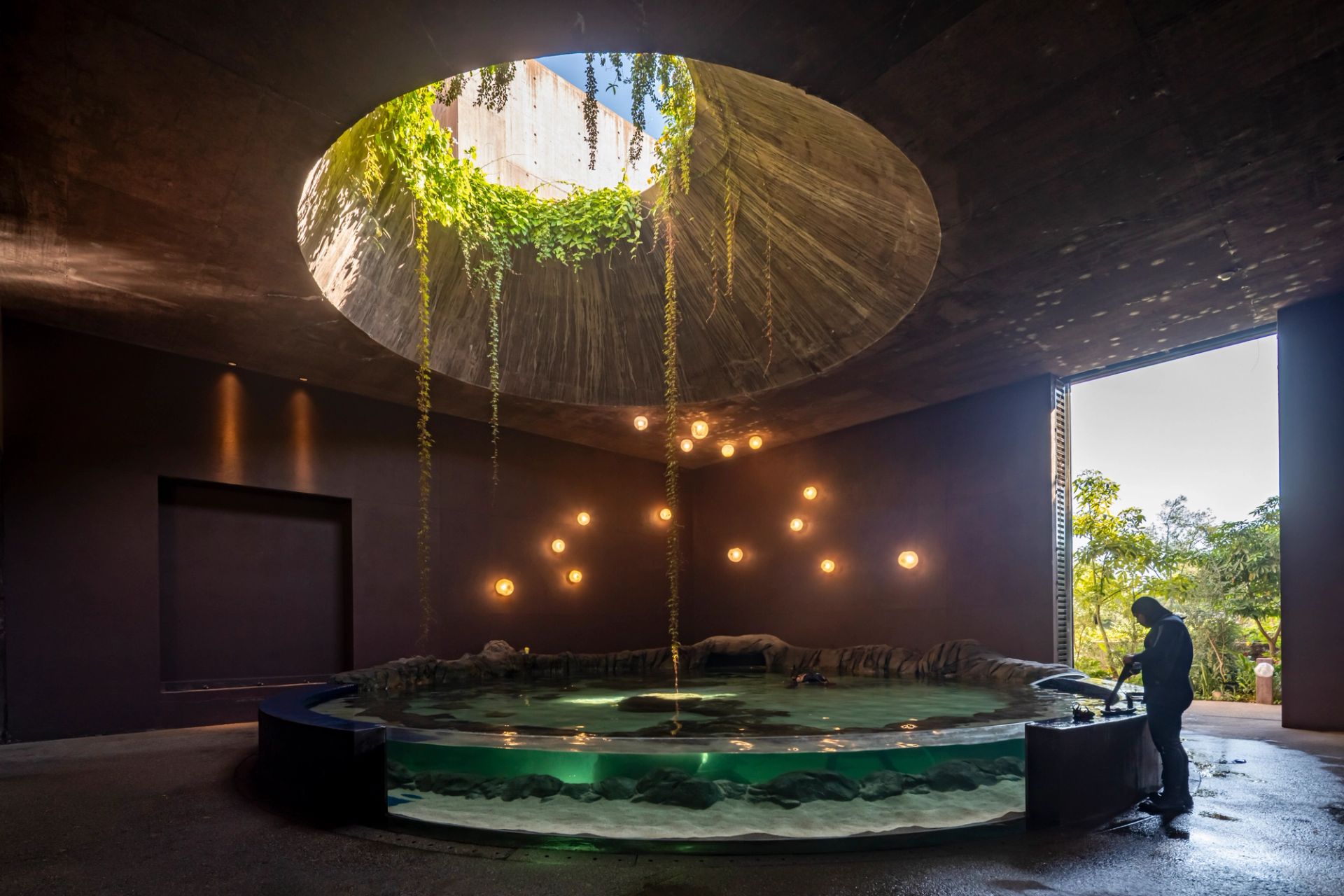
TB Evidently the client really liked what we were doing in terms of the lagoon and the park and how we were intervening in that. But we had never considered working on an aquarium, for various reasons — That is a completely new and unknown typology for us. Then too, they wanted a really iconic building that would encourage connection between the society of Mazatlan with their ecosystem, which is the Sea of Cortez. The first thing we said was that we’re not putting penguins under a glass dome in Mazatlan…
"The first thing we said was that we’re not putting penguins under a glass dome in Mazatlan…"
Tatiana Bilbao Estudio © Onnis Luque
AC What they wanted was not just a conceptual design, but something closer to a pre-construction document, where everything is defined. But at the beginning we didn't know anything about aquariums; as Tatiana said, we even had doubts about them as a typology. We also felt that we needed to change the point of view we have towards nature — all in two months. We jumped into different levels, starting with revising our relationship with nature, but also the technical parts: the life support system, the weight of tanks filled with tonnes of water, the adjacencies of the programme, the back of house… We had many consultants, and both technical and conceptual aspects were developed in parallel.
So what does an aquarium look like? As a kid, you know how to draw a house. But a building that both expresses and allows natural processes to happen is another thing. We started with a very rational, orthogonal structure that at the same time can be broken into different spaces. This grid can hold the tanks, but the spaces can be flexible and can be broken up. We were thinking about entering the building like diving into the water and coming up for air; allowing, where possible for nature to take control of the building — because at the end, we are a very tiny part of nature.
"So what does an aquarium look like? As a kid, you know how to draw a house. But a building that both expresses and allows natural processes to happen is another thing."
In the second week of developing this two-month project, we were hit with a big earthquake in Mexico City, on September 19 2017. It only lasted for a minute or so,, but it was a really big quake — the speed was terrifying. Actually, we were on a Skype call at the time, talking with the consultants for life support systems and exhibition displays — they saw everything. When we went back to work in two days, we were determined to define a building that can allow nature to take control.
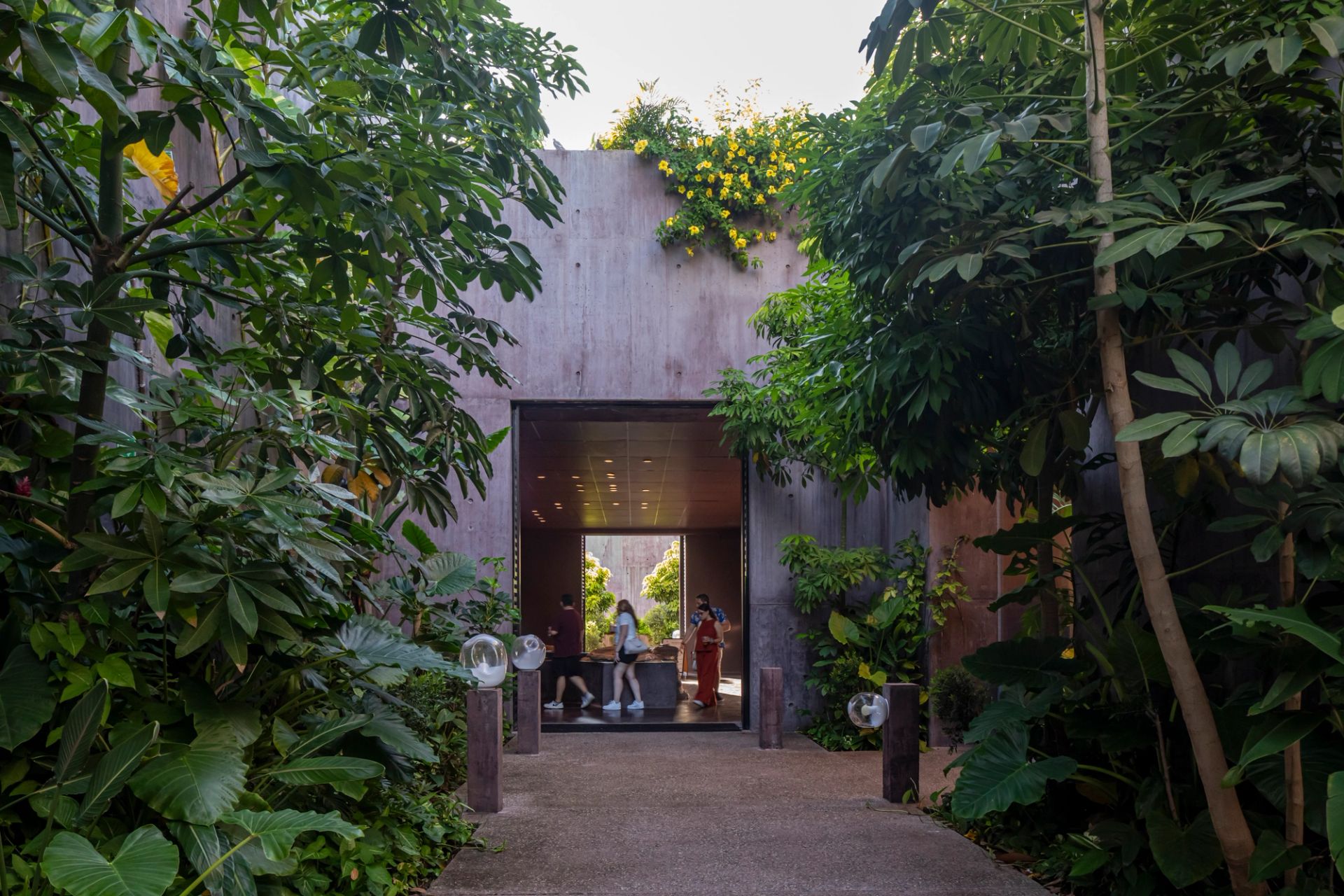
Someone asked us if the building was thought of as a system of walls or a system of volumes. We look at it as a system of flows that creates spaces of intersection and cross-views; it’s a flexible grid. It’s actually a very difficult building to describe in terms of horizontals or verticals; ultimately you need to understand all the flows and systems moving through it. It’s not only the flow of the people; each animal has their way of moving into the tanks and spaces were designed so that each has its habitat.
Tatiana Bilbao Estudio © Onnis Luque
If we had more time, we probably would have questioned ourselves. But our first impetus was really to understand and define so many systems; 60–70% of the building is all in life support systems. We wanted to start with all the ingredients on the table, knowing if you move one thing, it affects another, and another. To maintain your concept, you need to know that from the beginning, shoulder to shoulder with your consultants. Yet you also need a very strong concept that gives a sense of identity and allows for an experience, so that when you pass through that building, you are affected, and able to witness many forms of life — from vegetation to sea life to the social.
"When you pass through that building, you are affected, and able to witness many forms of life — from vegetation to sea life to the social."
TB I wanted to add something about the earthquake, which was no joke. The office was damaged, there was a lot of damage in the city. We also engaged in some reconstruction work in different towns. It was a very difficult moment for the city and for everybody; even our clients and consultants on the call were a little traumatized. And this did impact on the way we continue to work on this project.
AC From the beginning, we were working in sync with the engineers, not only for earthquakes. We know we’re in a seismic zone; that has to do with the tolerance of movement and structural independence in the design. We knew about flood and hurricane risks in this part of Mexico — that's why the building has no basements; the entire building volume is above the ground. Our solution had to allow the building to work independently, especially because the collection inside is alive — if the life-support system goes down, the animals could die. So we had those priorities, risks and tolerances on the table too. The earthquake just underlined what we already knew.
"Our solution had to allow the building to work independently, especially because the collection inside is alive — if the life-support system goes down, the animals could die."
TB I was in Mexico City for the earthquake of 1985 — this huge, massive quake that destroyed the city centre, and in which tens of thousands of people perished. I was little, but it really impacted my life. The city that we have today is the consequence of that event for sure, in every regard, it was massive. The crazy thing is that it was the exact same date — 19 September of 1985. Every September 19, we have a national earthquake drill and a flag ceremony at 7AM, because the earthquake was in the morning. So in 2017, on September 19, we had the drill ceremony as normal, bla bla bla — and at one in the afternoon, this earthquake hit. Since I was little, I became very aware that architecture is a very static, undynamic thing that holds also a constant, ever-changing process, which is life. So architecture mediates between its kind of own inflexibility and the need to hold or contain something that is ever changing. This is something of which I was always aware; being in Mexico City, the ground moves every day. This is our quotidian. And it's not cool.
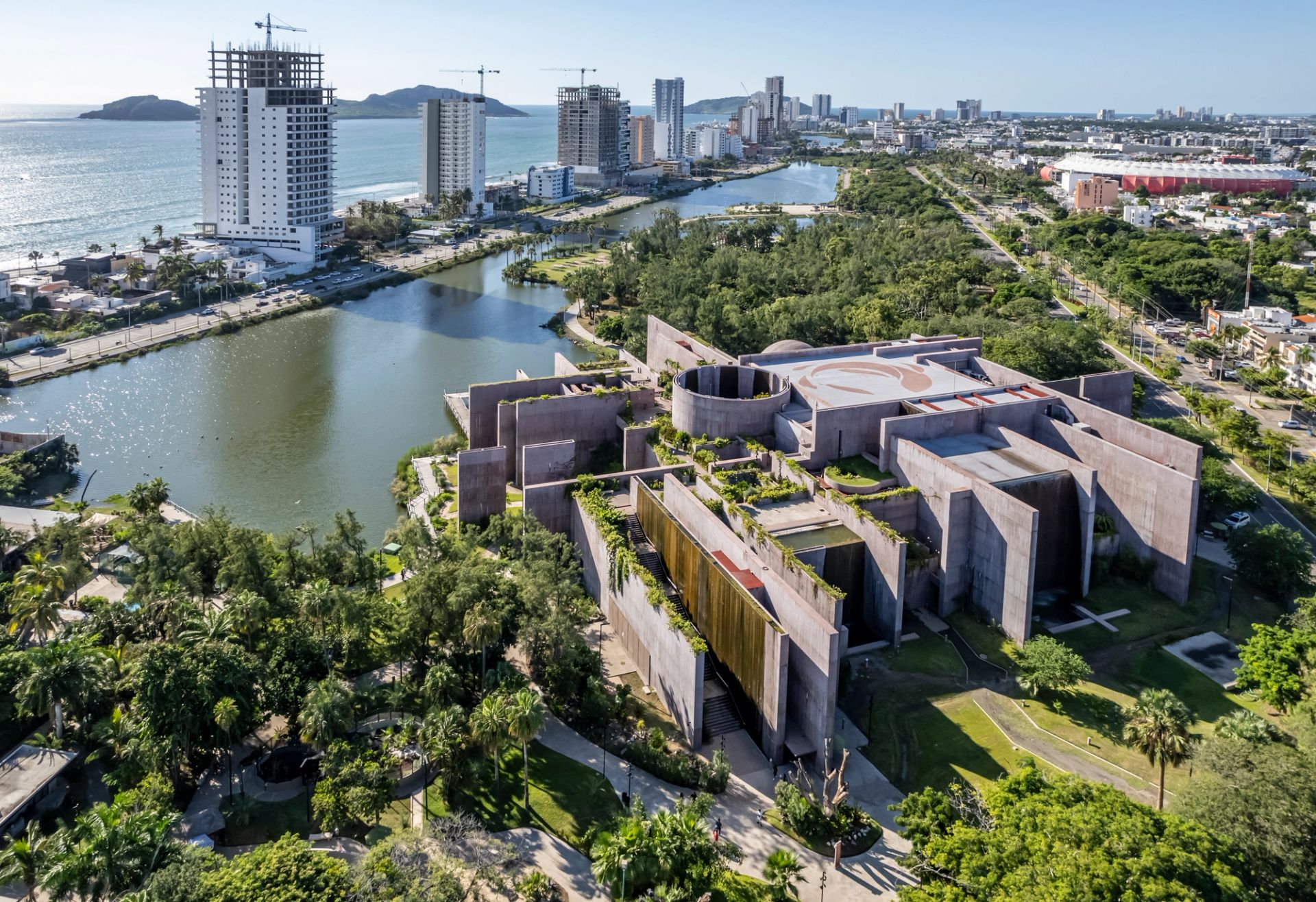
The second part of the story has to do with two conditions: firstly, that our client was not so aware of the power of architecture, although he loved the narrative for this project. Secondly,the contractor assigned to the project did not quite help us in the process. From the first moment that we presented the project, we invented a narrative for this building. In this story, the building is built in the year 2020 before the arrival of floods of 2100, where the building becomes totally submerged. After the water recedes — in the year 2289 — we return to find the building as a ruin, yet completely full of life. So we just open paths for people to see how life takes over, in an enigmatic ruin. After our presentation, the client could not believe what he was seeing. He was silent, and I thought, we’ve lost this job.
The next day he calls me and says: “Tatiana, I understand — we're building Atlantis! I love the story, let's do it.” He really believed the story, to the point where he even mentioned it to a prize jury — they were asking about the building systems and how it was built, and he spoke up to say, “Didn't you understand? We don't know why this building was built; we were not there then, it was rediscovered like this.” He really believes in the story! On the other hand, with physical matters, he is less involved — so we were working, frankly, with a contractor unfamiliar with this kind of project.
The contractors did not believe in this concept of a robust ruin, nor even in the power of architecture; to them, it was just a building in concrete. So why did we want to pour a slab, why did we want to make it in situ? Why would you want walls with a certain texture or finish? Constant fights, constantly defending the project — the only way to keep our client anchored was to mention that ruin narrative.
Tatiana Bilbao Estudio © Kingu
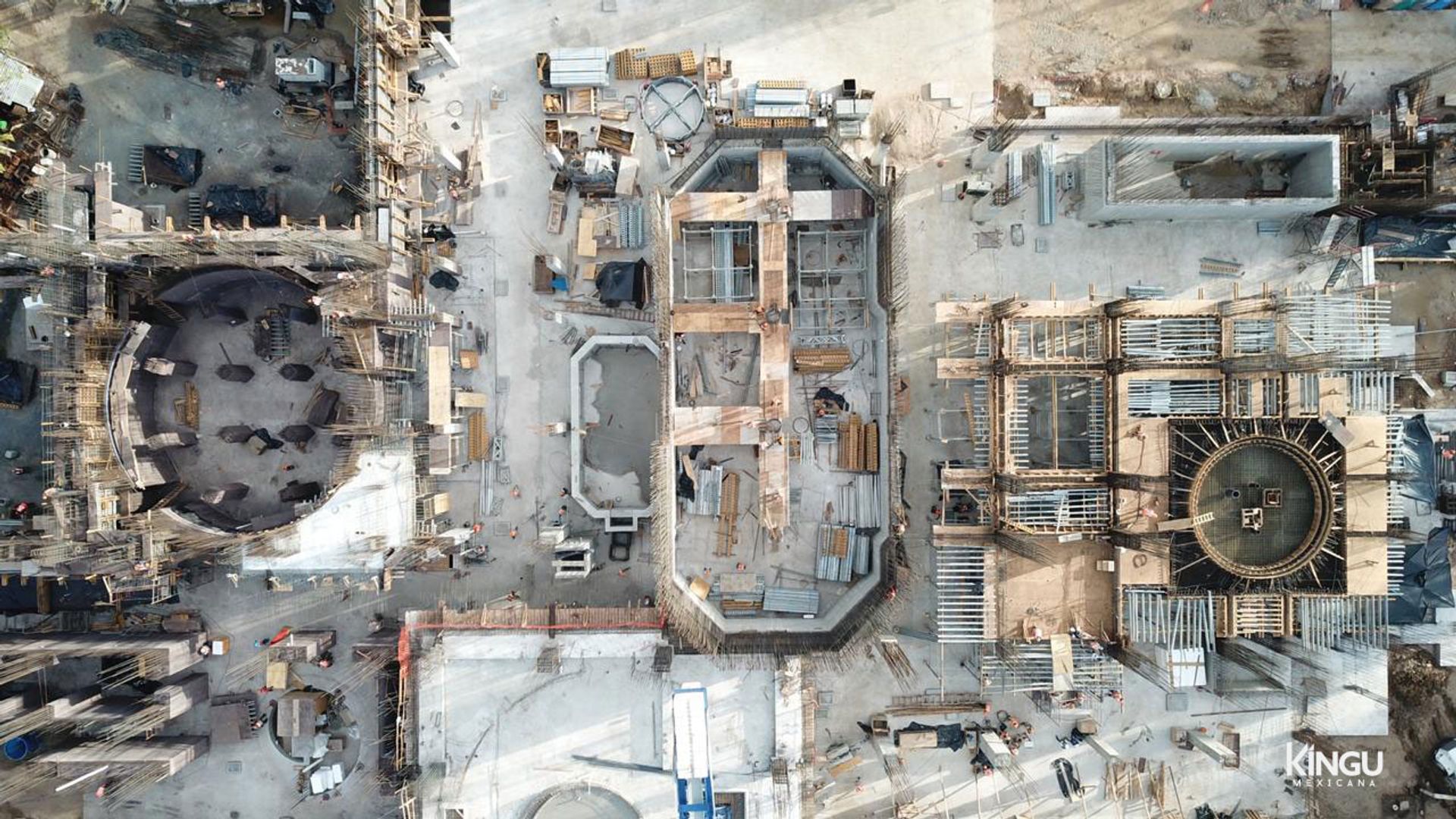
TB At one point, it got really serious; the contractor seemed to have a personal agenda to simplify all the structure — which, for him, involved changing our project completely. From day one, this guy wanted to optimise costs, erase things and replace materials. Our project is a concrete structure — that’s the final definition. Once you pour the concrete, that's the project: the walls, the slabs, everything. At one point he was about to replace a poured concrete slab, above one of the major tanks, with what I can only describe as a supermarket roof — this very light metal pitched roof, with armatures. For us, there was no way we could let that happen.
So I ended up in almost a personal fight. Now, there are aesthetic and functional reasons that we wanted to stick to our design — the roof is the fifth facade, the highest point in the project — but our fight was not about that. The main reason any metal roof would shed heavy particles and pollute the tank. This particular roof would be just above the main water plant; it would become a very difficult issue for maintenance and would really damage the animals. Yet the contractor seemed to have a particular interest in making sure the only solution was to use this metal roof. I don’t know if it was more a battle of costs or power, but we had a difficult time for sure.
AC Eventually we proposed a compromise, which was to use precast, prestressed concrete slabs — but in just a few days, we had to find a supplier close to Mazatlan that both had that capacity for production and was able to be on site, with all the paperwork, the liabilities and everything. We even had to draw the position of the crane to convince the client and the contractor to agree to that solution. For ten days we were calling people, begging favours, praying…
TB Also, this was during the pandemic, so everything was happening on Zoom. We brought in specialists on fish; we even argued on behalf of the tank — which is a massive investment, currently the largest aquatic tank on the continent and made of glass from Japan. All so the living beings in there can become contaminated, you’re going to put metal over that? I even brought on a previous client with whom we built the Botanical Gardens — also a major investor on this project — to join this call. The issue was really a deal-breaker; if they had gone with the metal roof, we would have had to leave the project. And if this was the last battle, I was going to bring my whole army!
"The issue was really a deal-breaker; if they had gone with the metal roof, we would have had to leave the project. And if this was the last battle, I was going to bring my whole army!"
But it was the final solution of the precast concrete that solved everything. It was not as costly as the slab — indeed closer to the cost of the shitty metal roof, as it was produced off-site. Finally, everybody is super happy with the final building; for whatever reason, the contractor's involvement ended, and we're still here. Realising a project, especially here in Mexico, can be very harsh; you have to negotiate with these conditions — and that’s something you're not taught in architecture school. The fact is that many people think that as architects, we're defending ideas simply because we want things to be built as we intend, as beautiful sculptures. Indeed, some reputations grow for a reason. But in many cases — certainly in our case — we are defending life.
Tatiana Bilbao Estudio © Onnis Luque
BIOS
Tatiana Bilbao (HFAIA) is an architect and the principal of Tatiana Bilbao ESTUDIO, which she founded in 2004, with the aim of integrating research, design, community-based strategies, and responsible construction. Her practice develops architecture as a platform to enhance life across geographies and typologies.Prior to this, she was an advisor in the Ministry of Development and Housing in Mexico City. Bilbao holds a recurring teaching position at Yale University School of Architecture and has taught at Harvard University GSD, Columbia University GSAPP, Rice University, University of Andrés Bello in Chile, and Peter Behrens School of Arts at HS Dusseldorf in Germany.
Alba Cortes is an architect and partner at Tatiana Bilbao ESTUDIO, where she oversees strategic projects and research. During her 13 years of professional experience, Alba has collaborated on the design, management, and execution of projects of varying scales, including housing, urban plans, theaters, museums, and cultural centers. She also has experience in low-cost housing research projects and community engagement projects.
Tatiana Bilbao ESTUDIO is a Mexico City-based architecture studio, founded in 2004. At the core of the studio's practice is the understanding that architecture is a primary form of care, therefore they design projects caring for this responsibility. The studio is comprised of six partners: Tatiana Bilbao, Catia Bilbao, Juan Pablo Benlliure, Mariano Castillo, Alba Cortés, Soledad Rodríguez