Naples: A Sea Change
In 1973 Naples was once again visited by cholera. On 28 August, two women died in hospital in the coastal suburb of Torre del Greco. Other deaths soon followed, amounting to a total of fifteen over the next two weeks.50 It was the only European outbreak of the last (and still ongoing) cholera pandemic, and a minor one compared to those that claimed tens of thousands of victims in sub- Saharan Africa and Latin America. But the mere possibility of cholera returning to Italy, at a time of portentous econo-mic growth (the national GDP was rising by over 5% a year), was a major humiliation.
The national response was to quarantine Naples both physically and metaphorically – singling it out as an exception in an otherwise functioning Western economy. Newspapers called the epidemic ‘the great scare’, wildly overstating its extent and blaming it on the Neapolitan underclass. The infection was erroneously traced to the consumption of raw mussels, which resulted in a blanket prohibition of the sale of seafood, fruits, and vegetables, causing cascade effects on the city’s economy. Street food outlets closed down, and did not return until the 2000s. Many Neapolitans started relying on processed and packaged foods in a way they never had before.51
In reality, the cause was to be found in the real-estate speculation that had covered the suburbs of Naples with concrete in the post-war period, and the corruption of the Christian Democrat ruling class who had never upgraded the old sewers or the drinking water supply. Whenever it rained heavily, tons of industrial discharge mixed with raw sewage flowed down the hillsides and into the waters of the Gulf of Naples which, owing to its particular geo-graphy, concentrated rather than dissolved the contaminants.52 Yet the story of the raw mussels stuck. It helped detract attention from the political responsibilities behind the outbreak. In response, the Neapolitan playwright Eduardo De Filippo wrote a satirical poem titled ‘The Accused’, in which a mussel explains what happened in the first person:53
‘Dear mussel, you are in trouble,’ said the judge, ‘the facts are clear, here not even Jesus can save you: it’s either a life sentence, or a bullet.
Here is the evidence, my dear… You brought the bacillus of cholera: Your presence is a dark one, people die in the street.
What do you say in your defence?’ ‘Well, you see… In the bottom of the sea the mussel has to make do,’ said the accused, ‘and you know it…
Down there, your excellence, it’s hell! Whatever comes, the mussel eats: If shit comes, it comes from outside!’
Real-estate speculation was by no means a problem in Naples alone. The flows of money and power that had re-shaped the city reached deep into the rest of the country, but it was convenient for Italy to pretend that Neapolitans alone were to blame, in order to preserve a newfound, precarious modernity. The issue was not that of containing cholera – by that point preventable with a vaccine – but that the 1973 epidemic was threatening to reveal the shaky foundations of the Italian economic miracle: haphazard and illegal housing, opaque networks of patronage, tenacious ‘indecorous’ customs such as eating raw shellfish. All this took place everywhere in Italy, north and south, but just like the seawater, in Naples it was all more concentrated.
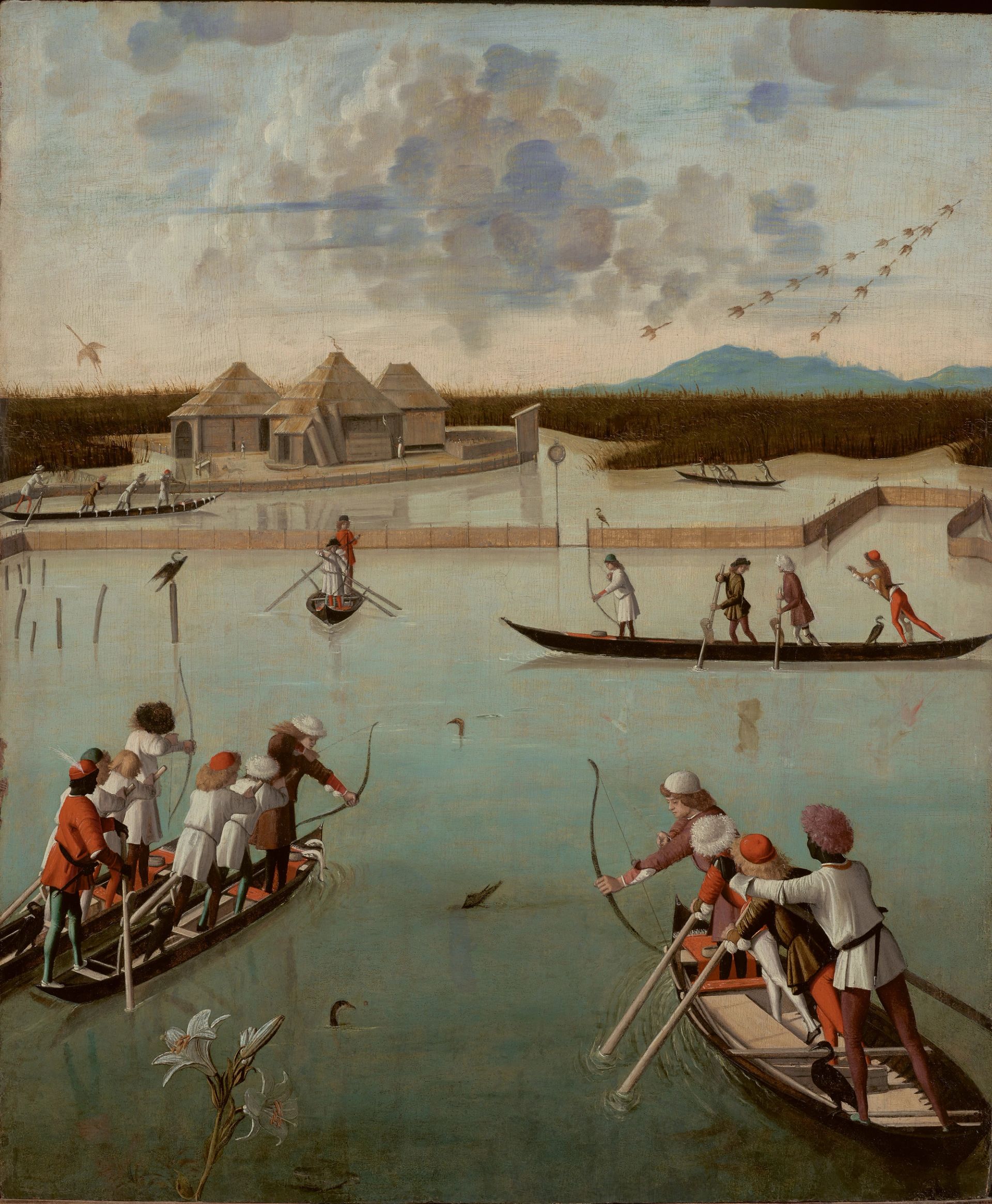
Vittore Carpaccio, Hunting on the Lagoon , 1490–95
In fact, Naples was able to react in ways that still impress and are perhaps unique. During the 1973 cholera outbreak, once again its poor were quarantined by the upper classes. In the areas most affected by the infection, doctors refused to perform vaccinations or simply left. Pharmacies were shut down. Medical advice was absent, contradictory, or patronising, as the radical leftist magazine L’erba voglio described in the epidemic’s immediate aftermath:
For the masses, the chaos of ‘scientific’ opinions – incredibly, no one seems to have clear ideas on this disease and the ways to prevent it – did not allow any coherent interpretation. One paper said one thing, another something different, and before they settled on the mussels the only advice dispensed in the evening news – that vile instrument of Christian Democrat propaganda – was: be clean. Sure, but how does one manage to keep clean, in the alleys?54
In response to this situation, left-wing activists set up a network of neighbourhood clinics to administer vaccinations, making up for the slowness of public health institutions. Women-led groups set up barricades around the city and the suburbs to demand better water supply, rubbish collection, and public health provisions which the wealthier neighbourhoods already enjoyed. Others launched a bottom-up inquiry into the health conditions in the city, and organised teams to provide medical care in all those districts where doctors weren’t venturing.
The organising was not confined to healthcare. Out of the cholera epidemic, and specifically its consequences on the labour market, an original political formation emerged: the Movimento disoccupati organizzati (Movement of the United Unemployed). When, in the aftermath of the epidemic, the government moved to repress the informal economy on which the city centre still relied (the alleys were an ‘open-air factory’, in the words of journalist Luca Rossomando), many Neapolitans, especially women, found themselves out of work overnight. But they rejected the individualised job search as a remedy, and came together to demand a basic income. It was the first public recognition of informal work in Italy, and among the first by a largely female workforce.55
The 1973 epidemic made visible the social margins of the city that existed right at its centre, not through the paternalistic lens of Villari or Serao, but as a site of struggle and emancipation. The collective response showed that such social shocks need not result in a further expansion of capitalist accumulation, as had been the case after 1884, but could catalyse latent conflicts into action, energise social movements, and confront the limitations of medical know-ledge. The streets were not just a backdrop for the bourgeoisie to stroll past, but a real place in which the struggle for collective improvements could unfold.
If Covid-19 had started in Naples, we would probably have seen a return of the worst of the hooligan chants and centuries-old portrayals of the city as a hotbed of infection. But I cannot help but wonder if we might also have seen ways of coming together and fighting back that were largely absent in Milan and Bergamo. Perhaps Naples would have emerged not as a virus infecting Western civilisation, but once again as the place where its limits and contradictions are laid bare.
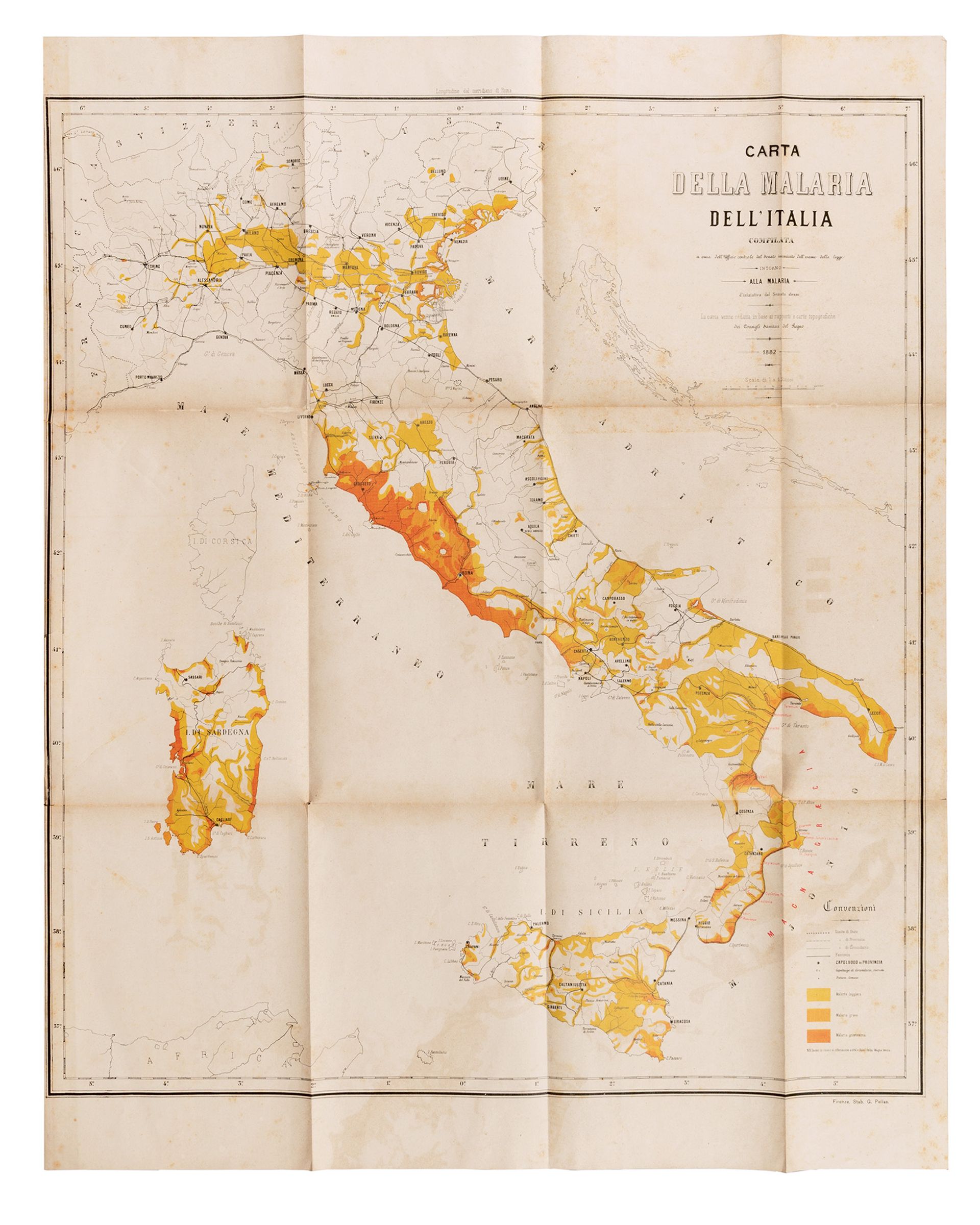
Luigi Torelli’s map of malaria in Italy, 1882
Matera: Undoing the Knots
The day after our first walk, Lionetti and I went foraging for wild asparagus. We followed a beautiful path that moved between the open pastures of the Murgia and the Lucignano wood, the last remnant of a much bigger forest that once covered the area. It was impossible to keep up with Lionetti, who could spot a lone asparagus amid thorny shrubs from fifty metres away. He continually inspected the various plants and animal species we encountered so as to observe their change through the seasons. It was the middle of April and the landscape was in full bloom. The Murgia plateau might look barren from a distance, but you can find everything from orchids to wild cherry trees to mushrooms there. The same conditions that make it unsuitable for agriculture have preserved it as a haven of biodiversity – an environment that for centuries has nourished the local population.
As we walked, Lionetti explained how plants were traditionally used as medicine. The principles of this usage derived from the School of Salerno of the tenth to twelfth centuries, according to which a condition could be cured with a substance that mirrored the illness. When we came across a swarm of myriapods under a rock, Lionetti told me that they would be used to treat jaundice on account of the yellowish substance they emit when crushed. Kidney stones could be healed with plants that bloom among the rocks. A feverish individual would be kept warm with hot decoctions and woollen shawls. Pointing at some Papaver somniferum flowers, opium poppies, Lionetti recalled that their capsules were used until not long ago to assuage cough and chest pain.
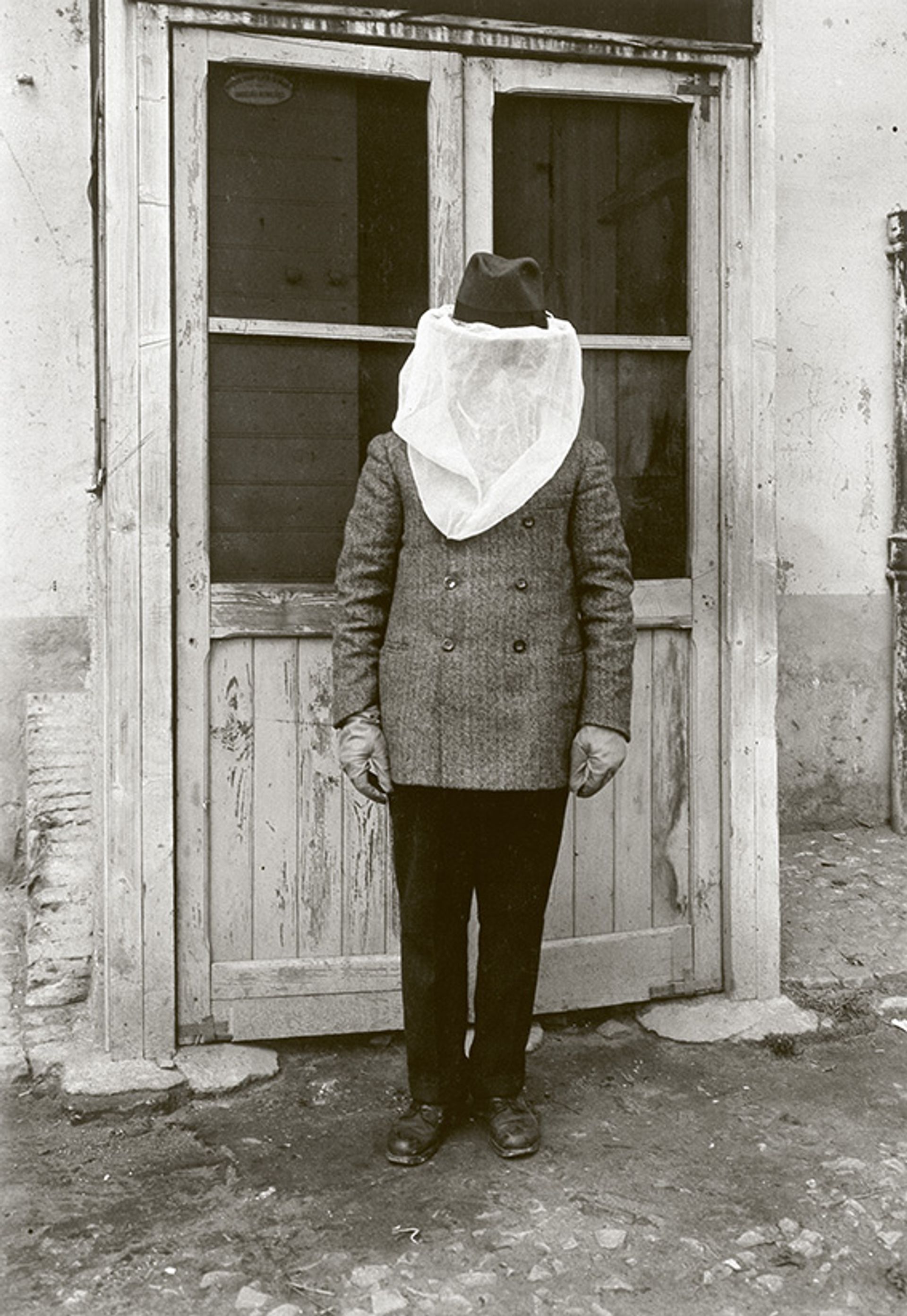
A demonstration of personal protective equipment against mosquitoes in the Pontine Marshes, ca. 1920
While plants were always the first recourse in traditional Materan medicine, serious illnesses would call for magical–religious rituals. There were clear gender roles in the execution of these. The healer was a fattucchiera, a woman who had the ability to take the malady upon herself. In every town there was at least one fattucchiera to whom the population would turn in cases of ill health as well as after traumatic events such as a sudden loss. (The Italian term fattucchiera, dating at least from the sixteenth century, is thought to derive from the Latin fatum, meaning ‘fate’; in the local dialect, a female healer is known as a maciara.) Then there was a male figure called the ceraulo (a term that might descend from the Ancient Greek keraúlēs for ‘hornblower’), traditionally the seventh male child of seven male children. His prerogative was interaction with snakes and poisonous animals, controlling them when alive, preparing their bodily fluids when dead, and ministering to their bites. The memory of these figures is recent in Basilicata; a ceraulo would pass by Matera for the annual feast of the Madonna della Bruna until the early 1980s. A few maciare are still said to exist and practice.
These rituals have ancient origins, going back to the Hellenic colonisation (eighth to third centuries BCE) or even earlier. They were found throughout southern Italy, reflecting how Matera was not at all isolated, but rather connected to the wider world through extensive transhumance routes. Lionetti and I were now walking one. Magical traditions and beliefs were found all over peasant Europe, but happened to survive here for longer.
When, after unification, the Italian state and its emissaries made their discovery of Matera, they made little of such traditional beliefs. Like the homes of the Sassi, they saw them as primitive, dangerous relics. Their way of observing and describing peasant magic and herbal medicine – and life in the South more generally – was shaped by three distinct modes of knowledge. The first was ethnography, which in Italy was spearheaded by the Sicilian physician Giuseppe Pitrè. In keeping with nineteenth-century colonial anthropology, Pitrè saw the social scientist as superior to the subjects of study, and considered folklore something that belonged only to underdeveloped social groups. He classified and compared popular customs from around the country in an ostensibly objective way, but in fact presented them as no more than exotic curiosities.
The second was the scientific gaze of the many governmental and parliamentary inquiries conducted on the living conditions of the Southern poor. These used statistics to explain poverty as a problem to be solved through the expertise of medical doctors, agronomists, hydraulic engineers, and urban planners. Although some of their findings include valuable information, these inquiries were a direct emanation of a liberal land-owning elite whose vision of the South was as a vast tract of unproductive land that needed to be ‘improved’.
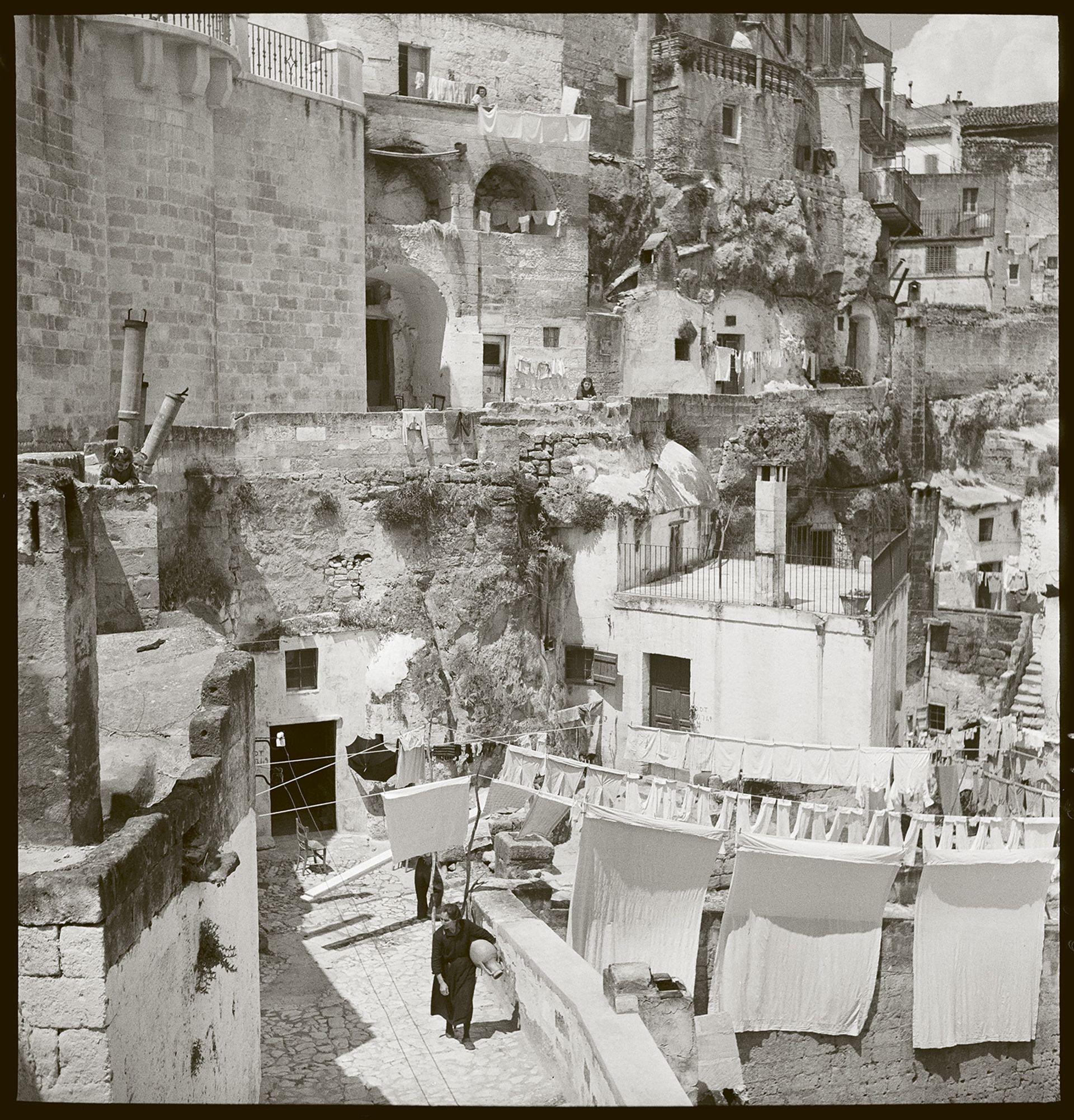
Life in the Sassi before the evictions, photographed by American photo- journalist Marjory Collins, 1950
The third was the discourse around rural hygiene. In the late eighteenth century, ‘hygiene’ came to be defined through a dialectic opposition between ‘dirty’ and ‘clean’, and in this guise used to medicalise the masses of European countries as well as their colonies. As the historian Adriano Prosperi has explained, ‘dirty’ in this context had little to do with dust or grime, but referred instead to the (supposed) promiscuity that defined the life of the peasants – blurred boundaries between humans and animals, or between inside and outside (as in the vicinati).41 Hygienists proposed to improve the living conditions by imposing neat distinctions; what they never addressed were the material causes of the peasants’ misery (above all, unequal landownership). The leading voice of hygiene in Italy was the anthropologist Paolo Mantegazza, who sought to prevent infection among the Italian body politic through a veritable epidemic of articles, booklets, and manuals. In his writings, he mixed practical advice with undertones that were not just intensely paternalistic and moralising (‘Wash Yourselves!’) but misogynistic, racist, and eugenicist.42 Rural hygiene as espoused by Mantegazza was only superficially about the prevention of disease; it was, in fact, ‘a veritable ideology of social purification.’43
These three strands of nineteenth-century thought converge in the writings of Michele Lacava, a doctor from Basilicata who had studied with Mantegazza and fought alongside Garibaldi for the nationalist cause. In 1885 Lacava compiled an influential medical survey of the region, expressing disparaging judgements of the superstitions held by the peasants. According to him, traditional healers were in fact the cause of disease:
A source of illness is the prejudices that reign among the popular classes, who take medicaments at their own whim or following the gossip of humble women of the neighbourhood. […] Another illness is the wizards and witches whose arts rest on the stupid credulity of the lower classes regarding magic.44
A particular hostility for the role of women in these healing practices is found time and again in the work of Lacava and other (male) doctors. Old tropes about malign witches were used to belittle the knowledge of the women they had. In 1896, the local physician Gerardo Pasquarelli wrote:
Besides the doctor and the pharmacist, our art is practiced by any gossiping woman, more rarely a few men. […] And if one heals, it was for the grace of some saint moved to pity by the prayers; no one talks about the doctor except to contrast his remedy with that of the female healer. But if one dies, it is always the fault of the doctor who did not identify the illness and give medicines against it.45
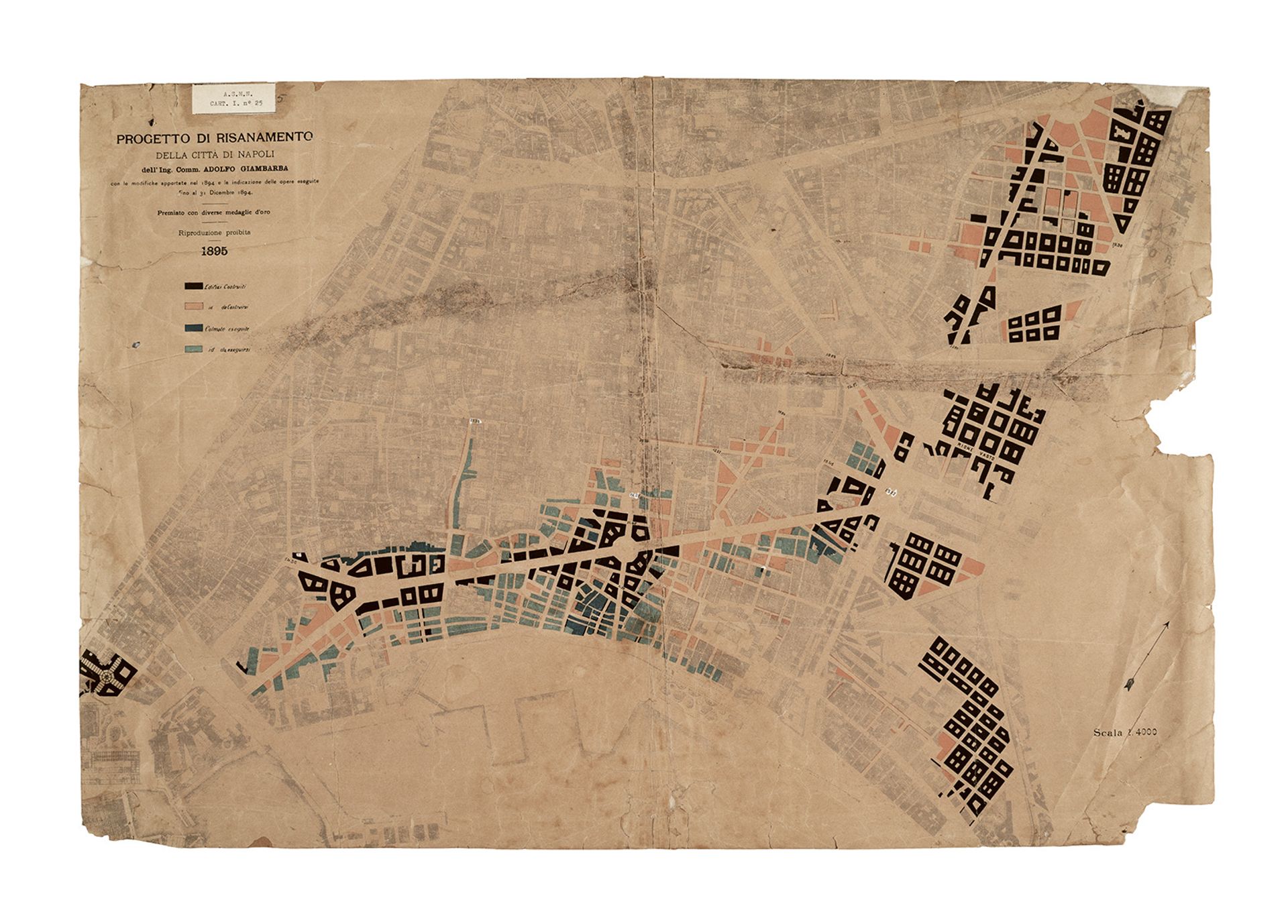
The Risanamento masterplan showing the state of construction works in 1895. Areas in black are already built, while those in other colours are under construction
It took Carlo Levi, an antifascist intellectual who had practiced as a doctor in Turin before being exiled to Basilicata in 1935, to suggest a different understanding of popular medicine. In Christ Stopped at Eboli, published in 1945, he explained how he learned to understand and accept magic – even while he was regularly asked by the peasants to treat them with real medicines. Moreover, Levi suggested that modern medicine could itself be a form of magic.
Popular magic treats pretty much every disease, and almost always with the pronouncement of formulae and spells. Some are specific to a certain illness, while others are generic. Some are, from what I gather, of local origin; others belong to the corpus of classical magic lore, which arrived here no one knows when or how. […]
Initially, the peasants tried to hide their amulets, and almost apologised for wearing them, because they knew that doctors here despise these superstitions and rail against them, in the name of reason and science. […]
I respected the abracadabra [an amulet consisting of a tiny roll of inscribed paper], I honoured its ancient, obscure simplicity; I preferred to be an ally rather than an enemy. The peasants were grateful, and perhaps the abracadabra really did them good. Indeed, the magical rituals here are all harmless, and the peasants don’t see any contradiction with official medicine. In any case, the doctor’s habit of giving each patient a medical prescription, even when it isn’t necessary, is nothing if not a magical custom: even more so when the prescription is written, as it once was, in Latin, or, as they are now, in unreadable handwriting. Most prescriptions could heal patients simply by being strung around the patient’s neck like an abracadabra.46
The peasants of Basilicata, Levi saw, had good reasons to distrust modern medicine. Village doctors were clueless: untrained to deal with local health conditions, with expertise limited to notions learned by heart, and concerned only with their own social standing such that they obsessively looked down on the peasants. Medicines themselves were trusted, but they were generally too expensive or simply unavailable. Pharmacists often took advantage of or blatantly ripped off the largely illiterate population.47
Levi’s sense that magical beliefs existed because they fulfilled objective needs – that they worked, in other words – resonates in the work of another antifascist author, Cesare Pavese. His 1950 novel The Moon and the Bonfires deals with the partisan guerrillas in the hills of north-west Italy, a long way from Matera. In one moment, two characters chat about the traditional midsummer bonfires held on St John’s Eve. The worldly narrator is sceptical of their utility, but his friend Nuto, a communist partisan, asserts that the bonfires, like farming according to lunar phases, really do improve the harvest:
‘The moon?’ said Nuto. ‘How can you not believe? Cut a pine tree when the moon is full and the worms’ll eat it up. When you’re washing a vat you need a new moon. Even grafts, if you don’t do them in the first days of the new moon, they won’t take.’
Then I told him I’d heard a bunch of tall stories in my travels, but these were the tallest. What was the point of him banging on about the government and the priests if he believed the same superstitions his grandmother’s parents had? So then very calmly Nuto told me that something was only a superstition if it was hurtful, if someone, for instance, used the moon and the bonfires to cheat the peasants and keep them in the dark, OK in that case he’d be the moron and deserve shooting in the piazza. But before passing judgement I should soak up this country life again.48
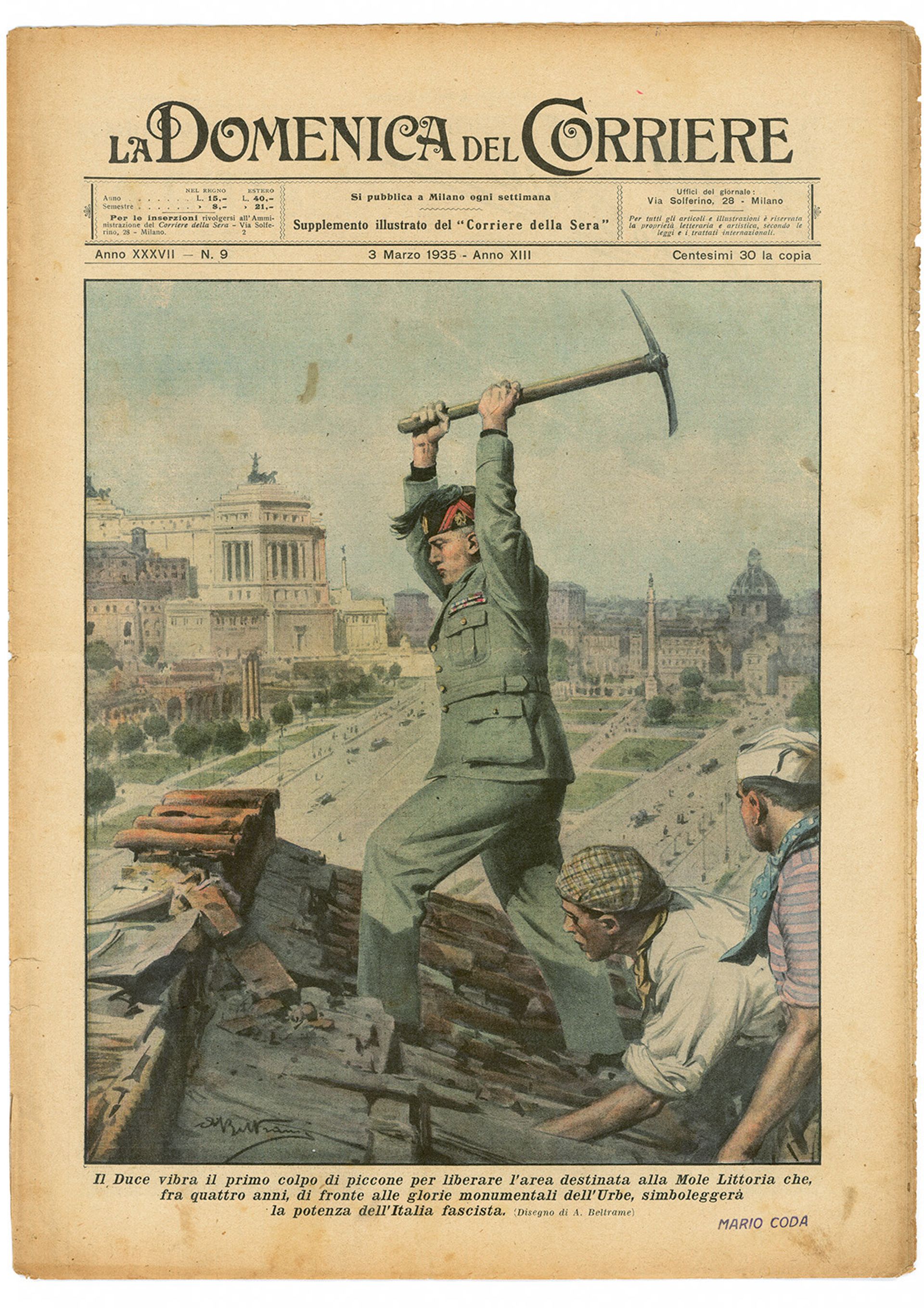
The cover of La Domenica del Corriere from 3 March 1935, showing Mussolini kicking off the demolition of a building in Rome to make way for new construction
Book
In Terra Infecta: Disease and the Italian Landscape (MACK Books, 2025), architect and writer Andrea Bagnato shows how the modern quest for sanitation transformed Italy’s urban and rural landscapes, from the draining of the Venetian wetlands to the replanning of Naples. Since the birth of tourism, the cities and landscapes of Italy have been bywords for beauty and grandeur. But, at home and abroad, the same places have also been haunted by associations with disease and uncleanliness. Spanning Italian unification and the aftershocks of Covid-19, and drawing on medical and architectural records as well as his own travels, this book pieces together revelatory histories of community, health, and resistance to offer a new perspective on the making of modern Europe.
Bio
Andrea Bagnato is an architect and writer. He has taught at the Architectural Association in London, Piet Zwart Institute in Rotterdam, and DAAS in Stockholm, andco-edited the books Rights of Future Generations (2022) and A Moving Border: Alpine Cartographies of Climate Change (2019). He lives in Genoa.
Notes
Naples: A Sea Change
50 William B. Baine et al., ‘Epidemiology of Cholera in Italy In 1973’, The Lancet 304: 7893 (December 1974), 1370–74.
51 Conversation with Marcello Anselmo, Naples, 14 March 2023.
52 Marcello Anselmo, ‘La città infetta. Il colera a Napoli del 1973’, Rivista Il Mulino, 10 May 2021, https://www.rivistailmulino.it/a/la-citt-infettail-colera-a-napoli-del-1973
53 ‘Cara còzzeca, tu staie nguaiata», / decette ’o magistrato, «’O fatt’è chisto, / ccà nun te salva manco Giesú Cristo; / o l’ergastolo, o muore fucilata. / Qui ci sono le prove, figlia mia... / Tu hai portato il bacillo del colera: / la tua presenza è una presenza nera, / ’a gente more all’erta mmiez’ ’a via. / Che dici a tua discolpa?» «Ecco vedete... / affunn’ ’o mare ’a còzzeca s’arrangia», / dicette l’imputata, «e lo sapete... / Là ssotto, Presidè, pare l’inferno! / Chello c’arriva ’a cozzeca se mangia: / si arriva mmerda, arriva dall’esterno!’ Eduardo De Filippo, ‘L’imputata’, in Le Poesie (Turin: Einaudi, 2018), 167. Thanks to Chiara Davino for pointing out this poem to me.
54 ‘Appunti sul colera’, L’erba voglio 12 (August/September 1973), 7.
55 This section is indebted to conversations with Marcello Anselmo and Patrizio Esposito in Naples, 14 March 2023. See also: Marcello Anselmo, ‘Bandiera Gialla. Napoli 1973’, Tre Soldi (five-part broadcast for Rai Radio 3, 29 March–2 April 2021), https://www.raiplaysound.it/playlist/bandieragiallanapoli1973; Luca Rossomando, Le fragili alleanze
(Naples: Monitor, 2022), 259–328; Biagio Quattrocchi, ‘I “disoccupati organizzati”. Lotte e lavoro durante l’epidemia di colera a Napoli’, DINAMOpress (blog), 28 May 2020, https://www.dinamopress.it/news/disoccupati-organizzati-lotte-lavoro-lepidemia-colera-napoli
Matera: Undoing the Knots
41 Adriano Prosperi, Un volgo disperso: Contadini d’Italia dell’Ottocento (Turin: Einaudi, 2019), 41–42.
42 Rhiannon Noel Welch, Vital Subjects: Race and Biopolitics in Italy (Liverpool: Liverpool University Press, 2016), 75–122.
43 Prosperi, Un volgo disperso, 121.
44 Michele Lacava, ‘Le condizioni igienico-sanitarie della Provincia di Basilicata nell’anno 1885’, republished in Rocco Mazzarone, ‘Condizioni di vita dei contadini della Basilicata in una inchiesta sanitaria dell’800’, Lares 59:4 (1993), 671–72. Italics in original.
45 Michele Gerardo Pasquarelli, Medicina, magia e classi sociali nella Basilicata degli anni venti: Scritti di un medico antropologo, ed. Giovanni Battista Bronzini (Galatina: Congedo, 1987), 233.
46 Levi, Cristo si è fermato a Eboli, 209–10.
47 Levi, Cristo si è fermato a Eboli, 213.
48 Cesare Pavese, The Moon and the Bonfires (1949), trans. Tim Parks (London: Penguin, 2021), p. 41.