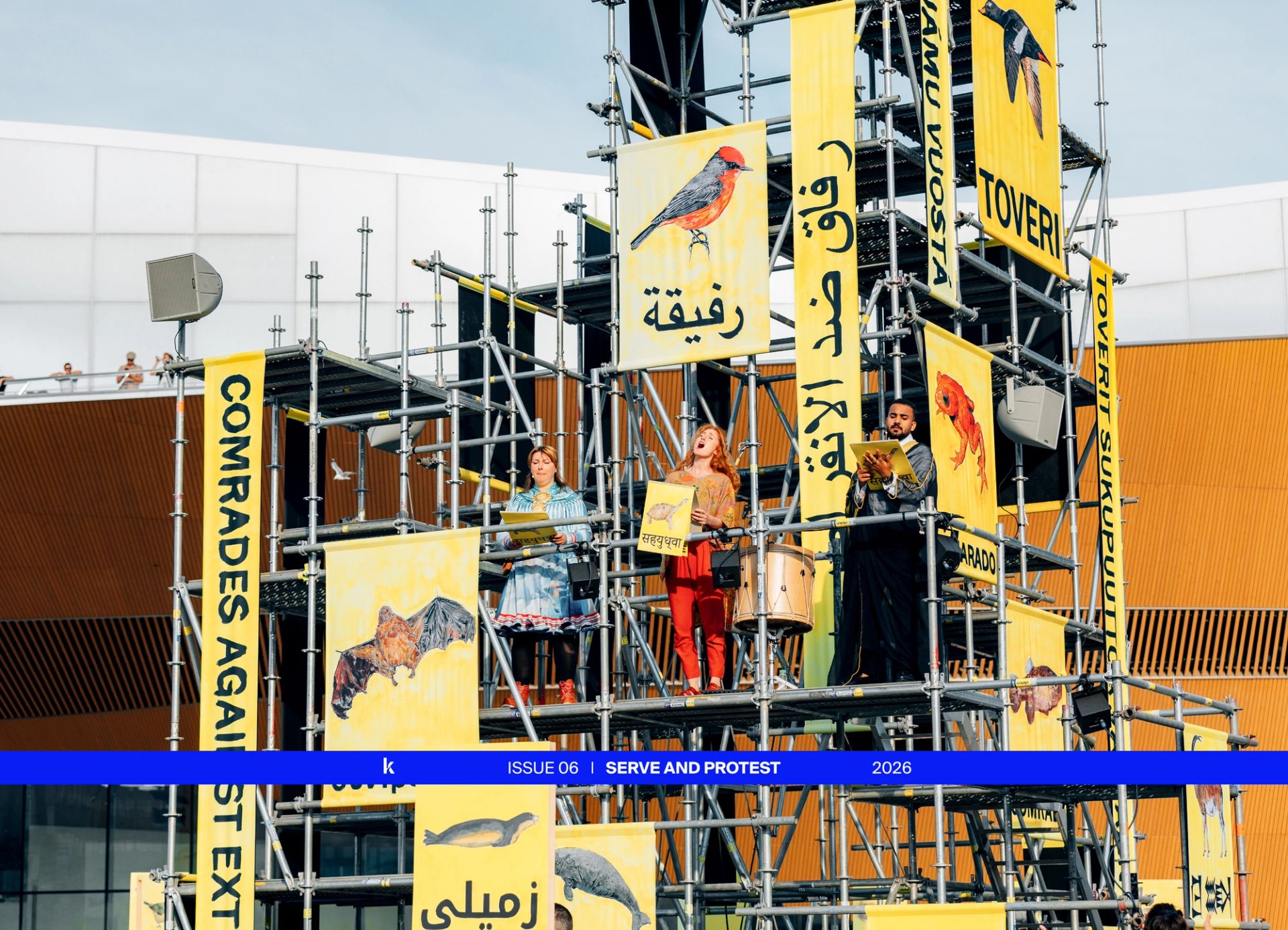
This piece is part of KoozArch Issue #06 Serve and Protest.
The medieval concept of master builder could accurately be described as a service provider; later on "service to mankind" acted as twentieth-century Modernism's justification for its purported alignment with function. The architect, in this reading, exists to answer human need — translating social requirements into built form, giving material shape to collective aspiration. This understanding of architecture as fundamentally responsive has deep roots in the discipline's self-conception, from Vitruvius's insistence on utility to the social housing programmes of the post-war welfare state.
Yet there are several arguments for the autonomy of architecture as a discipline, in practice and as a theoretical position. The counter-tradition — from Enlightenment theories through to the radical pedagogies of the 1960s — has positioned architecture as cultural production irreducible to mere utility. Architects in this lineage claim kinship with artists and philosophers: figures whose work transcends the brief and speaks to conditions beyond the immediate programme. The position against architecture as a "service industry" argues for artistic expression and even political statement — in opposition, for instance, to commodification — and against a profession beholden to the service of either capital or state. Yet autonomy carries its own contradictions. The architect who claims independence from market forces nonetheless relies on clients and institutional structures for realisation. The critical practitioner who refuses complicity may find themselves confined to gallery or academy — theoretical purity purchased at the cost of material intervention. So if "architecture as service" is under question, it may be pertinent to enquire further: in service to whom?
This is not an innocent question. The history of architecture is inseparable from the history of power — from monumental assertions of empire to the disciplinary architectures that Foucault anatomised. To serve has never been neutral; it has always implied hierarchy and the potential for exploitation. The medieval master builder served Church and Crown; the Modernist architect served the state; the contemporary practitioner serves globalised capital flows and regulatory frameworks that often operate at considerable remove from the communities ostensibly being served.
"To serve has never been neutral; it has always implied hierarchy and the potential for exploitation."
The title of this issue — Serve and Protest — plays on the dialogic pairing, to serve and protect. 'Serve and protect' itself derives from the Bible; from certain translations otherwise rendered as 'to till and keep' — with clear implications for acting with care towards land, fellow humans, and society at large. The agricultural metaphor is instructive: to till is to work the earth, to transform through labour; to keep is to maintain, to hold in trust for future generations. This suggests service that is active and generative, oriented towards long-term flourishing rather than immediate extraction.
In its more secular usage, 'Protect and Serve' is — ironically or not — the motto of the Los Angeles Police Department, which returns us to the interrogation of service to particular entities or codes, as well as querying what is deemed worthy of protection — and from whom. The adoption of this phrase by law enforcement reveals its ideological plasticity: service and protection are always partial, always embedded in structures of inclusion and exclusion. The question of who is protected — and who is policed, surveilled, or displaced — is fundamentally spatial. It is answered through the design of borders, the zoning of territories, the architecture of detention. Spatial practitioners are always already implicated in these distributions of protection and exposure.
If architecture is at the service of society rather than capital — and today that must include responsibility on a planetary level, as an urgent concern for all of society — then the conservative, even paternalistic premise of 'protection' is somewhat problematic. Protection implies vulnerability, dependency, the need for guardianship. It positions the protector as knowing best, as capable of shielding those who cannot protect themselves. This asymmetry sits uneasily with commitments to participation and self-determination. Moreover, in an era of climate breakdown, protection requires radical expansion: beyond the human, beyond the present, beyond the boundaries that have historically delimited architectural concern.
Instead, this issue chooses to stay with the trouble of intentionally positioning practice, which extends to the ability to protest. To position practice is to acknowledge that neutrality is impossible, that every design act carries political weight, and that practitioners must continually negotiate their relationship to the systems within which they operate. This is not a call for purity, but for reflexivity and the willingness to take sides. As stated by Ewa Effiom, in his address ‘In Progress’ given to the LINA community earlier this year, “This shift means that established hierarchies are being dismantled in order for architecture to return to relevance. These practices remind us that architecture, despite efforts to the contrary, is still able to imagine a better future” 1
"To position practice is to acknowledge that neutrality is impossible, that every design act carries political weight."
In what circumstances are spatial practitioners able to speak truth to power, and to what extent do the industries of construction and production proscribe dissent, acts of solidarity or disruptive protest? The construction industry, with its material flows, its precarious labour, and its imbrication with finance capital, presents formidable obstacles to critical practice. Professional codes emphasise client service; liability structures discourage risk; economics reward compliance. Yet practitioners have found ways to intervene: through advocacy, through strategic deployment of expertise in service of movements rather than markets. As Bangladeshi architect Marina Tabassum claims, in her recent essay Designing for Change, “It is not sufficient to wait for clients to pursue architects with dream projects; architects must engage proactively with communities and stakeholders, offering their knowledge and services to improve living environments and promote inclusive design.” 2
Whether in marches against genocidal acts of war, or in alarmingly forthright anti-immigrant displays across Western countries: protest in its most visible, full-throated form has become an unavoidable urban reality across the globe in recent years. The streets have become stages for collective assertion, from the occupation of public squares to the encampments transforming university campuses into sites of contestation. These movements understand that space is not merely a backdrop to political action but its very medium. The design of streets and plazas shapes what forms of assembly are possible, what bodies can gather, what voices can be heard.

Free Speech Flag, the colours of which correspond to the hexadecimal values of an AACS encryption key that the entertainment industry sought to suppress.
"...space is not merely a backdrop to political action but its very medium."
At a time when AI-boosted surveillance, seamless ID tracking and cloud data correlation allows for incredible acuity in terms of tracking movements in space, how has this impacted freedom and control within metropolitan environments? The smart city reveals its shadow-side as a machinery of observation. Facial recognition scans crowds; mobile data maps populations; algorithms flag anomalous behaviour. Public assembly becomes a calculated risk, as participants weigh collective action against identification and future consequence. To what extent can spatial practitioners, architects and designers oppose and collude against systems of control? Collusion here means playing together: conspiratorial alignment against dominant powers. This might mean designing spaces that confound surveillance, withholding expertise from carceral projects, or sharing spatial knowledge with movements seeking to transform their environments.
This issue examines practitioners who serve communities — human and non-human — that are underserved, underprivileged or under-recognised in terms of spatial design and experience, whether through ageism, gender discrimination or other forms of negligence, ignorance, exploitation and oppression. We are interested in practices beginning from the needs of those historically excluded: the elderly navigating environments designed for the able-bodied; the homeless rendered invisible by hostile architecture; the migrant detained in dehumanising spaces; the species displaced by development recognising only human habitation. To serve these communities is not charity but justice.
Furthermore, it gathers and learns from strategies of resistance and protest, at a time when spatial practitioners would hope to avoid collusion with the forces that would destroy life on the planet. From inflatable barricades to guerrilla gardens, from refugee camp architectures to autonomous zones: spatial ingenuity flourishes wherever people refuse imposed conditions. These vernacular tactics hold lessons in improvisation and the political efficacy of temporary intervention.
We aim to gather a collection of positions, reflections and actions demonstrating architecture’s capacity to refuse the false choice between service and autonomy, understanding practice as entangled and strategically positioned. We welcome theoretical interventions, project documentations, and accounts of spatial activism — work that takes seriously both the constraints and possibilities of practice in a moment of converging crises. Above all, we hope that this collection takes seriously both the constraints and the possibilities of spatial practice in a moment of converging crises — and that dares to imagine architecture as a form of solidarity.
"Above all, we hope that this collection takes seriously both the constraints and the possibilities of spatial practice at a moment of converging crises."
Bio
Shumi Bose is chief editor at KoozArch. She is an educator, curator and editor in the field of architecture and architectural history. She is a Senior Lecturer in architectural history at Central Saint Martins and also teaches at the Royal College of Art, the Architectural Association and the School of Architecture at Syracuse University in London. She has curated exhibitions at the Venice Biennale of Architecture, the Victoria and Albert Museum and the Royal Institute of British Architects. In 2020 she founded Holdspace, a digital platform for extracurricular discussions in architectural education, and currently serves as trustee for the Architecture Foundation.
Notes
1 Effiom, Ewa, ‘In Progress’, State of Architecture address delivered for the European platform LINA, 11 December 2025 https://lina.community/notes/ewa-effiom-in-progress/
2 Tabassum, Marina, ‘Designing for Change’, in Plugin House: Modern Prefab Architecture, eds. Public Architecture Office, (Thames & Hudson, 2026) pp.137–144
Header image: Inflatable cobblestone, action of Eclectic Electric Collective in cooperation with Enmedio collective during the General Strike in Barcelona 2012. Image by Oriana Eliçabe/Enmedio.info