The reliance on mechanical systems of interior climate control have resulted in homogenous architectural landscapes, a diffusion of social spaces for gathering and a dichotomy between the interior and exterior. Perhaps most concerning, this reliance on energy significantly contributes to our current ecological crisis; the irony is of course that a thermally uniform interior contributes to an increasingly unpredictable exterior. We must recognise that buildings not only create interior climates, but also alter exterior climates. The purpose of this exploration is not intended to be anti-technology, but to acknowledge and consider the consequence of our currentreliance on these systems.
The first project, "The Temple of Thermal Diversity" responds to a brief for a pavilion to be situated in Hyde Park, London. Thepavilion explores this idea of diversity by creating thermal different zones passively. Responding to the homogeny of both form and feeling that has been cultivated by mechanical systems of climate control, the notion ofthermal diversity proposes we move away from a idealising the neutral interior.
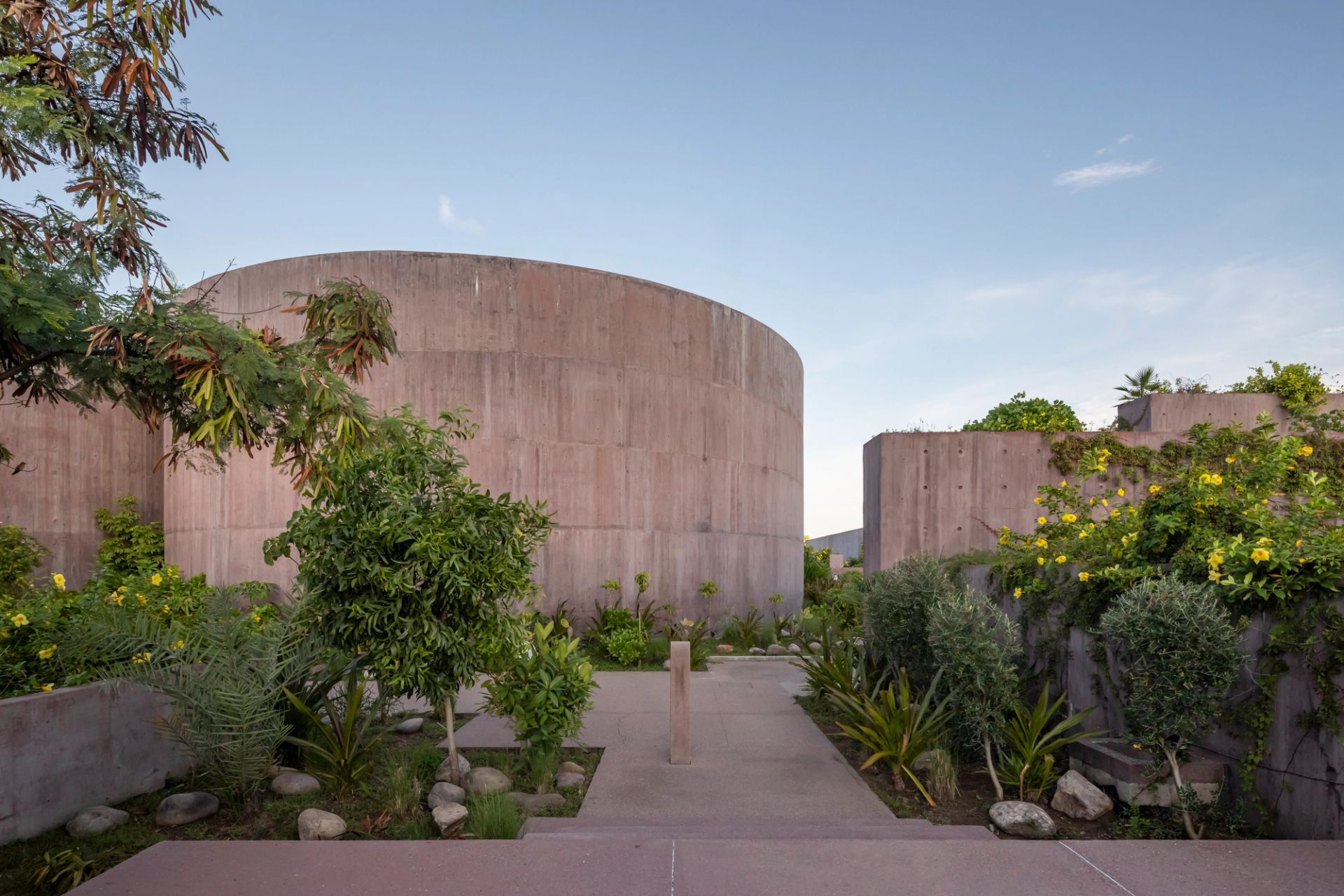
The second project "The Parliament of Thermal Justice" looks at Jamaica, where the heat is often oppressive and energy theft is widespread. More and more, developers build buildings unable to be passively comfortable in the name of cost efficiency and ‘modern architecture’, and tenants live with the exceedingly high cost of being cool. As such the design intends to explore a more thermally just architecture. The project is interested in creating site specific climatic interventions, searching for openness and adaptability. The political space, in this case responding to a competition for a New Parliament, presents an opportunity to dissolve the hierarchy and barriers created to accommodate mechanical cooling. Dissolving the barrier between interior and exterior will haveeffects on the way politics are shaped and the culture of assembly.
The project was developed at the Royal College of Art.
KOOZ What prompted the project?
AG The project was undertaken during my final year of my Master’s degree in Architecture at the Royal College of Art. My aim was to develop a project which highlighted the intersection between climate justice and social justice. This was inspired by the experience of the air-conditioned interior as a homogenous, divisive and increasingly prevalent space in my home, Jamaica. Thermal Delight by Lisa Heschoeng largely influenced my work; Heschoeng responds to the cultural effect of the thermal homogeny that has been created by mechanised climate control. She proposes that our culture is fundamentally connected to our local climate – from the clothes we wear, to the food we eat, to the spaces we inhabit – and that this diversity should not be designed out of existence for a thermally neutral world.
KOOZ What questions do the projects raise and which does it address?
AG Primarily, the project questions our current notion of comfort: standards emerged from air conditioner companies who placed young American males in a sealed box in order to find the thermal optimum for efficiency. However, more recent studies highlight the diversity of comfort based on gender and nationality. Furthermore, air conditioning ads were mostly targeted to hot humid climates, and often used imagery of persons of colour from developing or third world nations sweating in the heat, juxtaposed against white Americans in conditioned rooms. Pseudo-scientific philosophies of climate determinism claimed that the heat of these countries made the population unproductive and unruly.
Ultimately the project asks: is the sealed interior an ultimately biased space? As a reaction against the sealed box, the project proposes a porous Parliament, dissolving the hierarchy between the interior and exterior.
KOOZ You talk about buildings defining both an interior and exterior climate, could you explore this notion further?
AG Today, air conditioning is the norm in hot humid regions. The reliance on mechanical systems of interior climate control have resulted in homogenous architectural landscapes, a division of social space, and a disconnect between interior and exterior. Perhaps most concerning, this reliance on energy alongside the HFCs released by leaking units, significantly contribute to our current ecological crisis. The irony is of course that a thermally uniform interior contributes to an increasingly unpredictable exterior. Sasha Roesler, professor and architectural theorist, discusses the idea of the climate as a human artefact. While as architects we primarily consider the indoor conditions a structure might create, they also alter the exterior conditions – from the scale of the micro-climate to the macro-climate. My thesis proposes we consider buildings effect on both interior and exterior climate with equal weight.
KOOZ How does the project embrace and explore notions of “low-tek”?
AG Prior to the advent and proliferation of mechanical cooling, the built environment was often a direct response to the climate; its primary function to produce comfortable and resilient shelter. As such, the vernacular building approach presents ready to use climate solutions, which we have the opportunity to use and adapt in search of a more passively comfortable architecture. The purpose of this exploration is not intended to be anti-technology, but to acknowledge and consider the consequence of our current reliance on these systems. More and more, developers build buildings unable to be passively comfortable in the name of cost efficiency and ‘modern architecture’, and tenants live with the exceedingly high cost of being cool.
KOOZ What are for you the greatest shortcoming of our industry in relation to the climate crisis?
AG I think that within our industry, the greatest shortcoming exists within the education system. At the moment (at least in my personal experience), sustainability is not a key topic. It’s difficult, because sustainability is often complex and subjective.
While I hope that as an industry we all play our part in making a positive impact, I do believe that a lot of the shortcomings fall outside of the architectural industry. I say this because I believe many solutions are being and have been developed but don’t appear to be assimilated into standard practice. While architects and designers often create sustainable alternatives, they don’t always have the power to have these realised. I hope that political reform will force the building industry to adopt certain standards to make space for alternative solutions to be tried and tested.
KOOZ What is for you the power of the architectural imaginary?
AG I see the architectural imaginary as an optimistic reimagining of (and response to) our world. In an academic environment we have the opportunity and freedom to push the boundaries. With less restrictions, the imagination gives us unlimited expressions. While the Parliament of Thermal Justice would no doubt require adaptation to work in the real world, it presents idealistic aspirations of what a ‘thermally-just’ architecture could be in this context.
Bio
Amber Godfrey is a London-based architectural designer interested in sustainable and equitable design. Originally from Jamaica, Amber moved to the UK to study at Oxford Brookes University, and went on to spend two years at Michaelis Boyd Associates. During her time as an architectural assistant, she gained experience in residential, interior and commercial projects. Here she designed a built pavilion for the London Festival of Architecture.