London’s Night Time Economy is one of the most vibrant economies within the UK. The Mayor of London has recently put the economy in the public’s focus as a hope to maintain and increase the annual 26 million pounds revenue. However, many of its workers such as office cleaners or night time public transport drivers have been marginalized, neglecting much of their welfare and wellbeing within our society.
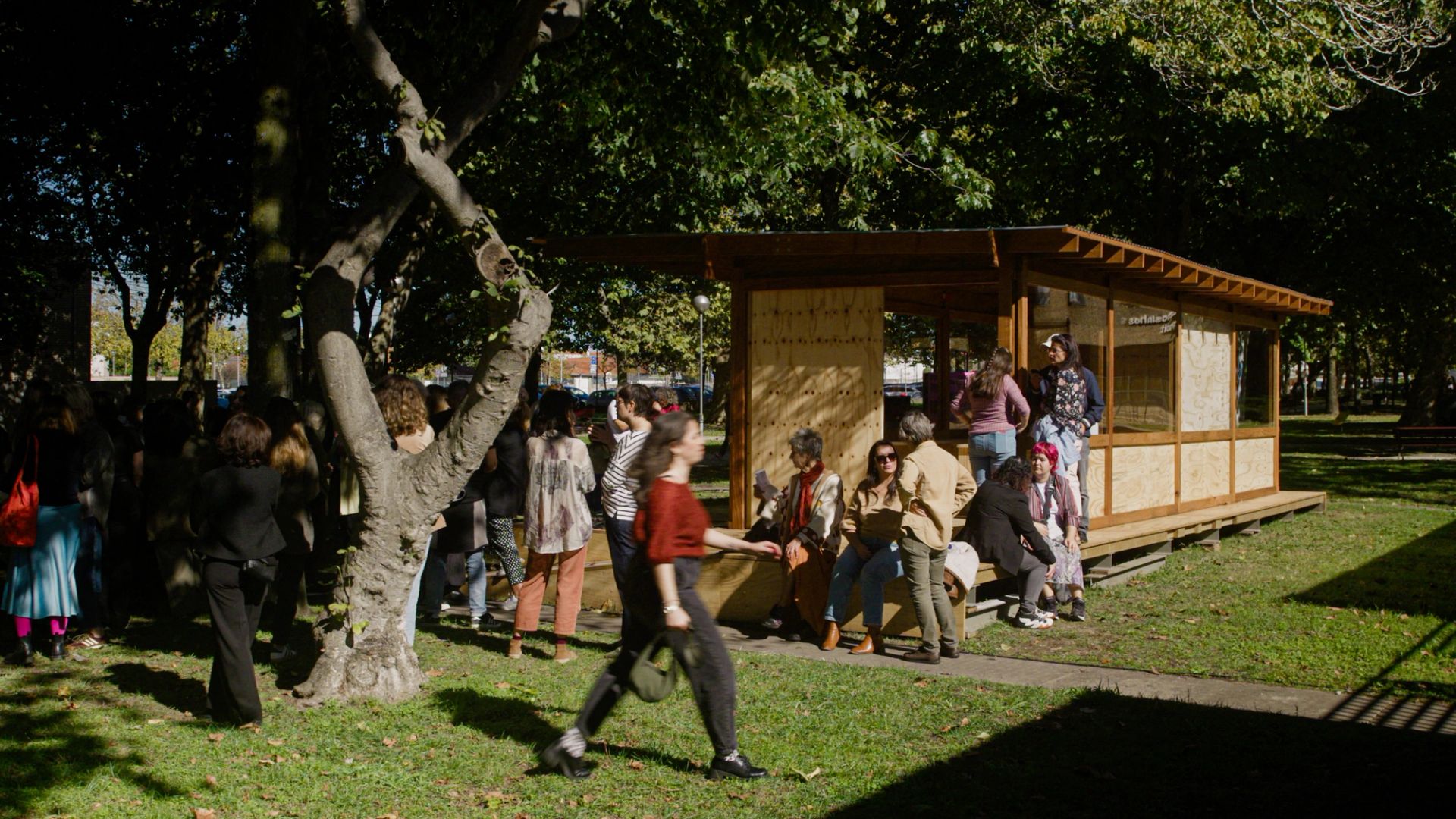
"The Midnight Communes" is a pilot program located at Marble Arch by the Night Time Borough Commission, a newly established group of people in charge of maintaining a healthy cohort of workers of the Night Time Economy. It is designed to not only provide support for the Night Time Economy workers but also introduce a platform to empower them and engage with the public for a better work/life balance. Through the design of lightweight, reversible pavilions with systems of inflatable roof structures, the Midnight Communes would provide resting and social spaces for a variety of Night Time Economy workers throughout Westminster.
The project aims to explore the different experiences of time through the night in aspects of materiality, social interactions and personal emotions. Despite being an infrastructural themed, it also acts as a potential template for other similar Night Time Economy boroughs throughout London such as Camden or Hackney.
The project was developed at the Bartlett School of Architecture.
KOOZ What prompted the project?
SW It was during the discovery that many of London’s public spaces, especially the ones in the city center, are mainly deserted at night. There was a stark contrast between the public spaces during the day with people with day-time jobs and the public spaces during the night with people with night-time jobs. The public spaces would often be used during the day by office workers or the general public for leisure activities but when it comes to night time, these spaces are often abandoned or even closed for safety reasons. Safety is one of the main reasons that many of these public spaces are inaccessible during the night and as part of the Mayor of London’s annual plan, it was proposed to improve the safety at night to help bolster London’s night time economy, which contributes a great deal to the UK’s overall economy.
However, I believe by revitalising these public spaces at night would counter-intuitively increase the night time safety of these spaces and allowing the public to use them again.
KOOZ What questions does the project raise?
SW I think primarily, it would question the amount of welfare and support that people who work in the night time economy receive in general. Many people would associate a “night time economy worker” as those who work in the leisure and hospitality sector but for the most part, there are a lot more people working in transportation, logistics and maintenance sectors. These people are often marginalized when it comes to policy-making as they’re not the ones that make it to the headlines most of the time. They’re the ones that help clean up after a busy night, the ones who bring night-time goers back home and the ones who make sure that shops are stocked for the next morning. It’s interesting to investigate the kind of lifestyle that one has to adapt to because the majority of their working hours are in the social hours of those who work during the day. What kind of needs and desires would they have to improve their work-life balance? Would they benefit from a collective of social spaces for “night-owls” of the city?
These people are often marginalized when it comes to policy-making as they’re not the ones that make it to the headlines most of the time.
KOOZ How did you approach the design of the project as a series of pavilions?
SW By using a series of pavilions, it would take advantage of the large public spaces that are available during the night, in this case for the project, at Marble Arch. The idea was to create a carnival-like design with different pavilions for different programs and they would be designed to be light-hearted and relaxing. It would almost be a communal hub for these workers, giving them a wider public space rather than convicting everything down to a single building. It also keeps these programs on the ground level, which allows more interactions between pedestrians and the users of the pavilions. The close proximity to passersby could make it even more inviting to those making their way home or just on a short break.
KOOZ How do these work individually and as a network?
SW I’d like to think that each of these pavilions are able to provide a unique experience for their users, whether it is a social space for drivers of public transport or a shower house for the general public. As a network, they would also complement each other in the way that one person can utilize this entire space as a journey. For example, they could join a workshop held at the auditorium before going for a shower at the shower house, then if they’d like they could take a quick nap at the napping station next door and head home for a proper rest after getting tomorrow’s breakfast at the on-site coffee shop. The pavilions are there for the public to plan out their journey however they wish.
KOOZ How does the project approach the role of architecture within the contemporary city?
SW With more and more cities trying to become 24-hour cities or “the City that never sleeps” like you see in New York or Hong Kong for example, it would be helpful to attempt different strategies in trying to invite those that are marginalized back into the community and design with them. We can also take advantage of these unused public spaces that were designed for the day and inject a new life into them and give them a different character during the night. Of course with the rise of privately-owned public spaces being more apparent in the contemporary city, it increases the difficulty for pavilions to be built because these public spaces are now designed aesthetically rather than for the public. Therefore this project tries to introduce reversible structures and designs that could essentially “move out” of the space if need be.
The project and concept itself that I am proposing was intended to be a pilot program for Westminster, a borough of London with the largest night time economy community, but the future of it could be expanding towards other boroughs and neighbourhoods that are also filled with night time businesses. There could be multiple of these “Midnight Communes” across the city, all of which could be tailored for the benefit of not only the workers in the area, but also the general public, as a means for them to understand the lifestyle of those who work in the night time economy.
KOOZ What is the power of the architectural imagination?
SW Imagining things architecturally could essentially be imagining what life would be like if we were in a particular design of an environment. It would be about storytelling, and it doesn’t even have to be explicitly architectural. It’s argumentative to think whether architecture correlates to everything we do as a lifestyle, but nonetheless the thoughts that are provoked from trying to imagine such things would inherently allow us to generally rethink our actions. Whether or not every project is realised is irrelevant because what is relevant is the fact that we have told our story to someone who wanted to listen and that alone, would be enough to plant a seed of thought or idea that could blossom into something probably even greater and better than what the project originally intended. That, would be the power of the architectural imagination.
Bio
Simon Wong (Simes) is a Masters of Architecture (Part II) student at the Bartlett School of Architecture, UCL. He studied his bachelors at the University of Hong Kong before working for a couple of years in the city, specializing in mixed-use complexes. During his free time, he would create digital illustrations of both flat illustrations and isometric drawings. He is particularly interested in landscape drawings and integrating architecture and a derived lifestyle into his drawings.