The ‘Taxonomy of Living’ aims to build a more humane understanding of the home, examining the micro-and macro-politics of domestic space, focusing on health and wellbeing, sustainable development and responsible consumption. The way we work, socialise, and live has changed profoundly – each activity not necessarily occurring within a designated space, instead the boundaries between interiors and exteriors becoming far more diffused. Using Lubetkin’s Cranbrook Estate as a case study, this project presents an alternative view for this modernist development. Embracing this collapse of boundaries, the remodelling of mid-rise building Harold House interrogates how, within co-housing developments, balance can be achieved between shared and private spheres and supported/independent modes of living, while respecting the architects’ intentions where appropriate. Tackling issues surrounding London’s chronic housing shortage, increasing levels of loneliness and the shifting notions in the way we live, the renovation will focus on creating a co-living block centred around 3 concepts: a shift towards sharing, a diffusion of boundaries and architectural agency and empowerment.
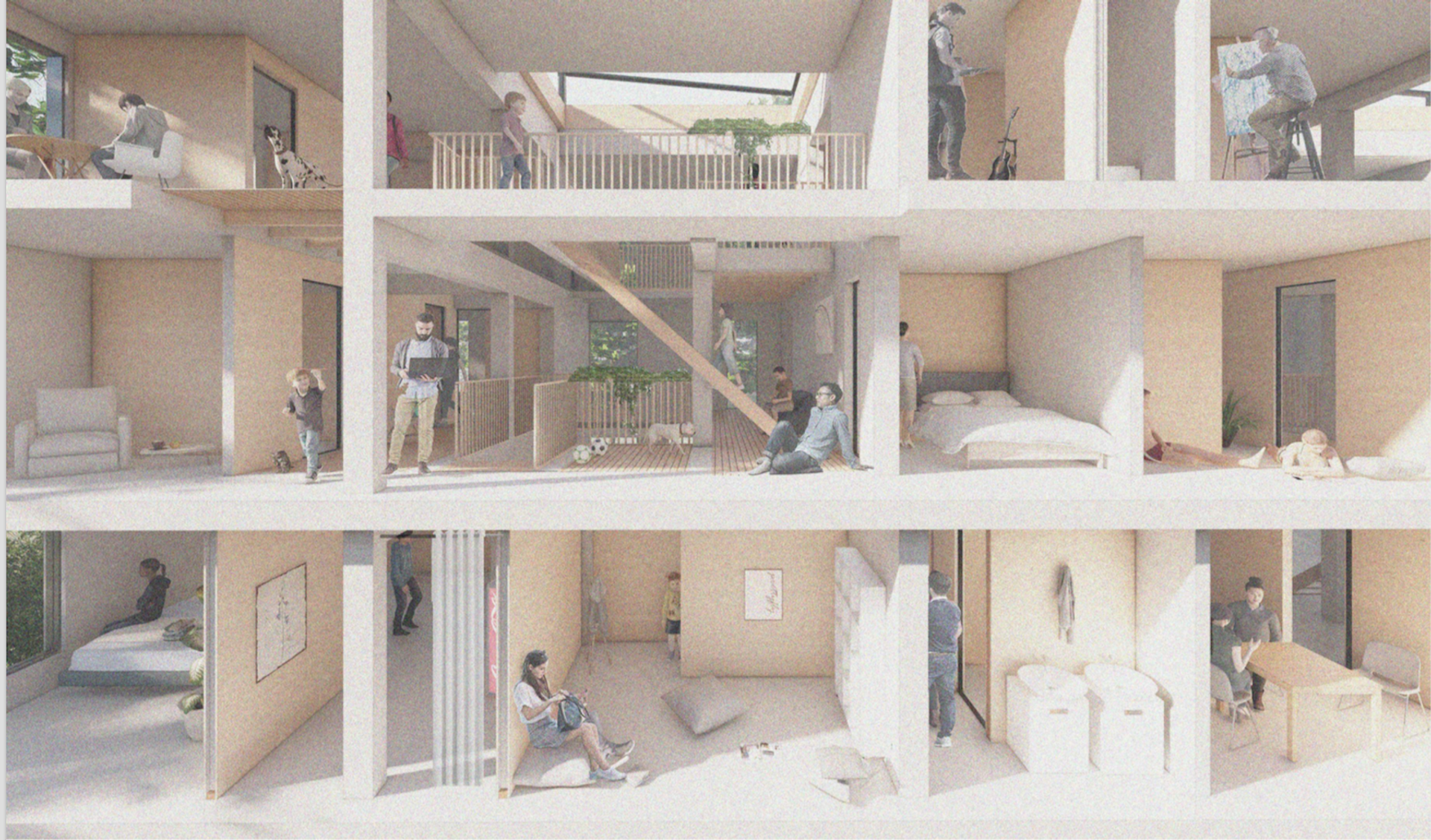
The interiors for the shared block generate a sequence of legible, light, uncluttered spaces that are vertically and horizontally connected via a central atrium like collection of shared spaces & light perforated walkways. These are surrounded on the periphery by a series of generic rooms allowing for appropriation by the resident, the room size based on a revised ideal standard minimum for the private spaces. Voids are created between the shared spacing maintaining visual and acoustical connection to the communal spaces on each floor.
The project was developed at Central Saint Martins and won the Spatial Practices Award.
KOOZ What prompted the project?
SM The initial impetus for this project arises from a concern as to why we have moved away from co-living models and towards individual homes especially in cities such as London where chronic housing shortages, surging rental prices and increasing levels of loneliness desperately point to the urgency in exploring alternate modes of living. Of equal relevance to prompting the questions raised by this project are the cultural, political, technological and other relevant shifts transforming the social fabric of the city and the impact these shifting notions have on the way we live. From co-operative housing to the rise in self build to the enforcement of the Addison’s act to Margret Thatcher’s right to build to the advent of smartphones, to the embracement of the shared economy to Airbnbs the way we live has drastically changed. Unlike mono functional cities which separate residential, commercial and leisure activities, lockdown has proved that this functionalist approach no longer applies to our domestic settings where the separation between home, work and play has dissolved – each activity not necessarily occurring within a designed space. Instead the boundaries defining public and private, indoors and outdoors are far more obscure and our spaces, more than ever before, need to be flexible and adaptable to our changing needs to support more desirable ways of living.
Through the examination of my own domestic setup and after conducting series of interviews with residents from Cranbrook estate itself I realised that the transformative power of architecture lies in understanding that the needs and possibilities of each of us are different and my architecture should not be prescriptive. This prompted the development of my project towards reinforcing the agency of architecture – providing a platform for certain activities to occur but not defining every activity within it such that the spaces are adaptable, flexible and allow a degree of appropriation such that the residents can make it their own.
KOOZ What questions does the project raise and which does it address?
SM Each of the three concepts I was exploring hoped to raise and address a distinct set of questions aimed at challenging conventional ideas surrounding domesticity. The primary questions I asked myself instrumental to the narrative of the project were – ‘to what extent can a tenant participate in the process of homemaking? what makes a space – objects or architecture? and who are we privileging or disempowering in our current residential setups?’ Another question crucial to the exploration was ‘what are the limits of the home?’ When examining the value of returning to past models of co-living to combat increasing levels of loneliness and support new modes of living I asked questions such as ‘Is shared living better living? How can balance be achieved between communal & private spaces? How can we empower people to make more meaningful human connections?’ I consistently asked myself what it takes to successfully create a dialectical relationship between the past present and future. ‘How could I transform and reactivate spaces to meet contemporary needs whilst ensuring that the original features and history of the building are equally celebrated and respected?’
The resolution of the project responds to different aspects within each of these questions – understanding the home as a diffuse and flexible space with a minimal structural transformation aimed at empowering people to adapt the space according to their needs. For instance, the undefined function of the generic private spaces allows the residents to appropriate the space as whatever/with whatever they desire delving on the object/architecture question as well as addressing the degree the tenant participation, empowerment and control by the user. To cater to the needs of growing families these generic rooms are adjoining one another such that such that simply breaking an interior stud partition allows them to expand their private space in case of need, here addressing the flexibility and limits question. To prevent privatization of spaces, the extensions arise only from the shared spaces and can be used by all residents of the affording the same privileges to every resident. The limits of the home are further expressed in the ambiguity of the boundaries between the public and private the generic rooms designed to feel like extensions of the communal spaces which themselves are designed to encourage spill overs and chance interactions.
KOOZ What drew you to explore Lubetkin’s Cranbrook Estate volume as a case study? How relevant is this within our contemporary community?
SM The UK has the oldest housing stock in Europe. The UK housing standards need to drastically improve to meet the UN net-zero target by 2050 and adapt to contemporary ways of living. Council estates particularly are constantly under threat of demolition, radical redevelopment and fights against privatisation often due to lack of maintenance, misuse of spaces and outdated living standards.
Cranbrook estate is representative of one of these many council estates which whilst may have been built with grand visions and utopian ideals of creating an equitable housing development is currently insufficient to support the ways of life of its 21st century residents. On analysis the spaces are revealed to be rigid, restrictive, inflexible and entirely defined with each typology within the estate designed to attract a specific age group. These issues with Cranbrook estate are deeply relevant as they are contingent with those experienced in a number of different estates across the UK and hence has been chosen as an exemplar. While the architect Berthold Lubetkin’s intentions for the estate may have been appropriate for the 60’s (when the estate was built), the estate today requires rethinking. As such, there is a need to examine how the design of such council estates and housing in general meets our contemporary needs, responds to the current global ecological and health crisis, and allows us to reconnect with others -both humans and non-humans. In the wake of the current declared climate emergency the solution a lot of times is working with the existing through a careful balance between conservation, refurbishment and extensions. The strategy I have relied on for the project could be applied to many other council estates across the UK. The remodelling focuses on mapping strategic conservation and dynamic new design on the same space through minimal structural changes aimed harmonising the old and new whilst putting social, cultural and economic value in social housing all of which increasingly relevant to our contemporary community.
KOOZ How and to what extent has the current pandemic affected the way we design and inhabit our domestic spaces?
SM In 1884, Karl Marx wrote of his concept of ‘alienated labour’. This alienation was categorised into four types: alienation from nature, from other people, from our work and from ourselves. These four forms of alienation, so relevant today, are essentially connected to the countless ecological, health, social and political emergencies that we are facing. With the current pandemic, our domestic spaces have proved to more important than ever before. The way we live has changed dramatically – people beginning to question what makes them feel comfortable and what what it takes to live and share their daily spaces. A single room or space can be used simultaneously as a temporary school, bar, gym, a place to work, rest, eat or spend time with friends. Consequently, the reality of lockdown has affected the way we design our future domestic spaces for one our homes will need to facilitate multiple uses – majority of our daily activities now occurring within our homes itself. There is a call for flexibility and adaptability in the design of homes. Access and connection to outdoor spaces has also become an invaluable asset to any domestic setup. While for some there is a need for increased privacy; for others struggling to live alone, private spaces would readily be given up for the luxury of connectedness. The home is the space to start our de-alienation – each of these factors greatly impacting the how future domestic spaces will be designed.
The home is the space to start our de-alienation.
KOOZ What have been the more and less resilient elements of the home?
SM More than water resistant materials and robust structural systems, there are elements of the home which stand through the test of time. For me, these are are feelings and experiences which are intrinsically and indelibly connected with the spaces we frequent. There are a lot of random elements which contribute to to the feeling of ‘home’ for me – the trust and security I feel with my flatmates; the sound of the ocean; my most frequented playlist; conversations over the dining table; and the pure bliss of sipping a hot cup of tea. These constituent elements evoke the meaningful resilience of a home. They are readily transferable, and can be carried with me wherever I go. They are elements which give me a sense of security and self assured contentment – irrespective of external circumstances.
KOOZ What are for you the greatest opportunities which can arise and re-imagining the home today?
SM Reimaging the way we live, work, dwell and share the spaces that exist in our cities today unlocks limitless possibilities in how we build for tomorrow. There is a need to move beyond ingrained constructs and re-evaluate the very meaning of the home and what it means to us – who said a bedroom has to be a room in which there is a with a bed or a dining room one in which there are tables and chairs? The home today is in a constant state of flux and reinventing the way we think and design such spaces allows us to create a more egalitarian society – cities in which spaces have a positive impact on the peoples well-being and where people want to live and spend their time. The reinvention I speak of here doesn’t need to be daringly unique but simply needs to acknowledge that each individual is different and consequently a one size fits all model of housing holds little relevance.
Bio
Saamia Makharia is an architectural designer who’s work strives to understand the spirit of the places we build by constantly questioning the norms of spatial production through a heavily process driven and experimental approach. Her creative process relies upon establishing synergies between art, architecture and the world valuing both the extrinsic and intrinsic parameters that define the built environment. Originally from Mumbai, Saamia moved to London to study architecture at Central Saint Martins where she recently completed her RIBA Part 1. Her graduate project ‘Taxonomy of Living’ where she explored alternative models of domestic space following strategies that have a positive impact on people’s well-being was recognised for the ‘Spatial Practices Award’ at CSM and has been nominated for the ‘AJ Student Prize.’ Her previous work and BA dissertation focused on her interest in the role urban planning directly plays in exacerbating inequalities within the city and how these can be addressed to create an egalitarian society.