"In the Name of Resilience" is an urban response to the different crises that are currently ravaging the city of Beirut. In a context where the population’s wellbeing is completely disregarded by the State, this project rethinks the nature of infrastructures of care by building a network decentralised interventions on small inconstructible parcels dispersed across the urban fabric. By providing care on a very local and human level it exposes the population to the possibility of an alternative Social Contract revolving around the wellbeing of the citizen.
This project proposes an alternative architectural paradigm, focused on care rather than profit, centred on people rather than capital, built with intelligence rather than arrogance. It is a collaboration and a conversation with different actors of the dynamic civil society of Beirut. It brings different people, ideas, and resources together to propose a network of spaces catered for the civic, social, and humanitarian needs of the different neighbourhoods of the city.
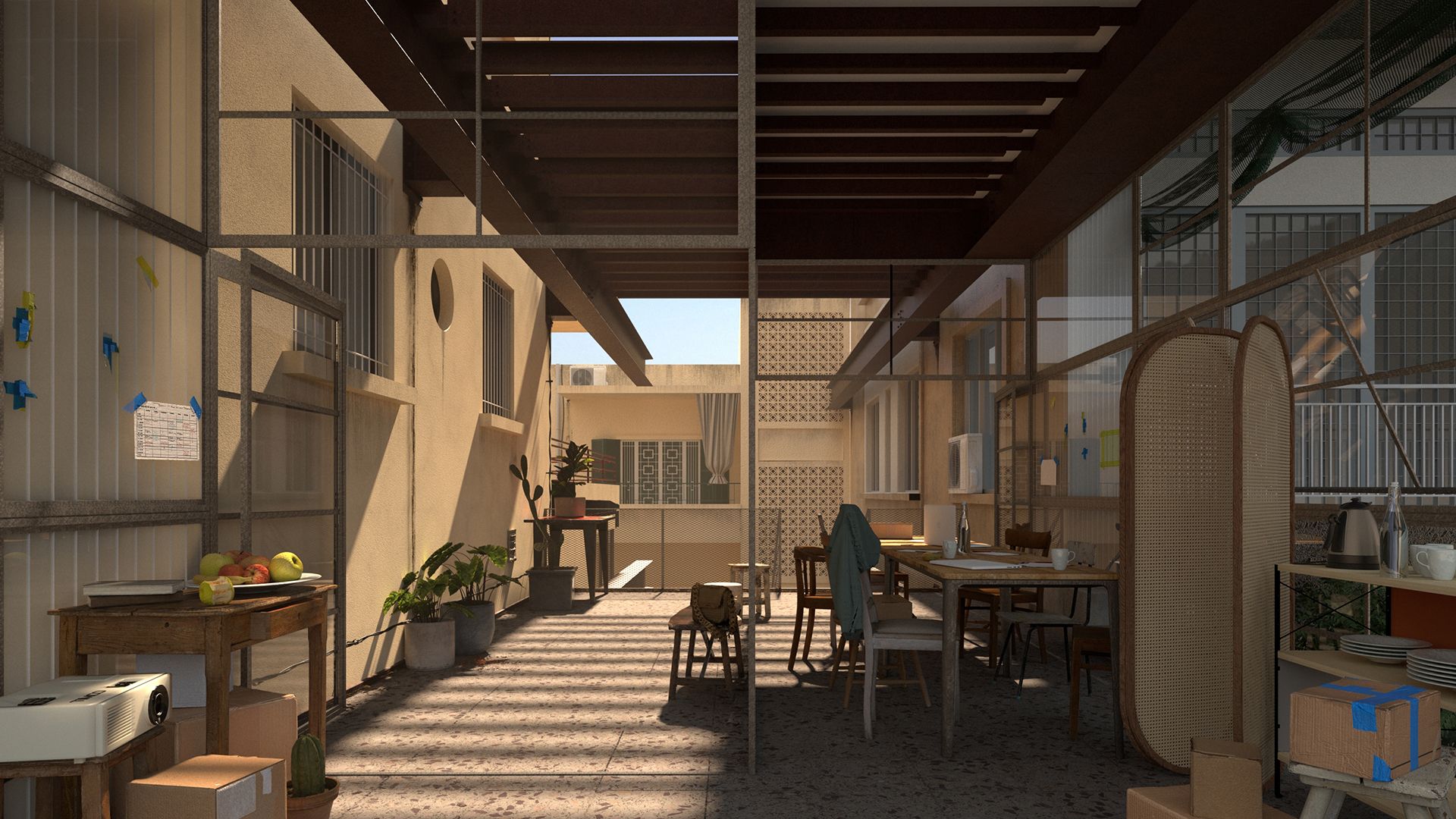
The proposed interventions explore design strategies to navigate through the ‘inconstructibility’ of the parcels. Ignored for decades, these parcels are unlocked for the rapid construction of different structures that vary in function and size to support a wide variety of services - such as medical or legal consultations, economic or mental health support, and cultural or political disruptions. By retaining a distinct architectural language that signals the presence of care throughout the city, architecture here becomes a key ingredient for change.
Through this network of highly frictional infrastructures, an environment of care for the citizen is overlaid on the urban fabric of the city, as a response to the collective anxieties of living in this uncaring neoliberal city. This sets an important precedent for the potential future development of public infrastructures while introducing a much needed social safety net to the population, amplifying voices that need to be heard and increasing the right to the city. Following a series of tragic events that have brought my fellow Lebanese citizens to their knees, I hope that this project can materialise and lead to the creation of pockets of light, spaces of hope throughout the city of Beirut. I hope it can help it recover and grow as a city of greater care and inclusivity, while encouraging its population to finally look forward to a tangible future that can bring tolerance and peace.
The project was developed at the Architectural Association School Of Architecture.
KOOZ What prompted the project?
PG This project is a response to the frustration that I share with many Lebanese citizens about the concept of ‘resilience’. In fact, in Lebanon, resilience has a peculiar relationship to History, as it engraves memories of past traumas on the collective memory to instil a fear of change and ensure the sustenance of a regime that sources its power in these exact traumas. Indeed, an extremely violent civil war, that lasted from 1975 to 1990, with no proper closure, has devastated an entire population that is today kept under the constant spectre of future potential wars. Out of this narrative comes the concept of resilience that justifies an array of micro-aggressions that have been forced on the population ever since - from extreme poverty and recurring violences, to a lack of social infrastructures and repeated politico-economic crises - that culminated in recent months in the monstrosity that represented the explosion of the Port of Beirut on the 4th of August 2020.
This is exactly what the discourse of resilience is about; attempting to convince a population that life is a never ending process of constant adaptation to crises and threats that are said to be out of its control. It is about thriving in times of continuous chaos while maintaining the compliance with a narrative that justifies the disengagement of the state and its institutions in favour of a subjective response to crises.
KOOZ What questions does the project raise and which does the project address?
PG This project argues that resilience prevents social and political change in Lebanon, through constant acceptance of, and adaptation to situations of crisis. But with a growing awareness and an increasing refusal of this concept of ‘resilience’, this project asks how the resilient means of the population can be channelled into a civic infrastructural system that can start to generate change at the grassroot level. To combat the current neoliberal system that thrives on vulnerability, it is imperative to convince the general population that an alternative revolving around care is viable and palpable, in order to then engage in the democratic process of political change. And Lebanon is in urgent need of a politics that puts care front and centre. So how could architecture contribute to materialising this politics, to putting care at the very centre of urban life?
This project rethinks the nature of infrastructures of care in Beirut by building a network of localised, and decentralised interventions on small parcels dispersed across the city. Because in a context where care to society is completely absent, providing spaces for the citizen to be received with non- commercialised care exposes the possibility of an alternative Social Contract, and can start to impose new expectations from public infrastructures that can then generate change.
Providing spaces for the citizen to be received with non-commercialised care exposes the possibility of an alternative Social Contract.
KOOZ What informed the city of Beirut as the site of the project? How did you approach the research and mapping of this?
PG It is a project that was born from the unique social and political context of Beirut, and was developed for the specific needs of the population of the city. In its current form, it could hardly be replicated elsewhere. I would describe it as a primarily social project for Beirut, and its architectural manifestation is only the product of the social necessities of the city. In that regard, I had started the project not with an architectural aim, but rather with a social and political goal that gradually shaped the architecture of the proposal. It was a careful navigation through the spatial qualities of the city, the legal regulations, the political challenges, and the social and humanitarian needs. The approach to the urban fabric of the city was therefore one that looked for the best spatial opportunities, through legal loopholes, for the most adequate provision of non-commercialised care.
This project is informed by the invaluable literature developed by Lebanese scholars on the historical evolution of urban fabric of the city of Beirut, and the challenges and qualities of its current state. But it’s a project that sources its drive primarily in its conversation with urban planners, designers, activists, and more, that inform and ground the project in the current social reality of the city. Out of these different exchanges, the understanding and mapping of Beirut, and the design and function of the proposal were kept in a continuous state of change, constantly absorbing new information and morphing according to their implications.
KOOZ How do the proposed interventions operate as single entities and as a city network? How do they support individual local communities?
PG On a territorial scale, this project operates as network of small interventions collectively acting as an oversized and decentralised care centre for the citizens of Beirut - visible, accessible, and free of charge. By democratising care to every single citizen of the city, regardless of the class, religion, or political affiliation that currently determine the divisions of Beirut, it serves to unite the population under one single framework that can start to become an important precedent for the potential future development of public infrastructures in Lebanon.
But while this project overlays a much needed environment of care for the citizens over the entire urban fabric of Beirut, the proposed interventions are rooted in the specific social and humanitarian realities of the different neighbourhoods they sit in. Their function is therefore curated for the immediate needs of the population of their respective zone of influence, providing urgent humanitarian support in poorer neighbourhoods, or simply introducing spaces for civic conversations for those less in need, for example.
But from the singularities of each of Beirut’s neighbourhoods, the proposed network of spaces emerges as one that transcends the divisions of the city by engaging with the very dynamic and diverse social civic movement that recently emerged across Beirut. By providing the different organisations, charities, and initiatives with this multitude of spaces across the city, this project aims at expanding their reach beyond their current regions of operation, to allow them to touch and influence a greater diversity of people. It therefore links the different fringes of the population under one infrastructure that exposes them to different political views and alternatives social realities in an attempt to break the dependency on the politically driven aid and propaganda that serve the sustenance of current political elite, preventing any possibility of change in the country.
The proposed network of spaces emerges as one that transcends the divisions of the city by engaging with the very dynamic and diverse social civic movement.
KOOZ What defined their positioning around the city of Beirut?
PG Their positioning around Beirut is mainly driven by the need for accessible care for every person that lives or works in Beirut. A standardised grid - within which each square is assigned an intervention - is therefore overlaid over Beirut for the provision of care within less than 10 minutes by walk from any location in the city. While a grid might evoke outdated modernist ideas for western eyes, in Beirut, the grid serves to introduce a much needed standardisation in the provision of social services that is today hijacked by the different political parties that source their power in the social, political, and religious divisions of the city and the country as a whole. It forces the repositioning of the State as the sole legitimate provider of social services to the population without any distinctions.
The project specifically looks at so-called ‘inconstructible parcels’ - defined by the law as too small, or too odd in shape to be built on - as potential sites for the interventions due to their current lack of profit that renders their mobilisation favourable for the provision on non-commercialised care across the city. Their very large number and their deep reach within the urban fabric furthermore presents them as suitable sites for the democratisation of care in Beirut. This project therefore explores design strategies for the construction of light but permanent infrastructures to work around the non-constructability of these parcels.
KOOZ What is for you the power of the architectural imaginary?
PG In Architecture and Disjunction Bernard Tschumi writes, "Architecture and its spaces do not change society, but through architecture and the understanding of its effect, we can accelerate processes of change under way."
This quote was the main grounding element of my project in it early days, and is what very much defined thepositioning of it throughout its development. It pushed me to define the change in which it situated itself and identifythe actors it would work with: it was a project that would accompany the emergence of the unprecedented social civic movement that is providing the desperately needed social services that the State was unwilling to provide to its citizens, in order to assist the determination of a new social contract in Lebanon.
In that regard, the power of the architectural imaginary in this project lies in providing the actors of change and thepopulation they target with a visualisation of the idea of an alternative Lebanon onto the urban fabric of its capital. It helps assisting this change underway by imagining and planting the seeds for the materialisation of this idea as spaces that centre the narrative around the people as the providers and beneficiaries of care, allowing both to find their place in this potential future urban environment. This architectural imaginary visualises hope as spaces that repositions Beirut as a city of greater care and inclusivity, while encouraging its population to finally look forward to, and act towards a tangible future that can bring tolerance and peace.
Bio
Philip Gharios is a multidisciplinary designer and researcher from Lebanon that graduated from the Architectural Association in 2021 with Diploma Honours.
His practice is informed by trans-disciplinary interests revolving around the tensions between the social, political, environmental, and humanitarian fields, in an attempt to explore the potential of architecture in the generation of change across different societies. His current focus is on a long term project that aims at deconstructing the neocolonial and neoliberal concept of ‘resilience’ in order to use architecture as a resistance tool that can empower grass-root initiatives and enhance societal change.