

Based on the need of exploring and rethinking the way how the field of architecture has been continuously developed, as well as the constant need of human beings to be changing and updating the processes in which they operate and that somehow they demand the ‘monotonous’ in terms of representation and design, the idea of reformulating these processes to generate new and advanced ways of thinking is brought into discussion in this course. The thought of reversing these processes is formulated, reimagining the discourse of contemporary architecture dominated by a mixture of digital and analog, both in theory and in practice. It is also within this discourse the development of a new form of representation of matter in the evolution of the post-human, seeking and deepening the correlation and non-correlation between the physical and the digital, the past and the future, the permanent and the temporary, the real and the fiction, the theoretical and the practical.
This is called by Bruno Latour "materialism" as an idealist definition of matter and its various agencies or what can be also called by Laruelle a mixture of ontologies as a non-correlation philosophy, which can only be achieved generating a new way of thinking, breaking certain parameters to which the human being is familiarized, as well as unlocking and revealing new meanings of those that may be hidden and have never been explored or analyzed before. For this reason, the coherent relationship between new ways of representing architecture in this course comes also into discussion: the compilations of services or functions in dense, complex and convulsed urban sectors (clusters) – focusing on their complexity in the city of Bogotá as a new ontology of representation. The Latin-American city and, specifically, the large capitals, compress services or functions in dense, complex and convulsive urban sectors. These apparently monofunctional sectors have specific characteristics and a series of singularities that give it coherence and consistency as a Cluster.
The diversity of these areas refers to activities such as automotive (I.e.: 7 de Agosto in the case of Bogotá), carpentry / furniture, universities, financial, art or health, even small antiques enclaves or large market clusters (Gamarra, Lima; San Victorino, Bogotá), among others. They are constituted as a series of associative relationships that coexist (i.e .: mechanics, brass workers, painters, spare parts sellers, etc.), as a part of the same social, cultural and economical ecosystem. The approach of the studio will be from the reflection of urban renewal starting from the understanding of these clusters, to propose from the architecture the transformation of these territories. Based on these ideas, we propose to challenge the idea of architecture as an landscape infrastructure that enhance the future of our cities. Is it possible to define a Hyper-Clusters as a result of enhance, mix, densify, hybridize and reformulate some of the current monofunctional sectors? Is it possible to alter, transform and make these territories sustainable and diverse? Is it possible to re-program the soil? The idea of the Hyper-Cluster is ultimately an exploration from the informed architecture and the research trough design speculations.
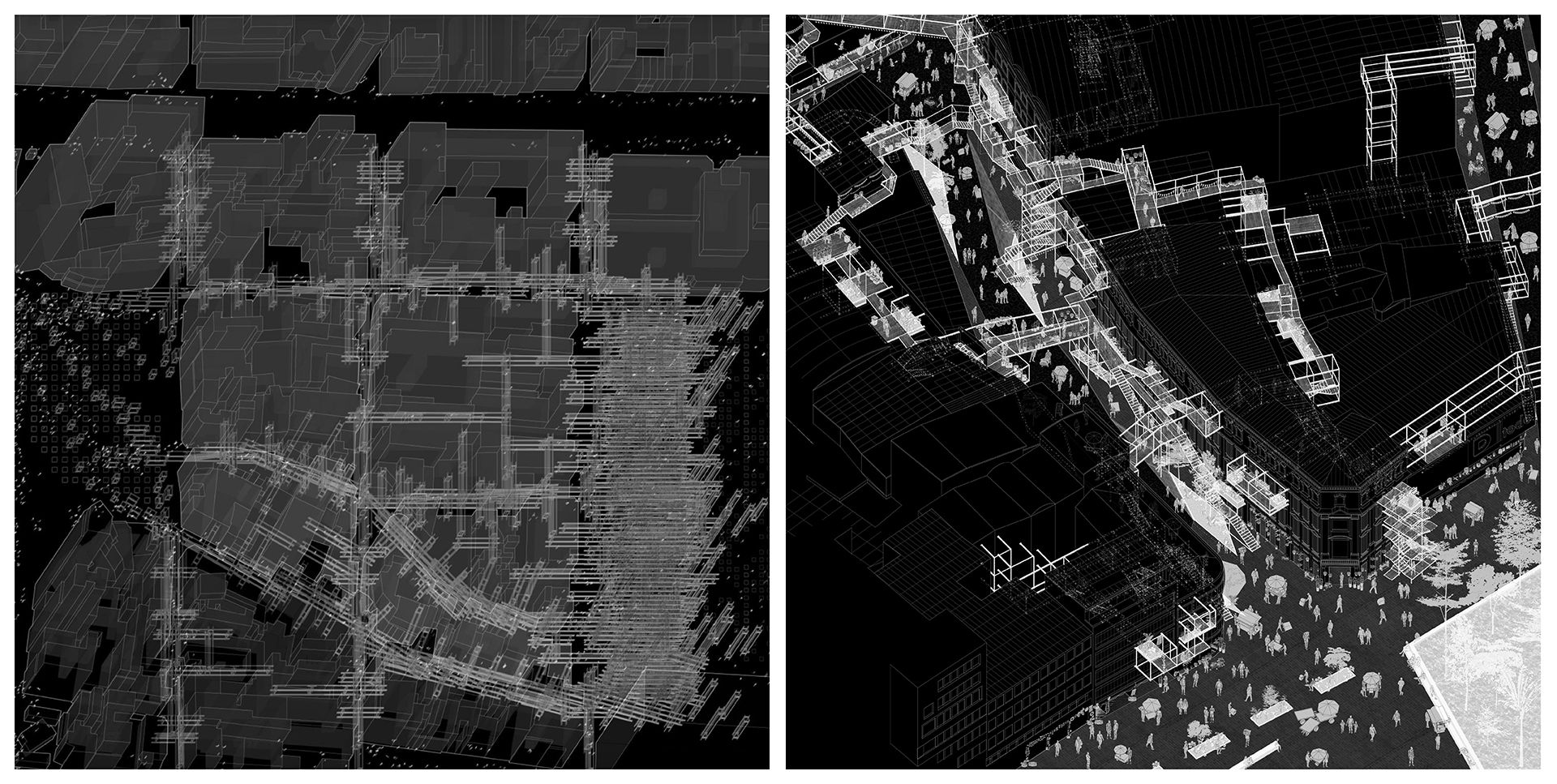
Operating from the complexity allows architects to speculate on the future of the city but at the same time to investigate and speculate on how complexities can be approached and represented. It is for this complexity composed of parts, successions and groupings, in this course students investigated as part of the research process through a type of compound representation or Hyperimagery, based also on Bergson’s argument “matter is an aggregate of images” and as a term initially used by Peter Sloterdijk as “a hyperimagery makes our highly artificial, highly abstract world accessible to a no less artificial contemplation”.
Seen from this perspective, a hyperimagery synthesizes an accumulation of complexities in a single way of representation. This is why the materialism of the recent past now looks so idealistic: it takes the idea of what things in themselves should never stop staring at the way that makes them ‘resemble’ in their geometrical reproduction in drawings. The whole notion of mechanism is a twice-idealized definition of the way we know and of the behavior of what we know. Although the conventional system of representation is left down in the way that it is limited only to a flat image, where the three-dimensional volumetric fails and loses its quality, the images generated allow the initiative to the representation of three-dimensional flatness as a single unit retaining both volumetric and flat qualities.
The objective of this core course was primarily to speculate and represent the complexities of the city in a particular way, generating a representation composed for both physically and digitally, synthesizing using unique techniques of each student for their project and part of their discourse and research, but at the same time replicable in other similar conditions through theoretical, practical and visual means. The explanatory diagram conceptually tells what is intended to be done in their projects, including abstract conceptual ideas, volumetric iterations, project programs, visualization, exploration and research. Using advanced modeling and representation techniques (solid projections, image extrusions, remapping, image manipulation, data collection and post-production techniques) the students represented as a new normal collision of concepts their projects in which multiple layers of information were compiled in a unique diagram as the engine and strategic point of the investigation.
The course was developed within the context of the Universidad de Los Andes in Universidad de Los Andes in Bogotá, Colombia.

KOOZ What prompted the line of enquiry of the studio?
DA | CR The study focused its attention on the investigation of different urban clusters of the contemporary Latin American city and to understand architecture as a trigger for transformation opportunities of these places, in order to turn them into hyper clusters. Hyper-clusters can only be understood from their complex spatial, cultural and economic understanding. This is why hyper-imagery exercises seek to reveal hidden conditions, unlocking complex systems, that allow the production of architecture as a support infrastructure for the city and its cultural, economic and environmental conditions.
The objective of this core course was primarily to speculate and represent the complexities of the city in a particular way, generating a representation composed for both physically and digitally, synthesizing using unique techniques of each student.
KOOZ What questions does the studio seek to answer and address?
DA | CR Is architecture to be thought of as an infrastructure of social, cultural and economic support for complex sectors of the Latin American city? If there is such a notion of urban or architectural infrastructure of a public nature, which agents should be attended to determine the different responsibilities of the project. In this sense, the analysis of the complex systems that operate in the reality of certain urban sectors must be confronted with the emerging properties of architecture operating in them. Questions such as: Representing and understanding time can be the element to consider to design the transformation or change in certain urban clusters and convert them as hyper clusters? Is it possible to make an architecture whith responsibilities including the restitution of certain social or ecosystem services?
KOOZ How does the studio define the notion of city?
DA | CR From the previous questions or sub-questions, what we do have clear is that the binary considerations of “public” or “private” are increasingly blurred … at least in large Latin American cities. The clusters determine the programmatic efficiency in the use and speculation of land, building large sectors of functional homogeneity, without a doubt, positioning themselves as a great opportunity for urban transformation or renewal. We proposed as a starting point a city defined more by cultural, social and origin diversity than by functional homogeneity.
KOOZ How does the studio approach the site of Bogota?
DA | CR Bogotá, like other large cities in the country (and in Latin America) have a very similar base or social structure. We face the same challenges. It is an urban mega-structure made up of more than 10 million inhabitants. Complex, emulsified and convulsed, they can be three adjectives that define the Colombian capital city, which at no time should be understood as pejorative definitions. In fact, it is these same characteristics that give architecture and its representation a sense of opportunity and operational work. The study determines the question of identification of various mono-functional clusters, to later reveal the potential for work and transformation from revealing their most hidden human, spatial or environmental values. Let’s not forget that this workspace is formulated as an open question about the future of our cities, with its unique challenges, but always taking as a starting point what exists, the way in which certain agencies operate, the potential environmental wealth or the most complex challenges from the spatial point of view.
Many of our cities do not have land available. They continue to grow as a great urban sprawl that devours hectares of land on the periphery and turns the urban system into a great expanse of inefficiency, pollution, water systems, weeds, social segregation and functional or wealth accumulations. That is where architecture as infrastructure becomes an engine of transformation, of breaking spatial limits and of promoting activities to present alternatives to the conventional system of real estate speculation.
Hyper-clusters can only be understood from their complex spatial, cultural and economic understanding. This is why hyper-imagery exercises seek to reveal hidden conditions, unlocking complex systems.
KOOZ What role did both physical and digital technologies play in analysing and revealing the complexities of the urban fabric?
DA | CR All this complexity explained in the previous questions cannot be addressed from a single approach. Technology becomes the means and the end to reveal these existing working conditions (analysis) but also to understand the responsibilities of the project. If we talk about transformation, the temporal narrative for example is fundamental in the decision making of the project. Research through the project, or through design, allows us to understand the technology to address these questions. We have always asked our students: How can time be a design factor in architecture projects? And to respond to this we must delimit and delve into the performativity and materialization of time. (i.e .: Climatically and / or chronologically), among others how to think diachronically and synchronously the process of transformation of an urban place.
KOOZ How does the body of work developed by the students exist as a collective of ideas and reflections?
DA | CR We consider not only the universe of proposals developed in the study as a collective work. Our students approach from diverse particular interests to diverse clusters to determine the central question of the investigation: the hyper clusters. We consider the result as an atlas or a constellation of ideas that operate on various scales but that undoubtedly retain a background structure that gives them solidity, consistency and coherence.
KOOZ What significant revelations did this lead to?
DA | CR A recent discovery open to our students is that they understand that architecture cannot be seen as a disciplinarily closed object of study. On the contrary, the open data with other sources of knowledge have allowed to amplify the responsibilities of a project. The transformation, as we said before, cannot be seen as a binary problem of private vs public. It has various agencies, it is permeable, mixed and undoubtedly multi-disciplinary. A more recent assertion is that our students have understood the impact of this approach in the formal processes of renewal from the public administration, in fact, some have already called from these spaces to incorporate their ideas.
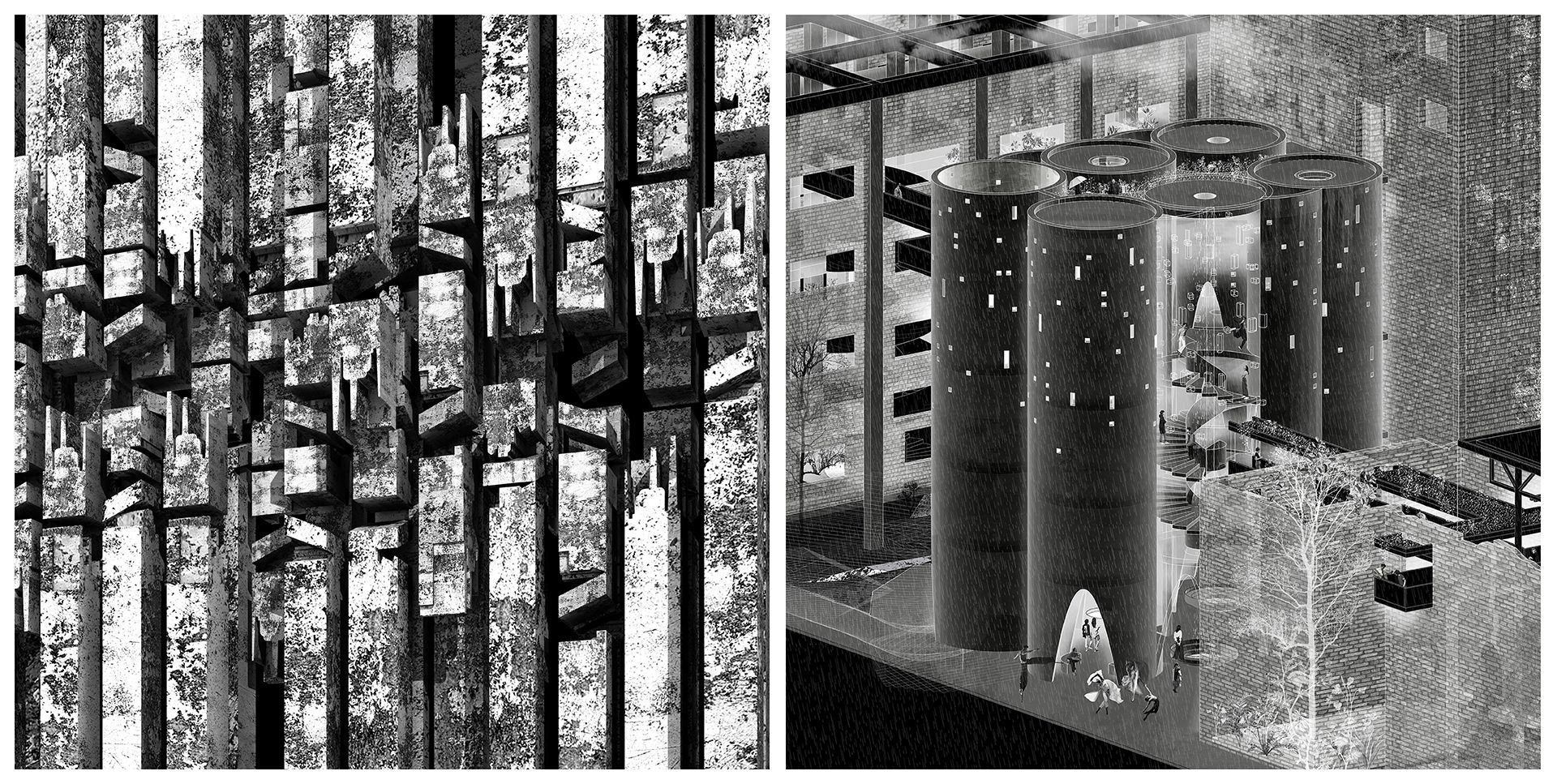
The transformation [...] cannot be seen as a binary problem of private vs public. It has various agencies, it is permeable, mixed and undoubtedly multi-disciplinary.
KOOZ How and to what extent do you imagine the city and our experience of it changing due to the current and potential future pandemics?
DA | CR We are still operating on this condition. However, we took as a starting point an experimental study that we carried out last summer called NON_FICTIONAL CITIES, where we were able to reaffirm this literary phrase by Gabriel García Márquez and that surely applies to our cities on a daily basis: Magic Realism. There is no greater fiction in Latin America than reality itself. The suffering became one more layer of complexities of our reality and that surely accentuates the great structural problems or challenges of our convulsed urban systems: inequity, inaccessibility to services, formal job opportunities, among many others. The pandemic has been a trigger for the serious, profound and non-politicized review of the role of architecture, urban transformation and the responsibilities of the project as a tool or mechanism of thought, reflection, criticism, but even more, as an instrument to dream our future.
Bio
Daniela Atencio completed her professional degree at Universidad Rafael Urdaneta in Venezuela and, subsequently, completed Post-Graduate studies (Master of Science in Architectural Technologies) at Southern California Institute of Architecture (SCI_Arc) in the United States. Her academic and professional work covers topics of advanced technologies in architecture, representation, robotics, coding and computer controlled fabrication. In 2019, she joins Universidad de Los Andes, where she currently coordinates and focuses her research work in areas of speculation in computational design, digital fabrication, robotics, representation and advanced technologies applied in both architecture and design.
Claudio Rossi is a doctor in Architecture, Master in Urban Design and Architect, with experience in architectural, landscape and urban projects in the professional and academic field that have been awarded. Lecturer, jury, critic and reviewer in Architecture, Urban Design and Landscape Architecture in different universities in Colombia, Venezuela, Argentina, Perú, Italy, Australia and United States. Associate Professor, Researcher at the Faculty of Architecture and Design, Universidad de Los Andes, Colombia [2009 – present]. Research topics: Architectural Anomalies / Biolent Cities: Collisions between Landscape and Infrastructure / Biolent Cities: Representation Frontiers in Latin-America cities.