(Re)designing a liveable future
This year alone blistering heat waves, floods and famines have proven that catastrophic climate change is the single greatest challenge of our time. A climate emergency means that it is time for business as usual to halt, for priorities to shift and to recognize obligations and responsibilities to those most affected by the crisis. What Design Can Do (WDCD) believes that creative innovators are fundamental in rethinking and actioning systemic and sustainable transitions and change. However, designers are often not included in policymaking and the implementation of solutions and great ideas are not being put into action due to a system that has been designed to draw profit above everything else. It is time to join forces and (re)design a liveable future.
Creative Climate Collective
To tackle the climate crisis, designers need international collaboration, creativity and a hands-on mentality. That is why What Design Can Do (WDCD), and Creative Industries Fund NL initiated the Creative Climate Collective, a group of 18 creative innovators from Egypt, Ghana, Kenya, Mali, Mozambique, the Netherlands and South Africa.
The goal of the Creative Climate Collective at COP27 is to connect to other stakeholders, advocate for design that advances action toward climate justice, exchange knowledge, experiences and ideas and build networks across geographies and disciplines. After all, WDCD’s hope lies in their collective action. In that spirit, they join those around the world who have already declared a climate emergency and invite everyone to join them.
Interviewees
Julian Restrepo is a Colombian architect and co-founder of TALLER architects. The project he is bringing to showcase is Montes de Maria, a natural laboratory to show that peace and environmental sustainability are possible. Instead of displacing its local families for environmental protection, both local communities and NGO´s and environmental authorities have joined a decade-long effort to establish socio-ecological corridors through voluntary agreements to conserve the Forest and its most critically endangered fauna within private lands. These agreements can become an effective model and set of tools that can help with the complex realities of much of the developing world.
Prof. Noha Essam is an award-winning design academic, Interdisciplinary designer, Foresight consultant, and environmental psychologist. She is the founder of Studio ne+ where she brings in how to move the masses and change behaviour through her foresight-based design approach and trend forecasting techniques that tackle design from different context and perspective. Her research aims to develop a better understanding of the relations between sustainable design education, and the creative industry with a focus on the multidisciplinary studies of future literacy and speculation.
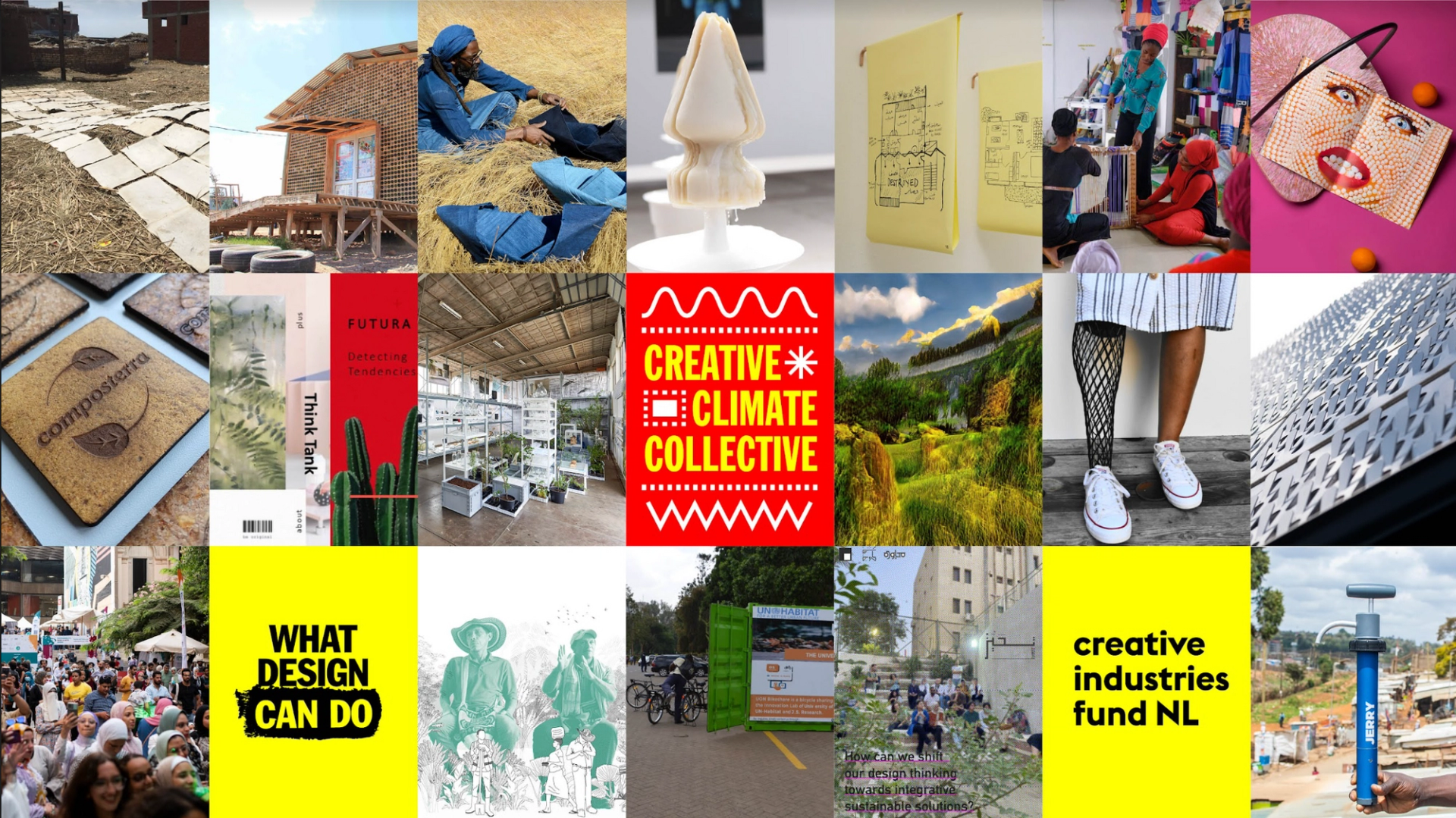
Official graphics of the Creative Climate Collective initiative.
Interview
KOOZ What role does education, design or architecture play in overcoming social and environmental crises?
JULIAN RESTREPO In my view architecture has the role of spatializing relations and facilitating interactions and conversations between people and their environments. In this sense, the social and environmental crisis are for the most part conversations that have been dealt with inappropriately for decades and now require urgent attention. Architecture can be a tool for dialogue in the pursuit of the common ground needed for joint action to tackle the unfolding crises. For that to properly take place, architecture should return to its social focus (broaden by a bigger understanding of the social that includes all living entities) and shift from a tool for capitalism to a discipline that ultimately seeks to serve others. When this begins to happen the dialogue between communities, the natural environment and decision makers becomes horizontal and the resulting decisions manage to incorporate a pluralistic and wiser narrative on architectural interventions within our living environments.
Architecture should return to its social focus (broaden by a bigger understanding of the social that includes all living entities) and shift from a tool for capitalism to a discipline that ultimately seeks to serve others.
NOHA ESSAM I believe Education is the key vector to prepare societies for global changes. Education can bring a fundamental shift in how we think, act and discharge our responsibilities toward one another and the planet. The promotion of sustainability in the design of the built environment is a key factor for addressing the challenges that mankind faces in response to finite resource availability, ecological deterioration and climate alteration.
In response to these challenges and considering the swift development of design and architecture methods and techniques in the building industry nowadays, the professional market demands graduates of architectural disciplines a number of competences that range from creative design and visualization skills up to detailed technical and environmental competence. I, therefore, introduced a new pedagogical methodology in order to overcome existing educational and professional barriers and act as a communication platform that facilitates the transfer of knowledge between sustainability-related building sciences and creative design in the architectural curriculum.
In the meantime, public debate about climate change action intensifies and paradoxes persist, including those related to the roles of education and educators in contributing to both the problems and solutions to the climate crisis. These challenges are familiar to environmental educationalists, educators and researchers, the crux of which is often framed as a reflexive question, namely whether education is the best means to address socio-ecological issues.
Moreover, in the design context and at the nexus of values, attitudes, needs and actions, designers have the potential to act as transdisciplinary integrators and facilitators. It is essential to pay attention to transdisciplinary design dialogue that will help to integrate the multiple perspectives and diverse knowledge base of different disciplines, value systems and stakeholders. Since sustainability requires widespread participation, communities everywhere need to begin to shape local, regional and global visions of sustainability, and offer strategies to collectively engage humanity in cooperative processes that will turn visions (designs) into reality.
I believe Education is the key vector to prepare societies for global changes. Education can bring a fundamental shift in how we think, act and discharge our responsibilities toward one another and the planet.
KOOZ COP27 will tackle issues pertaining to the future of new generations, human settlements, but also the implementation of biodiverse environments. What is your position towards these global challenges?
JULIAN RESTREPO If we take a look at the UN´s sustainable development goals all of the 17 goals could, from a technical point of view, be easily reached in a relatively short time span. The technical solutions are readily available. For example, we have enough food to feed everyone and there are enough economic resources to bring all of the human population out of economic poverty. However, we haven’t been able to reach any of them in practical terms. This means the solutions required are not technical, they are social in nature and our focus should lie there. In order to properly face all global challenges, we need to pursue the construction of “Sensible Environments”, both for humans and all living entities. This concept has to do with how we relate to others and our sensibility to all living beings.
When we dive into a project we try to approach it through a sensitivity lens that allows us to see beyond the material aspect of the profession and engage with the complex system of relations within its territory, communities and ecosystems in order to find a path forward. Each project, therefore, is an opportunity to contribute to the conversation by listening more and listening better before proposing a solution. In that process we try to tone down our egos as much as possible. We have seen incredible examples of communities thriving along with biodiverse environments that could be implemented all over the world. However, most of these examples do not come from what we call the developed world, but from regions or contexts that we usually undervalue and have, instead, much to teach us. The transition needed is complex in nature and requires a lot of conscious thought every step of the way. We want to be part of the transition, even though it is confusing most of the times. Hopefully the path will become clearer as we walk forward.
To face all global challenges, we need to pursue the construction of “Sensible Environments”, both for humans and all living entities. This concept has to do with how we relate to others and our sensibility to all living beings.
NOHA ESSAM We are reminded every day that climate change and many other environmental issues are not real or will impact the next generation; They are, instead, happening here and now. I see that designers, architects and even educators have been focusing on the reasons why. I think now it is time to really focus on how. How can we design to tackle environmental challenges? How can we increase biodiversity through design? How can we put our thoughts into action?
I also believe that we should consider implementing recycling habits into our daily lives, it is one of the most effective ways to help lessen landfill waste, conserve natural resources, save habitats, reduce pollution, cut down on energy consumption and slow down global warming. We also should be aware of the foresight studies in this context. It is important to ask “What are the goals of environmental planning?” In the most of cases, the time series studies on environmental public opinion had been carried out in developed countries due to the early presence of a concern for the environment. Environmental planning helps in the identification process of future challenges, while setting goals and objectives helps to ensure a balanced approach for the protection the environment as development occurs in safe and healthy conditions with regards to air quality, water quality and natural resources.
It is significant to focus on the role of environmental awareness and education in achieving sustainable development. For example, we know that highly biodiverse areas increase healthy habitats and generally create the most ideal conditions for plant growth. At the same time, current landscape architecture theory and practice do not provide the tools to meet the biodiversity challenge. Current developments call for a new way of integrating knowledge that is focused more on ecological content in order to address the loss of biodiversity in landscape designs. Our research projects focus on examining the implementation features that need to be considered to ensure that biodiversity offset programs are environmentally effective, economically efficient and equitable.
Current developments call for a new way of integrating knowledge that is focused more on ecological content in order to address the loss of biodiversity in landscape designs.
KOOZ Have you tackled or will you tackle any of these issues in your career? If so, how? What was the main scope of your project(s) and what did you achieve? How do you intend to address these issues in the future?
JULIAN RESTREPO Climate change and the social crisis are some of the main subjects of our current work. To tackle this matters we try to build the utopias of others. Architecture has lately focused too much on its own utopias, visions based on form, a single technological narrative of evermore perfect shapes and polished environments. We, on the other hand, think our discipline should help bring a new narrative forward but the narrative should come from others, and by that we mean the communities and ecosystems that have been left without a voice by the economic and political system in place. In our work in Colombia we have focused on communities and territories historically forgotten by the state, that have suffered greatly from our decade’s long internal conflict and that are at risk of ecological catastrophes. We have entered these territories trying to listen and learn first, not as “experts” but as people. As we engage with the territory and its inhabitants, our role becomes clear. We then try to fulfill it as best as possible. Sometimes our interventions are minimal from an architectural point of view, however, if that is in the communities’ benefit and they become empowered, we consider it as a great success. We are currently working on sustainable tourism projects in the Colombian Caribbean with Herencia Ambiental, an NGO that does incredible work in protecting the environment and bringing prosperity to its inhabitants.
As architects and designers we have focused on working with communities on trails, signage systems and infrastructure solutions to specific challenges the community faces. In the near future we plan to engage more with the territorial planning of ecological corridors and to work with private and public reserves to broaden the positive impact that our actions may have.
Our discipline should help bring a new narrative forward but the narrative should come from others, from the communities and ecosystems that have been left without a voice by the economic and political system in place.
NOHA ESSAM At studio ne+ we are already tackling environmental issues through our work. We believe in the power of the design research, it plays a crucial role in helping to fill gaps by conducting future studies to facilitate policy development, building institutional capacity and facilitating independent dialogue with civil society to help people live more sustainable lifestyles.
We believe it is time for mending and gathering, thus restoring the fabric of society: picking up the pieces and bringing them together in a patchwork of possibilities; as a quilt of substance, able to absorb shock, fear and uncertainty.
Design is an inherently futurist medium. In the sixties, key figures in the Modern design movement often used the word “design” indistinguishably from the word “planning.” Today is not so different, but what we mean by “the future,” a utopian ideal. We are then adopting a foresight vision as we engaged in a process of critical thinking and defining intellectual values to deliver design trend analysis, aesthetics and speculative practices, future inspiration to designers, leading brands, manufacturers and professionals.
Through our approach at FUTURA project we focus on ethnographic research as a catalyst to forecasting design futures. Forecasting plays such a psychological role bringing all aspects of modern design together. It determines with accuracy all that users may need or desire in the future and it provides a change pattern in the creative industry that leads to economic flow. The change in concepts, design ideas, colours, materials and finishes are no doubt a reflection to the mega trend as a forcing power that automatically affect the macro and micro trend.
We are detecting future tendencies based on the philosophy that supports the fact that utopian and dystopian fiction are genres of speculative fiction that explore social, cultural and political structures since utopian fiction portrays a setting that agrees with the society’s ethos. Dystopian fiction offers the opposite. Both genres, often are used as a metaphor for the different directions that humanity can take depending on its choices, ending up with one of two possible futures.
Other participating proposals tackling community development and land regeneration
Aboubakar Fofana, Mali
Fofana is a multidisciplinary artist and designer whose working mediums include calligraphy, textiles and natural dyes. In 2015 Aboubakar Fofana started an indigo farming cooperative project involving the local community in the district of Siby in southern Mali, in which the two types of indigenous West African indigo are the centrepiece for a permaculture model based around local food, medicine and dye plants. The ambition of his project is to heal the devastated land, replant trees and demonstrate a complex, entirely organically farmed, agricultural ecosystem, in which all the plants and cycles they undergo support the structure and the short-term goals of feeding local people, the medium-term goal of indigo production and dyeing, and the long-term goal of assisting to maintain biodiversity and preserving the agricultural and cultural heritage of this part of Mali.
Greenish, Egypt
Greenish is an Egyptian foundation that aims to achieve sustainable development through interactive educational activities, environmental assessment services, and provide support to local communities vulnerable to the adverse effects of climate change. Greenish aims to improve the wellbeing of MENA residents and the health of their natural environment through sustainable and conscious practices through promoting environmentally conscious practices through environmental education, partnerships, research, community engagement and advocacy.
Salma Belal, Egypt
Salma Belal is an architect and urbanist from and based in Cairo, Egypt. Through her work, Belal seeks to explore different forms of engagement with urban activism, inspired by Cairo’s complex and continuous flux. As a researcher and designer she works on multidisciplinary projects, tackling conservation and built heritage, advocacy for urban justice, and public-space upgrading. The Tahayyuz project aims to reorient the teaching approach towards integrative models addressing historic and precarious urban landscapes, climate change, multidisciplinarity, and spatial justice.