Behind the Houston Processing Center, there is a motel, a prison farm, a plantation, a Supreme Court case, a tax exemption, a landlord, and a developer. To echo Stephen Dillon in this book, it could go “on and on and on and on and on and on and on.” (269–291)
About $25 a night can get you a single room, a bathroom down the hall, and three meals in a Houston hostelry, which seems pretty reasonable at today’s prices. In fact, it isn’t even the “guests” who pay. But there’s a drawback. They can’t check out at will… —Marjorie Anders, describing the Houston Processing Center in Clovis News Journal, August 4, 19851 1
In November 1983, the Corrections Corporation of America (CCA) received its first federal contract from the Immigration and Naturalisation Service (INS) to build an immigrant detention center in Houston, Texas. The following April, it opened the Houston Processing Center, designed to accommodate roughly 350 individuals. It took just five months for the CCA to finance, design, build, and open the Houston center—though still not fast enough for the INS, which had already begun to enforce the more punitive policies of the early Reagan administration and to carry out a mode of governance that conflated criminal and immigration procedures. 2 These policies had spatial consequences, taking shape in new architectural devices meant to support a broader and enduring carceral system that instrumentalises and weaponises the built environment.
On January 22, 1984, with the construction for the Houston Processing Center underway, the CCA opened an interim facility at the Olympic Motel along Interstate 45. The motel’s short-lived role as detainer is preserved only in a horrifyingly hokey video of CCA cofounders T. Don Hutto and Tom Beasley recounting the early days of their company. 3 The INS had “very unrealistic expectations,” says Hutto. “They gave us ninety days.” The two arrived in Houston on New Year’s Eve to begin searching for their surrogate detention site: “We were both getting pretty weary. We had found a lot of places, but nothing seemed quite to work, nothing you could secure in a short period of time. Then we saw this big ‘ole sign: the ‘Olympic Motel.’” 4 They made an offer to lease the place.
Once rented, the CCA installed a 12-foot cyclone fence around the perimeter of the motel, “laced with bamboo to thwart the curious” and topped with coiled barbed wire. 5 The pool was drained and filled in with sand. The rooms were secured, windows outfitted with iron bars, and doors with exterior locks. Promising to return the motel in “three times as good a condition” and to leave all the “improvements in place,” not much else was done to the existing building. Signs were left untouched: “Olympic Motel,” “Color TV, Radio, Telephone,” and “Day Rates Available” were still advertised to the highway. The renovation was an exercise in DIY securitisation that included Hutto, American Express card in hand, running to a Houston hardware store for supplies and a Walmart for toiletries; the CCA hiring the landlord’s family as staff; and the motel employing additional guards from ABM Security Services. On Super Bowl Sunday of 1984, Hutto produced ad-hoc photo ID cards and fingerprinted individuals himself while other company leaders “distributed sandwiches and helped security staff escort detainees to their living quarters.” 6 The architectural sleights of hand carried out at the Olympic Motel modeled the ease with which motel slipped into detention site, living quarters into cells, and hostelry into (site of ) captivity.
This slippage is at the heart of the CCA’s founding. Describing the company’s premise, co-founder Tom Beasley once said you could “sell prisons ‘just like you were selling cars, real estate, or hamburgers.’” 7 Or, considering that CCA obtained its initial funding from serial entrepreneur Jack Massey—famed eventual owner of Kentucky Fried Chicken and founder of the Hospital Corporation of America (HCA)—it was just like selling fried chicken or hospitals. The forced equivalence underwriting CCA’s corporate model prefigured its speculative and opportunistic development model, which registered the built environment through spatial analogues.
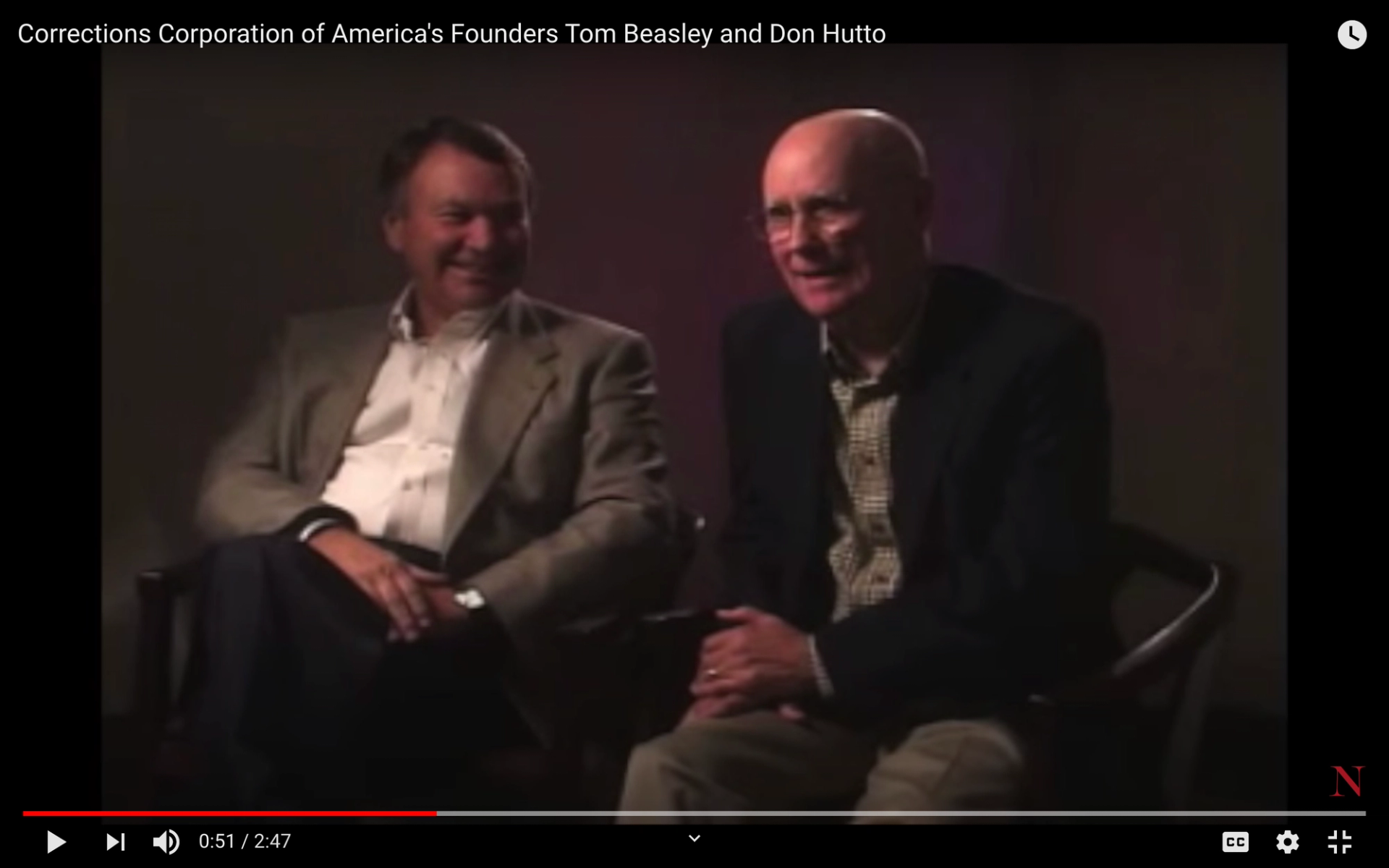
An intertitle from the CCA video of co-founders T. Don Hutto and Tom Beasley discussing how they secured the first of many contracts for housing detained undocumented immigrants. Courtesy of The Nation and posted to YouTube, February 27, 2013.
That the Olympic Motel came to house 140 asylum seekers and undocumented immigrants awaiting deportation over the course of four months ultimately faded into obscurity once the official Houston Processing Center opened. Hutto and Beasley’s use of the motel is now a self-professed scrappy origin of one of today’s largest for-profit prison corporations—CCA “was a start-up before start-ups were fashionable. We met the deadline, the detainees arrived, and a new relationship was forged between government and the private sector.” 8 This privately run detention facility speaks to a particular spatial tendency within the larger neoliberal project: “enterprise zones” that privatise the usual functions of the state. The company found an untapped site of possibility in the space behind bars, a space cleared by the social engineering, deregulation, and financialisation of the 1970s and 80s, which converted government, corporations, and citizens into opportunities for investment and capitalisation. 9
The CCA positioned itself as the answer to two interrelated problems: corrections bureaucracies—“the most entrenched bureaucracies of all”—and the growing demand for detention space. 10 The company sold a more “efficient” and “economical” delivery system of detention from construction to operation. Its ability to open the Houston Processing Center in roughly five months and at a cost of $14,000 per bed—opposed to the two years and $26,000 per bed it would have taken the INS—was celebrated by proponents of privatisation. 11 Today, the company claims that it delivers cost savings up to 25 percent and cuts the construction time of new facilities by 40 percent. Unencumbered by red-tape (like public approval), the company could “act faster than public agencies in everything from [attaining funding to choosing a site] to construction to buying shampoo.” 12

In 1967, Jack Massey, then owner of KFC, wrote a letter to persuade family friend Tommy Frist Jr., who was struggling to decide whether to pursue a career in business or medicine, to join the company: “Chicken, beef, or medicine. Make your decision soon.” The note inspired Frist Jr. to choose a hybrid of the three. In 1968, Massey and Frist Jr. founded HCA, a “new kind of hospital company.” Courtesy of HCA.
The Olympic Motel modeled the private-prison product CCA would ultimately become known for. It gave built form to the fiscal conservatism and tough-on-crime policies of the time that also recast asylum seekers and refugees, primarily from Latin America, as criminals. On the heels of the Mariel boatlift and in the midst of a raging civil war in El Salvador, the INS saw detaining large numbers of asylum seekers and refugees as a form of deterrence. By 1982 “all aliens without proper travel documents [were to be] detained pending a determination of their status.” 13 Not only did the INS’s budget for detention grow exponentially throughout the 80s (from $15.7 million to over $149 million) but so did its capacity to hold individuals and the average length of detention (from approximately 7 days in 1984 to 23 days in 1990). 14 As the INS intensified its policing and detaining efforts in the border region, US senator Lloyd Bentsen aired that it seemed the entirety of South Texas had become a “massive detention camp.” 15
In the context of this hostile territory and to the desperate eye of the CCA, the Olympic Motel offered 12,466 square feet of latent detention space. While this particular narrative of corporate annexation fell in line with a longer history of recycling and reusing sites of internment, it also marked the beginnings of an increasingly pervasive model that propagates the need it intends to fulfill. It is a model in which architecture is both the promise and the guarantor of carceral expansion. The fast and cheap delivery of beds at the Olympic Motel satisfied the current demand and also incentivised a future demand. It was proof for the CCA that they had not only devised an iterable scheme for the privatised service of carceral detention, which presupposed its continuance on a new market, but also that they had innovated a system of delivery through the built environment.
Between Use and Misuse
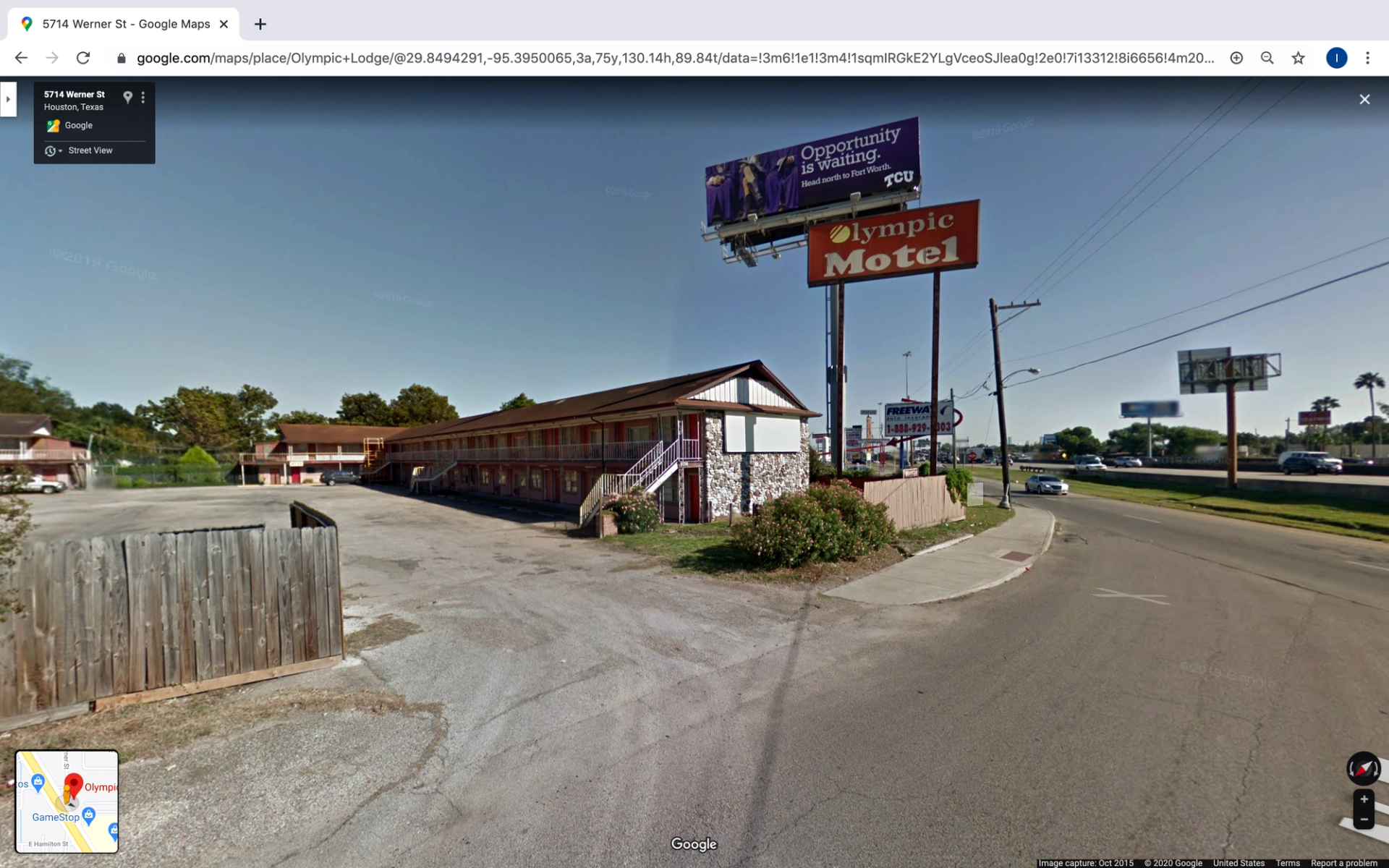
Olympic Motel at 5714 Werner Street, along the North Freeway, Houston, TX 77079, pictured here with a billboard advertisement from Texas Christian University that reads “Opportunity is Waiting.” © Google Street View 2015.
The case of the Olympic Motel shows how the late-capitalist carceral system might be less about producing new architectural forms than constructing new uses out of an otherwise familiar spatial environment. It is a story that recounts both the situated origins of a particular model of carceral production and the pervasive workings of neoliberalism. Sara Ahmed writes that “use offers a way of telling stories about things,” that “what has been used in the past can just as easily point us toward the future,” and that “if use records where we have been, use can also direct us along certain paths.” 16 That the Olympic Motel was taken up, put to use, or misused by the CCA on behalf of the INS is not intended to overly “direct” attention to the prominence of private corporations in the prison-industrial complex, nor is it intended to perpetuate the misconception that private prisons are the “corrupt heart” of this system of incarceration. 17 Rather, it is a story of urban-carceral transformation that evidences how the state—in this case through its corporate appendages—moves, restructures, and expands itself across the built environment according to its coercive functions. This is a narrative, then, that traces the sites of production, buildings, legal proceedings, rhetorical arguments, and financial instruments it uses to do so. The path that emerges from the Olympic Motel offers a way to describe contemporary carcerality, which entangles the devouring tendencies of privatisation and the sanctioned punitive policies of the racial state. In other words, the short-lived fate of the Olympic Motel helps to tell the story of the status quo. “What is the status quo?” asks and answers Ruth Wilson Gilmore: “Put simply, capitalism requires inequality and racism enshrines it.” 18
“Put simply, capitalism requires inequality and racism enshrines it.”
Use is contingent on the form it is given by practice, ideology, and policy. That the Olympic Motel could be “secured in a short period of time” speaks not only to its architectural characteristics but also to longstanding and widespread social beliefs about what kinds of places contain, support, enable, or are needed by certain ways of life. Take, for instance, Justice Antonin Scalia’s dissent in the 2015 Supreme Court case City of Los Angeles v. Patel:
Motels not only provide housing to vulnerable transient populations, they are also a particularly attractive site for criminal activity ranging from drug dealing and prostitution to human trafficking… Motels provide an obvious haven for those who trade in human misery. 19
This vision of how crime and poverty are distributed in space directs how the motel is legislated, policed, and circumscribed along racial lines—“insofar as geography,” as Jackie Wang observes in Carceral Capitalism, “is a proxy for race.” 20 Scalia’s statement evinces the biases that enlist the motel as a mechanism of racial enclosure. The degree to which crime is inherent at motels, and thus the degree to which those who use, live, or reside in them are criminalised, deprived, and immobilised, is also determined through a partisan push and pull. In the majority opinion, Justice Sonia Sotomayor articulates her own argument about the intended and non-intended function of architectural objects: “Hotels—like practically all commercial premises or services—can be put to use for nefarious ends. But unlike the industries that the court has found to be closely regulated, hotels are not intrinsically dangerous.” 21 While this juxtaposition may in some ways reproduce an all-too-easy dichotomy between conservative and liberal agendas, it also demonstrates the way in which judicial and political arguments proscribe and prescribe legitimate uses of state force in the built environment. At the very least, these contrary opinions insert the motel and the manifold vulnerabilities, itinerancies, and possibilities that it supports into the struggle over how and where carceral state power is expanded and justified.
“We can ask about objects by following them about,” Ahmed writes. 22 This call to attend to the “strange temporalities of use” unsettles certain assumptions about the built environment’s relationship to and participation in the carceral state. It offers a way to unfix the prison as a place and also as a set of political, pedagogical, and theoretical concerns. This implies eschewing the often all-too-stable concept of “site” and “place” within the discipline of architecture. It is a specifically architectural misprision to understand incarceration as a solid architecture that one is “put into” or “let out of,” an isolated and neatly packaged typological envelope of discipline and control. Paths to Prison: On the Architectures of Carcerality is instead premised on an understanding of the prison as a diffuse, porous, and mobile entity that coordinates the tactics, materials, and bodies that circulate beyond and through it. It is concerned with the “both/and” of the prison, where “the physical instantiation of the carceral is at once everywhere and also very specifically somewhere,” as Wendy L. Wright writes. That is, this book attempts to register the mobility of carcerality—which casts the prison as a machinery of oppression, a social and political economy of confinement that extends well beyond the institution’s walls.
The prison pervades, with various degrees of intensity and duration, the everyday terrain between distinct spaces of containment: typologies and histories and lived experiences assumed to be “outside” of the sphere of incarceration. As Brett Story offers, “to consider ‘ordinary space’ is therefore to contend with how the prison system etches its violence into the social fabric in ways as diverse and complex as they are quiet and mundane.” To bring this idea back to the history of the Olympic Motel, it is perhaps the motel’s ordinariness that obscures the extraordinary circumstances that have come to mark and mobilise it.
To understand the prison today, one must pursue, as Jarrett M. Drake powerfully proposes, “not a cultural biography of things but rather an ethnography of exchange.” This book aims to trace the contours of such an exchange. It follows the objects and ideologies that underwrite the prison, how they ebb and flow across the carceral continuum in the present, tracking how these objects and ideologies mutate in their historical course. The Olympic Motel models a very discrete exchange—a single site that moves “through hands, contexts, and uses” with enormous consequences for the lives within it—while also demanding that we look elsewhere, in time and in place, to see how such spatial fungibility is made possible. To tell the story of the state’s insatiable custodial appetite, one must pursue various protagonists (human and otherwise), slip between past and present, and move across both discursive and material sites. It requires a narrative that is not set spatially or historically but that, in its movement, pieces together a layered geography of carcerality. Drawing on the struggle, imagination, and potential of Black women’s geographies to reframe and undo traditional geographic “arrangements,” Katherine McKittrick writes in Demonic Grounds “that our engagement with place, and with three-dimensionality, can inspire a different spatial story, one that is unresolved but also caught up in the flexible, sometimes disturbing, demands of geography, which some people ‘wouldn’t think was so sane.’ 23 Paths to Prison is deeply indebted to McKittrick’s work and seeks to engage the long tradition of thinking, living, and writing oppositional discourses that resist and find ways out of dominant spatial patterns that actively try to block the possibility of holding various places, practices, and oppressions in mutual relation.
Accounting for architecture’s participation in the carceral state means leaning into inconclusiveness. This book thus also emerges from an invitation put forth by Avery Gordon in Ghostly Matters to “make contact with what is without doubt often painful, difficult, and unsettling” and to write new stories about “what happens when we admit the ghost—that special instance of the merging of the visible and the invisible, the dead and the living, the past and the present—into the making of worldly relations and into the making of our accounts of the world.” 24 Gordon’s ghost—like McKittrick’s unresolved story and Ahmed’s proposal to follow—offers new epistemologies, methodologies, and ways of writing for the field of architecture. It insists that current accounts of the built world carry the full presence or weight of the past and insists on registering how the supposedly “over-and-done-with” is materialised in “new” forms and “new” structures. Paths to Prison proposes that we look behind and across carceral sites to see how historical forms of racial violence and dispossession are inherited, learned, determined, naturalised, and struggled over in the present—how incarceration manifests or reenacts racial, economic, and social hierarchies.
As Dylan Rodríguez poignantly states, the term “mass incarceration” has “canonised a relatively coherent narrative structure, based on a generalised assumption that such juridically sanctioned, culturally normalised state violence is a betrayal of American values as well as a violation of the mystified egalitarian ethos that constitutes US national formation.” Taking Rodríguez’s diagnosis as a challenge, this book aims to counter the apparent stability of that narrative with non-linear and mobile accounts of the seemingly disparate institutions, ideologies, practices, and spaces that enforce and perpetuate carceral power. It picks up the argument that this work is constitutive of and faithful to the foundations and values of the United States of America—that what we have come to call “mass incarceration” is not an aberration among American values but representative of them.
Please note the section ‘Cummins Farm’ is omitted from this republication; to read the whole chapter, please see here
Between Freedom and Unfreedom
Paths to Prison: On the Architectures of Carcerality invites the discipline of architecture to think about typology diachronically—to extend the geography of architectural inquiry to encompass “plantation futures,” which, as Katherine McKittrick writes, offer a “conceptualisation of time-space that tracks the plantation toward the prison and the impoverished and destroyed city.” 46 Rather than recapitulate the neoslavery narrative, this book asks: How is the logic of the plantation reconfigured in post-slave contexts, and how might these logics undergird or pass through socio-spatial life, organisation, development, and expropriation in the present?
The warning, however cliché, from Thomas O. Murton about the supposed reforms of the Arkansas Department of Corrections—“the more things change, the more they apparently remain the same”—resonates with legal scholar Reva Siegal’s description of a mode of “preservation through transformation.” Siegal’s term offers a framework for understanding the way basic forms of racial, class, and gender domination remain intact even when the legal rules and rhetoric governing those hierarchies change as the status quo, and what can be socially stomached, changes. 47 It also offers a way to evaluate to what degree white supremacy relies on the typological continuity of repressive mechanisms. This book thus asks: Which discursive formations and physical sites preserve white supremacy and maintain the blueprints for today’s racial carceral state while claiming they don’t? What other supposedly distinct typologies are entangled in this exchange?
Siegal’s proposal to hold continuity and change together can also be reframed: Notions of “freedom” are always shadowed by the ways we are made unfree by design. Jasmine Syedullah asks, “What if the spaces where we have been taught to feel most at home are holding us captive?” She argues that all imaginations of freedom should be rooted in the practice of inhabiting spaces of confinement. 48 Beyond the loophole of the Thirteenth Amendment, this book aims to puncture languages of liberation and bring together architectural narratives that practice this kind of inhabitation—that in addition to looking at the ways architecture imprisons, looks at the ways it apparently does not. What other loopholes—legal, spatial, financial, or otherwise—blur the distinction between freedom and unfreedom? This is another method of shifting the frame away from the prison as such and towards the promises and spaces of liberalism, as a way to see all other conditions of civil existence knotted into and connected to the prison. In this way, this book aims to describe the “double bind of freedom,” which, as Saidiya Hartman has written, intertwines the “emancipated and subordinated, self-possessed and indebted, equal and inferior, liberated and encumbered, sovereign and dominated, citizen and subject.”*
Maintaining this “bind” takes routine ideological, rhetorical, economic, legal work—which determines and distributes forms of citizenship unevenly across the built environment and renders those inequities as “normal.” The work of carceral normalisation is not always overt; it is not simply carried out by extreme acts of authority or blatant criminalisation but by what Naomi Murakawa and Katherine Beckett have called the “shadow” carceral state, which “operates in opaque, entangling ways, ensnaring an ever-larger share of the population through civil injunctions, legal financial obligations, and violations of administrative law.” 49 It operates through “liminal,” “fuzzy,” “fungible,” and “serpentine” mechanisms that reproduce and “mimic” punishment under terms that declare themselves “not-punishment.” This book hopes to surface how the carceral state annexes that which is supposedly free from its grips and to make visible the effort exerted by this entity’s many tentacles to normalise the production and maintenance of penal power.
Where processes of racialization arise, the shadow of property generally looms. — Adrienne Brown and Valerie Smith 50
Thirty-five years after its first detention facility opened in Houston, Corrections Corporation of America, now called CoreCivic, owns and operates forty-three correctional and detention facilities and manages an additional seven federally owned facilities—which altogether span 14.5 million square feet and hold 73,000 beds across the United States. The company has also expanded its portfolio to include twenty-nine residential reentry facilities and an additional twenty-eight properties that it leases to third parties or government agencies. The company’s rebranding and its expanding real estate portfolio are two sides of the same coin: the corporation’s “new view of corrections” that increasingly relies on the acquisition and transformation of the built environment. Not only does the company pride itself on controlling approximately 59 percent of all privately owned prison beds in the United States, but it also believes itself to be, more generally, “the largest private owner of real estate used by US government agencies.” 51 The cover of CCA’s 2009 annual letter to shareholders encapsulates this relation. Titled Partnership Prisons: The Best of Both Worlds, the document juxtaposes two equally generic images: a white corrections officer and an exterior view of an unspecified facility somewhere in the desert. Save for the blurry perimeter fence in the background, the property looks like any other office park. The “best of both worlds” refers to CCA’s public-private partnerships: “the essential oversight and accountability of government” coupled with “the flexibility, efficiency, and cost effectiveness of private business.” No matter how trite, this image captures a corporation in transition—a corporation that, for political expediency, future viability, and risk transference, has managed to move seamlessly from detainer to landlord and back.
This movement is possible because of a particular financial mechanism: the Real Estate Investment Trust (REIT). Created by Congress in 1960, REITs were designed to give investors the opportunity to pool capital for income-producing real estate—entirely free from federal corporate taxes. Operating like a mutual fund, the trust structure offers stockholders the chance to invest in large-scale commercial real estate assets and earn a share of the profit without having to actually buy, manage, or finance property themselves. For a company to qualify for REIT designation, it has to derive at least 75 percent of its gross income from real estate (rents from real property) and 95 percent from “passive” financial instruments (as opposed to “active” business activities). 52 This distinction between “passive” and “active” investment is crucial to understanding what passes the REIT income test—and what kind of bureaucratic maneuvering was undertaken by the CCA. REITs are restricted by the types of activities and services they can provide to their real estate assets, but the passage of the REIT Modernization Act in 2001 produced a loophole that allows companies to reap the benefits of massive tax breaks by breaking apart their active business activities (the operational side of, for example, private prison management) from their passive real estate investment (such as the ownership of correctional and detention facilities) through subsidiaries. 53

Partnership Prisons: The Best of Both Worlds. Cover of CCA’s 2009 annual letter to shareholders
And that’s exactly what CCA did. In 2013, the company (still CCA at the time) successfully converted its corporate structure to an REIT. 54 This meant that it had convinced the IRS of two things: first, that its facilities are not “lodging” or “healthcare,” and second, that the money it receives from government tenants is “rents from real property.’” 55 Declaring what the company (and thus what corrections) was not (neither site of care or housing) allowed CCA to claim that their property was held for investment, not operation. There is a similar denial in its second request: to consider money paid by federal agencies to incarcerate and house people as rent meant fundamentally bypassing the actual tenants of CCA’s facilities. The IRS’s determination opened up a redefinition of carceral space—labeling the state as the tenant and not the individuals sanctioned there.
The REIT regime incentivises building and leasing, not managing or operating. While the Houston Processing Center was the CCA’s first model of privatisation (financed, owned, and operated by CCA), the company has since shifted toward other models: privately financed and owned but publicly operated; privately financed and owned but eventually transferred to the public sector (i.e. rent-toown); and publicly owned but privately financed, designed, constructed, and maintained. 56
In CCA’s 2012 annual letter to shareholders announcing its new tax status, the company put forth a markedly different image of the company: as $3.6 billion in fixed assets. Alongside the narrative of REIT-generated double-digit growth, the company doubled down on its commitment to real estate with sterile and glossy aerial photographs of its properties—described not according to function but to acreage, square footage, number of beds, and age. These specifications were part of a new language aimed at repackaging CCA’s facilities as attractive investment opportunities. 57 The company’s ability to build shareholder value was thus intimately connected to its ability to build a stable real estate portfolio. CCA’s portfolio was sold as a “just-in-time inventory” of leasable space— one that was integral to the growth model of the company. The inventory was intended to accommodate the immediate and future needs of government partners and policy makers, thereby linking what the company offers (and what the company is) to whatever political, economic, and cultural climate it faces.
CCA’s tactical sprawl picked up speed between 2013 and 2016. In response to dips in national prison populations and increasing criminal sentencing reforms, CCA letters to shareholders began to cite “America’s recidivism crisis,” emphasizing “alternatives” to incarceration and an increased interest in reentry programming. In three years, it acquired three “community” corrections companies. These acquisitions enabled CCA to be a “better” service provider to its government “tenants,” but they also enabled the company to consolidate its increasingly dispersed (and diverse) footprint. The groundwork was laid for an emerging “treatment industrial complex.” 58 If this was “the link between prison and the community,” then CCA, according to Hininger, was poised to supplant that connection as it continued to “develop a robust pipeline of acquisition opportunities in this fragmented market.” 59
In October 2016, CCA became CoreCivic. With a solid REIT backbone and the foundation already laid for a pipeline to the community, the company underwent another round of rhetorical sanitisation, corporate renovation, and targeted acquisition. 60 Everything about the way CoreCivic presents itself today is designed to be benign. Alongside the tagline “Better the public good,” the company adopted a “bolder, sleeker and more modern” typeface and a color palette intended to invoke “safety, strength, passion, stability, integrity and seriousness.” Its new logo? A 13-stripe American flag extruded to symbolise a building. Business offerings like “Inmate Services” and “Security” were replaced with “Safety,” “Community,” and “Properties”—new umbrella terms for an expanding inventory of diverse carceral products. Today, CoreCivic Community encompasses a vast network of residential reentry centers and non-residential services. In 2018, the company acquired Rocky Mountain Offender Management Systems (RMOMS) and Recovery Monitoring Solutions, adding to its portfolio new programs like probation supervision, electronic monitoring and GPS tracking, remote electronic alcohol monitoring, random urine screening, and cognitive behavioral therapy. Perhaps not unlike the early prison-farm experiments in agricultural techniques, CoreCivic’s “community” and those in it have become the test site (and subjects) for a technological-social apparatus of governance—the gears of which have already been and will continue to be loosened for general use.
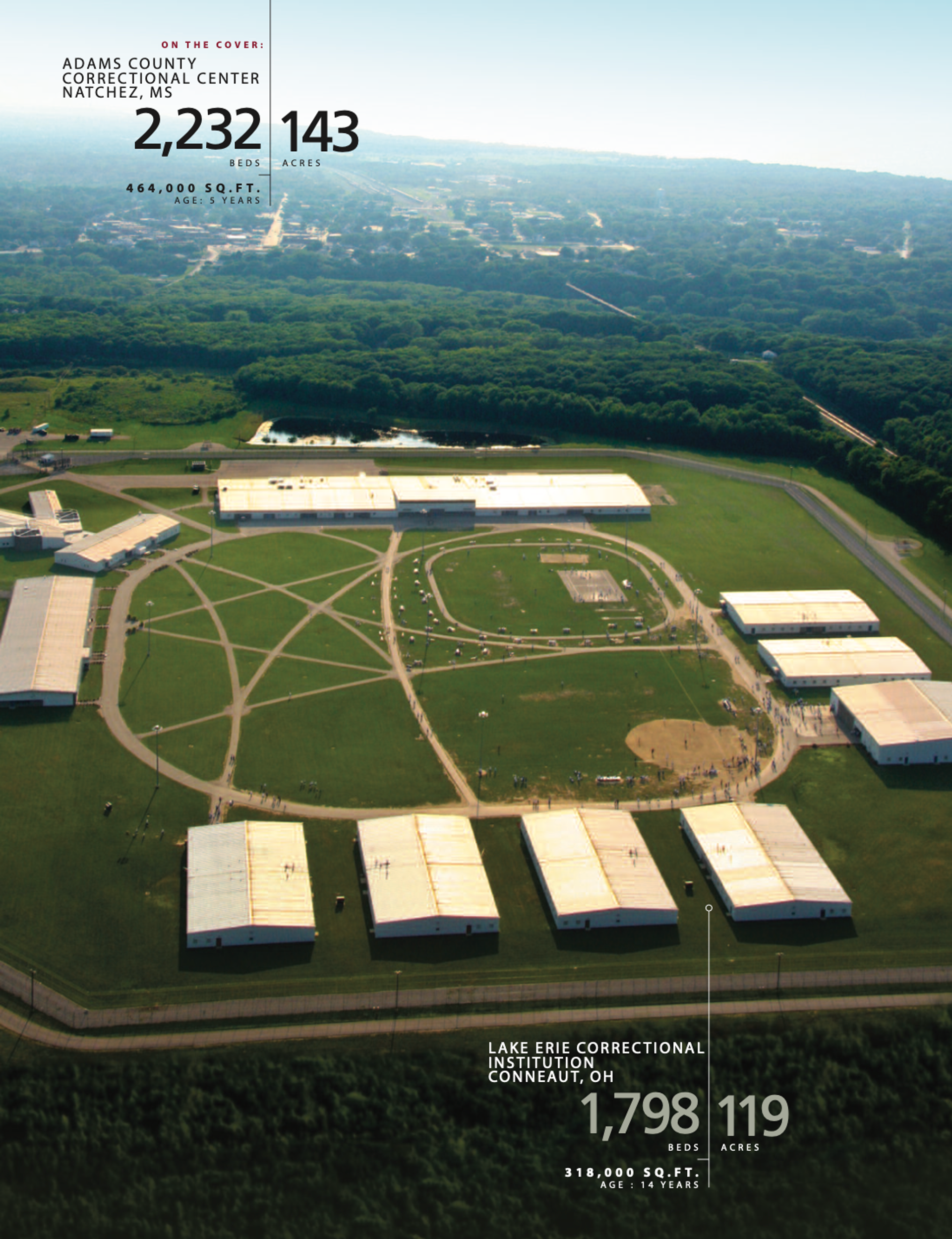
The first page of CCA’s 2012 annual letter to shareholders, titled A New View of Corrections, link The CCA also showcased Jenkins Correctional Center, Millen, GA: 105 acres, 233,000 square feet, 1,124 beds, one year old; Nevada Southern Detention Center, Pahrump, NV: 120 acres, 189,000 square feet, 1,074 beds, three years old; and Saguaro Correctional Facility, Elroy, Arizona: 34 acres, 352,000 square feet, 1,896 beds, six years old (this last facility is, in fact, the unnamed facility on the cover of the 2009 report).
The company has continued to metastasise with CoreCivic Properties. In the last few years, it has moved further into “non-corrections” space—acquiring and constructing a 261,000-square-foot Capital Commerce Center in Tallahassee, Florida, that is leased mostly to the Florida Department of Business and Professional Regulation; a 541,000-square-foot office building in Baltimore, Maryland, that is under a 20-year lease with the Social Security Administration; and a 217,000-square-foot built-to-suit building in Dayton, Ohio, for the National Archives and Records Administration, which includes 1.2 million cubic feet of storage space (90 percent of which is dedicated to the archives of the IRS). 61
CoreCivic now declares itself a “diversified government solutions company”—detainer, landlord, and developer. Still, according to their 2018 SEC filing, CoreCivic Safety made up 87 percent of the company’s total net operating income—compared to only 4.8 percent from CoreCivic Community—and of that, ICE accounted for 25 percent of the company’s total revenue. 62 The company may now be painted True Navy, Smoked Crimson, and Soft Gray, but, as the adage says, uttered this time by Tony Grande, Executive Vice President and Chief Development Officer of CoreCivic, “the more things change, the more they stay the same.’” 63
Please note the section ‘Between Continuity and Discontinuity’ is omitted from this republication; to read the whole chapter, please see here
Between Mobility and Immobility
How the institution of the prison has been and continues to be represented is a political project. Just as the prison is discursively called on to legitimise its own expansion, it is also visually deployed to make a reality without it seem impossible. It is worth repeating Gina Dent’s often-cited statement on the grip that images of prison hold on our imagination: “The history of visuality linked to the prison is also a main reinforcement of the institution of the prison as a naturalised part of our social landscape.” 79
The task of this book, then, is to make the familiar unfamiliar, to uncongeal the congealed, to denaturalise all that has been naturalised for us—shifting the epistemological frame away from the prison as such (or, in certain moments, zooming so far into the center of it) that we lose sight of it altogether, and recording what comes into view in its stead. Paths to Prison picks up and echoes a provocation from Brett Story: “Prisons are spaces of disappearance.” 80
“Prisons are spaces of disappearance.”
She means this in many ways: Prisons disappear bodies; they disappear the social crises they are tasked to solve; they are built in increasingly distant sites meant to disappear the violence, pain, and grief that they inflict and leave behind. But when directed at the field of architecture—a field that prides itself on its capacity to envision worlds totally different than our own—this proposition demands we rethink what it even means to visualise, to see or to not see, a space that actively holds itself out of view. The discursive underwrites the visual. The intelligibility of our language structures the coherence of our images. Sable Elyse Smith repeats that “scale and infrastructure are sometimes weapons. And language is both.” By changing or by disappearing and decreasing the opacity of the vocabularies, narratives, myths, and pedagogies that confirm the prison at the center of our field of vision—and that block out all of the other architectures that prop up the social functions of the prison as it courses through daily life—perhaps the discipline can start to un-circumscribe how it imagines, understands, and rejects its own complicity in the carceral state.
The “paths” of Paths to Prison offer not a fixed or inexorable account of how things are but a set of starting points and methodologies for re-seeing the architecture of carceral society and for undoing it altogether. As paths, they let us sidestep, arrive, bypass, and look back at the prison differently—carrying us through other sites, past and present, that serve “to establish a spatial distinction between the dispossessed and the free, the expendable and the nonexpendable, the abnormal and the normal, and to manifest the ongoing production of racial boundaries of this transitional space,” as Leslie Lodwick writes. (413–454) By locating architecture along other disciplinary paths too, we can better see its impact and be more critical about how it participates and exerts (or refuses to exert) this power. Paths to Prison intends to write new paths to prison into histories of architecture—histories that, by extending both what constitutes the carceral and what is ensnared in it, reveal more possibilities for rejecting it altogether. This is a book then that moves to see the prison anew, that shifts the frame in order to yield a different picture:
"The “paths” of Paths to Prison offer not a fixed or inexorable account of how things are but a set of starting points and methodologies for re-seeing the architecture of carceral society and for undoing it altogether."
Not of concrete walls but of highways, archives, the control unit, FamilySearch, Sensorvault, Church of Jesus Christ of Latter-Day Saints, the plantation, White Reconstruction, the Chesapeake and Ohio Railroad Company, fire camps, Appalachian coal mines, the Los Angeles Police Department, clinical psychology, critical infrastructure, a north Harlem apartment, the Thirteenth Amendment, alternative charter schools, private telecommunication networks, chain-link fences…
Not of crime but of oppression, redlining, debt, counter-insurgency, domestic warfare, wage theft, anti-Blackness, residential apartheid, extraction, White Geology, pathology, racial difference, surveillance, racial-colonial state violence, data colonialism, unemployment, home-ownership, imperialism, gentrification, invasion, home contracts, Otherness, stigma…
Not of only the racial state but also of liberal multi-culturalism, the American Dream, popular consent, cooperation, diversity, reform, “something akin to freedom,” the post-racial state…
Not of social death but of rent parties, eviction resistance, human and other-than-human relations, homefulness, poverty scholarship, captive maternals, liberation, repair, rebellious affects, anti- and ante-ownership, lines of flight, sitting with what is, writing, touching, dancing, kinship, care, self-determination, waywardness…
Book
Edited by Isabelle Kirkham Lewitt, the essay collection Paths to Prison: On the Architectures of Carcerality (Columbia Books on Architecture and the City, 2020) aims to expand the ways the built environment’s relationship to and participation in the carceral state is understood in architecture. The writings in this book implicate architecture in the more longstanding and pervasive legacies of racialised coercion in the United States—and follow the premise that to understand how the prison enacts its violence in the present one must shift the epistemological frame elsewhere: to places, discourses, and narratives assumed to be outside of the sphere of incarceration. Selected essays are openly accessible to read in full here
Bio
Isabelle Kirkham-Lewitt is a writer and editor based in New York City. She is the director of Columbia Books on Architecture and the City and a contributing editor of the Avery Review—working to model the possibilities of an editorial-architectural-research practice. Her edited volume Paths to Prison: On the Architectures of Carcerality was published in 2020.
Notes
1. Marjorie Anders, “Counties Turning to Privately Operated Jails,” Clovis News Journal, August 4, 1985.
2. For a more in-depth history of the origins of “crimmigration,” see César Cuauhtémoc García Hernández, “Creating Crimmigration,” Brigham Young Law Review 2013, no. 6 (February 2014): 1457–1515, https://digitalcommons. law.byu.edu/lawreview/vol2013/iss6/4; and Jonathan Simon, “Refugees in a Carceral Age: The Rebirth of Immigration Prisons in the United States,” Public Culture 10, no. 3 (Spring 1998): 577–607.
3. The Nation, “Corrections Corporation of America’s Founders Tom Beasley and Don Hutto,” video, 2:47, February 27, 2013, originally published on CCA’s website, https://www.youtube.com/watch?v=DAvdMe4KdGU.
4. A noteworthy coincidence: more than a decade later, in 1997, CCA bought another Olympic—the Olympic Hotel and Spa in Fallsburg, New York—for $470,000, in the hopes of expanding its operations to the Northeast. For more on this, see Lauren Brooke-Eisen’s Inside Private Prisons (New York: Columbia University Press, 2017), 103; and Steven Donziger, “The Hard Cell,” New York Magazine, June 9, 1997, 26–28.
5. Wayne King, “Contracts for Detention Raise Legal Questions,” New York Times, March 6, 1984, https://www.nytimes.com/1984/03/06/us/contracts-for- detention-raise-legal-questions.html.
6. Damon Hininger, “T. Don Hutto—The Mettle of the Man Behind Our Proud Facility,” Employee Insights, CCA, January 19, 2010, https://perma.cc/ G9ZZ-KVAJ.
7. Holly Kirby et al., The Dirty Thirty: Nothing to Celebrate about 30 Years of Corrections Corporation of America (Austin: Grassroots Leadership, 2013), 1. For more about the founding of the company, see Winthrop Knowlton’s case study Corrections Corporation of America (Cambridge, MA: Harvard Kennedy School of Government Case Program, 1985).
8. Hininger, “T. Don Hutto.”
9. The corporate globalization and deindustrialization of this period—exacerbated in the 1990s with free trade agreements like NAFTA—was a force of impoverishment. The spaces of concentrated poverty, disinvestment, and joblessness left in the wake of America’s development path were met with attacks on welfare and social programs, with the War on Drugs, with “tough on crime,” with more police, and more prisons. Angela Y. Davis has described the racialized social crisis that emerged from this pattern of economic development and globalized capital: “In fleeing organized labor in the US to avoid paying higher wages and benefits, [corporations] leave entire communities in shambles, consigning huge numbers of people to joblessness, leaving them prey to the drug trade, destroying the economic base of these communities and thus affecting the education system, social welfare and turning the people who live in those communities into perfect candidates for prison. At the same time, they create an economic demand for prisons, which stimulates the economy, providing jobs in the correctional industry for people who often come from the very populations that are criminalized by this process. It is a horrifying and self-reproducing cycle.” See Angela Y. Davis, “Globalism and the Prison Industrial Complex: An Interview with Angela Y. Davis,” by Avery F. Gordon, Keeping Good Time: Reflections on Knowledge, Power, and People (Abingdon, UK: Routledge, 2016), 48–49.
10. Erik Larsen, “Captive Company,” Inc., June 1, 1988, https://www.inc.com/ magazine/19880601/803.html.
11. James Austin and Garry Coventry, Emerging Issues on Privatized Prisons (Washington, DC: Bureau of Justice Assistance, 2001), 15, https://www. ncjrs.gov/pdffiles1/bja/181249.pdf.
12. Larsen,“CaptiveCompany.”) CCA’s operational efficiencies, no matter how small, are a part of the company’s larger cost-saving efforts to reduce the labor of managing its facilities through design. In fact, the provisional “design elements”—cyclone fence, barbed wire, bamboo, sand, exterior locks, iron bars—working to turn the Olympic Motel into a site of captivity also worked to undermine the conventional image of corrections.[](footnote “CCA rebranded as CoreCivic in October 2016. According to the company today, “Many of the once iconic symbols of correctional facilities that required substantial staffing, such as high concrete perimeter walls and even higher guard towers, have been rendered obsolete by modern technologies. Yet, such structures still exist at many government-owned correctional facilities across the country. CoreCivic’s design elements can create meaningful short- and long-term savings, while improving facility safety and security.” See CoreCivic, *ESG Report: Environmental, Social and Governance 2018, 17.
13. Codified in 8 C.F.R. SS 212.5, 235.3. See Michael Welsh, “The Immigration Crisis: Detention as an Emerging Mechanism of Social Control,” in “Immigration: A Civil Rights Issue for the Americas in the 21st Century,” ed. Susanne Jonas and Suzie Dod Thomas, special issue, Social Justice 23, no. 3 (Fall 1996): 170.
14. According to a report produced by the US General Accounting Office in 1992: “INS can detain about 99,000 aliens a year at its current facilities. However… about 489,000 aliens were subject to detention between 1988 and 1990 because they were criminal, deportable, or excludable. INS has released criminal aliens and not pursued illegal aliens because it did not have the detention space to hold them.” United States General Accounting Office, Immigration Control: Immigration Policies Affect INS Detention Efforts, report to the Chairman of the United States Senate Committee on Judiciary Subcommittee on International Law, Immigration, and Refugees (Washington, DC, 1992), 3. See also Welsh, “The Immigration Crisis,” 170.
15. César Cuauhtémoc García Hernández, Migrating to Prison: America’s Obsession with Locking up Immigrants (New York: New Press, 2019), 63.
16. Sara Ahmed, What’s the Use? (Durham, NC: Duke University Press, 2019), 22–23.
17. Over 90 percent of individuals are held in public prisons. See Wendy Sawyer and Peter Wagner, “Mass Incarceration: The Whole Pie 2020,” Prison Policy Initiative, press release, March 24, 2020, https://www.prisonpolicy.org/ reports/pie2020.html.
18. Ruth Wilson Gilmore, “The Worrying State of the Anti-Prison Movement,” Social Justice, February 23, 2015, http://www.socialjusticejournal.org/the- worrying-state-of-the-anti-prison-movement.
19. City of Los Angeles v. Patel, 576 US_(2015), dissent, 1, https://www. supremecourt.gov/opinions/14pdf/13-1175k537.pdf.
20. Wang writes this specifically about the supposed “race neutrality” of PredPol, a predictive policing software that focuses its crime data on time and location rather than on personal demographics. Though “PredPol is a spatialized form of predictive policing that does not target individuals or generate heat lists, spatial algorithmic policing, even when it does not use race to make predictions, can facilitate racial profiling by calculating proxies for race, such as neighborhood and location.” Typology can be added to this list of proxies. See Jackie Wang, Carceral Capitalism (South Pasadena: Semiotext(e), 2018), 249.
21. Patel, 576 US__, opinion of the court, at 14.
22. Ahmed, What’s the Use?, 23.
23. Here McKittrick is writing about, and quoting from, Octavia Butler’s Kindred—about how Dana Franklin, the young Black narrator and protagonist of Kindred, moves rather inexplicably between 1976 Los Angeles and antebellum Maryland, between her apartment and a plantation, between her present life and the life of her forebears. See Katherine McKittrick, Demonic Grounds: Black Women and the Cartographies of Struggle (Minneapolis: University of Minnesota Press, 2006), 2. Butler elsewhere has said that time travel was “just a device for getting the character back to confront where she came from.” And yet, this device produces a new unstable and uneven terrain—a different “spatial story” that “hooks” and “stacks” spatially and temporally distinct sites into one. See Octavia Butler, “An Interview with Octavia Butler,” by Randall Kenan, Callaloo 14, no. 2 (Spring 1991): 496.
24. Avery F. Gordon, Ghostly Matters: Haunting and the Sociological Imagination (Minneapolis: University of Minnesota Press, 2008), 23, 24.
46. Katherine McKittrick, “Plantation Futures,” Small Axe: A Caribbean Platform for Criticism 17, no. 3 (November 2013): 2. Also see McKittrick, “On Plantations, Prisons, and a Black Sense of Place,” Social & Cultural Geography 12, no. 8 (2011): 956.
47. An important disclaimer on the neoslavery narrative: For every account of continuity, there must also be an account of discontinuity. Michelle Alexander has put it very clearly: “Since the nation’s founding, African Americans repeatedly have been controlled through institutions such as slavery and Jim Crow, which appear to die, but then are reborn in new form, tailored to the news and constraints of the time.” See Michelle Alexander, “The Rebirth of Caste,” in The New Jim Crow: Mass Incarceration in the Age of Colorblindness (New York: New Press, 2012), 21. So, too, has Loïc Wacquant outlined a historical sequence that inevitably moves from one “peculiar institution” to another, linking chattel slavery, Jim Crow, the ghetto, and the hyperghetto/prison. See Loïc Wacquant, “From Slavery to Mass Incarceration: Rethinking the ‘Race Question’ in the US,” New Left Review 13 (January–Feburary 2002): 41–60, https://newleftreview.org/ II/13/loic-wacquant-from-slavery-to-mass-incarceration. However, this book intends to disrupt the inevitability of Wacquant’s “path.” In this way, I am indebted to Jordan T. Camp for his counternarrative to Wacquant in Incarcerating the Crisis: Freedom Struggles and the Rise of the Neoliberal State (Berkeley: University of California Press, 2016) and thus, of course, to Stuart Hall’s notion of contradiction and crisis: “As I see it, history moves from one conjuncture to another rather than being an evolutionary flow. And what drives it forward is usually a crisis, when the contradictions that are always at play in any historical moment are condensed, or, as Althusser said, ‘fuse in a ruptural unity.’” See Stuart Hall and Doreen Massey, “Interpreting the Crisis,” Soundings 44 (Spring 2010): 57, https://www.lwbooks.co.uk/sites/ default/files/s4406hallmassey.pdf.
48. Syedullah writes that “we need fugitives to find loopholes in our language of liberation.” These words have guided me in life and in work, ever since encountering them in her piece “What the World Needs Now,” in angel Kyodo williams, Lama Rod Owens, and Jasmine Syedullah, Radical Dharma: Talking Race, Love, and Liberation (Berkeley, CA: North Atlantic Books, 2016), 184.
49. Katherine Beckett and Naomi Murakawa, “Mapping the Shadow Carceral State: Toward an Institutionally Capacious Approach to Punishment,” Theoretical Criminology 16, no. 2 (2012): 222.
50. Adrienne Brown and Valerie Smith, eds., Race and Real Estate (New York: Oxford University Press, 2016), 3.
51. See CoreCivic, Form 10-K for the fiscal year ended December 31, 2019 (February 20, 2020), http://ir.corecivic.com/static-files/acc01462-f138-4e80- a699-10db834fec73.
52. There are, of course, many rules governing the REIT designation (like a company must also distribute 90 percent of its taxable income to sharehold- ers annually). But because REITs do not have to pay taxes, they have grown increasingly controversial—as more and more companies, including tech companies, claim the core of their business to be real estate. By 2011, the total market value of REITs had surged to $451 billion from $9 billion in 1990, bringing with it a whole slew of questions as to what constitutes real estate and “rents from real property.” For a more detailed history of REITs, see Peter E. Boos, “Runaway REIT Train? Impact of Recent IRS Rulings,” Tax Notes, September 15, 2014, http://www.taxhistory.org/www/ features.nsf/Articles/FFF8F863CF33DB1E85257E1B004BAD8F.
53. The act made the passive/active distinction even harder to parse as it gave a trust the opportunity to form and own Taxable REIT Subsidiaries (TRS), which would allow that trust to carry out non-customary services without jeopardizing its REIT status. For more on this, see “Summary of the REIT Modernization Proposal,” Nareit, https://www.reit.com/nareit/ advocacy/policy/federal-tax-legislation/reit-modernization-act-rma/ summary-reit-modernization.
54. CCA’s transition was not unique. The other major US-based for-profit prison corporation, GEO Group, restructured as an REIT in 2013 as well.
55. See what appears to be CCA’s private letter ruling from the IRS: Jonathan D. Silver, Letter no. 201320007 to Company A, May 17, 2013, https://www.irs. gov/pub/irs-wd/1320007.pdf.
56. For an extensive report on contract agreements, see In the Public Interest, An Examination of Private Financing for Correctional and Immigration Detention Facilities, June 2018, https://www.inthepublicinterest.org/wp- content/uploads/ITPIPrivatePrisonP3sJune2018FINAL.pdf.“ Speaking at the 2017 National Association of REITs conference, CoreCivic CEO Damon Hininger described these new arrangements as “a really meaningful catalyst for growth for the company and a great way… to diversify the company moving forward.” This diversification was also a new distribution of risk— as Hininger continues, “the operational risk and the head- line risk is with the government jurisdiction—we’re just the owner of the real estate.”[*](footnote "Emphasis added. See CoreCivic, company presentation, June 7, 2017, REITWeek 2017: NAREIT’s Investor Forum, New York, webcast, https:// reitstream.com/webcasts/reitweek2017.
57. What is attractive? The company touted, in particular, the number of “bought-and-paid-for” available beds; the ability to offer expanded correctional “capacity” (immediate leasable relief); the seventy-five-year economic lifespan of its facilities due to concrete and steel construction (and their overall newness with a median age of seventeen years); the flexibility of its lease agreements; the investment-grade credit rating of its government partners; and the 90 percent contract renewal rate. See John D. Ferguson and Damon T. Hininger, A New View of Corrections: 2012 Annual Letter to Shareholders (Nashville: CCA, 2012), http://ir.corecivic. com/static-files/56582057-2c3f-42df-9f63-b768e6d73872.
58. For more on this, see Caroline Isaacs, Treatment Industrial Complex: How For-Profit Prison Corporations are Undermining Efforts to Treat and Rehabilitate Prisoners for Corporate Gain (Austin: Grassroots Leadership, 2014), https://grassrootsleadership.org/sites/default/files/reports/TIC_ report_online.pdf; and Liliana Segura, “The First Step Act Could be a Big Gift to Core Civic and the Private Prison Industry,” The Intercept, December 22, 2018, https://theintercept.com/2018/12/22/first-step-act-corecivic- private-prisons.
59. Speaking at a town hall meeting in 2014 on the importance of capitalizing on reentry and on the emerging market for community alternatives, Hininger ranked the company’s allegiances: “It’s a responsibility to our government partners, to our shareholders, to the communities we live in and help protect, to victims of crime and to the inmates entrusted in our care.” See Damon Hininger, remarks prepared for CCA’s 2014 Third Quarter Town Hall, CCA Headquarters, Nashville, August 22, 2014, script, https:// ccamericastorage.blob.core.windows.net/media/Default/documents/Social- Responsibility/Providing-Proven-Re-Entry-Programs/Hininger-Reentry- Speech-Transcript.pdf. For the second quote see Hininger, remarks during CCA’s 2015 Third Quarter Earnings Call, November 5, 2015, transcript, Seeking Alpha, November 6, 2015, https://seekingalpha.com/article/3659136- corrections-corporation-americas-cxw-ceo-damon-hininger-q3-2015- results-earnings-call.
60. Its chosen new name, rid of all corrections connotations, did not come with- out controversy. The nonprofit Community Initiatives for Visiting Immi- grants in Confinement (CIVIC)—now Freedom for Immigrants—alleged that CoreCivic violated its common-law trademark rights. Dedicated to abolishing US immigration detention, the organization saw the new visual identity “as a [deliberate] effort to create undue confusion for immigrants in detention and exploit the goodwill associated with our name.” Perhaps confusion was the intention. See Freedom for Immigrants, “Our Founding,” https://www.freedomforimmigrants.org/our-founding. For more on CoreCivic’s new visual identity, see “Corrections Corporation of America Rebrands as CoreCivic,” News, CoreCivic, October 28, 2016, https:// www.corecivic.com/news/corrections-corporation-of-america-rebrands-as- corecivic; and also “Logos and Color Palette,” CoreCivic, https://www. corecivic.com/logos.
61. See CoreCivic, 2018 Annual Report, http://ir.corecivic.com/static-files/3cc 197ff-e1a0-495a-b1fc-1c347733d320; and John Egan, “How One Private Prison REIT Is Trying to Diversify,” National Real Estate Investor, March 22, 2019, https://www.nreionline.com/reits/how-one-private-prison-reit- trying-diversify.
62. Further, the US Marshals Service accounted for 17 percent, and the Federal Bureau of Prisons accounted for 6 percent. See CoreCivic, Form 10-K for the fiscal year ended December 31, 2018 (February 25, 2019), http://ir. corecivic.com/static-files/f289bea9-086c-4540-82b2-114dbfb95e4e.
63. Tony Grande, “In Times of Change, a Constant Purpose,” CoreCivic Magazine, Winter 2017, 7, https://ccamericastorage.blob.core.windows.net/ media/Default/documents/InsideCCA/CCMagazine-2017-Winter-FINAL_ Digital.pdf.
79. Gina Dent, “Stranger Inside and Out: Black Subjectivity in the Women-in- Prison Film,” in Black Cultural Traffic: Crossroads in Black Performance and Black Popular Culture, ed. Harry Elam and Kennel Jackson (Ann Arbor: University of Michigan Press, 2003), quoted in Angela Y. Davis, Are Prisons Obsolete? (New York: Seven Stories Press, 2003), 17–18.
80. Brett Story, Jack Norton, Jordan T. Camp, Annie Spencer, Christina Heatherton, and Kanishka Goonewardena, “Brett Story, The Prison in Twelve Landscapes (documentary, 87 Min., 2016),” in “Neoliberal Confinements: Social Suffering in the Carceral State,” ed. Alessandro De Giorgi and Benjamin Fleury-Steiner, special issue, Social Justice 44, nos. 2–3 (2017): 163–176.