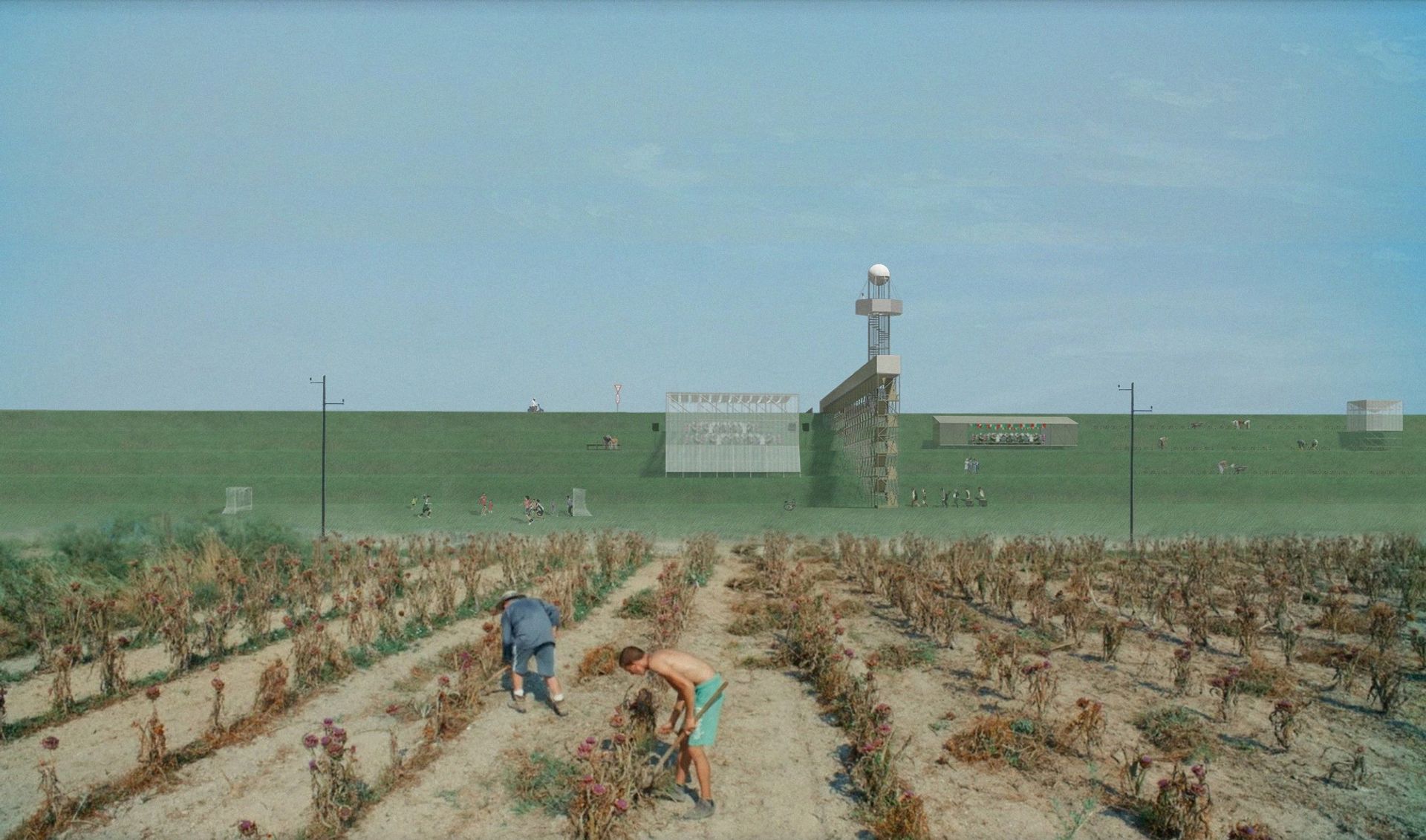
The Po Delta is an engineered landscape, shaped by centuries of political control and environmental transformation. Today, it operates at a post-human scale, where machines, control protocols, and sensors dominate. The inhospitable nature that once made it a refuge, recalls the current inhospitality of the anthropized territory, which could again serve as an outpost for the collectivity to hide in plain sight, within the clogs of the machine. The project questions how to care for this decaying land and its population. It rejects the idea of restoring the Delta to a former state, instead focusing on its fragility, visible in the layers of the embankment. The embankment, free from economic exploitation, provides a space of liberty and reconnection with the river, offering a chance to reintroduce uses, beyond efficiency of production. The proposal introduces a family of elements as a framework for the riverbank's appropriation. The abstract system aquires recognizable form. From abstraction to architecture. From system to family. On one side open to multiple configurations, on the other influenced by measures of the embankment, and shaped by a collective memory, establishing the shared cultural value of the project. Rather than a masterplan, the project operates at intervals, connecting collective spaces and establishing a network of care and observation for the fragile landscape and its population,scattered across a vast territory, as an act of resistance and emancipation.
The project was developed within the context of the Architectural Association .