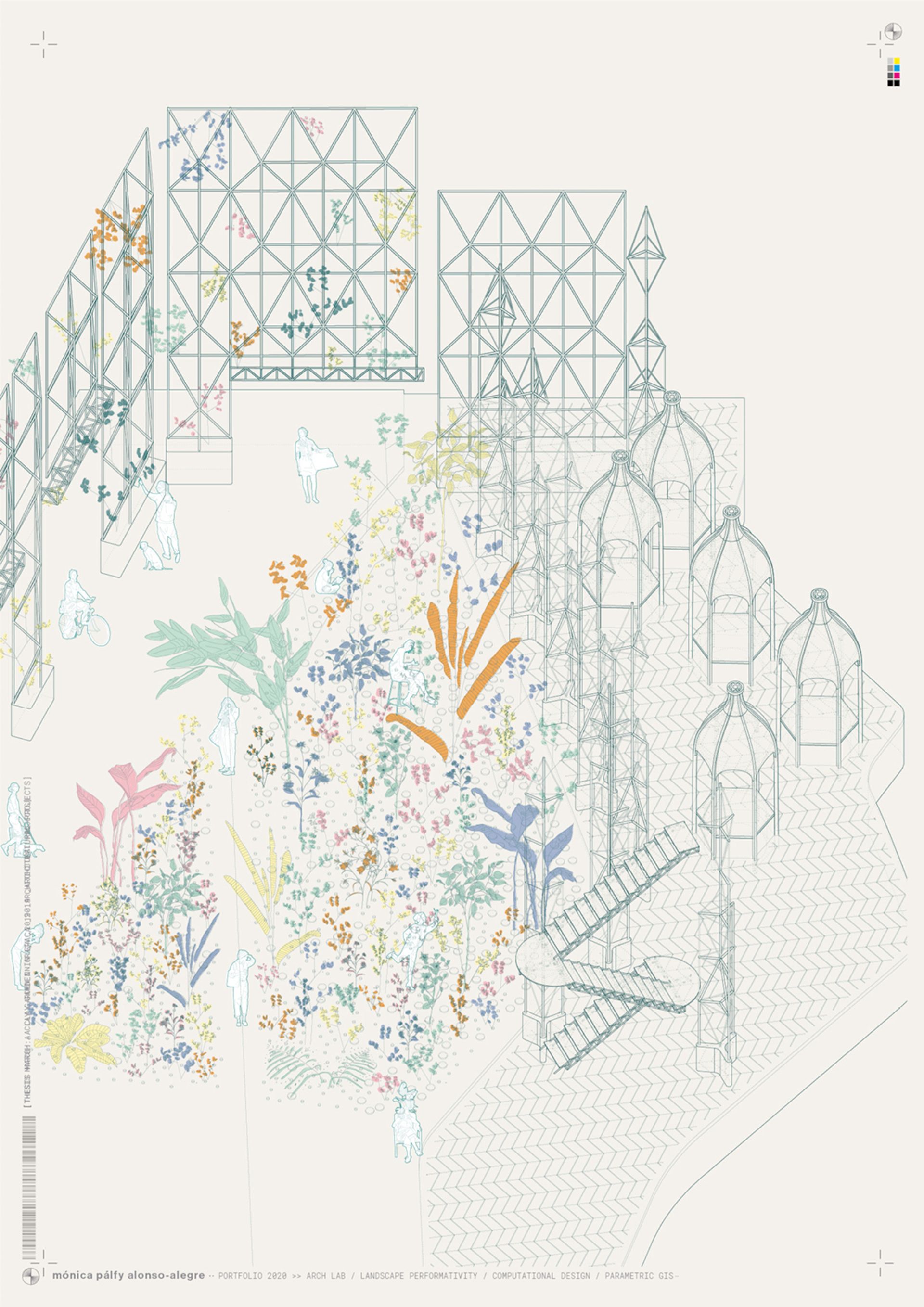
In an era of over-exposure, how can we understand interstitial locations to be the true essence of our cities? Lisboa’s hidden Miradouro - the silver lining of the city’s abrupt geography- is proof of this reality. Both wanderers and locals stroll around finding new, unmarked nooks overlooking the time-layered urban tapestry coexisting with the Tagus estuary. With them, as part of this long-lost archive of resilient architectures are what could be considered Smithson’s ruins in reverse: decadent facades preserved as a testament to the collectiveness of the Rua. They enclose an unacknowledged wilderness that reclaims the telluric condition of the ruin, a post-anthropocentric materiality we remain oblivious to.
The proposal brings back this wilderness to the cycles of urban dialectic, setting ground for a new performative ideal of urban type. Mapping these memories with a conscious glance to the material heritage of the surroundings gives the project a purpose, a productive means. By providing the neighbourhood with pottery infrastructure for the local artisans, a new programmatic catalyst is introduced to the urban fabric, enabling new hybrid imaginaries.